
BuddhistCatholicContemplativeEvangelicalGeneral ChristianHinduJewishLatter-day SaintMuslimNew VisionsProgressive Christian
Beliefs
- Buddhist
- Catholic
- Contemplative
- Evangelical
- General Christian
- Hindu
- Jewish
- Latter-day Saint
- More Voices
- Muslim
- New Visions
- Pagan
- Progressive Christian
Topics
- Religion News
- Food and Religion
- Sports and Religion
- Religious Art
- Religious Music and Entertainment
- Religious Events
- History and Religion
- Style and Religion
- Politics and Religion
- Women in Religion
- Recreation Outdoors and Religion
- Business Finance and Religion
- Careers Workplace and Religion
- Education and Religion
- Family Parenting and Religion
- Health Fitness and Religion
- Home and Religion
- Relationships and Religion
- Technology and Religion
- Travel and Religion
Columnists
- Buddhist Columnists
- Business Finance and Religion Columnists
- Careers Workplace and Religion Columnists
- Catholic Columnists
- Contemplative Columnists
- Education and Religion Columnists
- Evangelists Columnists
- Family Parenting and Religion Columnists
- General Christian Columnists
- Health Fitness and Religion Columnists
- Hindu Columnists
- History and Religion Columnists
- Home and Religion Columnists
- Jewish Columnists
- More Voices Columnists
- Latter Day Columnists
- Muslim Columnists
- New Visions Columnists
- Nonreligious Columnists
- Pagan Columnists
- Politics and Religion Columnists
- Progressive Columnists
- Recreation Outdoors and Religion Columnists
- Relationships and Religion Columnists
- Religion News Columnists
- Religious Art Columnists
- Religious Events Columnists
- Religious Music and Entertainment Columnists
- Sports and Religion Columnists
- Style and Religion Columnists
- Technology and Religion Columnists
- Travel and Religion Columnists
- Women in Religion Columnists
Resource Library
- 2026 Calendar
- Library of World Religions
- The 100 Most Holy Places on Earth
- Patheos Answers
- Podcasts
- Videos
- Faith Leaders Database
- Anglican Episcopalian
- Bahai
- Baptist
- Buddhism
- Christianity
- Confucianism
- Eastern Orthodoxy
- Hinduism
- Holiness and Pentecostal
- ISKCON
- Islam
- Judaism
- Lutheran
- Methodist
- The Church of Jesus Christ of Latter-day Saints
- New Age
- Paganism
- Presbytarian and Reformed
- Protestantism
- Religion Behind the Scenes
- Roman Catholic
- Scientology
- Shia Islam
- Sikhism
- Sufism
- Sunni Islam
- Taoism
- Zen
- See all religions
Research Tools
 Ad-Free & Subscriber Log-In Subscription Support
Ad-Free & Subscriber Log-In Subscription Support
Follow Patheos 

- Trending:
- Forgiveness
- |
- Marriage
- |
- Consciousness
- |
- Death Penalty
- |
- Election
- |
- Halloween

- Home
- Contemplative
- Do Christian Mystics Believe in Redemption?
Do Christian Mystics Believe in Redemption?
Last updated on: August 7, 2020 at 10:19 pm by Carl "Skye" McColman
Do Christian Mystics Believe in Redemption? 2020-08-07T22:19:16-04:00 Carl "Skye" McColman
Patheos Explore the world's faith through different perspectives on religion and spirituality! Patheos has the views of the prevalent religions and spiritualities of the world.
An email came to me today, with this question:
Dear Carl, I read your Big Book of Christian Mysticism a few years back, and it was very helpful for me in my understanding of the interrelation between the different “types and sorts” of mysticism. And you yourself have a pretty big inroad into different mystical communities, I know. How have you seen the gospel of redemption go forth into these communities?
An interesting question, so let me try to take it apart.
I’m not quite sure what the questioner means by “different mystical communities.” Christian mysticism has typically flourished more in communal settings rather than in solitary states, although there have certainly been Christian mystics who lived solitary or eremitic lives (i.e., as hermits). Julian of Norwich is perhaps the most famous example, but she’s hardly the only one. However, most followers of Christ recognize the point made by St. Basil the Great: “If you live alone, whose feet shall you wash?” So community is pretty much hard-wired into Christian spirituality, at least for most people.
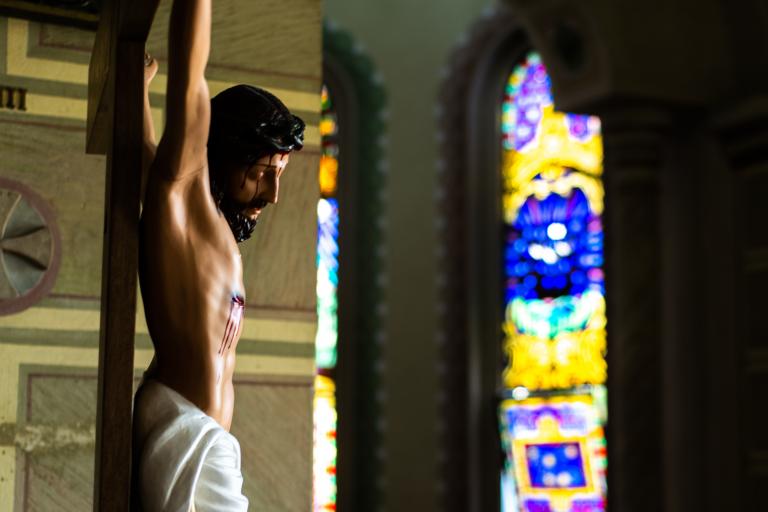
But what “mystical communities” are available to us today? For some seekers of the mystical life, such communities are found by becoming monks or nuns — or joining some other type of intentional community. But for most of us, we balance our desire for a contemplative community with the ordinary demands of secular life: having a family, a career, a home, and perhaps membership in a local church. Often, local churches are not particularly congenial to the mystical life! Therefore, many people choose, in addition to or instead of membership in a local church, to become involved in organizations like Contemplative Outreach, the World Community for Christian Meditation, Shalem, the Living School, Wisdom Schools, and/or lay associate communities affiliated with religious orders, such as Benedictine Oblates or Lay Carmelites or Third Order Franciscans. Such “para-church” communities often have an explicit orientation toward contemplative spirituality, and therefore are much more congenial to those who feel called to intentionally pursue the mystical life.
I’m saying all this to respond to the question above: that “mystical communities” come in many shapes and sizes — just like Christianity in general, which can be expressed in Orthodox, Catholic, Anglican, Protestant, Reformed, Evangelical or Pentecostal ways.
So to answer this question: How have I seen the gospel of redemption go forth into mystical communities? My first response would be that it really depends on the community.
Generally speaking, the more theologically conservative communities tend to place more of an emphasis on redemption, because such communities are more concerned about traditional theological teachings — such as humanity is sinful, and Christ came to redeem us.
By contrast, communities that tend to be less oriented toward traditional theological ideas would place less emphasis on redemption — not because they are opposed to the Christian ideas of redemption but rather because they consider it more important to emphasize prayer and spirituality over propositional doctrines and dogmas.
Once again: not because they reject such doctrines, but simply because they would suggest that thinking the right thoughts about God or Christ is less important than engaging in the spiritual practices necessary to foster a living relationship with God.
I know a Jesuit priest who would be more interested in whether or not you have ever felt or experienced a sense of being redeemed — to him, that would matter more than whether or not you were able to explain the theology of redemption. That might not win him any awards from the Society for the Preservation of Orthodox Doctrine (which, to the best of my knowledge, doesn’t exist), but it does make him an effective pastor and insightful spiritual director.
Seekers and practitioners of contemplative and mystical spirituality tend to have a very pragmatic approach to doctrine and dogma. Anyone can learn how to explain the intricacies of dogmatic formulas — but how has this teaching changed your life? If you believe Christ is your redeemer, then how does having a redeemer make a practical, real difference in your life and your relationships, right here and right now?
In the title to this blog post, I rephrased my reader’s question like this: Do Christian mystics believe in redemption? And the answer, based on my knowledge and experience, is of course they do. For some, doctrines like the redemption matter more than others. But even those who rarely or never talk about redemption are not in any way opposed to it. It’s a pretty universal Christian idea that humanity suffers from both an innate and a freely-chosen tendency to resist or reject love. Whether you call this sin, or depravity, or woundedness, it’s a pretty easily observed quality of the human condition. And since this universal tendency to resist or reject love causes so much suffering, naturally we want to do something about it. Christianity teaches that the spiritual healing we so long for comes through Christ. He is our redeemer.
Again, there are many different ways in which Christ’s redeeming action is understood. For example, the medieval mystic Julian of Norwich has a beautiful theology which sees the redeeming work of Christ as purely an expression of Christ’s love — and joy. Others, of course, emphasize ideas such as “paying a debt” or a “substitutionary atonement.” Since mystics and contemplatives tend to have such a strong theology of God as Love, I would imagine that many are more comfortable with the idea of redemption-as-expression-of-love rather than redemption-as-paying-off-a-debt. But I certainly can’t speak for others, and I’m sure that if you interviewed a cross section of contemplative Christians you would find many different perspectives on the theology of redemption — just as you would find many different perspectives on redemption if you just talked to all Christians, in general.
So yes, mystics believe in redemption; but many of them probably don’t place a lot of emphasis on it. They are less quick to emphasize doctrine and much more inclined to emphasize spiritual practice. Pray, meditate, contemplate, and open your heart to the Holy Spirit in silence. Do that every day for a while, and you will discover God’s redemption at work in your heart. You may not be able to explain it to the satisfaction of some academics. But you’ll be living it: embodying Christ’s redeeming work in the world, bringing healing both to your own heart and to the hearts of those whom you joyfully serve.
Featured photo by Mateus Campos Felipe on Unsplash.
Enjoy reading this blog?
Click here to become a patron.

Previous Post

July 28, 2020
Questions After a Retreat: What Books to Read, What Steps to Take Next
Next Post

August 17, 2020 In Defense of Forgiveness
Browse Our Archives
Select a Category Activism Announcements Art Books Catholicism Celtic Christianity Christian mysticism Christianity Contemplation Current events Etc. Family humor interfaith dialogue Interfaith Wisdom Interspirituality Lay Cistercians Living the Faith Meditation movies Mysticism Mystics nature Poetry Reviews Scripture silence Spirituality Uncategorized Writing
Select a Month February 2025 January 2025 November 2024 September 2024 August 2024 July 2024 June 2024 May 2024 March 2024 January 2024 December 2023 November 2023 August 2023 June 2023 April 2023 March 2023 February 2023 January 2023 December 2022 November 2022 October 2022 September 2022 August 2022 July 2022 June 2022 May 2022 April 2022 February 2022 January 2022 December 2021 November 2021 October 2021 September 2021 August 2021 July 2021 June 2021 May 2021 April 2021 March 2021 February 2021 January 2021 December 2020 November 2020 October 2020 September 2020 August 2020 July 2020 June 2020 May 2020 April 2020 March 2020 February 2020 January 2020 December 2019 November 2019 October 2019 September 2019 August 2019 July 2019 June 2019 May 2019 April 2019 March 2019 February 2019 January 2019 December 2018 November 2018 October 2018 September 2018 August 2018 July 2018 June 2018 May 2018 April 2018 March 2018 February 2018 January 2018 December 2017 November 2017 October 2017 September 2017 August 2017 July 2017 June 2017 May 2017 April 2017 March 2017 February 2017 January 2017 December 2016 November 2016 October 2016 September 2016 August 2016 July 2016 June 2016 May 2016 March 2016 February 2016 January 2016 December 2015 November 2015 October 2015 September 2015 August 2015 July 2015 June 2015 May 2015 April 2015 March 2015 February 2015 January 2015 December 2014 November 2014 October 2014 September 2014 August 2014 July 2014 June 2014 May 2014 April 2014 March 2014 February 2014 January 2014 December 2013 October 2013 September 2013 July 2013 May 2013 January 2013 December 2012 November 2012 August 2012 July 2012 June 2012 March 2012 December 2011 September 2011 October 2010 August 2010 March 2010 September 2009 July 2008 January 2008 December 2007 September 2007 February 2007 January 2007 December 2004
Follow Us!
TAKE THE
Religious Wisdom Quiz
True or False: Job's three friends were named Eliphaz, Bildad, and Zophar.
Select your answer to see how you score.
FALSE TRUE
Support this
Column


Related posts from Carl McColman

I Believe Prayer Changes Things. Here's a Few...

You don't have to become a monk to...

LSD, Anxiety, and Contemplation: Can Psychedelic Therapy Support...

Mysticism, Faith, and "Knowing" God's Will
TRENDING AT PATHEOS Contemplative

Handy Contemplative Practices for Political Spaces
A Spiritually Grounded Presence In order to bring a spiritually grounded presence...

Halloween: The Holiday of Loving Your Neighbor
All Hallows Eve Is Halloween the least Christian holiday in America, or...

Can Love Be Saved? Some Thoughts on the...
Happy Valentine's Day! I recently published a post on Patreon called Can...

"This Loving, Uniting Embrace": the Holy Ordinary
Today's guest post is by Mark Longhurst, author of The Holy Ordinary:...

How Are We Called to Live?: More About...
How Are We Called to Live? Many of us struggle with discerning...

A Spiritual Practice of Reading: Join Us Online
A Spiritual Practice of Reading A healthy spiritual practice of reading is...
view all Contemplative blogs
Ad-Free & Subscriber Log-In Subscription Support
- About Us
- 2026 Calendar
- Videos
- Podcasts
- Library of World Religions
- Faith In Media Tracker
- Advertise With Us
- Write for Us
- Privacy Policy
- Terms of Service
- Do Not Sell My Data
- Contact Us
- Radiant Digital
- Manage Newsletter Subscriptions
- Unsubscribe From Notifications
- Sitemap
Copyright 2008-2026, Patheos. All rights reserved.
Subscription Support Ad-Free & Subscriber Log-In
Follow Patheos