
BuddhistCatholicContemplativeEvangelicalGeneral ChristianHinduJewishLatter-day SaintMuslimNew VisionsProgressive Christian
Beliefs
- Buddhist
- Catholic
- Contemplative
- Evangelical
- General Christian
- Hindu
- Jewish
- Latter-day Saint
- More Voices
- Muslim
- New Visions
- Pagan
- Progressive Christian
Topics
- Religion News
- Food and Religion
- Sports and Religion
- Religious Art
- Religious Music and Entertainment
- Religious Events
- History and Religion
- Style and Religion
- Politics and Religion
- Women in Religion
- Recreation Outdoors and Religion
- Business Finance and Religion
- Careers Workplace and Religion
- Education and Religion
- Family Parenting and Religion
- Health Fitness and Religion
- Home and Religion
- Relationships and Religion
- Technology and Religion
- Travel and Religion
Columnists
- Buddhist Columnists
- Business Finance and Religion Columnists
- Careers Workplace and Religion Columnists
- Catholic Columnists
- Contemplative Columnists
- Education and Religion Columnists
- Evangelists Columnists
- Family Parenting and Religion Columnists
- General Christian Columnists
- Health Fitness and Religion Columnists
- Hindu Columnists
- History and Religion Columnists
- Home and Religion Columnists
- Jewish Columnists
- More Voices Columnists
- Latter Day Columnists
- Muslim Columnists
- New Visions Columnists
- Nonreligious Columnists
- Pagan Columnists
- Politics and Religion Columnists
- Progressive Columnists
- Recreation Outdoors and Religion Columnists
- Relationships and Religion Columnists
- Religion News Columnists
- Religious Art Columnists
- Religious Events Columnists
- Religious Music and Entertainment Columnists
- Sports and Religion Columnists
- Style and Religion Columnists
- Technology and Religion Columnists
- Travel and Religion Columnists
- Women in Religion Columnists
Resource Library
- 2026 Calendar
- Library of World Religions
- The 100 Most Holy Places on Earth
- Patheos Answers
- Podcasts
- Videos
- Faith Leaders Database
- Anglican Episcopalian
- Bahai
- Baptist
- Buddhism
- Christianity
- Confucianism
- Eastern Orthodoxy
- Hinduism
- Holiness and Pentecostal
- ISKCON
- Islam
- Judaism
- Lutheran
- Methodist
- The Church of Jesus Christ of Latter-day Saints
- New Age
- Paganism
- Presbytarian and Reformed
- Protestantism
- Religion Behind the Scenes
- Roman Catholic
- Scientology
- Shia Islam
- Sikhism
- Sufism
- Sunni Islam
- Taoism
- Zen
- See all religions
Research Tools
 Ad-Free & Subscriber Log-In Subscription Support
Ad-Free & Subscriber Log-In Subscription Support
Follow Patheos 

- Trending:
- Forgiveness
- |
- Marriage
- |
- Consciousness
- |
- Death Penalty
- |
- Election
- |
- Halloween

- Home
- Contemplative
- Questions After a Retreat: What Books to Read, What Steps to Take Next
Questions After a Retreat: What Books to Read, What Steps to Take Next
Last updated on: July 28, 2020 at 11:45 am by Carl "Skye" McColman
Questions After a Retreat: What Books to Read, What Steps to Take Next 2020-07-28T11:45:59-04:00 Carl "Skye" McColman
Patheos Explore the world's faith through different perspectives on religion and spirituality! Patheos has the views of the prevalent religions and spiritualities of the world.
Shortly after concluding my Praying with the Spanish Mystics Retreat, one of the persons who participated sent me this follow-up email:
Hello. I have your book Answering the Contemplative Call, which I will be reading shortly. Which other books do you recommend for someone who attends silent retreats?
I started reading Thomas Merton’s The Seven Story Mountain — what commentary book would you recommend on Merton? Likewise St Theresa or maybe I should pick a different mystic for starters after Merton?
You have many retreats but for a beginner which ones again would you recommend?
As for your book Christian Mystics, I only have the Kindle sample— could you just briefly touch on the 108 mystics?
Thanks for these many questions! Let me take them one at a time, not necessarily in order.
Recommended Retreats for Beginners
You know, I am still adapting to life during the pandemic, when so many retreat house and monastery guesthouses are closed to the public, so most retreats are now being offered online. It gives us a new opportunity to have a retreat experience even from the comfort of our own homes. St. Ignatius of Loyola pioneered the idea of a “retreat in everyday life,” when he suggested that the Spiritual Exercises could be done on a 30-day, dedicated retreat — or as a daily prayer commitment of 60-90 minutes each day, over about an eight month period. That’s how I did the Spiritual Exercises, and it was truly a meaningful experience.
But back to your question: what retreats are best for beginners? You asked about my retreats specifically, but let me answer in more general terms. Christian spirituality is a wisdom tradition and it is also a way of life. I think it makes sense to participate in retreats that emphasize both of these dimensions (or, balance your diet between retreats that emphasize one or the other).
“Wisdom Tradition” retreats emphasize what we can learn about spirituality: they focus on the Bible, the great mystics of history, or ways to integrate spirituality with science or spirituality with social justice. These are the “theory” retreats and they can help us to have a more expanded understanding of what it means to follow Christ and embrace a spiritual way of thinking and seeing.
“Way of Life” retreats emphasize how we put our spirituality into practice. These include retreats that teach us how to pray, that emphasize the practice of meditation and contemplation, that integrate yoga or tai chi or walking a labyrinth or other embodied practices into spirituality, or that help us to appreciate the liturgical year by focussing on the themes of a given moment in time (Advent Retreat, Lenten Retreat, etc.). If the Wisdom-oriented retreats teach us a new way of seeing and thinking, these Way of Life retreats teach us how to embody and live a more deeply spiritual life.
My retreats tend to fall more in the “Wisdom Tradition” category, although I have led some prayer retreats in the past and hope that I can do so again. I’ve done several retreats that are specifically designed for beginners in mind. This fall I’ll be leading a World Mysticism seven-week course through the Zeitgeist Center in Atlanta (but offered online, so it’s open to everyone), and then in January a four week course on the Wisdom of the Christian Mystics offered through Columbia Theological Seminary’s Center for Lifelong Learning. Both of those would be excellent for beginners. The Zeitgeist course is an interfaith program, whereas the Columbia Seminary course is centered on Christian spirituality. Naturally, some people will be more interested in one than the other (although it’s okay to take both!).
I do have one more “practice” oriented retreat in the works as well: a two-day retreat on dealing with distractions during centering prayer. For more information, click here.
The bottom line is that most retreats are offered with an eye to both beginners and more seasoned practitioners. So there’s not really any specific order you need to follow. Find the retreat topic(s) which interest you, and take those retreats. Let your interests guide you.
Recommended Books for Retreatants
“So many books, so little time!” There are so many good books on the topics of Christian mysticism and contemplative spirituality that it’s hard to know where to begin. The person who asked the question is going to read Answering the Contemplative Call which was written with beginners in mind. Three other books that I think are especially helpful for newcomers to the spirituality of silence would include:
- Into the Silent Land: A Guide to the Christian Practice of Contemplation by Martin Laird. Probably the best single “introductory” book on contemplative (silent) prayer that I’ve ever read. And I’ve read a lot! But this book is simple, down-to-earth, steeped in the teaching of the saints and mystics, and universal in scope: the material that Martin covers applies equally well to centering prayer, Christian meditation, and the Jesus prayer.
- Centering Prayer and Inner Awakening by Cynthia Bourgeault. Thomas Keating is the acknowledged “master teacher” of Centering Prayer, and his books are important and worth reading by anyone on the spiritual path, even if you aren’t a Centering Prayer practitioners. But Cynthia’s book is so warmly written and accessible, and does such a good job at orienting beginners but also illustrating just how deep this prayer practice can go, that I think hers is the single best book for beginners.
- The Naked Now: Learning to See as the Mystics See by Richard Rohr. This gentle, informally written book does a wonderful job at making mysticism accessible to ordinary folks like you and me. Richard is one of the most popular spiritual writers alive today, and this book shows why. He’s taken a difficult and imposing topic — Christian mysticism — and shown how everyone can be nurtured by this way of spirituality. Of course I recommend you follow up with The Big Book of Christian Mysticism, but read Richard’s book first to get oriented.
There are many other worthy books. If you want to consider some other titles, check out my Recommended Reading list.
Thomas Merton, St. Teresa (or Other Mystics Worth Reading)
What commentary would I recommend on Thomas Merton? I don’t know of one specifically on The Seven Storey Mountain, but there are plenty of general books about Merton and his writings. For example: Merton’s Palace of Nowhere by James Finley; Thomas Merton: An Introduction by William H. Shannon; The Franciscan Heart of Thomas Merton: A New Look at the Spiritual Inspiration of His Life, Thought, and Writing by Daniel P. Horan; and many others. When I was first discovering Merton back in graduate school, I read Merton: A Life by Monica Furlong which I found quite helpful.
I would suggest that the best way to get to know Merton is just to read his own works. The Seven Story Mountain is a literary masterpiece but it is spiritually immature. So follow up with one or two of his later, more practice-oriented books like New Seeds of Contemplation or The Inner Experience. Or get Thomas Merton: Spiritual Master which is an anthology that provides a nice overview of Merton’s entire body of work.
Now, as for Saint Teresa of Ávila: is she the best mystic to begin with? Probably not. Like so many of the great mystics who lived before the year 1600, she writes with a voice and a sensibility that in some ways is very removed from our own. Plus we’re reading her in translation, which adds another layer of distortion. Don’t get me wrong: she’s brilliant, and her books — especially The Interior Castle — are luminous. But if you’re just getting started on your exploration of Christian mysticism, let me recommend five books to get you started.
- Evelyn Underhill, Practical Mysticism— Also a dated book, but it’s just over 100 years old so it’s much more accessible than older books on the subject. Underhill offers a gentle and simple introduction to the most important topic of all in mysticism: how mystics pray.
- Bernard McGinn (ed.), The Essential Writings of Christian Mysticism — This brilliant and comprehensive anthology offers a great “big picture” view of the literature of mysticism, but what really makes it shine is McGinn’s insightful introductions to each of the mystics and their writings. This book is a great litmus test: if you can make it through this 500 page tome and enjoy doing so, you’re ready to read the mystical classics.
- Carl McColman (ed.), The Little Book of Christian Mysticism— McGinn’s anthology is scholarly, mine — based on short mystical “soundbites” — is more devotional in its aim and purpose. Read it and let it accompany you in your daily prayer time: and the mystics will become your guides in prayer.
- Anonymous, The Cloud of Unknowing — Especially in the accessible translation by Carmen Acevedo Butcher, this is a great book to start on your journey of reading the mystics. It’s a bit heady and the language can be stern, but it’s very practical and beneath the toughness is a truly warm invitation into contemplation.
- Julian of Norwich, The Showings — Like The Cloud of Unknowing, this book was written in Middle English in the late 1300s. Both are mystical classics, but they present radically different approaches to spirituality: The Cloud is stern, prosaic, and practical; Julian’s writing is deeply poetic, filled with ringing affirmations of Divine Love, and profoundly imaginative. Read these books together to get a rich introduction to the “yin and yang” of contemplative spirituality. Mirabai Starr’s translation is probably best for beginners.
After these books, then I would say it’s time to read some of the more challenging or philosophical mystical writings. Key voices to explore include St. Teresa of Ávila, St. John of the Cross, Meister Eckhart, John Ruusbroec, Simone Weil, St. Bernard of Clairvaux, and Ramon Panikkar — among many others!
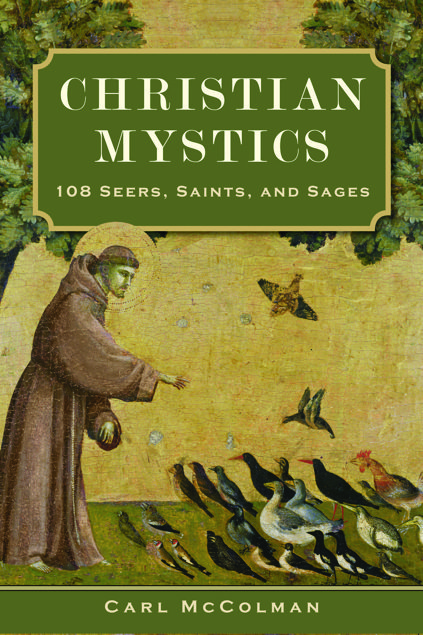
Christian Mystics
Christian Mystics: 108 Seers, Saints and Sages
Finally, I was asked to comment briefly on my book Christian Mystics: 108 Seers, Saints and Sages. It was written as a companion volume to my previous book, The Big Book of Christian Mysticism, so I would say to start with that one. But when you come to Christian Mystics, you’ll find that it is a book designed to help you get to know many of the great mystics — and to appreciate the diversity of their gifts. When I wrote this book I was worried that if I arranged it alphabetically it would read like an encyclopedia, and if I arranged it chronologically it would read like a history book — and while there’s nothing wrong with either encyclopedias or history books, I wanted to create a resource that was more spiritually useful. So this book is intended not only to introduce you to the great mystics, but also to encourage the reader to pray about, and discern, how you are being called to respond to God’s love. I do believe we are all called to be mystics, but not all of us are called to be philosophers or poets or memoirists or theologians. So when you read this book, don’t just see it as a collection of facts to fill your head with. Rather, I hope you’ll approach it as an adventure in getting to know the tremendous variety of mystics who have graced the earth over the centuries, and then to pray this question: “God, what kind of contemplative am I called to be?”
I hope all this is helpful. Thanks for reading and retreating with me!
Enjoy reading this blog?
Click here to become a patron.

Previous Post
July 25, 2020
Praying with the Spanish Mystics
Next Post
August 7, 2020 Do Christian Mystics Believe in Redemption?
Browse Our Archives
Select a Category Activism Announcements Art Books Catholicism Celtic Christianity Christian mysticism Christianity Contemplation Current events Etc. Family humor interfaith dialogue Interfaith Wisdom Interspirituality Lay Cistercians Living the Faith Meditation movies Mysticism Mystics nature Poetry Reviews Scripture silence Spirituality Uncategorized Writing
Select a Month February 2025 January 2025 November 2024 September 2024 August 2024 July 2024 June 2024 May 2024 March 2024 January 2024 December 2023 November 2023 August 2023 June 2023 April 2023 March 2023 February 2023 January 2023 December 2022 November 2022 October 2022 September 2022 August 2022 July 2022 June 2022 May 2022 April 2022 February 2022 January 2022 December 2021 November 2021 October 2021 September 2021 August 2021 July 2021 June 2021 May 2021 April 2021 March 2021 February 2021 January 2021 December 2020 November 2020 October 2020 September 2020 August 2020 July 2020 June 2020 May 2020 April 2020 March 2020 February 2020 January 2020 December 2019 November 2019 October 2019 September 2019 August 2019 July 2019 June 2019 May 2019 April 2019 March 2019 February 2019 January 2019 December 2018 November 2018 October 2018 September 2018 August 2018 July 2018 June 2018 May 2018 April 2018 March 2018 February 2018 January 2018 December 2017 November 2017 October 2017 September 2017 August 2017 July 2017 June 2017 May 2017 April 2017 March 2017 February 2017 January 2017 December 2016 November 2016 October 2016 September 2016 August 2016 July 2016 June 2016 May 2016 March 2016 February 2016 January 2016 December 2015 November 2015 October 2015 September 2015 August 2015 July 2015 June 2015 May 2015 April 2015 March 2015 February 2015 January 2015 December 2014 November 2014 October 2014 September 2014 August 2014 July 2014 June 2014 May 2014 April 2014 March 2014 February 2014 January 2014 December 2013 October 2013 September 2013 July 2013 May 2013 January 2013 December 2012 November 2012 August 2012 July 2012 June 2012 March 2012 December 2011 September 2011 October 2010 August 2010 March 2010 September 2009 July 2008 January 2008 December 2007 September 2007 February 2007 January 2007 December 2004
Follow Us!
TAKE THE
Religious Wisdom Quiz
Which Christian denomination is known for wearing plain clothing and avoiding modern technology?
Select your answer to see how you score.
Baptists Amish Lutherans Presbyterians
Support this
Column


Related posts from Carl McColman

"This Loving, Uniting Embrace": the Holy Ordinary

I Believe Prayer Changes Things. Here's a Few...

You don't have to become a monk to...

If You Worship an Angry God, You'll Be...
TRENDING AT PATHEOS Contemplative

Handy Contemplative Practices for Political Spaces
A Spiritually Grounded Presence In order to bring a spiritually grounded presence...

Halloween: The Holiday of Loving Your Neighbor
All Hallows Eve Is Halloween the least Christian holiday in America, or...

Can Love Be Saved? Some Thoughts on the...
Happy Valentine's Day! I recently published a post on Patreon called Can...

"This Loving, Uniting Embrace": the Holy Ordinary
Today's guest post is by Mark Longhurst, author of The Holy Ordinary:...

How Are We Called to Live?: More About...
How Are We Called to Live? Many of us struggle with discerning...

A Spiritual Practice of Reading: Join Us Online
A Spiritual Practice of Reading A healthy spiritual practice of reading is...
view all Contemplative blogs
Ad-Free & Subscriber Log-In Subscription Support
- About Us
- 2026 Calendar
- Videos
- Podcasts
- Library of World Religions
- Faith In Media Tracker
- Advertise With Us
- Write for Us
- Privacy Policy
- Terms of Service
- Do Not Sell My Data
- Contact Us
- Radiant Digital
- Manage Newsletter Subscriptions
- Unsubscribe From Notifications
- Sitemap
Copyright 2008-2026, Patheos. All rights reserved.
Subscription Support Ad-Free & Subscriber Log-In
Follow Patheos