
BuddhistCatholicContemplativeEvangelicalGeneral ChristianHinduJewishLatter-day SaintMuslimNew VisionsProgressive Christian
Beliefs
- Buddhist
- Catholic
- Contemplative
- Evangelical
- General Christian
- Hindu
- Jewish
- Latter-day Saint
- More Voices
- Muslim
- New Visions
- Pagan
- Progressive Christian
Topics
- Religion News
- Food and Religion
- Sports and Religion
- Religious Art
- Religious Music and Entertainment
- Religious Events
- History and Religion
- Style and Religion
- Politics and Religion
- Women in Religion
- Recreation Outdoors and Religion
- Business Finance and Religion
- Careers Workplace and Religion
- Education and Religion
- Family Parenting and Religion
- Health Fitness and Religion
- Home and Religion
- Relationships and Religion
- Technology and Religion
- Travel and Religion
Columnists
- Buddhist Columnists
- Business Finance and Religion Columnists
- Careers Workplace and Religion Columnists
- Catholic Columnists
- Contemplative Columnists
- Education and Religion Columnists
- Evangelists Columnists
- Family Parenting and Religion Columnists
- General Christian Columnists
- Health Fitness and Religion Columnists
- Hindu Columnists
- History and Religion Columnists
- Home and Religion Columnists
- Jewish Columnists
- More Voices Columnists
- Latter Day Columnists
- Muslim Columnists
- New Visions Columnists
- Nonreligious Columnists
- Pagan Columnists
- Politics and Religion Columnists
- Progressive Columnists
- Recreation Outdoors and Religion Columnists
- Relationships and Religion Columnists
- Religion News Columnists
- Religious Art Columnists
- Religious Events Columnists
- Religious Music and Entertainment Columnists
- Sports and Religion Columnists
- Style and Religion Columnists
- Technology and Religion Columnists
- Travel and Religion Columnists
- Women in Religion Columnists
Resource Library
- 2026 Calendar
- Library of World Religions
- The 100 Most Holy Places on Earth
- Patheos Answers
- Podcasts
- Videos
- Faith Leaders Database
- Anglican Episcopalian
- Bahai
- Baptist
- Buddhism
- Christianity
- Confucianism
- Eastern Orthodoxy
- Hinduism
- Holiness and Pentecostal
- ISKCON
- Islam
- Judaism
- Lutheran
- Methodist
- The Church of Jesus Christ of Latter-day Saints
- New Age
- Paganism
- Presbytarian and Reformed
- Protestantism
- Religion Behind the Scenes
- Roman Catholic
- Scientology
- Shia Islam
- Sikhism
- Sufism
- Sunni Islam
- Taoism
- Zen
- See all religions
Research Tools
 Ad-Free & Subscriber Log-In Subscription Support
Ad-Free & Subscriber Log-In Subscription Support
Follow Patheos 

- Trending:
- Forgiveness
- |
- Marriage
- |
- Consciousness
- |
- Death Penalty
- |
- Election
- |
- Halloween

- Home
- Contemplative
- Altamont, Auschwitz, Bethlehem, and My Lai — The Challenge of Contemplating the Dark Side
Altamont, Auschwitz, Bethlehem, and My Lai — The Challenge of Contemplating the Dark Side
Last updated on: December 7, 2019 at 12:19 am by Carl "Skye" McColman
Altamont, Auschwitz, Bethlehem, and My Lai — The Challenge of Contemplating the Dark Side 2019-12-07T00:19:53-04:00 Carl "Skye" McColman
Patheos Explore the world's faith through different perspectives on religion and spirituality! Patheos has the views of the prevalent religions and spiritualities of the world.
1969 was quite a year, and so in 2019 we’ve had plenty of “50th Anniversary” moments: marking the fiftieth anniversary of the first humans on the moon, of the Woodstock Festival, and of the Beatles’ last recorded album, Abbey Road. It was the year that Monty Python’s Flying Circus and Sesame Street premiered on television, and some movies from this year included Midnight Cowboy, Butch Cassidy and the Sundance Kid, and Easy Rider. Maya Angelou’s I Know Why the Caged Bird Sings and Kurt Vonnegut’s Slaughterhouse Five were among the books published in 1969. So it was a remarkable year, and there’s plenty for us to commemorate now, fifty years later.
But there was a dark side to 1969. The Vietnam War was raging on, and student unrest was simmering in America (which would boil over the following spring with the Kent State shootings). It was the year of the Tate-Labianca murders, with the Manson Family becoming the first highly visible sign that the peace and love generation had its own violent, dangerous shadow side. And then, on December 6 — fifty years ago today — came Altamont.
The Shadow Side of Woodstock
This morning, the Washington Post published a lengthy feature profiling the free concert at the Altamont Speedway, east of San Francisco. It was meant to be a “West Coast Woodstock,” featuring bands like the Rolling Stones, Jefferson Airplane, Grateful Dead, Santana, and Crosby Stills Nash and Young. But with over 300,000 people showing up for the free concert, almost no logistical infrastructure to handle a crowd that size and “security” provided by the Hell’s Angels Motorcycle Gang (!), it turned out to be the “Anti-Woodstock” — and since the Stones were being filmed, the violence and chaos that culminated in the murder of a man in the audience was all recorded, showing up in the documentary Gimme Shelter.
With the exception of the Rolling Stones, all the bands that were scheduled to play at Altamonte (Grateful Dead never played; spooked by the violent energy in the crowd, they simply refused to perform) were part of the California hippie scene; most of the bands had played at Woodstock, and they all represented the “peace and love” ethos of the counterculture of the time. They branded themselves as the sane alternative to the insanity going on in southeast Asia. And yet, their free concert devolved into violence.
In the bitter words of a song John Lennon would record the following year, “The Dream is Over.”
I love the hippie music of the late sixties, but it’s sobering to consider that Woodstock and Altamont were less than four months apart. It seems that the groovy anti-war idealism of the ’60s counterculture had a pretty short shelf-life. It’s important to remember that the violence of both the Manson Family and Altamont had racist overtones (the man killed at Altamont was African-American; his white killer was acquitted after claiming he acted in self defense). Apparently, the songs and poetry of hippie peace and love were not enough to confront the dark underbelly of racism and privilege, which — sorry to say — remains a problem in our society today.
Echoes of Altamont
As I read the Washington Post article, with its detailed exposition of everything that went wrong on that day — at what was supposed to be a happy, free concert — I found myself thinking of several other moments in time that reveal the depth of the human shadow: the slaughter of the innocents in Bethlehem after the birth of Jesus; the concentration camps of Auschwitz; the massacre of villagers at My Lai, Vietnam; and the caging of children along the U.S./Mexico border in our own time.
The slaughter of the innocents is to the nativity what Altamont was to Woodstock. I don’t like contemplating either of them, but they both need to be reckoned with, at least from a contemplative perspective. Granted, the slaughter of the innocents as recorded in Matthew 2:16 is mythological. But it’s hardly the only example of wanton killing of innocent people by soldiers — indeed, it was thinking about the Holy Innocents that reminded me of the My Lai Massacre.
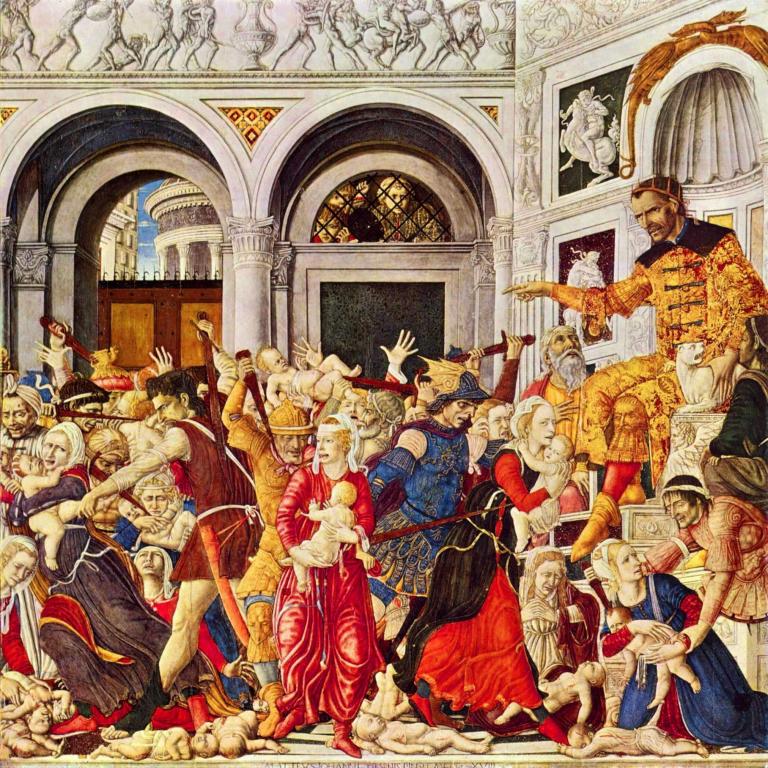
The Massacre of the Innocents at Bethlehem, by Matteo di Giovanni (c. 1430-1495)
The My Lai massacre took place in March 1968 but become public knowledge in November 1969, just days before Altamont. It was during an operation in Vietnam (where American soldiers were attempting to defeat the Viet Cong, the communist organization that U.S. Troops were fighting). In a classic example of “we had to destroy the village in order to save it,” somewhere between 300 and 500 civilians were killed that day, including women and children; many of the women raped prior to being executed. This was all done supposedly in the interest of neutralizing a communist threat. But even if most of the My Lai villagers really were part of (or sympathetic to) the Viet Cong, would that justify the brutality? Of course not.
It was a slaughter of the innocents, in our lifetime. I remember My Lai, I remember the controversy surrounding the trial of Lt. William Calley, the only person convicted for this war crime. What I don’t recall (but learned from a Google search just now) was that the public was actually sympathetic to his defense that he was just “following orders” — the dark side of obedience. And I didn’t realize that the man who ordered him to commit the atrocities was acquitted of any wrongdoing, thanks to being defended by a high-powered lawyer.
It all stinks. Looking back, I realize that my own commitment to nonviolence and justice, to resisting militarism, probably began when as an 8-year boy my conscience was troubled by My Lai. Ironically, though, I walked away from the military culture my father represented, into the world of the hippies and the Grateful Dead: the world of Woodstock, but also of Altamont.
Contemplating These Infamous Moments
I never was part of the military, but I think everyone should ask ourselves some hard questions. If I were a soldier at My Lai, would I have just “followed orders” and killed the civilians? If I were a soldier in King Herod’s army, would I have obeyed a command to kill baby boys?
Or would I have found the courage to stand up for what is right? Of course, I prefer to think that I would do the right thing, and I hope everyone reading these words would be just as clear in your convictions. But I am also humble enough to realize that so many of the people who commit atrocities — think of the German citizens who staffed concentration camps like Auschwitz — have been “normal” and “good” people, upstanding members of their communities. It’s the nature of evil that it thrives in dysfunctional systems. Whether it’s a rock concert that is badly managed, or a rogue military operation, or a policy of incarcerating undocumented immigrants in a way that separates families and leaves children in cages.
In 1969 Richard Nixon was president, and just a few years later he would resign in disgrace to avoid impeachment. Today, we are facing another impeachment process; if we include Nixon’s, this makes the fourth incidence of impeachment in our nation’s almost 250 years. Three of those have occurred in the last 50 years. I wonder what that signifies?
Depending on who you talk to, the current impeachment process is a necessary effort to hold a corrupt leader accountable — or, a politically motivated effort to attack that same leader on (pardon the pun) Trumped-up charges. What confounds me is how both of these narratives seem to be almost totally at odds with each other, yet depending on whether you get your news from Fox or CNN, you are likely to believe in one and dismiss the other out of hand.
So what does all this have to do with contemplation?
What does it mean to be a contemplative in a world where innocent people get murdered by soldiers? Or concertgoers experience violence that could have been prevented? What does it mean to navigate morality and ethics in a world where refugee populations have reached crisis proportions, and some governments respond by closing their borders or treating those who seek entry like common criminals?
Back to the story of the Holy Innocents. Even though this story was most certainly a kind of folk-tale, it carries plenty of spiritual meaning that is worth exploring. Systematic forces of evil react violently in response to an unjust king’s fearful hold on power. But in the midst of that, we have a story of quiet heroism, as Joseph and Mary flee to Egypt to protect their son — becoming refugees themselves in the process.
So when we find ourselves in the midst of evil, even systemic evil over which we have little or no control, there may still be the possibility of making moral choices. Our actions can still make a difference, even if we can’t stem the tide of the evil. After all, Joseph’s actions saved Jesus’ life, and paved the way for Jesus to literally change history.
I think we need to sit with the paradox of this baby — the incarnation of Love — being born in the midst of such dark violence and fear. How can we invite that baby, that incarnation of Love, into our darkest and most fearful places? Into our partisan politics, and our mistreatment of immigrants and refugees, our racism, our classism, our culture of bullying and violence, our complicity? And when we do so, are we really willing to let that baby change us, from the inside out? I hope so.
Enjoy reading this blog?
Click here to become a patron.


Next Post

December 8, 2019 Thank you for your support
Browse Our Archives
Select a Category Activism Announcements Art Books Catholicism Celtic Christianity Christian mysticism Christianity Contemplation Current events Etc. Family humor interfaith dialogue Interfaith Wisdom Interspirituality Lay Cistercians Living the Faith Meditation movies Mysticism Mystics nature Poetry Reviews Scripture silence Spirituality Uncategorized Writing
Select a Month February 2025 January 2025 November 2024 September 2024 August 2024 July 2024 June 2024 May 2024 March 2024 January 2024 December 2023 November 2023 August 2023 June 2023 April 2023 March 2023 February 2023 January 2023 December 2022 November 2022 October 2022 September 2022 August 2022 July 2022 June 2022 May 2022 April 2022 February 2022 January 2022 December 2021 November 2021 October 2021 September 2021 August 2021 July 2021 June 2021 May 2021 April 2021 March 2021 February 2021 January 2021 December 2020 November 2020 October 2020 September 2020 August 2020 July 2020 June 2020 May 2020 April 2020 March 2020 February 2020 January 2020 December 2019 November 2019 October 2019 September 2019 August 2019 July 2019 June 2019 May 2019 April 2019 March 2019 February 2019 January 2019 December 2018 November 2018 October 2018 September 2018 August 2018 July 2018 June 2018 May 2018 April 2018 March 2018 February 2018 January 2018 December 2017 November 2017 October 2017 September 2017 August 2017 July 2017 June 2017 May 2017 April 2017 March 2017 February 2017 January 2017 December 2016 November 2016 October 2016 September 2016 August 2016 July 2016 June 2016 May 2016 March 2016 February 2016 January 2016 December 2015 November 2015 October 2015 September 2015 August 2015 July 2015 June 2015 May 2015 April 2015 March 2015 February 2015 January 2015 December 2014 November 2014 October 2014 September 2014 August 2014 July 2014 June 2014 May 2014 April 2014 March 2014 February 2014 January 2014 December 2013 October 2013 September 2013 July 2013 May 2013 January 2013 December 2012 November 2012 August 2012 July 2012 June 2012 March 2012 December 2011 September 2011 October 2010 August 2010 March 2010 September 2009 July 2008 January 2008 December 2007 September 2007 February 2007 January 2007 December 2004
Follow Us!
TAKE THE
Religious Wisdom Quiz
What did David take from Saul's camp while he was sleeping?
Select your answer to see how you score.
Crown and robe Sword and scroll A sack of gold Spear and water jug
Support this
Column


Related posts from Carl McColman

Four Dimensions of Mindfulness and Centering Prayer
A Contemplative Reflection on the Death of Christ

LSD, Anxiety, and Contemplation: Can Psychedelic Therapy Support...
Discover the Three Forms of Contemplation, according to...
TRENDING AT PATHEOS Contemplative

Handy Contemplative Practices for Political Spaces
A Spiritually Grounded Presence In order to bring a spiritually grounded presence...

Halloween: The Holiday of Loving Your Neighbor
All Hallows Eve Is Halloween the least Christian holiday in America, or...

Can Love Be Saved? Some Thoughts on the...
Happy Valentine's Day! I recently published a post on Patreon called Can...

"This Loving, Uniting Embrace": the Holy Ordinary
Today's guest post is by Mark Longhurst, author of The Holy Ordinary:...

How Are We Called to Live?: More About...
How Are We Called to Live? Many of us struggle with discerning...

A Spiritual Practice of Reading: Join Us Online
A Spiritual Practice of Reading A healthy spiritual practice of reading is...
view all Contemplative blogs
Ad-Free & Subscriber Log-In Subscription Support
- About Us
- 2026 Calendar
- Videos
- Podcasts
- Library of World Religions
- Faith In Media Tracker
- Advertise With Us
- Write for Us
- Privacy Policy
- Terms of Service
- Do Not Sell My Data
- Contact Us
- Radiant Digital
- Manage Newsletter Subscriptions
- Unsubscribe From Notifications
- Sitemap
Copyright 2008-2026, Patheos. All rights reserved.
Subscription Support Ad-Free & Subscriber Log-In
Follow Patheos