
BuddhistCatholicContemplativeEvangelicalGeneral ChristianHinduJewishLatter-day SaintMuslimNew VisionsProgressive Christian
Beliefs
- Buddhist
- Catholic
- Contemplative
- Evangelical
- General Christian
- Hindu
- Jewish
- Latter-day Saint
- More Voices
- Muslim
- New Visions
- Pagan
- Progressive Christian
Topics
- Religion News
- Food and Religion
- Sports and Religion
- Religious Art
- Religious Music and Entertainment
- Religious Events
- History and Religion
- Style and Religion
- Politics and Religion
- Women in Religion
- Recreation Outdoors and Religion
- Business Finance and Religion
- Careers Workplace and Religion
- Education and Religion
- Family Parenting and Religion
- Health Fitness and Religion
- Home and Religion
- Relationships and Religion
- Technology and Religion
- Travel and Religion
Columnists
- Buddhist Columnists
- Business Finance and Religion Columnists
- Careers Workplace and Religion Columnists
- Catholic Columnists
- Contemplative Columnists
- Education and Religion Columnists
- Evangelists Columnists
- Family Parenting and Religion Columnists
- General Christian Columnists
- Health Fitness and Religion Columnists
- Hindu Columnists
- History and Religion Columnists
- Home and Religion Columnists
- Jewish Columnists
- More Voices Columnists
- Latter Day Columnists
- Muslim Columnists
- New Visions Columnists
- Nonreligious Columnists
- Pagan Columnists
- Politics and Religion Columnists
- Progressive Columnists
- Recreation Outdoors and Religion Columnists
- Relationships and Religion Columnists
- Religion News Columnists
- Religious Art Columnists
- Religious Events Columnists
- Religious Music and Entertainment Columnists
- Sports and Religion Columnists
- Style and Religion Columnists
- Technology and Religion Columnists
- Travel and Religion Columnists
- Women in Religion Columnists
Resource Library
- 2026 Calendar
- Library of World Religions
- The 100 Most Holy Places on Earth
- Patheos Answers
- Podcasts
- Videos
- Faith Leaders Database
- Anglican Episcopalian
- Bahai
- Baptist
- Buddhism
- Christianity
- Confucianism
- Eastern Orthodoxy
- Hinduism
- Holiness and Pentecostal
- ISKCON
- Islam
- Judaism
- Lutheran
- Methodist
- The Church of Jesus Christ of Latter-day Saints
- New Age
- Paganism
- Presbytarian and Reformed
- Protestantism
- Religion Behind the Scenes
- Roman Catholic
- Scientology
- Shia Islam
- Sikhism
- Sufism
- Sunni Islam
- Taoism
- Zen
- See all religions
Research Tools
 Ad-Free & Subscriber Log-In Subscription Support
Ad-Free & Subscriber Log-In Subscription Support
Follow Patheos 

- Trending:
- Forgiveness
- |
- Marriage
- |
- Consciousness
- |
- Death Penalty
- |
- Election
- |
- Halloween

- Home
- Contemplative
- When You Say “Yes” to God — Where Will It Lead?
When You Say “Yes” to God — Where Will It Lead?
Last updated on: October 17, 2019 at 6:38 am by Guest Contributor
When You Say “Yes” to God — Where Will It Lead? 2019-10-17T06:38:44-04:00 Guest Contributor
Patheos Explore the world's faith through different perspectives on religion and spirituality! Patheos has the views of the prevalent religions and spiritualities of the world.
Today’s post is by guest contributor Dr. Marie Marquardt, who is a novelist (Dream Things True), scholar, and contemplative activist. This is the transcript of a reflection she offered at St. Thomas More Catholic Church, Decatur GA, on September 22, 2019. Her thoughts are based on the following scripture passages: Amos 8:4-7; Psalm 113:1-2, 4-6, 7-8; I Timothy 2:1-8; and Luke 16:1-13 (the parable of the shrewd manager). Dr. Marquardt looks at how God’s invitation to say “Yes!” made all the difference in her life — and can do the same for anyone willing to take the risk.
A couple of weeks ago, I was sitting at my desk working when an email came in from Fr. Mark Horak, SJ, inviting me to share my thoughts on today’s readings. Without hesitating, I replied with a simple “Yes!” and hit the send button. Why such a quick reply? Well, I’m deeply grateful for our parish’s work to expand the role of the laity, and I’m willing to play my part. Also, frankly, I knew that if I thought about it too much, I might lose my nerve!
A few days later, I began to prepare. Examining commentaries on today’s Gospel reading, I saw a clear and consistent theme emerge. As one New Testament scholar put it: “The parable of the “shrewd” or “dishonest” manager is perhaps the most baffling of Jesus’ parables.” Other scholars and commentators described the parable as “confusing” and even “incomprehensible.”
So, thanks, Fr. Mark, for inviting me to preach this week!
How We Relate to Money Can Reveal How We Relate to God
Let’s start with my take on this baffling parable: Jesus suggests that people like the “shrewd” manager are incredibly inventive, out there hustling when it comes to “small matters” like money. So shouldn’t we be even more creative — hustle even harder — when it comes to the true riches of God’s Kingdom?
All of us who run households know that we have to work, and we have to make money. But the Gospel reminds us today that how we relate to money is an important barometer of how we relate to God. Jesus gets very clear on this by the end of our Gospel reading: No servant can serve two masters. We will either hate one and love the other, or be devoted to one and despise the other. We cannot serve both God and mammon.
In our gospel reading two weeks ago (Luke 14:25-33), Jesus offered a similar, and similarly extreme pronouncement. If we want to be disciples, we must “hate” our father and our mother, and even ourselves. Fr. Mark, reflecting on that reading, reminded us that these extreme contrasts aren’t to be taken literally. They’re designed to make a point: we must serve God above all else.
But what does that mean?
Serving God — While Embedded in This Economy
We might feel tempted to throw up our hands at this question, especially when we’re talking about “mammon”. After all, we’ve got to put food on the table, get decent health insurance, save for college or pay off college loans, and — as a mother of four kids, I’ll add — pay for braces! Sure, it could be nice to head off into the woods and live the life of a hermit (I’ll admit that I sometimes dream of doing this), but most of us have no choice but to participate fully in economic life.
The Prophet Amos lived in a time of peace and prosperity for Israel, but he repeatedly reminded the people of Israel that their prosperity was built on the backs of the poor. To be clear: commerce itself was not the issue for Amos. He recognized that buying and selling were part of everyday life. He said, simply, that observing the Sabbath is far more important than accumulating wealth — “mammon” — particularly when done at the expense of the poor and vulnerable.
Those of us who struggle with how to serve God while participating in economic life are fortunate to have a rich and long tradition of Catholic Social teachings to consult. These teachings remind us that humans shouldn’t exist to serve the economy; rather, the economy should exist to serve the human person. A fundamental measure of any economy should be how the poor and vulnerable are faring. I sometimes muse about this when I turn on the news: Wouldn’t it be amazing if, before giving a daily update on the Dow Jones Industrial Average, the evening news reported some sort of metric on how the poor and vulnerable did today? Imagine!
In the meantime, we have to be inventive. We, perhaps like the “shrewd manager” in our parable, have to come up with clever ways to hustle inside this economy. Frankly, I look to my teenage kids and their friends for inspiration on this: they are enormously creative as consumers, shopping thrift stores and e-bay because buying second-hand is cheaper and better for the environment. When they buy new sneakers and jeans, they save up so that they can purchase from companies that treat their workers fairly and use eco-friendly materials. I watch them and think: Way to hustle, kids. Way to serve God, even in such simple acts as buying a pair of shoes.
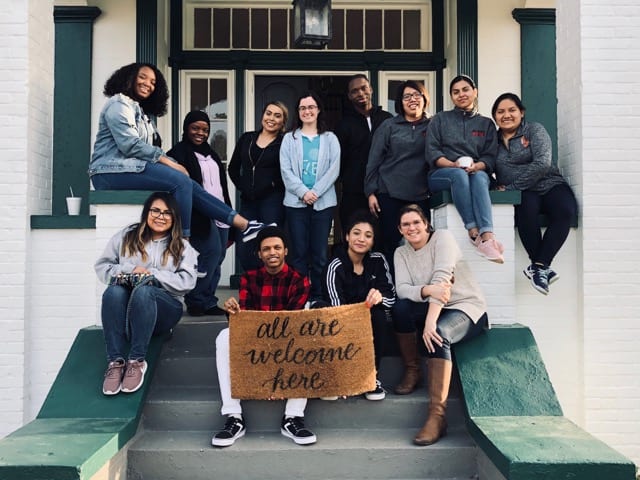
Members of the El Refugio family. Marie is in the bottom row, far right.
Wouldn’t it be amazing if, before giving a daily update on the Dow Jones Industrial Average, the evening news reported some sort of metric on how the poor and vulnerable did today?
What Does it Mean to Serve God Above All Else?
Today’s readings, particularly when taken in conjunction with our readings from the past few weeks, also encourage us to ask the question more broadly: What does it mean to serve God above all else, and how in the world will we know when we’re doing it?
Two summers ago, I had the great joy of joining several friends from college in Los Angeles for a wedding. On the morning of the wedding, I found myself cooling off in the pool with my freshman-year roommates – women I’ve loved deeply for almost thirty years (you do the math!). I know these women, so I shouldn’t have been surprised that, while languishing in the heat, one of them threw this fun proposition at us: Let’s go around and tell each other our ten-year plans! You know, so that we can hold each other accountable. She turned to me with a probing look. After stumbling about for a while, I told her what was on my heart, which basically boiled down to “I got nothin’ — I’m drawing a total blank.” Maybe it’s the heat, I thought. Frying my brain. Later, when I recounted the mildly traumatizing event to my husband, Chris and I realized something: not having a ten-year plan was, in fact, a very deliberate decision on my part. I might go so far as to describe it as a spiritual practice — an incredibly challenging one, developed over decades of adulthood and inspired by none other than Mary, herself.
Let’s imagine for a moment what might have happened if — just before the angel Gabriel arrived on the scene — Mary had been hanging out in Nazareth with her girl Elizabeth, making their ten-year plans. I’m quite certain that getting pregnant out of wedlock — with none other than the son of God — would NOT have been on her list of goals. But, thanks be to God, Mary didn’t have a ten-year plan. Or, who knows? Maybe she did. But she set aside her goals and ambitions and she did something quite extraordinary: “Here I am,” she said, “the servant of the Lord; let it be with me according to your word.”
Mary said YES.
Needless to say, I’m no Mary. It has taken me decades of adulthood to even begin this spiritual practice of YES. And what, exactly, am I supposed to say YES to? Jesus makes it pretty clear in Mark 12:
“Love the lord your God with all your heart and with all your soul, with all your mind and with all your strength; and love your neighbor as yourself.”
I believe that, if we love God, then we’ll love and serve our neighbor, not only with our minds (our rational selves) but with our hearts (our emotional selves) with our souls (our spiritual selves), and with our strength (our physical, embodied selves).
My first strange and surprising YES to serving neighbors came almost a decade ago. My friend Anton Flores had a completely impractical idea: “Hey, Marie. Let’s rent a house a mile down the road from the nation’s largest immigration detention center. We can take turns staying at the house on the weekends, so that families visiting their loved ones in detention will have a free, safe place to stay. Are you in?” I had an academic career to pursue, books to write, maybe even a little wealth to accumulate. Not to mention, the house he found, in a tiny southwest Georgia town I had never heard of, didn’t have any actual beds yet, and no one seemed to have a plan for acquiring them.
But, we got inventive, creative. Perhaps like the “shrewd” manager, we hustled. And, by the grace of God, a few weeks and nine air mattresses later, El Refugio Ministry welcomed our first guests into that little yellow house.
Since 2010, El Refugio has served thousands of detained immigrants and their families, walking alongside them as they suffer the crisis of deportation. We offer free food and lodging for families visiting their detained loved ones, and we also run a visitation program, which brings hundreds of volunteers each year to visit with detained immigrants and asylum-seekers who have no one else to visit them.
Our little ministry is nothing fancy, but the work of El Refugio is profound. Sharing a meal with families inside our hospitality house, talking with our detained friends on the phone through a glass partition, we recognize, acknowledge, and sometimes even celebrate our shared humanity. We build relationships of loving mutual recognition that are profoundly countercultural — that go against the wave of voices that tell us to dismiss our immigrant friends as outsiders who don’t belong. Inside our hospitality house, we strive — together with our guests — to create an environment of loving, mutual hospitality, which stands in stark contrast to the radical inhospitality of the Stewart Detention Center.
I thank God every day that I said YES to Anton’s impractical request. The neighbors I have been called to serve at El Refugio have transformed my heart. I do not exaggerate even a tiny bit when I say that, In them — broken and hurting but also resilient and loving — I encounter the Christ that I long to know.
Where Will Your “YES!” Lead?
So, as I wrap this up, I come back once more to the question raised by our readings: What does it mean to serve God above all else? I think it means to wait, in joyful hope, for those unexpected opportunities to say YES. And, when the opportunities come, to take them — quickly, before we lose our nerve.
Let me leave you all with an idea: when we reflect on this question, let’s do so with a heart like Mary’s – proclaiming, “Here I am, the servant of the lord.” If we do, I know that, like Mary, we will find our lives filled with joy and purpose, with deep relationships and strong community, with riches far greater than mammon. And then we will proclaim, as Mary did, “My soul magnifies the Lord, and my spirit rejoices!”
To learn more about El Refugio, including ways to support the ministry as a donor and/or a volunteer, please visit the El Refugio website: www.elrefugiostewart.org.
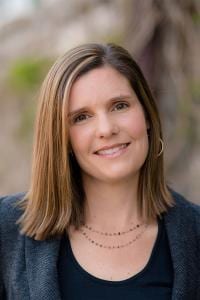
About the Guest Contributor: Dr. Marie Marquardt is the Scholar-in-Residence at Emory University’s Candler School of Theology, and is one of the founding coordinators for El Refugio, a ministry of hospitality and visitation serving immigrants detained at a south Georgia detention center. Dr. Marquardt’s books include several young adult novels, including Flight Season, Dream Things True, and The Radius of Us. She is a co-author of Living “Illegal”: The Human Face of Unauthorized Immigration (The New Press, 2011), and Globalizing the Sacred: Religion Across the Americas (Rutgers Univ. Press, 2003).

Enjoy reading this blog?
Click here to become a patron.

Previous Post

October 11, 2019
Romans 8:28-39: Basic Instructions for A Mystical Worldview
Next Post

November 2, 2019 Gatekeeping and Contemplation: Is the Church Its Own Worst Enemy?
Browse Our Archives
Select a Category Activism Announcements Art Books Catholicism Celtic Christianity Christian mysticism Christianity Contemplation Current events Etc. Family humor interfaith dialogue Interfaith Wisdom Interspirituality Lay Cistercians Living the Faith Meditation movies Mysticism Mystics nature Poetry Reviews Scripture silence Spirituality Uncategorized Writing
Select a Month February 2025 January 2025 November 2024 September 2024 August 2024 July 2024 June 2024 May 2024 March 2024 January 2024 December 2023 November 2023 August 2023 June 2023 April 2023 March 2023 February 2023 January 2023 December 2022 November 2022 October 2022 September 2022 August 2022 July 2022 June 2022 May 2022 April 2022 February 2022 January 2022 December 2021 November 2021 October 2021 September 2021 August 2021 July 2021 June 2021 May 2021 April 2021 March 2021 February 2021 January 2021 December 2020 November 2020 October 2020 September 2020 August 2020 July 2020 June 2020 May 2020 April 2020 March 2020 February 2020 January 2020 December 2019 November 2019 October 2019 September 2019 August 2019 July 2019 June 2019 May 2019 April 2019 March 2019 February 2019 January 2019 December 2018 November 2018 October 2018 September 2018 August 2018 July 2018 June 2018 May 2018 April 2018 March 2018 February 2018 January 2018 December 2017 November 2017 October 2017 September 2017 August 2017 July 2017 June 2017 May 2017 April 2017 March 2017 February 2017 January 2017 December 2016 November 2016 October 2016 September 2016 August 2016 July 2016 June 2016 May 2016 March 2016 February 2016 January 2016 December 2015 November 2015 October 2015 September 2015 August 2015 July 2015 June 2015 May 2015 April 2015 March 2015 February 2015 January 2015 December 2014 November 2014 October 2014 September 2014 August 2014 July 2014 June 2014 May 2014 April 2014 March 2014 February 2014 January 2014 December 2013 October 2013 September 2013 July 2013 May 2013 January 2013 December 2012 November 2012 August 2012 July 2012 June 2012 March 2012 December 2011 September 2011 October 2010 August 2010 March 2010 September 2009 July 2008 January 2008 December 2007 September 2007 February 2007 January 2007 December 2004
Follow Us!
TAKE THE
Religious Wisdom Quiz
"Train up a child in the way he should go" is found in which book?
Select your answer to see how you score.
Matthew Job Jonah Proverbs
Support this
Column


Related posts from Carl McColman

If Contemplative Prayer is For Resting in God,...

Why Christian Social and Political Activists Need Contemplation...

What is the Relationship Between Silence and Social...

TRENDING AT PATHEOS Contemplative

Handy Contemplative Practices for Political Spaces
A Spiritually Grounded Presence In order to bring a spiritually grounded presence...

Halloween: The Holiday of Loving Your Neighbor
All Hallows Eve Is Halloween the least Christian holiday in America, or...

Can Love Be Saved? Some Thoughts on the...
Happy Valentine's Day! I recently published a post on Patreon called Can...

"This Loving, Uniting Embrace": the Holy Ordinary
Today's guest post is by Mark Longhurst, author of The Holy Ordinary:...

How Are We Called to Live?: More About...
How Are We Called to Live? Many of us struggle with discerning...

A Spiritual Practice of Reading: Join Us Online
A Spiritual Practice of Reading A healthy spiritual practice of reading is...
view all Contemplative blogs
Ad-Free & Subscriber Log-In Subscription Support
- About Us
- 2026 Calendar
- Videos
- Podcasts
- Library of World Religions
- Faith In Media Tracker
- Advertise With Us
- Write for Us
- Privacy Policy
- Terms of Service
- Do Not Sell My Data
- Contact Us
- Radiant Digital
- Manage Newsletter Subscriptions
- Unsubscribe From Notifications
- Sitemap
Copyright 2008-2026, Patheos. All rights reserved.
Subscription Support Ad-Free & Subscriber Log-In
Follow Patheos