
BuddhistCatholicContemplativeEvangelicalGeneral ChristianHinduJewishLatter-day SaintMuslimNew VisionsProgressive Christian
Beliefs
- Buddhist
- Catholic
- Contemplative
- Evangelical
- General Christian
- Hindu
- Jewish
- Latter-day Saint
- More Voices
- Muslim
- New Visions
- Pagan
- Progressive Christian
Topics
- Religion News
- Food and Religion
- Sports and Religion
- Religious Art
- Religious Music and Entertainment
- Religious Events
- History and Religion
- Style and Religion
- Politics and Religion
- Women in Religion
- Recreation Outdoors and Religion
- Business Finance and Religion
- Careers Workplace and Religion
- Education and Religion
- Family Parenting and Religion
- Health Fitness and Religion
- Home and Religion
- Relationships and Religion
- Technology and Religion
- Travel and Religion
Columnists
- Buddhist Columnists
- Business Finance and Religion Columnists
- Careers Workplace and Religion Columnists
- Catholic Columnists
- Contemplative Columnists
- Education and Religion Columnists
- Evangelists Columnists
- Family Parenting and Religion Columnists
- General Christian Columnists
- Health Fitness and Religion Columnists
- Hindu Columnists
- History and Religion Columnists
- Home and Religion Columnists
- Jewish Columnists
- More Voices Columnists
- Latter Day Columnists
- Muslim Columnists
- New Visions Columnists
- Nonreligious Columnists
- Pagan Columnists
- Politics and Religion Columnists
- Progressive Columnists
- Recreation Outdoors and Religion Columnists
- Relationships and Religion Columnists
- Religion News Columnists
- Religious Art Columnists
- Religious Events Columnists
- Religious Music and Entertainment Columnists
- Sports and Religion Columnists
- Style and Religion Columnists
- Technology and Religion Columnists
- Travel and Religion Columnists
- Women in Religion Columnists
Resource Library
- 2026 Calendar
- Library of World Religions
- The 100 Most Holy Places on Earth
- Patheos Answers
- Podcasts
- Videos
- Faith Leaders Database
- Anglican Episcopalian
- Bahai
- Baptist
- Buddhism
- Christianity
- Confucianism
- Eastern Orthodoxy
- Hinduism
- Holiness and Pentecostal
- ISKCON
- Islam
- Judaism
- Lutheran
- Methodist
- The Church of Jesus Christ of Latter-day Saints
- New Age
- Paganism
- Presbytarian and Reformed
- Protestantism
- Religion Behind the Scenes
- Roman Catholic
- Scientology
- Shia Islam
- Sikhism
- Sufism
- Sunni Islam
- Taoism
- Zen
- See all religions
Research Tools
 Ad-Free & Subscriber Log-In Subscription Support
Ad-Free & Subscriber Log-In Subscription Support
Follow Patheos 

- Trending:
- Forgiveness
- |
- Marriage
- |
- Consciousness
- |
- Death Penalty
- |
- Election
- |
- Halloween

- Home
- Contemplative
- Eight Pagan Books (by a Christian Author)
Eight Pagan Books (by a Christian Author)
Last updated on: June 20, 2019 at 8:23 am by Carl "Skye" McColman
Eight Pagan Books (by a Christian Author) 2019-06-20T08:23:29-04:00 Carl "Skye" McColman
Patheos Explore the world's faith through different perspectives on religion and spirituality! Patheos has the views of the prevalent religions and spiritualities of the world.
In my forthcoming book Unteachable Lessons, I tell how I spent a period of time estranged from Christianity — the faith I was brought up in, and the faith I adhere to now. But for a number of years in my middle adult years, I explored a variety of new religious movements that are inspired by the old pagan religions of Europe and other areas. These new movements go by a variety of names: Paganism, Neopaganism, Wicca, Goddess spirituality, Druidism, Celtic Reconstructionism… there are others, but these are the paths that I explored.
While I was on my “Pagan journey” I wrote a number of books that explored this alternative spiritual world from a variety of perspectives. These were all published between 2001 and 2005. When I wrote these books, I thought that I was a “former Christian” — but the time came when I realized that I yearned to be reconnected with Christ and the Christian community. So after a fair amount of soul searching, long conversations with friends, and several sessions with a therapist, I began to re-integrate myself into the church, a process that ultimately led to my family and I becoming Catholic, and I becoming a Lay Cistercian (a layperson under the spiritual guidance of Cistercian monks).
Time often offers us a new perspective on the choices we made in the past. When I look back now on my interest in, and eventual exploration of, Pagan spirituality, I realize that much of my motivation had to do with seeking a mystical form of spirituality—more than what I was finding in the churches I attended at the time. I chafed against the prosaic religion of my childhood and early adult years. There were many things I loved about Paganism, including its recognition that the earth is sacred, that nature can be a wise spiritual teacher, and that the Divine has both a feminine as well as a masculine dimension. Eventually, when I realized that Paganism really wasn’t where I belonged, I went on to explore Celtic and contemplative Christianity more thoroughly, and discovered that everything I wanted from Paganism I was able to find in mystical Christianity.
Recognizing this, when I look back at the books I wrote about Paganism, I see in my writing the voice of an alienated Christian trying to find his way, rather than the voice of a convinced Neopagan. I point this out not to criticize Paganism or my many friends who remain Pagan. Indeed, one of the lasting gifts I received from the Pagan community was a recognition that respecting other faiths in no way diminishes one’s own. I am a better Christian for having spent time hanging out with the Pagans. And I am more capable of doing real interfaith exploration with my friends who are Buddhist, Jewish, and Muslim (as well as other faiths), thanks to having been a “temporary Pagan” when I was younger.
So is it fair to say these “Pagan books” are by a “Christian author”? At the time I wrote them I might have disagreed, but now I think that’s a fair assessment. When I wrote these books, I was still motivated by Christian ideas about community, ethics, spirituality, and worship, even if only subconsciously. One of the many things I’ve learned as an author is that even the most carefully written book always seems to have something to say in addition to whatever the author may have consciously intended. For me, these books carry the “hidden” message that when a Christian explores non-Christian spirituality, he or she will generally bring at least some Christian ways of thinking along for the ride.
Are these books worth reading? Well, that’s up to you. If you are a Christian interested in Paganism (or, for that matter, a Pagan interested in Christianity) then you might find these books particularly interesting. For that matter, anyone interested in interfaith dialogue and interspirituality might enjoy several of these books. And I hope that they remain relevant even to people who are only interested in learning about, or practicing, Pagan spirituality. But that’s for the reader to decide.
Alas, most of these books are now out of print, although used copies are generally available online and several are available as e-books. If you’d like to read them, I’ve provided links to help you find copies.
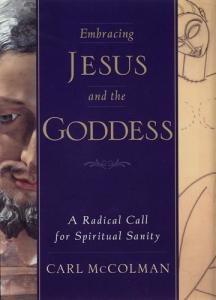
Embracing Jesus and the Goddess (2001)
This book was written in the late 1990s, when I was an Episcopalian struggling to make sense of my profound sense of interest in, and spiritual connection to, the Goddess spirituality of our time. I wrote the book especially for those who want to “maintain a light, spacious relationship” with both Goddess-centered and Christian forms of spirituality. But even beyond that, it calls for religious tolerance, goodwill and hospitality for all spiritual seekers of any path or faith tradition.
The book is written in a style similar to Thich Nhat Hanh’s Living Buddha, Living Christ — in other words, it’s light on theology, and mostly just articulates my wish that someone could explore both traditions if they so desired. I compared Christianity to the music of Bach, and Goddess worship to a rainbow-family-style drum circle. I didn’t see why a person couldn’t enjoy both equally. It was a sweet sentiment, if not necessarily a very compelling argument. Still, I’ve received plenty of letters over the years from readers who have found this book meaningful.
Embracing Jesus and the Goddess is out of print and no ebook version is currently available. You can search for used copies at Amazon, Barnes & Noble, or through ISBN.nu.
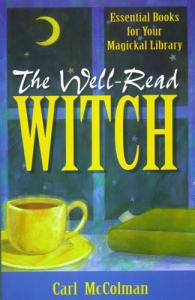
The Well-Read Witch (2002)
I’m a book nerd. When I realize I’m interested in a new topic, the first thing I want to do is buy an armload of books about it. I first became interested in Neo paganismand Goddess spirituality when an old High School friend suggested I read Starhawk’s The Spiral Dance: A Rebirth of the Religion of the Great Goddess. From then on I read book after book on the topic, years before I actually mustered up the courage to seek out other Pagans and actually attend Pagan events or gatherings.
From 1997 to 2001 I worked for the New Leaf Company, a major wholesaler/distributor of mind/body/spirit books and other products. New Leaf carried a vast selection of books on earth-based religion and spirituality: Wicca, witchcraft, and other forms of Neopaganism. This book arose out of my personal desire to learn about these religions and spiritualities, and the research I did, talking to priests and priestesses of various Pagan and Wiccan communities to discover which of the many books on earth spirituality were the most highly recommended and/or the most popular. In the end, over 400 books on some thirty different topics were reviewed in The Well-Read Witch, making it an annotated bibliography for a lifetime’s worth of Pagan-oriented reading material.
A friend of mine who was a Wiccan priestess chided me on the title. She thought only someone who had undergone an initiation ritual deserved to call themselves a “witch” (in the Pagan world, “witch” is a unisex term), and since I hadn’t had such an initiation, I had no right to even use the word in the title of a book I wrote. At the time, I thought she was being persnickety, but when I gave up on Paganism a few years later, her criticism suddenly made more sense to me. A more honest title for this book would be “A List of Books for People Who Want to Learn About Paganism” but that’s not very marketable, is it? So like it or not, The Well-Read Witch is what it is.
The Well-Read Witch is out of print in book form with no e-book version available. You can search for used copies at Amazon, Barnes & Noble, or through ISBN.nu.
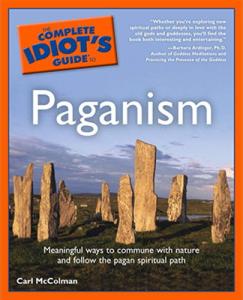
The Complete Idiot’s Guide to Paganism (2002)
If Embracing Jesus and the Goddess was my way of saying “I like to explore Paganism” and The Well-Read Witchwas me saying “Here’s how I’m going to do that exploring,” then my third Pagan book, The Complete Idiot’s Guide to Paganism, was my way of saying “Okay, here’s what I’ve learned.”
Like all “Idiot’s Guides” this work is meant to be a simple but factual introduction to its topic, written in a playful, down-to-earth, and easy-to-read style. It was meant to be a positive, basic overview of the fast-growing world of earth-based and Goddess-oriented spirituality.
At the time I wrote this book I was studying with a local Wiccan group; in retrospect, this book suffers from over-emphasizing Wicca to the detriment of other forms of Paganism. Nowadays I think it is interesting primarily as a personal document: it shows what aspects of Paganism appealed to me. So I emphasize veneration of nature, appreciating mythology, and an ethic of nonviolence and earth care.
The Complete Idiot’s Guide to Paganism is out of print in book form, but of course you can search for used copies at Amazon, Barnes & Noble, or through ISBN.nu. It is, however, available as an e-book for the Kindleand the Nook.
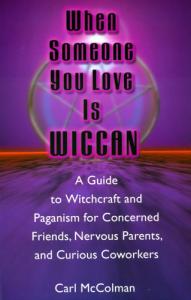
When Someone You Love is Wiccan (2003)
Like the previous three books, this book continues my personal arc of exploring how Paganism was impacting my life. Specifically: how to tell my elderly parents that their son, who at one time was talking about becoming a Lutheran minister, was now exploring witchcraft and magic? After a particularly awkward conversation during a family visit, I realized “there should be a book about this” and When Someone You Love is Wiccan is the result.
When Someone You Love is Wiccanwas an attempt to share my interest in Paganism not only with my family, but with anyone who might want to learn more about earth-based spirituality but without wanting to practice it for themselves. Concentrating on “mainstream” forms of Neopaganism like eclectic Wicca, the book aimed to dismantle stereotypes and misconceptions and instead build bridges of understanding.
I was horrified by the book’s cover art (like most authors, I pretty much have to accept the cover art that the publisher decides is best). I thought the cover art was designed to appeal to Pagans rather than to the non-Pagan readers I was writing for. Even now, if I were to choose one of my Pagan books to be reprinted/republished, this would be the one. But hopefully with a better design!
When Someone You Love is Wiccan is out of print in book form, but of course you can search for used copies at Amazon, Barnes & Noble, or through ISBN.nu. It is, however, available as an e-book for the Kindleand the Nook.
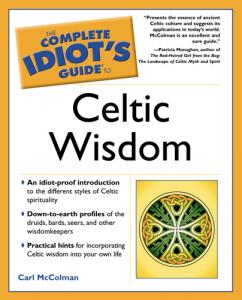
The Complete Idiot’s Guide to Celtic Wisdom (2003)
My first “Idiot’s Guide” sold well enough that the editor asked me if I’d like to write another one. I pitched a couple of ideas to her (one of them was on mysticism — which years later would blossom as The Big Book of Christian Mysticism), but the one she liked was Celtic spirituality.
Celtic spirituality — the spirituality of Ireland, Scotland, Wales, and other Celtic lands — is a natural topic for someone interested in both Christianity and Paganism. After all, it was Christian monks who diligently preserved the mythology of the pagan Celts — writers from William Butler Yeats and James Joyce, down to John Moriarty and even John O’Donohue, have all been steeped in this colorful ancient mythology. Given my own Scottish ancestry, Celtic myth and religion were a strong draw for me when I explored Paganism, so it’s no surprise that this became the latest installment on my journey.
In my opinion, I did a much better job providing a survey of Celtic spirituality than I did the year previously with Paganism as a whole. In this book I look at how Celtic spirituality can be expressed in a variety of ways — and even included a chapter on Christianity.
The Complete Idiot’s Guide to Celtic Wisdom is out of print in book form, but of course you can search for used copies at Amazon, Barnes & Noble, or through ISBN.nu. It is, however, available as an e-book for the Kindleand the Nook.
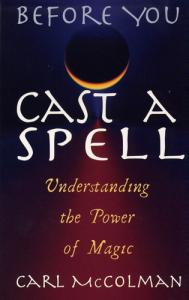
Before You Cast a Spell (2004)
This book arose out of a conversation I had with several Wiccan and Pagan booksellers who were frustrated by the many beginners in the Wiccan/Pagan world who wanted to learn about magic and spells — while ignoring the spiritual and ethical dimensions of magical religion. In retrospect, I believe writing Before You Cast a Spellrepresented the beginning of my journey from Paganism back to a primarily Christian identity, for in it I argue that ethics, personal responsibility, and choosing to be happy and empowered, are all ultimately more important than magic. But even though the book marks my own personal spiritual turning point, it has been warmly embraced by many teachers and elders within the Pagan community, and won a prestigious national award from the Coalition of Visionary Resources (the trade association for new age and metaphysical businesses) as the “Best Magic Book” of 2004.
Before You Cast a Spell is out of print in book form, but of course you can search for used copies at Amazon, Barnes & Noble, or through ISBN.nu. It is, however, available as an e-book for the Kindleand the Nook.
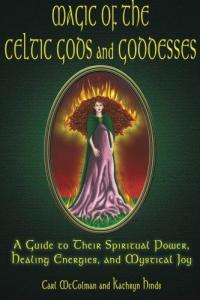
Magic of the Celtic Gods and Goddesses (with Kathryn Hinds) (2005)
Kathryn Hinds was on the editorial team of The Complete Idiot’s Guide to Celtic Wisdom; she and I moved in the same social circles here in Georgia. Having had a good experience working together on that book, we co-conspired to put together another project. Because her Wiccan coven was structured about Welsh mythology, and my interest was primarily in Irish myth, we thought it might be fun to write a devotional book about the various gods and goddesses of the Irish, Welsh, and other Celtic traditions. The publisher agreed, and this book is the result.
Collaborating with Kathryn was a delightful experience. We divided the work, so each chapter in the book is primarily written by one of us — with the other one reading and offering editorial feedback. Because of Kathryn’s professionalism and editorial acumen, I believe this book represents the best writing I did of all my Pagan-themed books. That’s a bittersweet statement to make, for it’s also my Pagan swan song, for within six months of finishing it I had begun to cut my ties to the Pagan community. Nevertheless, I still think this book provides a useful (and positive) overview of how Neopagan Celtic spirituality can be practiced in today’s world.
Kathryn passed away in 2018. Even though our spiritual paths diverged, I count it a great joy to have worked with such a fine writer, editor, and all-around wonderful human being.
Magic of the Celtic Gods and Goddesses can be purchased either new or used by following one of these links: Amazon, Barnes & Noble, or through ISBN.nu. It is also available as an e-book for the Kindleand the Nook.
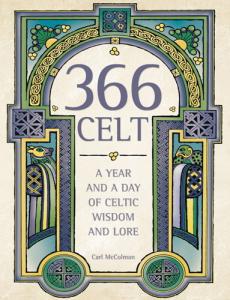
366 Celt (2005)
Written more or less concurrently with Magic of the Celtic Gods and Goddesses, this book provides a more nuanced glimpse into my personal spiritual development, as someone who had identified with Paganism but now was slowly beginning to recognize within myself the desire to return to the Christian faith. If Embracing Jesus and the Goddesschronicles my entry into Paganism, 366 Celt— a series of brief daily meditations on a variety of Celtic-themed topics — details the other end of that seven year journey. The end result? A book that, I hope, could be of use to all seekers of Celtic wisdom, whether Christian or Pagan.
At the suggestion of the book’s editor, a decade later I revised it (and ultimately largely rewrote it) to make a more Christian-centered book, An Invitation to Celtic Wisdom. While that latter book reveals where my journey took me, 366 Celtis a devotional statement of where my journey had taken me in the past.
366 Celt can be purchased either new or used by following one of these links: Amazon, Barnes & Noble, or through ISBN.nu. You can also purchase a copy directly from me.
After All That…
In 2005 my family and I were received into the Catholic Church and that fall I began working at the monastery where eventually I would become a Lay Associate. I thought I was done with professional writing — but in 2007 the editor who had worked with me on Embracing Jesus and the Goddess and 366 Celtcalled me and asked for a new proposal. I explained that I was no longer writing about Paganism, but his reply was to ask for a proposal based on my current interests. So I went back to the idea I had developed five years earlier — for an introductory book on Christian mysticism — revised the proposal to bring it in line with my current thinking on the topic, and sent it in. Within just a few months, I had a contract offer to publish what would become The Big Book of Christian Mysticism. And the rest, as they say, is history!
Enjoy reading this blog?
Click here to become a patron.


Next Post

June 26, 2019 What is Spiritual Formation?
Browse Our Archives
Select a Category Activism Announcements Art Books Catholicism Celtic Christianity Christian mysticism Christianity Contemplation Current events Etc. Family humor interfaith dialogue Interfaith Wisdom Interspirituality Lay Cistercians Living the Faith Meditation movies Mysticism Mystics nature Poetry Reviews Scripture silence Spirituality Uncategorized Writing
Select a Month February 2025 January 2025 November 2024 September 2024 August 2024 July 2024 June 2024 May 2024 March 2024 January 2024 December 2023 November 2023 August 2023 June 2023 April 2023 March 2023 February 2023 January 2023 December 2022 November 2022 October 2022 September 2022 August 2022 July 2022 June 2022 May 2022 April 2022 February 2022 January 2022 December 2021 November 2021 October 2021 September 2021 August 2021 July 2021 June 2021 May 2021 April 2021 March 2021 February 2021 January 2021 December 2020 November 2020 October 2020 September 2020 August 2020 July 2020 June 2020 May 2020 April 2020 March 2020 February 2020 January 2020 December 2019 November 2019 October 2019 September 2019 August 2019 July 2019 June 2019 May 2019 April 2019 March 2019 February 2019 January 2019 December 2018 November 2018 October 2018 September 2018 August 2018 July 2018 June 2018 May 2018 April 2018 March 2018 February 2018 January 2018 December 2017 November 2017 October 2017 September 2017 August 2017 July 2017 June 2017 May 2017 April 2017 March 2017 February 2017 January 2017 December 2016 November 2016 October 2016 September 2016 August 2016 July 2016 June 2016 May 2016 March 2016 February 2016 January 2016 December 2015 November 2015 October 2015 September 2015 August 2015 July 2015 June 2015 May 2015 April 2015 March 2015 February 2015 January 2015 December 2014 November 2014 October 2014 September 2014 August 2014 July 2014 June 2014 May 2014 April 2014 March 2014 February 2014 January 2014 December 2013 October 2013 September 2013 July 2013 May 2013 January 2013 December 2012 November 2012 August 2012 July 2012 June 2012 March 2012 December 2011 September 2011 October 2010 August 2010 March 2010 September 2009 July 2008 January 2008 December 2007 September 2007 February 2007 January 2007 December 2004
Follow Us!
TAKE THE
Religious Wisdom Quiz
What does "Beersheba" mean?
Select your answer to see how you score.
Valley of Water Well of the Oath Blessed Field House of the King
Support this
Column


Related posts from Carl McColman

Join Me for "24 Meditations for 2024"

Contemplative Books to Read and Savor During Advent...
New From Encountering Silence: Exploring the Lost History...
Twelve Mystical Anthologies That Belong in Every Contemplative...
TRENDING AT PATHEOS Contemplative

Handy Contemplative Practices for Political Spaces
A Spiritually Grounded Presence In order to bring a spiritually grounded presence...

Halloween: The Holiday of Loving Your Neighbor
All Hallows Eve Is Halloween the least Christian holiday in America, or...

Can Love Be Saved? Some Thoughts on the...
Happy Valentine's Day! I recently published a post on Patreon called Can...

"This Loving, Uniting Embrace": the Holy Ordinary
Today's guest post is by Mark Longhurst, author of The Holy Ordinary:...

How Are We Called to Live?: More About...
How Are We Called to Live? Many of us struggle with discerning...

A Spiritual Practice of Reading: Join Us Online
A Spiritual Practice of Reading A healthy spiritual practice of reading is...
view all Contemplative blogs
Ad-Free & Subscriber Log-In Subscription Support
- About Us
- 2026 Calendar
- Videos
- Podcasts
- Library of World Religions
- Faith In Media Tracker
- Advertise With Us
- Write for Us
- Privacy Policy
- Terms of Service
- Do Not Sell My Data
- Contact Us
- Radiant Digital
- Manage Newsletter Subscriptions
- Unsubscribe From Notifications
- Sitemap
Copyright 2008-2026, Patheos. All rights reserved.
Subscription Support Ad-Free & Subscriber Log-In
Follow Patheos