
BuddhistCatholicContemplativeEvangelicalGeneral ChristianHinduJewishLatter-day SaintMuslimNew VisionsProgressive Christian
Beliefs
- Buddhist
- Catholic
- Contemplative
- Evangelical
- General Christian
- Hindu
- Jewish
- Latter-day Saint
- More Voices
- Muslim
- New Visions
- Pagan
- Progressive Christian
Topics
- Religion News
- Food and Religion
- Sports and Religion
- Religious Art
- Religious Music and Entertainment
- Religious Events
- History and Religion
- Style and Religion
- Politics and Religion
- Women in Religion
- Recreation Outdoors and Religion
- Business Finance and Religion
- Careers Workplace and Religion
- Education and Religion
- Family Parenting and Religion
- Health Fitness and Religion
- Home and Religion
- Relationships and Religion
- Technology and Religion
- Travel and Religion
Columnists
- Buddhist Columnists
- Business Finance and Religion Columnists
- Careers Workplace and Religion Columnists
- Catholic Columnists
- Contemplative Columnists
- Education and Religion Columnists
- Evangelists Columnists
- Family Parenting and Religion Columnists
- General Christian Columnists
- Health Fitness and Religion Columnists
- Hindu Columnists
- History and Religion Columnists
- Home and Religion Columnists
- Jewish Columnists
- More Voices Columnists
- Latter Day Columnists
- Muslim Columnists
- New Visions Columnists
- Nonreligious Columnists
- Pagan Columnists
- Politics and Religion Columnists
- Progressive Columnists
- Recreation Outdoors and Religion Columnists
- Relationships and Religion Columnists
- Religion News Columnists
- Religious Art Columnists
- Religious Events Columnists
- Religious Music and Entertainment Columnists
- Sports and Religion Columnists
- Style and Religion Columnists
- Technology and Religion Columnists
- Travel and Religion Columnists
- Women in Religion Columnists
Resource Library
- 2026 Calendar
- Library of World Religions
- The 100 Most Holy Places on Earth
- Patheos Answers
- Podcasts
- Videos
- Faith Leaders Database
- Anglican Episcopalian
- Bahai
- Baptist
- Buddhism
- Christianity
- Confucianism
- Eastern Orthodoxy
- Hinduism
- Holiness and Pentecostal
- ISKCON
- Islam
- Judaism
- Lutheran
- Methodist
- The Church of Jesus Christ of Latter-day Saints
- New Age
- Paganism
- Presbytarian and Reformed
- Protestantism
- Religion Behind the Scenes
- Roman Catholic
- Scientology
- Shia Islam
- Sikhism
- Sufism
- Sunni Islam
- Taoism
- Zen
- See all religions
Research Tools
 Ad-Free & Subscriber Log-In Subscription Support
Follow Patheos 

- Trending:
- Advent
- |
- Forgiveness
- |
- Thanksgiving
- |
- Election
- |
- Seasonal Holidays
- |
- Marriage

- Home
- Contemplative
- Thin Places, Contemplation, and Discernment: A Few Questions About Celtic Spirituality
Thin Places, Contemplation, and Discernment: A Few Questions About Celtic Spirituality
Last updated on: May 24, 2019 at 12:27 pm by Carl "Skye" McColman
Thin Places, Contemplation, and Discernment: A Few Questions About Celtic Spirituality 2019-05-24T12:27:41-04:00 Carl "Skye" McColman
Patheos Explore the world's faith through different perspectives on religion and spirituality! Patheos has the views of the prevalent religions and spiritualities of the world.

Chalice Well, in Glastonbury, England. A Holy Well and a Thin Place (photo by Carl McColman)
Recently I led a Celtic spirituality retreat through the Copper Beech Institute in Connecticut. During the retreat we talked about such topics as the spirituality of holy wells, thin places, and the concept of “the edge of waiting” as a Celtic way of contemplating.
One of the participants sent me an email after the retreat ended with a few questions that came to mind:
How do thin places/experiences intersect with the para-normal?
If a coincidence is “God being anonymous”, how does this relate to thinness?
You described a contemplative attitude as being “in waiting”. Where does discernment figure into this?
He gave me permission to answer these questions here on the blog, so here goes.
Thin Places and the Paranormal
A thin place, by its very nature, is a location where the veil between the material and spiritual realms seems, well, “thin.” Thin places tend to be sacred sites or places of natural wonder where people report feeling a sense of closeness to heaven and/or to the “otherworld” of Celtic legend and lore. Is this a subjective or objective experience? I’m not sure that anyone can really provide a definitive answer to this question, so I will assume that the thin place experience is subjective by nature: some people visit thin places and sense that closeness to the spiritual realm, while others might feel nothing extraordinary. As Elizabeth Barrett Browning reminded us:
Earth’s crammed with heaven,
And every common bush afire with God,
But only he who sees takes off his shoes;
The rest sit round and pluck blackberries.
It’s a mystery to me why some people “see” and take off their shoes, while others just keep on plucking their berries. But that’s how things roll. I imagine it has something to do with grace — the person who “sees” has been given a special gift — but also has to do with the disposition of the person: the one who sees is disposed to seeing. Just as the one who recognizes the presence of God in their hearts very often is the one who is open to such a knowing.

An Invitation to Celtic Wisdom
And the key word here is indeed knowing. This is an epistemological question: how do we know when we are especially present to the Mystery-with-a-capital-M, whether that means the presence of God, the realm of Spirit, or simply earth “crammed with heaven”?
My retreatant asks about the paranormal. In other words, is this a matter of clairsentience — like clairvoyance, only instead of the second sight, what’s at play here is a kind of “second knowing.”
I’m going to dodge the question, not because I don’t think this could be clairsentience — I see no reason why it couldn’t be — but because I just tend to opt for the most simple explanation. I think the kind of “mystical knowing” that recognizing a thin place entails does not have to be paranormal. In other words, it could be perfectly within the ordinary experience of average, ordinary human beings.
It’s a way of knowing, which doesn’t have to be a paranormal way of knowing (clairsentience) — but by the same token, it’s not your normal, linear left-brain mind’s way of knowing either. Thin places are recognized through intuition, through feeling, through attentiveness to silence and the subtle knowing of the human body. It’s what Maggie Ross calls the “deep mind” — or what Iain McGilchrist called the “master,” in contrast to the “emissary” which is the rational/linear way of knowing.
I think especially for those who are not used to listening to the deep mind, the intuitive sense of knowing that it can sometimes spontaneously offer up can certainly seem to be “paranormal” or clairsentient. But I don’t think it’s helpful to label something as extraordinary just because it tends to be something ignored by our mainstream ways of knowing. We need to become more familiar with intuitive knowing, and suggesting it is something exotic is probably not the best strategy.
By saying all this, am I suggesting that paranormal ways of knowing don’t exist? No, not at all. I believe in miracles, and in God anything is possible. But I also believe that the ordinary, everyday human being is more capable of deep intuitive knowing that we give ourselves credit. And if we can learn to set that intuitive side of ourselves free, many beautiful wonders will await us.
Coincidences, Thin Places, and the Hiddenness of God
I love this idea of “coincidence” being God acting anonymously. Although I prefer the word serendipity for this kind of heavenly dot-connecting.
I’m not sure that there is any special relationship to the thin places, however. Except maybe this: to recognize the serendipitous movement of the Holy Spirit in our lives requires the same kind of intuitive deep knowing that the ability to recognize a thin place requires.
In both cases, learning to live in wonder, to be friendly with silence and stillness and not-knowing, to accept paradox and ambiguity and to approach God in a spirit of deep trust — these are the raw materials for a way of knowing that is anchored in deep intuition, and it is this way of knowing that reveals both thin places and moments of serendipity to us.
Contemplative Waiting and Discernment
In the retreat, I described contemplation as “waiting” by pointing to the Irish word for contemplation, rinnfheitheamh, which literally means “at the edge of waiting.” How does this relate to contemplation? Consider this verse from Psalm 62: “For God alone my soul waits in silence.” (Psalm 62:1).
Now, then, how does discernment relate to the act of contemplative waiting? Discernment can be defined as the process of coming to spiritual insight or understanding, sometimes (but not always) with an eye to making a decision. Perhaps the key word here is process. While it is theoretically possible to discern quickly — akin to making a snap decision — my sense of the culture of Christian spirituality is that discernment is seen as a process that benefits from time. We need time to weigh different perspectives, to look at the ramification of different choices, to listen within for a sense of where the Spirit (or our heart) might be leading us.
Such a discerning process naturally takes time.
Therefore, I would say that whenever time and circumstances permit, contemplative waiting is discernment’s best friend.
If you are seeking spiritual understanding — or seeking guidance in making a decision, whether big or small — give yourself the gift of rinnfheitheamh — of taking time to pray at the edge of waiting. It will be worth the wait!
Carl McColman is the author of numerous books, including An Invitation to Celtic Wisdom and 366 Celt: A Year and a Day of Celtic Wisdom and Lore.
Enjoy reading this blog?
Click here to become a patron.

Previous Post

May 8, 2019
Julian of Norwich's Timeless Message
Next Post

June 4, 2019 Miann: The Ardent Desire for God
Browse Our Archives
Select a Category Activism Announcements Art Books Catholicism Celtic Christianity Christian mysticism Christianity Contemplation Current events Etc. Family humor interfaith dialogue Interfaith Wisdom Interspirituality Lay Cistercians Living the Faith Meditation movies Mysticism Mystics nature Poetry Reviews Scripture silence Spirituality Uncategorized Writing
Select a Month February 2025 January 2025 November 2024 September 2024 August 2024 July 2024 June 2024 May 2024 March 2024 January 2024 December 2023 November 2023 August 2023 June 2023 April 2023 March 2023 February 2023 January 2023 December 2022 November 2022 October 2022 September 2022 August 2022 July 2022 June 2022 May 2022 April 2022 February 2022 January 2022 December 2021 November 2021 October 2021 September 2021 August 2021 July 2021 June 2021 May 2021 April 2021 March 2021 February 2021 January 2021 December 2020 November 2020 October 2020 September 2020 August 2020 July 2020 June 2020 May 2020 April 2020 March 2020 February 2020 January 2020 December 2019 November 2019 October 2019 September 2019 August 2019 July 2019 June 2019 May 2019 April 2019 March 2019 February 2019 January 2019 December 2018 November 2018 October 2018 September 2018 August 2018 July 2018 June 2018 May 2018 April 2018 March 2018 February 2018 January 2018 December 2017 November 2017 October 2017 September 2017 August 2017 July 2017 June 2017 May 2017 April 2017 March 2017 February 2017 January 2017 December 2016 November 2016 October 2016 September 2016 August 2016 July 2016 June 2016 May 2016 March 2016 February 2016 January 2016 December 2015 November 2015 October 2015 September 2015 August 2015 July 2015 June 2015 May 2015 April 2015 March 2015 February 2015 January 2015 December 2014 November 2014 October 2014 September 2014 August 2014 July 2014 June 2014 May 2014 April 2014 March 2014 February 2014 January 2014 December 2013 October 2013 September 2013 July 2013 May 2013 January 2013 December 2012 November 2012 August 2012 July 2012 June 2012 March 2012 December 2011 September 2011 October 2010 August 2010 March 2010 September 2009 July 2008 January 2008 December 2007 September 2007 February 2007 January 2007 December 2004
Follow Us!
TAKE THE
Religious Wisdom Quiz
What did Elisha heal by throwing salt into it?
Select your answer to see how you score.
A spring of water A pot of stew A fig tree River Jordan
Support this
Column


Related posts from Carl McColman
Register for the "Celtic Spirituality School" — Yearlong...

Explore Celtic Spirituality with "Spirituality and Practice" Online...
"Do I stay Christian?" A Conversation with Brian...
How to Find the Right Contemplative Community
TRENDING AT PATHEOS Contemplative

Handy Contemplative Practices for Political Spaces
A Spiritually Grounded Presence In order to bring a spiritually grounded presence...

Halloween: The Holiday of Loving Your Neighbor
All Hallows Eve Is Halloween the least Christian holiday in America, or...

Can Love Be Saved? Some Thoughts on the...
Happy Valentine's Day! I recently published a post on Patreon called Can...
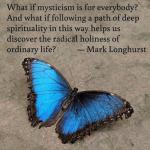
"This Loving, Uniting Embrace": the Holy Ordinary
Today's guest post is by Mark Longhurst, author of The Holy Ordinary:...

How Are We Called to Live?: More About...
How Are We Called to Live? Many of us struggle with discerning...

A Spiritual Practice of Reading: Join Us Online
A Spiritual Practice of Reading A healthy spiritual practice of reading is...
view all Contemplative blogs
Ad-Free & Subscriber Log-In Subscription Support
- About Us
- 2026 Calendar
- Videos
- Podcasts
- Library of World Religions
- Faith In Media Tracker
- Advertise With Us
- Write for Us
- Privacy Policy
- Terms of Service
- Do Not Sell My Data
- Contact Us
- Radiant Digital
- Manage Newsletter Subscriptions
- Unsubscribe From Notifications
- Sitemap
Copyright 2008-2026, Patheos. All rights reserved.
Subscription Support Ad-Free & Subscriber Log-In
Follow Patheos