
BuddhistCatholicContemplativeEvangelicalGeneral ChristianHinduJewishLatter-day SaintMuslimNew VisionsProgressive Christian
Beliefs
- Buddhist
- Catholic
- Contemplative
- Evangelical
- General Christian
- Hindu
- Jewish
- Latter-day Saint
- More Voices
- Muslim
- New Visions
- Pagan
- Progressive Christian
Topics
- Religion News
- Food and Religion
- Sports and Religion
- Religious Art
- Religious Music and Entertainment
- Religious Events
- History and Religion
- Style and Religion
- Politics and Religion
- Women in Religion
- Recreation Outdoors and Religion
- Business Finance and Religion
- Careers Workplace and Religion
- Education and Religion
- Family Parenting and Religion
- Health Fitness and Religion
- Home and Religion
- Relationships and Religion
- Technology and Religion
- Travel and Religion
Columnists
- Buddhist Columnists
- Business Finance and Religion Columnists
- Careers Workplace and Religion Columnists
- Catholic Columnists
- Contemplative Columnists
- Education and Religion Columnists
- Evangelists Columnists
- Family Parenting and Religion Columnists
- General Christian Columnists
- Health Fitness and Religion Columnists
- Hindu Columnists
- History and Religion Columnists
- Home and Religion Columnists
- Jewish Columnists
- More Voices Columnists
- Latter Day Columnists
- Muslim Columnists
- New Visions Columnists
- Nonreligious Columnists
- Pagan Columnists
- Politics and Religion Columnists
- Progressive Columnists
- Recreation Outdoors and Religion Columnists
- Relationships and Religion Columnists
- Religion News Columnists
- Religious Art Columnists
- Religious Events Columnists
- Religious Music and Entertainment Columnists
- Sports and Religion Columnists
- Style and Religion Columnists
- Technology and Religion Columnists
- Travel and Religion Columnists
- Women in Religion Columnists
Resource Library
- 2026 Calendar
- Library of World Religions
- The 100 Most Holy Places on Earth
- Patheos Answers
- Podcasts
- Videos
- Faith Leaders Database
- Anglican Episcopalian
- Bahai
- Baptist
- Buddhism
- Christianity
- Confucianism
- Eastern Orthodoxy
- Hinduism
- Holiness and Pentecostal
- ISKCON
- Islam
- Judaism
- Lutheran
- Methodist
- The Church of Jesus Christ of Latter-day Saints
- New Age
- Paganism
- Presbytarian and Reformed
- Protestantism
- Religion Behind the Scenes
- Roman Catholic
- Scientology
- Shia Islam
- Sikhism
- Sufism
- Sunni Islam
- Taoism
- Zen
- See all religions
Research Tools
 Ad-Free & Subscriber Log-In Subscription Support
Follow Patheos 

- Trending:
- Advent
- |
- Forgiveness
- |
- Thanksgiving
- |
- Election
- |
- Seasonal Holidays
- |
- Marriage

- Home
- Contemplative
- Julian of Norwich’s Timeless Message
Julian of Norwich’s Timeless Message
Last updated on: May 8, 2019 at 4:01 am by Carl "Skye" McColman
Julian of Norwich’s Timeless Message 2019-05-02T16:49:39-04:00 Carl "Skye" McColman
Patheos Explore the world's faith through different perspectives on religion and spirituality! Patheos has the views of the prevalent religions and spiritualities of the world.
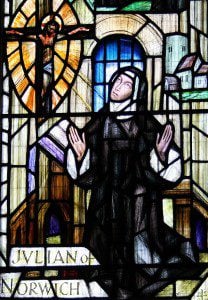
Julian of Norwich Stained Glass, Norwich Cathedral. Photo by Ian-S, used by permission.
We know the first woman who wrote a book in the English language (at least, the first one that has been preserved for posterity).
But there is a lot about that author, who lived in the fourteenth century, that we don’t know.
We know she was a visionary based in Norwich, England. But we don’t know her name, where she was from or what her family life was like. We can only guess at her education or when she died. Even the date of her extraordinary mystical experience is up for grabs, thanks to the ambiguity that can be embedded in a handwritten manuscript.
Today (May 8) might be the anniversary of this mysterious woman’s extraordinary visions. But it might just as easily have been May 13.
In script, a “V” and an “X” are not so very different—so when one manuscript mentions May VIII, and another May XIII, we can assume that less than precise penmanship on the part of some long-forgotten scribe means that today we are left with a mystery that cannot be solved. We simply don’t know if Julian of Norwich (that’s not her name, but that’s what we call her) received her visions on the 8th or the 13th day of May, in the year 1373.
No worries, though. Anglican calendars typically remember Julian on the 8th, while Roman calendars prefer the 13th. I just make a point to remember the mystic of Norwich on both days and leave it at that. After all, the date of her life-changing encounter with Christ, and Mary, and even the fiend matters little when compared to the spiritual and theological insights contained in her visions.
Wisdom from a Medieval Solitary
We call the woman “Julian of Norwich,” because at some point—probably after her visionary experience—she became a consecrated solitary, living alone in a cell adjacent to the Church of St. Julian in Norwich. That church is dedicated to an obscure saint, the first bishop of Le Mans, France, who probably lived in the fourth century or even earlier. But the name of that church will forever be associated with the anonymous woman who dwelled within its walls a millennium after its patronal saint lived; indeed, today the church is a shrine for the mystic, a haven of rest and silence in a bustling modern English city.
Why all this fuss over someone almost totally consigned to medieval obscurity? Because of her words, of course.

St. Julian’s Cell, Norwich, England
Shortly after her visions, she recounted them in a relatively short manuscript, but she reworked it and expanded it, once and perhaps more than once, resulting in a “long text” alongside her earlier “short text.” Both versions of her story include detailed information on her visions, but the long text gives more interpretive, theological detail, presumably the fruit of years of meditation and reflection on the meaning of her visionary encounter.
Her best known line, “All shall be well, and all shall be well, and all manner of things shall be well” has become part of our larger cultural lexicon, thanks to T. S. Eliot, who nicked the line for one of his Four Quartets; the poem “Little Gidding.” This line is spoken by Christ himself in Julian’s vision, reassuring her that even though such a thing as sin exists, “all shall be well”—in God, even the worst elements of life will ultimately be healed.
But lest we accuse Julian of universalism, she repeatedly affirms all “the teaching of holy church” and leaves it to a “secret” in God as to just how all things shall be made well.
Julian is also renowned for her clever wordplay in which she deconstructs the masculine gender of God. “As truly as God is our father, so truly is God our mother,” she bluntly states, making her (like some other medieval mystical women) sort of an honorary foremother of feminist theology in our day. But Julian doesn’t just settle for a God in drag: her depictions of God are not only both maternal and paternal, but also sensual, anchored in natural imagery, and deeply trinitarian.
“Truth sees God, and wisdom beholds God. And of these two come the third, and that is a marvelous, holy delight in God, which is love.” Truth leads to a Pauline, intellectual apprehension of God, while wisdom ushers in a Johannine contemplation (“beholding”) of God—and the fruit of both of these is delightful love.
Then there is the hazelnut vision, where Julian sees “a little thing” small enough to rest in the palm of her hand—and which she is told “is all that is made.” Julian wonders that it continues to exist, which makes sense to me: imagine holding a tiny model of the entire cosmos small enough to rest in your hand; it would probably shine and shimmer and seem to have barely any substance at all. But in her understanding she receives this reassuring message: “It lasts and ever shall, for God loves it. And so all things have being through the love of God.”
Reflecting on this in her customary trinitarian way, Julian notes three qualities in this “little thing”: God made it, God loves it, and God keeps it. She goes on to reflect how human life is filled with angst because we seek our “rest”—our sense of identity, purpose, and pleasure—in the littleness of created things, rather than the vastness of Divine love.
Julian is no systematic theologian, nor is her writing intellectually demanding like the work of Thomas Aquinas or, for that matter, Meister Eckhart. She is more poet than philosopher. But her emphasis on love as the heart not only of God’s being but also God’s action in the universe leads to a theological vision that remains profoundly relevant here in the postmodern world. For Julian, Christ’s death is not a way to buy off the devil or to satisfy that righteous anger of God the Father. Rather, it is simply a vivid and sensual way to express Divine love: “No one has greater love than this, to lay down one’s life for one’s friends” (John 15:13).
And if Julian pulls a few punches when it comes to questions of how eternity will reconcile love and justice, this is understandable, for she lived in a time when heretics paid for their dissent with their lives. Even so, she has left us with a treasure that can aid in the monumental task to re-visioning the Gospel: the splendid proclamation of God’s love, a love that can break out from the confining limitations of the closed, reward-punishment system that has characterized juridical Christian theology for too long.
Which means after over six centuries, we still have barely begun to plumb the implications of her singular visions.
Want to explore Julian for yourself? Her original middle English voice is worth exploring, but if you’re new to her words, there are some useful modern-English translations; try The Showings of Julian of Norwich translated by Mirabai Starr. For a good brief introduction to Julian’s life and thought, check out Veronica Mary Rolf’s An Explorer’s Guide to Julian of Norwich.
Enjoy reading this blog?
Click here to become a patron.

Previous Post

May 6, 2019
I'm Uncomfortable with the Notion of the "False Self." Here's Why.

Browse Our Archives
Select a Category Activism Announcements Art Books Catholicism Celtic Christianity Christian mysticism Christianity Contemplation Current events Etc. Family humor interfaith dialogue Interfaith Wisdom Interspirituality Lay Cistercians Living the Faith Meditation movies Mysticism Mystics nature Poetry Reviews Scripture silence Spirituality Uncategorized Writing
Select a Month February 2025 January 2025 November 2024 September 2024 August 2024 July 2024 June 2024 May 2024 March 2024 January 2024 December 2023 November 2023 August 2023 June 2023 April 2023 March 2023 February 2023 January 2023 December 2022 November 2022 October 2022 September 2022 August 2022 July 2022 June 2022 May 2022 April 2022 February 2022 January 2022 December 2021 November 2021 October 2021 September 2021 August 2021 July 2021 June 2021 May 2021 April 2021 March 2021 February 2021 January 2021 December 2020 November 2020 October 2020 September 2020 August 2020 July 2020 June 2020 May 2020 April 2020 March 2020 February 2020 January 2020 December 2019 November 2019 October 2019 September 2019 August 2019 July 2019 June 2019 May 2019 April 2019 March 2019 February 2019 January 2019 December 2018 November 2018 October 2018 September 2018 August 2018 July 2018 June 2018 May 2018 April 2018 March 2018 February 2018 January 2018 December 2017 November 2017 October 2017 September 2017 August 2017 July 2017 June 2017 May 2017 April 2017 March 2017 February 2017 January 2017 December 2016 November 2016 October 2016 September 2016 August 2016 July 2016 June 2016 May 2016 March 2016 February 2016 January 2016 December 2015 November 2015 October 2015 September 2015 August 2015 July 2015 June 2015 May 2015 April 2015 March 2015 February 2015 January 2015 December 2014 November 2014 October 2014 September 2014 August 2014 July 2014 June 2014 May 2014 April 2014 March 2014 February 2014 January 2014 December 2013 October 2013 September 2013 July 2013 May 2013 January 2013 December 2012 November 2012 August 2012 July 2012 June 2012 March 2012 December 2011 September 2011 October 2010 August 2010 March 2010 September 2009 July 2008 January 2008 December 2007 September 2007 February 2007 January 2007 December 2004
Follow Us!
TAKE THE
Religious Wisdom Quiz
Whose dreams of sheaves and stars caused jealousy?
Select your answer to see how you score.
Issachar Judah Joseph Asher
Support this
Column


Related posts from Carl McColman

I Believe Prayer Changes Things. Here's a Few...

You don't have to become a monk to...

LSD, Anxiety, and Contemplation: Can Psychedelic Therapy Support...

Mysticism, Faith, and "Knowing" God's Will
TRENDING AT PATHEOS Contemplative

Handy Contemplative Practices for Political Spaces
A Spiritually Grounded Presence In order to bring a spiritually grounded presence...

Halloween: The Holiday of Loving Your Neighbor
All Hallows Eve Is Halloween the least Christian holiday in America, or...

Can Love Be Saved? Some Thoughts on the...
Happy Valentine's Day! I recently published a post on Patreon called Can...
"This Loving, Uniting Embrace": the Holy Ordinary
Today's guest post is by Mark Longhurst, author of The Holy Ordinary:...

How Are We Called to Live?: More About...
How Are We Called to Live? Many of us struggle with discerning...

A Spiritual Practice of Reading: Join Us Online
A Spiritual Practice of Reading A healthy spiritual practice of reading is...
view all Contemplative blogs
Ad-Free & Subscriber Log-In Subscription Support
- About Us
- 2026 Calendar
- Videos
- Podcasts
- Library of World Religions
- Faith In Media Tracker
- Advertise With Us
- Write for Us
- Privacy Policy
- Terms of Service
- Do Not Sell My Data
- Contact Us
- Radiant Digital
- Manage Newsletter Subscriptions
- Unsubscribe From Notifications
- Sitemap
Copyright 2008-2026, Patheos. All rights reserved.
Subscription Support Ad-Free & Subscriber Log-In
Follow Patheos