
BuddhistCatholicContemplativeEvangelicalGeneral ChristianHinduJewishLatter-day SaintMuslimNew VisionsProgressive Christian
Beliefs
- Buddhist
- Catholic
- Contemplative
- Evangelical
- General Christian
- Hindu
- Jewish
- Latter-day Saint
- More Voices
- Muslim
- New Visions
- Pagan
- Progressive Christian
Topics
- Religion News
- Food and Religion
- Sports and Religion
- Religious Art
- Religious Music and Entertainment
- Religious Events
- History and Religion
- Style and Religion
- Politics and Religion
- Women in Religion
- Recreation Outdoors and Religion
- Business Finance and Religion
- Careers Workplace and Religion
- Education and Religion
- Family Parenting and Religion
- Health Fitness and Religion
- Home and Religion
- Relationships and Religion
- Technology and Religion
- Travel and Religion
Columnists
- Buddhist Columnists
- Business Finance and Religion Columnists
- Careers Workplace and Religion Columnists
- Catholic Columnists
- Contemplative Columnists
- Education and Religion Columnists
- Evangelists Columnists
- Family Parenting and Religion Columnists
- General Christian Columnists
- Health Fitness and Religion Columnists
- Hindu Columnists
- History and Religion Columnists
- Home and Religion Columnists
- Jewish Columnists
- More Voices Columnists
- Latter Day Columnists
- Muslim Columnists
- New Visions Columnists
- Nonreligious Columnists
- Pagan Columnists
- Politics and Religion Columnists
- Progressive Columnists
- Recreation Outdoors and Religion Columnists
- Relationships and Religion Columnists
- Religion News Columnists
- Religious Art Columnists
- Religious Events Columnists
- Religious Music and Entertainment Columnists
- Sports and Religion Columnists
- Style and Religion Columnists
- Technology and Religion Columnists
- Travel and Religion Columnists
- Women in Religion Columnists
Resource Library
- 2026 Calendar
- Library of World Religions
- The 100 Most Holy Places on Earth
- Patheos Answers
- Podcasts
- Videos
- Faith Leaders Database
- Anglican Episcopalian
- Bahai
- Baptist
- Buddhism
- Christianity
- Confucianism
- Eastern Orthodoxy
- Hinduism
- Holiness and Pentecostal
- ISKCON
- Islam
- Judaism
- Lutheran
- Methodist
- The Church of Jesus Christ of Latter-day Saints
- New Age
- Paganism
- Presbytarian and Reformed
- Protestantism
- Religion Behind the Scenes
- Roman Catholic
- Scientology
- Shia Islam
- Sikhism
- Sufism
- Sunni Islam
- Taoism
- Zen
- See all religions
Research Tools
 Ad-Free & Subscriber Log-In Subscription Support
Ad-Free & Subscriber Log-In Subscription Support
Follow Patheos 

- Trending:
- Forgiveness
- |
- Marriage
- |
- Consciousness
- |
- Death Penalty
- |
- Election
- |
- Halloween

- Home
- Contemplative
- “Kindle No Fire” — A Detail Missing From Recent Ways We Talk About Observing the Sabbath
“Kindle No Fire” — A Detail Missing From Recent Ways We Talk About Observing the Sabbath
Last updated on: March 4, 2019 at 8:10 am by Guest Contributor
“Kindle No Fire” — A Detail Missing From Recent Ways We Talk About Observing the Sabbath 2019-03-03T00:58:03-04:00 Guest Contributor
Patheos Explore the world's faith through different perspectives on religion and spirituality! Patheos has the views of the prevalent religions and spiritualities of the world.
Today’s guest post is by Jon M. Sweeney, author of numerous books including The Pope’s Cat and When Saint Francis Saved the Church. Jon is the editor of Thomas Merton’s A Course in Christian Mysticism and the forthcoming A Course in Desert Spirituality. In today’s post he offers a reflection on how current insights about observance of the Sabbath often overlook a subtle, but important, detail — that has a surprising contemplative implication.

Shabat Table. Photo Credit: Gilabrand at English Wikipedia. Licensed under the Creative Commons Attribution 2.5 Generic license.
I’ve read many books and articles, heard many sermons and exhortations, on the topic of the Sabbath.
And, as I’m married to a Jewish woman, who’s also a rabbi, our family observes a weekly Sabbath every Saturday.
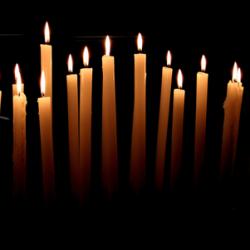
We “make Shabbat,” as it is said, usually lighting candles, blessing our children, studying Torah, and generally refraining for twenty-four hours from most of the usual weekly tasks and work.
In the last twenty years – perhaps since Wayne Muller’s Sabbath was published in 1999 – there’s been a rediscovering of Shabbat as a spiritual practice for Jews and Christians. It has focused attention on the Sabbath’s potential to revive, renew, regenerate, and retool us at the end, and as a beginning, of each new week.
But I think we might be missing an essential ascetic, contemplative dimension of Shabbat discipline. It seems to be missing from how all the recent books talk of Shabbat, and even how we practice it in our home.
Looking closely at the Torah, the portion for this past week began in Exodus, chapter 35. Look at that third verse and you see raised up as a primary “don’t” on the Sabbath, “kindling a fire.”
You shall kindle no fire in all your dwellings on the sabbath day. (Exodus 35:3)
Three thousand years ago or so, the kindling of a fire would have been central to everyday work, life, and comfort. Without a fire in the winter, even in the land of Israel, your dwelling would have been very cold.
Without a fire, you couldn’t have cooked, which means that your eating would have been lousy. Then, of course without a fire you couldn’t do other sorts of everyday work that many people typically did to earn their keep.
My point is: We often make observing the Sabbath out to be a lovely, calming, ahhh sort of experience, as in, Ahhh, a day on which I’m commanded by God to stop working, and stop toiling and worrying. Beautiful! Sign me up!
That’s all good. In fact, the rabbis of old even say that the Sabbath is a day to be joyful. Don’t work, take a leisurely walk. Don’t do the dishes, let them wait until tomorrow. You are supposed to find joy particularly on this day. To that end, for example, the rabbis say that sex with your spouse on the Sabbath is a special blessing.
But what about the ascetic opportunities the Sabbath must have been intended for? It wouldn’t have been comfortable long ago to take that day off, without kindling a fire. But the fact is, that without that comfort, the joy of a Sabbath day was made possible. The blessing of Sabbath was created, in part, by denying yourself normal comforts.
If you were not keeping your house warm, or spending your time preparing the usual cooked meals, then you’d have time for other things. Shabbat discipline would help you turn your mind and heart to God in the way that fasting, long periods of prayer, sitting in meditation, observing silence, and careful lectio with a religious book, might do.
Turning away (conversion, which takes a lifetime, is about “turning”) from weekly distractions would have given our ancestors fresh opportunities for pondering their lives and connecting with God. I think this must have been the purpose, and not simply resting with a sense of Ahhh.
Enjoy reading this blog?
Click here to become a patron.

Previous Post

March 2, 2019
When to Let the Sacred Word Fall Away (and When to Keep On Praying It)
Next Post

March 8, 2019 Five Ways to Think About Christian Mysticism
Browse Our Archives
Select a Category Activism Announcements Art Books Catholicism Celtic Christianity Christian mysticism Christianity Contemplation Current events Etc. Family humor interfaith dialogue Interfaith Wisdom Interspirituality Lay Cistercians Living the Faith Meditation movies Mysticism Mystics nature Poetry Reviews Scripture silence Spirituality Uncategorized Writing
Select a Month February 2025 January 2025 November 2024 September 2024 August 2024 July 2024 June 2024 May 2024 March 2024 January 2024 December 2023 November 2023 August 2023 June 2023 April 2023 March 2023 February 2023 January 2023 December 2022 November 2022 October 2022 September 2022 August 2022 July 2022 June 2022 May 2022 April 2022 February 2022 January 2022 December 2021 November 2021 October 2021 September 2021 August 2021 July 2021 June 2021 May 2021 April 2021 March 2021 February 2021 January 2021 December 2020 November 2020 October 2020 September 2020 August 2020 July 2020 June 2020 May 2020 April 2020 March 2020 February 2020 January 2020 December 2019 November 2019 October 2019 September 2019 August 2019 July 2019 June 2019 May 2019 April 2019 March 2019 February 2019 January 2019 December 2018 November 2018 October 2018 September 2018 August 2018 July 2018 June 2018 May 2018 April 2018 March 2018 February 2018 January 2018 December 2017 November 2017 October 2017 September 2017 August 2017 July 2017 June 2017 May 2017 April 2017 March 2017 February 2017 January 2017 December 2016 November 2016 October 2016 September 2016 August 2016 July 2016 June 2016 May 2016 March 2016 February 2016 January 2016 December 2015 November 2015 October 2015 September 2015 August 2015 July 2015 June 2015 May 2015 April 2015 March 2015 February 2015 January 2015 December 2014 November 2014 October 2014 September 2014 August 2014 July 2014 June 2014 May 2014 April 2014 March 2014 February 2014 January 2014 December 2013 October 2013 September 2013 July 2013 May 2013 January 2013 December 2012 November 2012 August 2012 July 2012 June 2012 March 2012 December 2011 September 2011 October 2010 August 2010 March 2010 September 2009 July 2008 January 2008 December 2007 September 2007 February 2007 January 2007 December 2004
Follow Us!
TAKE THE
Religious Wisdom Quiz
"Train up a child in the way he should go" is found in which book?
Select your answer to see how you score.
Matthew Job Jonah Proverbs
Support this
Column


Related posts from Carl McColman

Join Me for "24 Meditations for 2024"

LSD, Anxiety, and Contemplation: Can Psychedelic Therapy Support...

TRENDING AT PATHEOS Contemplative

Handy Contemplative Practices for Political Spaces
A Spiritually Grounded Presence In order to bring a spiritually grounded presence...

Halloween: The Holiday of Loving Your Neighbor
All Hallows Eve Is Halloween the least Christian holiday in America, or...

Can Love Be Saved? Some Thoughts on the...
Happy Valentine's Day! I recently published a post on Patreon called Can...

"This Loving, Uniting Embrace": the Holy Ordinary
Today's guest post is by Mark Longhurst, author of The Holy Ordinary:...

How Are We Called to Live?: More About...
How Are We Called to Live? Many of us struggle with discerning...

A Spiritual Practice of Reading: Join Us Online
A Spiritual Practice of Reading A healthy spiritual practice of reading is...
view all Contemplative blogs
Ad-Free & Subscriber Log-In Subscription Support
- About Us
- 2026 Calendar
- Videos
- Podcasts
- Library of World Religions
- Faith In Media Tracker
- Advertise With Us
- Write for Us
- Privacy Policy
- Terms of Service
- Do Not Sell My Data
- Contact Us
- Radiant Digital
- Manage Newsletter Subscriptions
- Unsubscribe From Notifications
- Sitemap
Copyright 2008-2026, Patheos. All rights reserved.
Subscription Support Ad-Free & Subscriber Log-In
Follow Patheos