
BuddhistCatholicContemplativeEvangelicalGeneral ChristianHinduJewishLatter-day SaintMuslimNew VisionsProgressive Christian
Beliefs
- Buddhist
- Catholic
- Contemplative
- Evangelical
- General Christian
- Hindu
- Jewish
- Latter-day Saint
- More Voices
- Muslim
- New Visions
- Pagan
- Progressive Christian
Topics
- Religion News
- Food and Religion
- Sports and Religion
- Religious Art
- Religious Music and Entertainment
- Religious Events
- History and Religion
- Style and Religion
- Politics and Religion
- Women in Religion
- Recreation Outdoors and Religion
- Business Finance and Religion
- Careers Workplace and Religion
- Education and Religion
- Family Parenting and Religion
- Health Fitness and Religion
- Home and Religion
- Relationships and Religion
- Technology and Religion
- Travel and Religion
Columnists
- Buddhist Columnists
- Business Finance and Religion Columnists
- Careers Workplace and Religion Columnists
- Catholic Columnists
- Contemplative Columnists
- Education and Religion Columnists
- Evangelists Columnists
- Family Parenting and Religion Columnists
- General Christian Columnists
- Health Fitness and Religion Columnists
- Hindu Columnists
- History and Religion Columnists
- Home and Religion Columnists
- Jewish Columnists
- More Voices Columnists
- Latter Day Columnists
- Muslim Columnists
- New Visions Columnists
- Nonreligious Columnists
- Pagan Columnists
- Politics and Religion Columnists
- Progressive Columnists
- Recreation Outdoors and Religion Columnists
- Relationships and Religion Columnists
- Religion News Columnists
- Religious Art Columnists
- Religious Events Columnists
- Religious Music and Entertainment Columnists
- Sports and Religion Columnists
- Style and Religion Columnists
- Technology and Religion Columnists
- Travel and Religion Columnists
- Women in Religion Columnists
Resource Library
- 2026 Calendar
- Library of World Religions
- The 100 Most Holy Places on Earth
- Patheos Answers
- Podcasts
- Videos
- Faith Leaders Database
- Anglican Episcopalian
- Bahai
- Baptist
- Buddhism
- Christianity
- Confucianism
- Eastern Orthodoxy
- Hinduism
- Holiness and Pentecostal
- ISKCON
- Islam
- Judaism
- Lutheran
- Methodist
- The Church of Jesus Christ of Latter-day Saints
- New Age
- Paganism
- Presbytarian and Reformed
- Protestantism
- Religion Behind the Scenes
- Roman Catholic
- Scientology
- Shia Islam
- Sikhism
- Sufism
- Sunni Islam
- Taoism
- Zen
- See all religions
Research Tools
 Ad-Free & Subscriber Log-In Subscription Support
Ad-Free & Subscriber Log-In Subscription Support
Follow Patheos 

- Trending:
- Forgiveness
- |
- Marriage
- |
- Consciousness
- |
- Death Penalty
- |
- Election
- |
- Halloween

- Home
- Contemplative
- The Easy Way to Pray the Liturgy of the Hours
The Easy Way to Pray the Liturgy of the Hours
Last updated on: February 11, 2019 at 12:03 pm by Carl "Skye" McColman
The Easy Way to Pray the Liturgy of the Hours 2019-02-11T12:03:41-04:00 Carl "Skye" McColman
Patheos Explore the world's faith through different perspectives on religion and spirituality! Patheos has the views of the prevalent religions and spiritualities of the world.
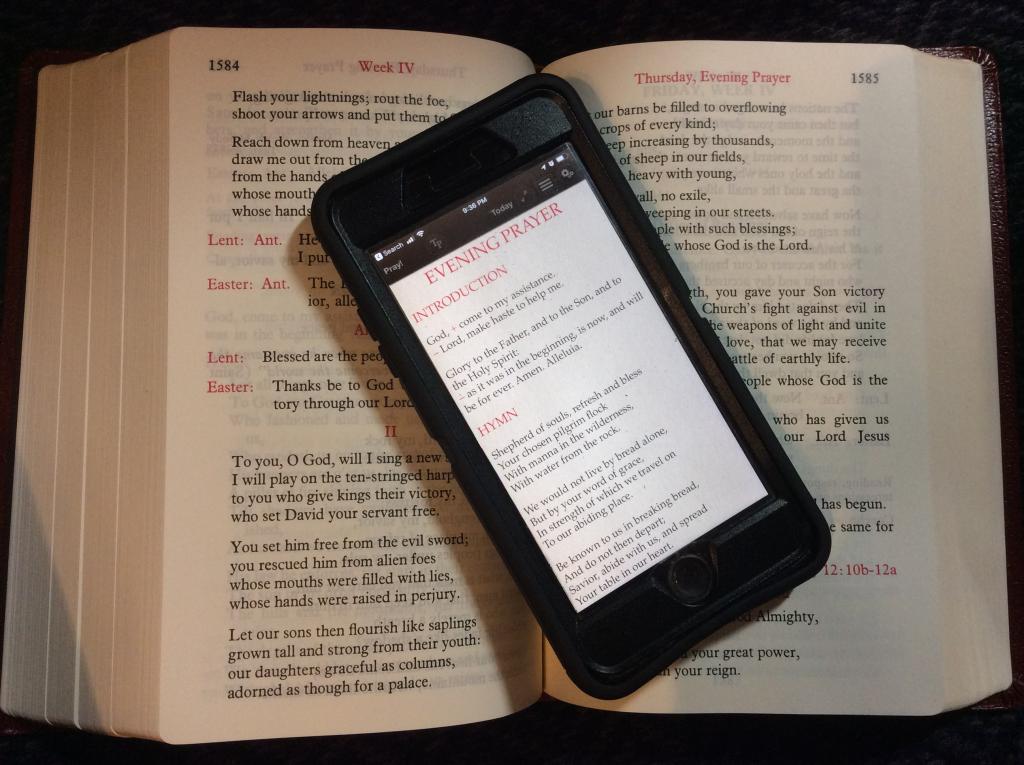
Photo by Fran McColman
I believe that anyone who is serious about embracing the Christian contemplative path needs some form of sustainable daily prayer. For most of Christian history, this has meant using a breviary — a prayer book which contains prayer “services” or offices for praying throughout the day. Such collections of prayers are known as The Liturgy of the Hours or The Daily Office or The Divine Office.
The Liturgy of the Hours is the structure of prayer that nearly all Christian monasteries follow. There are different liturgies for different traditions within Christianity (Orthodox, Catholic, Anglican) and for different religious communities within the various churches (Benedictine, Cistercian, Carmelite, and so forth). In our day, even some Protestant, Reformed, and Evangelical versions of the Liturgy of the Hours has been published, which is remarkable since many of the faith communities in the evangelical world tend to avoid formal types of prayer.
But the Daily Office is a practical way to pray — even for people who don’t like to pray out of a book. Why? For the same reason that musicians collect sheet music of songs. Yes, maybe they would rather play “from heart” or memory, but musicians understand that to grow as musicians, they need to learn a variety of different tunes, songs, melodies, styles of playing — and it just makes more sense to rely on written music to expand one’s musical repertoire.
Likewise, people who pray seriously (and regularly) might soon discover that, if they rely only on their own experience and their own vocabulary when praying, sooner or later their prayer all starts to sound the same. But if they turn to the great literature of prayer: the psalms, the canticles, great hymns, and written prayers composed and collected from throughout the ages — then over time, their “prayer lexicon” expands, and they develop a deeper and more nuanced voice for prayer.
Among other things, daily prayer books like The Liturgy of the Hours teach us how to pray.
“What Do I Do With All These Ribbons?”
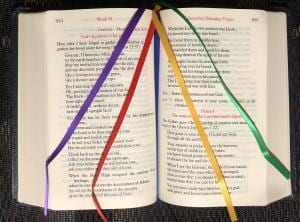 I recommend investing some money into one or more versions of the Divine Office. At the end of this post I list links to several of my personal favorite prayer books. Some are single volume collections of prayers, others run up to four volumes — the entire set consisting of almost 8000 pages of prayers! These books are designed to be used multiple times every day, day in and day out, year in and year out. Prayers are organized by the season of the year (Lent, Easter, Advent, Christmas, and so forth), with special prayers for days that commemorate key events in the life of Christ, or memorials for the lives of great saints and martyrs.
Which means — when we pray the Liturgy faithfully, day in and day out, it not only teaches us how to pray, but it also forms us in the knowledge and memory of the Christian faith.
But there’s a catch.
Every year, the calendar of the Christian year changes slightly. Sure, Christmas is always on December 25 and the feast of St. Teresa of Ávila is always on October 15. But Easter varies from year to year, calculated based on the first full moon after the spring equinox. The date of Easter determines the dates of other key dates — Ash Wednesday, Palm Sunday, Good Friday, and Pentecost being some of the big ones. And finally, since the alignment of days on the calendar and days of the week shift each year (this year February 11 is a Monday, next year it will fall on a Tuesday), there is always a shift in what prayers need to be prayed on which particular day.
So how is that managed?
Traditionally, breviaries (prayer books) include certain prayers that are prayed daily or almost daily (such as the Canticle of Zechariah and the Canticle of Mary, known respectively as the Benedictus and the Magnificat), others that are prayed in a rotation (such as the 150 Psalms, which are prayed over a two-week or four-week cycle) and then of course various prayers that are only prayed on rare occasions, usually linked to a particular saint’s day or feast day of the church year). There’s no way to organize all these prayers — so the prayer books rely on a series of colored ribbons that function as bookmarks. Each day before you begin praying, you mark the pages of the Psalms, canticles and prayers that you will be using. That way, when you are actually praying, you can quickly turn from page to page to find just the specific prayers you need for that particular day.
If it sounds like a lot of bother — that’s because it is.
People who pray regularly get the hang of using the ribbons. But for many people, the learning curve is cumbersome. They want to be praying, for heaven’s sake — not fooling around with ribbons in a book!
Fortunately, for those of us who are ribbon-challenged, technology has come to our rescue.
Apps for Daily Prayer
Several smartphone/tablet apps have been published that make praying the Liturgy of the Hours almost foolproof. You simply have to open the app, make sure it is set on the current day, and then find the particular prayers you want to prayer — Morning Prayer, Evening Prayer, or several of the other “offices” of the day.
Most of these apps are available free or for a minimal cost. Some may have a subscription service — particularly with audio files. Yes, thanks to smartphone technology, you can listen to the Liturgy of the Day in addition to (or instead of) merely reading the prayers. Definitely a blessing for people who are visually impaired.
My personal favorite is iBreviary but I also like Universalis. Both of these apps feature the Roman Catholic Liturgy of the Hours in English. If you are an Episcopalian or simply prefer Anglican liturgy, you can use an app called The Daily Office from Mission St. Clare (these links all take you to the Apple/iTunes App Store; but the Catholic apps can also be downloaded through Google Play and Amazon if your phone isn’t an iPhone).
Once you’ve installed the app, then you’re ready to pray. Make it a habit! Praying the Liturgy (in part or in its entirety) is not meant to replace silent prayer practices like centering prayer or the Jesus Prayer, or for that matter Lectio Divina. And of course, praying is never meant to replace being a compassionate or loving person. On the contrary — pray the Daily Office as a way to open your heart, so that the Holy Spirit can direct you into the heart of love.
Prefer Books to Apps? Here’s a Few to Get You Started
- The Liturgy of the Hours — the current official Roman Catholic daily office. Very traditional, gendered language, but poetic and deeply devotional. Available in several four-volume editions; this link takes you to the least expensive version.
- The Prayer Book Office — the daily liturgy from the Episcopal Book of Common Prayer. I guess most Episcopalians just use the Prayer Book, as this edition is now out of print — and used copies are expensive.
- Benedictine Daily Prayer: A Short Breviary — a lovely one-volume prayer book edited by Benedictine monks. One of a number of liturgies based on the usage of a particular monastic community.
- The Saint Helena Breviary — an inclusive language liturgy as used by the Episcopal Order of Saint Helena. A gorgeous book, and as a bonus — several of the canticles included are drawn from the writing of Julian of Norwich!
- Common Prayer: A Liturgy for Ordinary Radicals — this resource comes from the neo-monastic community of ecumenical Christians seeking to revive monastic spirituality in new ways for our time. This liturgy has a strong emphasis on social justice.
- Celtic Daily Prayer: Book One and Book Two — a two-volume breviary from the Northumbria Community in England, based on the spirituality of the Celtic Church.
Happy praying, my friends!
Enjoy reading this blog?
Click here to become a patron.


Next Post

February 14, 2019 How to Find God in Your Dreams
Browse Our Archives
Select a Category Activism Announcements Art Books Catholicism Celtic Christianity Christian mysticism Christianity Contemplation Current events Etc. Family humor interfaith dialogue Interfaith Wisdom Interspirituality Lay Cistercians Living the Faith Meditation movies Mysticism Mystics nature Poetry Reviews Scripture silence Spirituality Uncategorized Writing
Select a Month February 2025 January 2025 November 2024 September 2024 August 2024 July 2024 June 2024 May 2024 March 2024 January 2024 December 2023 November 2023 August 2023 June 2023 April 2023 March 2023 February 2023 January 2023 December 2022 November 2022 October 2022 September 2022 August 2022 July 2022 June 2022 May 2022 April 2022 February 2022 January 2022 December 2021 November 2021 October 2021 September 2021 August 2021 July 2021 June 2021 May 2021 April 2021 March 2021 February 2021 January 2021 December 2020 November 2020 October 2020 September 2020 August 2020 July 2020 June 2020 May 2020 April 2020 March 2020 February 2020 January 2020 December 2019 November 2019 October 2019 September 2019 August 2019 July 2019 June 2019 May 2019 April 2019 March 2019 February 2019 January 2019 December 2018 November 2018 October 2018 September 2018 August 2018 July 2018 June 2018 May 2018 April 2018 March 2018 February 2018 January 2018 December 2017 November 2017 October 2017 September 2017 August 2017 July 2017 June 2017 May 2017 April 2017 March 2017 February 2017 January 2017 December 2016 November 2016 October 2016 September 2016 August 2016 July 2016 June 2016 May 2016 March 2016 February 2016 January 2016 December 2015 November 2015 October 2015 September 2015 August 2015 July 2015 June 2015 May 2015 April 2015 March 2015 February 2015 January 2015 December 2014 November 2014 October 2014 September 2014 August 2014 July 2014 June 2014 May 2014 April 2014 March 2014 February 2014 January 2014 December 2013 October 2013 September 2013 July 2013 May 2013 January 2013 December 2012 November 2012 August 2012 July 2012 June 2012 March 2012 December 2011 September 2011 October 2010 August 2010 March 2010 September 2009 July 2008 January 2008 December 2007 September 2007 February 2007 January 2007 December 2004
Follow Us!
TAKE THE
Religious Wisdom Quiz
What did Jesus use to heal deaf man?
Select your answer to see how you score.
Water Fingers in ears Oil Mud
Support this
Column


Related posts from Carl McColman

"This Loving, Uniting Embrace": the Holy Ordinary

I Believe Prayer Changes Things. Here's a Few...

If You Worship an Angry God, You'll Be...

The Difference Between Apophatic and Kataphatic Spirituality
TRENDING AT PATHEOS Contemplative

Handy Contemplative Practices for Political Spaces
A Spiritually Grounded Presence In order to bring a spiritually grounded presence...

Halloween: The Holiday of Loving Your Neighbor
All Hallows Eve Is Halloween the least Christian holiday in America, or...

Can Love Be Saved? Some Thoughts on the...
Happy Valentine's Day! I recently published a post on Patreon called Can...

"This Loving, Uniting Embrace": the Holy Ordinary
Today's guest post is by Mark Longhurst, author of The Holy Ordinary:...

How Are We Called to Live?: More About...
How Are We Called to Live? Many of us struggle with discerning...

A Spiritual Practice of Reading: Join Us Online
A Spiritual Practice of Reading A healthy spiritual practice of reading is...
view all Contemplative blogs
Ad-Free & Subscriber Log-In Subscription Support
- About Us
- 2026 Calendar
- Videos
- Podcasts
- Library of World Religions
- Faith In Media Tracker
- Advertise With Us
- Write for Us
- Privacy Policy
- Terms of Service
- Do Not Sell My Data
- Contact Us
- Radiant Digital
- Manage Newsletter Subscriptions
- Unsubscribe From Notifications
- Sitemap
Copyright 2008-2026, Patheos. All rights reserved.
Subscription Support Ad-Free & Subscriber Log-In
Follow Patheos