
BuddhistCatholicContemplativeEvangelicalGeneral ChristianHinduJewishLatter-day SaintMuslimNew VisionsProgressive Christian
Beliefs
- Buddhist
- Catholic
- Contemplative
- Evangelical
- General Christian
- Hindu
- Jewish
- Latter-day Saint
- More Voices
- Muslim
- New Visions
- Pagan
- Progressive Christian
Topics
- Religion News
- Food and Religion
- Sports and Religion
- Religious Art
- Religious Music and Entertainment
- Religious Events
- History and Religion
- Style and Religion
- Politics and Religion
- Women in Religion
- Recreation Outdoors and Religion
- Business Finance and Religion
- Careers Workplace and Religion
- Education and Religion
- Family Parenting and Religion
- Health Fitness and Religion
- Home and Religion
- Relationships and Religion
- Technology and Religion
- Travel and Religion
Columnists
- Buddhist Columnists
- Business Finance and Religion Columnists
- Careers Workplace and Religion Columnists
- Catholic Columnists
- Contemplative Columnists
- Education and Religion Columnists
- Evangelists Columnists
- Family Parenting and Religion Columnists
- General Christian Columnists
- Health Fitness and Religion Columnists
- Hindu Columnists
- History and Religion Columnists
- Home and Religion Columnists
- Jewish Columnists
- More Voices Columnists
- Latter Day Columnists
- Muslim Columnists
- New Visions Columnists
- Nonreligious Columnists
- Pagan Columnists
- Politics and Religion Columnists
- Progressive Columnists
- Recreation Outdoors and Religion Columnists
- Relationships and Religion Columnists
- Religion News Columnists
- Religious Art Columnists
- Religious Events Columnists
- Religious Music and Entertainment Columnists
- Sports and Religion Columnists
- Style and Religion Columnists
- Technology and Religion Columnists
- Travel and Religion Columnists
- Women in Religion Columnists
Resource Library
- 2026 Calendar
- Library of World Religions
- The 100 Most Holy Places on Earth
- Patheos Answers
- Podcasts
- Videos
- Faith Leaders Database
- Anglican Episcopalian
- Bahai
- Baptist
- Buddhism
- Christianity
- Confucianism
- Eastern Orthodoxy
- Hinduism
- Holiness and Pentecostal
- ISKCON
- Islam
- Judaism
- Lutheran
- Methodist
- The Church of Jesus Christ of Latter-day Saints
- New Age
- Paganism
- Presbytarian and Reformed
- Protestantism
- Religion Behind the Scenes
- Roman Catholic
- Scientology
- Shia Islam
- Sikhism
- Sufism
- Sunni Islam
- Taoism
- Zen
- See all religions
Research Tools
 Ad-Free & Subscriber Log-In Subscription Support
Ad-Free & Subscriber Log-In Subscription Support
Follow Patheos 

- Trending:
- Forgiveness
- |
- Marriage
- |
- Consciousness
- |
- Death Penalty
- |
- Election
- |
- Halloween

- Home
- Contemplative
- Three Wonderful Julian of Norwich Books
Three Wonderful Julian of Norwich Books
Last updated on: February 22, 2020 at 2:40 pm by Carl "Skye" McColman
Three Wonderful Julian of Norwich Books 2020-02-22T14:40:42-04:00 Carl "Skye" McColman
Patheos Explore the world's faith through different perspectives on religion and spirituality! Patheos has the views of the prevalent religions and spiritualities of the world.
 I’m not sure why the fall of 2013 belonged to Julian of Norwich (except to the extent that any time is a good time for reading and reflecting on Julian’s wisdom). What I do know is that three wonderful books about Julian were published that fall.
If you’re already a Julian nut (yes, that’s a pun) like me, rejoice, for these are all worthy books to add to your library. If you have not yet discovered Julian — the medieval anchoress (solitary) who experienced a series of vivid mystical visions and then wrote the first book in the English language by a woman, a text which shimmers with optimistic spiritual insight — any one of these books would be an excellent entry point.
What’s wonderful about Julian is that she never goes out of style. So these books may be a few years old — but they are still worth reading, and would make great holiday gifts as well.
The Showings of Julian of Norwich
First up is a new translation of Julian’s long text, The Showings of Julian of Norwich: A New Translation (Hampton Roads) by Mirabai Starr. If you’re not familiar with Mirabai Starr, you need to be; she has already penned luminous translations of works by John of the Cross and Teresa of Avila (read my review of Starr’s translation of St. Teresa’s The Book of My Life here) as well as a lovely book about interspirituality called God of Love.
Because she approaches the mystics primarily from an interspiritual perspective, Starr brings a fresh perspective to her translation, and tries to avoid using language that has become overfreighted with baggage (thus, she often translates “sin” as “to miss the mark,” which actually is a fairly accurate representation of the connotation of the Greek and Hebrew words for sin.
Granted, not everyone will agree with her decision to replace Julian’s “those who will be saved” with the more inclusive “all beings,” but given that Julian wrestled with the problem of traditional church teaching about judgment and damnation, I think the case can be made that this is what Julian truly meant. If nothing else, at least Starr is honest about all the ways in which she paraphrased Julian’s words in her preface to the actual text.
 But what a lovely translation it is. Starr brings a kind of earthy simplicity to her rendering of Julian’s words, making this sort of the Julian equivalent to The Message. In other words, this version finds a sweet spot between readability and accessibility, while remaining faithful to the poetic, and love-infused, lyricism of the original text.
Selections from Julian, Annotated and Explained
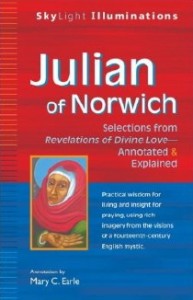
For readers who may want a more concise introduction to Julian’s wisdom, with annotations to amplify the meaning, Mary C. Earle’s Julian of Norwich: Selections from Revelations of Divine Love—Annotated & Explained (Skylight Paths) offers an insightful overview of the anchoress’s main themes. It’s part of the “Skylight Illuminations” series from Skylight Paths Publishers, a series of a variety of sacred texts and mystical writings from the world’s great traditions, arranged with selections from the text on one page and annotations on the facing page.
It’s a user-friendly way to read an annotated text, and since it only consists of selections, which are arranged topically, it’s a great overview of Julian’s thought. Chapter topics include “Images of God,” “Our Relationship to God,” “Prayer and Faith,” and of course, the two points for which Julian is most renowned: “The Motherhood of God” and “All Shall Be Well.” Earle’s commentary is insightful but not overly academic, making this a superb overview of this mystic’s thought.
Julian’s Gospel
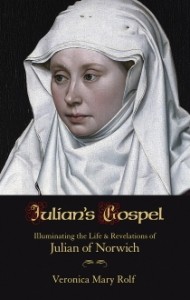 Finally, the most in-depth exploration of the anchoress’s work comes from Veronica Mary Rolf’s Julian’s Gospel: Illuminating the Life & Revelations of Julian of Norwich (Orbis Books). At over six hundred pages, this is quite the tome! It’s a detailed study not only of Julian, but of the world in which she lived. The first part of the book considers what Barbara Tuchman called “the calamitous fourteenth century,” providing insight into the city of Norwich of Julian’s time, and some of the key characteristics of the age: the plague, the politics and conflicts that shaped both England and the church of her day, as well as the domestic realities of medieval marriage and family life.
Against this backdrop, Rolf provides a detailed commentary, with an exciting new approach to translating Julian’s own words: by keeping a number of Julian’s most commonly used words in their middle English form, Rolf creates a sort of hybrid text that is more accessible to the twenty-first century eye, but still retains a flavor of Julian’s original voice. If your goal is to eventually read Julian in the middle English, Julian’s Gospel can function as a sort of gateway to that project, introducing the reader more gently to both the beauty and the strangeness of the English language of Julian’s day.
Part of what makes Rolf’s perspective unique is her background in the theater (she is a playwright, actor, and drama teacher), so she considers Julian’s wisdom from a theatrical perspective, with a fascinating chapter on how the medieval mystery plays no doubt formed part of Julian’s education in theology. When she notes that in one of the passion plays performed in Norwich in Julian’s lifetime, Pontius Pilate (!) says “All shall be well,” I was electrified.
Does this prove that Julian saw that play, and quoted it in her own writing? Of course not. But Rolf goes on to note that other writers like Walter Hilton used a similar phrase, concluding that it may have been a popular saying of time, sort of like “It’s all good” is heard colloquially in our day. Tidbits like this make Julian come alive, more real and human than merely reading her own words could ever do.
Last May marked the 640th anniversary of Julian’s visions. If these three wonderful new editions of Julian’s writing and commentaries on her work can be published in a year like ours, can you imagine the treasures that will come out in ten years, to mark her 650th anniversary? Delicious as that may be to ponder, it’s best to enjoy the present — and these three books give us plenty to savor.
Disclosure: a complimentary review copy of each book reviewed in this post was supplied to me by the publisher. If you follow the link of a book mentioned in this post and purchase it or other products from Amazon.com, I receive a small commission from Amazon. Thank you for doing so — it is the easiest way you can support this blog.
Enjoy reading this blog?
Click here to become a patron.

Previous Post
November 21, 2018
Devotional Reading for the Three Celtic Lents

Browse Our Archives
Select a Category Activism Announcements Art Books Catholicism Celtic Christianity Christian mysticism Christianity Contemplation Current events Etc. Family humor interfaith dialogue Interfaith Wisdom Interspirituality Lay Cistercians Living the Faith Meditation movies Mysticism Mystics nature Poetry Reviews Scripture silence Spirituality Uncategorized Writing
Select a Month February 2025 January 2025 November 2024 September 2024 August 2024 July 2024 June 2024 May 2024 March 2024 January 2024 December 2023 November 2023 August 2023 June 2023 April 2023 March 2023 February 2023 January 2023 December 2022 November 2022 October 2022 September 2022 August 2022 July 2022 June 2022 May 2022 April 2022 February 2022 January 2022 December 2021 November 2021 October 2021 September 2021 August 2021 July 2021 June 2021 May 2021 April 2021 March 2021 February 2021 January 2021 December 2020 November 2020 October 2020 September 2020 August 2020 July 2020 June 2020 May 2020 April 2020 March 2020 February 2020 January 2020 December 2019 November 2019 October 2019 September 2019 August 2019 July 2019 June 2019 May 2019 April 2019 March 2019 February 2019 January 2019 December 2018 November 2018 October 2018 September 2018 August 2018 July 2018 June 2018 May 2018 April 2018 March 2018 February 2018 January 2018 December 2017 November 2017 October 2017 September 2017 August 2017 July 2017 June 2017 May 2017 April 2017 March 2017 February 2017 January 2017 December 2016 November 2016 October 2016 September 2016 August 2016 July 2016 June 2016 May 2016 March 2016 February 2016 January 2016 December 2015 November 2015 October 2015 September 2015 August 2015 July 2015 June 2015 May 2015 April 2015 March 2015 February 2015 January 2015 December 2014 November 2014 October 2014 September 2014 August 2014 July 2014 June 2014 May 2014 April 2014 March 2014 February 2014 January 2014 December 2013 October 2013 September 2013 July 2013 May 2013 January 2013 December 2012 November 2012 August 2012 July 2012 June 2012 March 2012 December 2011 September 2011 October 2010 August 2010 March 2010 September 2009 July 2008 January 2008 December 2007 September 2007 February 2007 January 2007 December 2004
Follow Us!
TAKE THE
Religious Wisdom Quiz
True or False: The first plague in Egypt turned the Nile River into blood.
Select your answer to see how you score.
TRUE FALSE
Support this
Column


Related posts from Carl McColman

Contemplative Books to Read and Savor During Advent...
New From Encountering Silence: Exploring the Lost History...
Twelve Mystical Anthologies That Belong in Every Contemplative...
TRENDING AT PATHEOS Contemplative

Handy Contemplative Practices for Political Spaces
A Spiritually Grounded Presence In order to bring a spiritually grounded presence...

Halloween: The Holiday of Loving Your Neighbor
All Hallows Eve Is Halloween the least Christian holiday in America, or...

Can Love Be Saved? Some Thoughts on the...
Happy Valentine's Day! I recently published a post on Patreon called Can...

"This Loving, Uniting Embrace": the Holy Ordinary
Today's guest post is by Mark Longhurst, author of The Holy Ordinary:...

How Are We Called to Live?: More About...
How Are We Called to Live? Many of us struggle with discerning...

A Spiritual Practice of Reading: Join Us Online
A Spiritual Practice of Reading A healthy spiritual practice of reading is...
view all Contemplative blogs
Ad-Free & Subscriber Log-In Subscription Support
- About Us
- 2026 Calendar
- Videos
- Podcasts
- Library of World Religions
- Faith In Media Tracker
- Advertise With Us
- Write for Us
- Privacy Policy
- Terms of Service
- Do Not Sell My Data
- Contact Us
- Radiant Digital
- Manage Newsletter Subscriptions
- Unsubscribe From Notifications
- Sitemap
Copyright 2008-2026, Patheos. All rights reserved.
Subscription Support Ad-Free & Subscriber Log-In
Follow Patheos