
BuddhistCatholicContemplativeEvangelicalGeneral ChristianHinduJewishLatter-day SaintMuslimNew VisionsProgressive Christian
Beliefs
- Buddhist
- Catholic
- Contemplative
- Evangelical
- General Christian
- Hindu
- Jewish
- Latter-day Saint
- More Voices
- Muslim
- New Visions
- Pagan
- Progressive Christian
Topics
- Religion News
- Food and Religion
- Sports and Religion
- Religious Art
- Religious Music and Entertainment
- Religious Events
- History and Religion
- Style and Religion
- Politics and Religion
- Women in Religion
- Recreation Outdoors and Religion
- Business Finance and Religion
- Careers Workplace and Religion
- Education and Religion
- Family Parenting and Religion
- Health Fitness and Religion
- Home and Religion
- Relationships and Religion
- Technology and Religion
- Travel and Religion
Columnists
- Buddhist Columnists
- Business Finance and Religion Columnists
- Careers Workplace and Religion Columnists
- Catholic Columnists
- Contemplative Columnists
- Education and Religion Columnists
- Evangelists Columnists
- Family Parenting and Religion Columnists
- General Christian Columnists
- Health Fitness and Religion Columnists
- Hindu Columnists
- History and Religion Columnists
- Home and Religion Columnists
- Jewish Columnists
- More Voices Columnists
- Latter Day Columnists
- Muslim Columnists
- New Visions Columnists
- Nonreligious Columnists
- Pagan Columnists
- Politics and Religion Columnists
- Progressive Columnists
- Recreation Outdoors and Religion Columnists
- Relationships and Religion Columnists
- Religion News Columnists
- Religious Art Columnists
- Religious Events Columnists
- Religious Music and Entertainment Columnists
- Sports and Religion Columnists
- Style and Religion Columnists
- Technology and Religion Columnists
- Travel and Religion Columnists
- Women in Religion Columnists
Resource Library
- 2026 Calendar
- Library of World Religions
- The 100 Most Holy Places on Earth
- Patheos Answers
- Podcasts
- Videos
- Faith Leaders Database
- Anglican Episcopalian
- Bahai
- Baptist
- Buddhism
- Christianity
- Confucianism
- Eastern Orthodoxy
- Hinduism
- Holiness and Pentecostal
- ISKCON
- Islam
- Judaism
- Lutheran
- Methodist
- The Church of Jesus Christ of Latter-day Saints
- New Age
- Paganism
- Presbytarian and Reformed
- Protestantism
- Religion Behind the Scenes
- Roman Catholic
- Scientology
- Shia Islam
- Sikhism
- Sufism
- Sunni Islam
- Taoism
- Zen
- See all religions
Research Tools
 Ad-Free & Subscriber Log-In Subscription Support
Ad-Free & Subscriber Log-In Subscription Support
Follow Patheos 

- Trending:
- Forgiveness
- |
- Marriage
- |
- Consciousness
- |
- Death Penalty
- |
- Election
- |
- Halloween

- Home
- Contemplative
- The Contemplative Charism of the Humble Haiku (Anam Ċara in Verse, Part II)
The Contemplative Charism of the Humble Haiku (Anam Ċara in Verse, Part II)
Last updated on: August 11, 2018 at 8:45 am by Guest Contributor
The Contemplative Charism of the Humble Haiku (Anam Ċara in Verse, Part II) 2018-08-08T12:23:52-04:00 Guest Contributor
Patheos Explore the world's faith through different perspectives on religion and spirituality! Patheos has the views of the prevalent religions and spiritualities of the world.
 N.B. Today’s guest post is by Judith Valente, poet, Benedictine oblate, and author of How to Live: What the Rule of St. Benedict Teaches Us About Happiness, Meaning, and Community. To read the first post in this series, click here:** Anam Ċara in Verse: How Poetry Is a Soul Friend.
Gray mist between trees
Portal we pass through en route
To new adventures
— Judith Valente
There are times when a particular moment might grasp our attention. We stop, listen, look, and look again. It might seem as if this quick revelation has interrupted the flow of time. This is a haiku moment.
A few years ago, I traveled to the Abbey of Gethsemani outside of Louisville to report a piece for PBS-TV on the enduring legacy of the Trappist monk and writer, Thomas Merton. One of the people I interviewed was Brother Paul Quenon. Brother Paul had joined the monastic community when Merton was novice director. Merton authored more than 50 books about the spiritual life. He was also a fine poet, who continued writing poetry until his death in 1968. Merton encouraged Brother Paul to write.
When we met, Brother Paul was finishing his fourth poetry collection. He told me something that intrigued me. He said every day, he writes a haiku — as part of his meditation practice. Most of us will remember this poetic form from school. The classic Japanese haiku is usually set in nature and contains three lines, seventeen syllables — five, seven and five syllables spread across the three lines.
“In meditation, I aim for a simple awareness of the present moment,” Brother Paul told me. “My haiku is an articulation of the gift of that moment, a brief conclusion to the time spent in silence.” Because of its brevity, writing a haiku doesn’t become “just another distraction.”
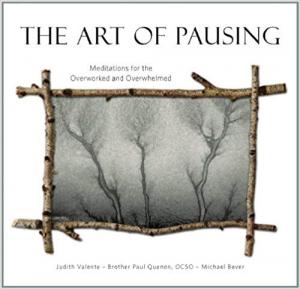 As a lover and writer of poetry myself, I boldly suggested Brother Paul and I start exchanging daily haiku. It was something we did for nearly three years. Eventually, we collected our little treasures, added brief three-paragraph reflections to accompany them, and gathered them in a book called The Art of Pausing: Meditations for the Overworked and Overwhelmed.
We don’t exchange as often as before, but writing the humble haiku is still an important part of both of our efforts to live more attentively. For those of us seeking to slow down amid the tyranny of Twitter, the stress of the daily commute, the distractions and demands of work and family, haiku moments provide pauses written on our days. They are like the stops African tribesmen make on safari. They pause periodically to listen to the beating of the heart. They say they are trying to let their souls catch up with them on the journey.
Sooner or later, we all have to let our souls catch up with the rest of our lives.
When guiding retreats on ‘The Art of Pausing,” I often ask those attending to recall a sacred or transcendent moment they experienced in the last 24 or 48 hours – a time when they felt part of something larger than themselves. Inevitably, someone speaks up to say they have suffered from “poetry anxiety” since their school days and there is no way they are going to attempt to write even a three-line poem. That person usually ends up writing one the best haiku in the group.
Here is a haiku written by someone who insisted she couldn’t write one:
Rule of Silence
To speak in few words
In the right voice, right tone
Of things necessary
Modern haiku writers take various liberties with the form – there is even one famous haiku that consists of just one word: Tundra. I think that makes writing them all the more fun. Brother Paul and I are very different writers. His haiku are honed by years of practicing patient contemplation. Mine are often dashed off on scraps of paper during my busy work day. His might resemble a delicate water color. Mine are like black and white photos of my day.
Still, whenever I write my three lines, I come away with a better sense of having lived my day. Brother Paul beautifully captured both the quickness and the leisure of the “haiku mind” in one of his poems:
I’ve nothing to do
So I’ll get down to nothing
Expeditiously
I encourage you to get reacquainted with this most companionable of poetic forms. Maybe find a partner with whom to exchange a daily haiku, creating your own personal haiku community. These slender threads of experience lead us toward what T.S. Eliot called “the still point” of the mind and in that place, we dance.
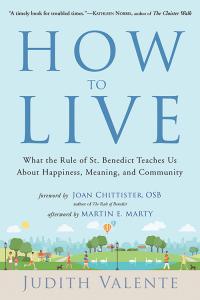 Judith Valente is a journalist, retreat leader, poet and author. Her newest book is How to Live: What the Rule of St. Benedict Teaches Us About Happiness, Meaning, and Community. Her poetry collections include Inventing An Alphabet and Discovering Moons. She is the co-editor of Twenty Poems to Nourish Your Soul and co-author of The Art of Pausing with Br. Paul Quenon. She is also the author of Atchison Blue: A Search for Silence, a Spiritual Home, and a Living Faith. Visit her online at www.judithvalente.com.
Brother Paul Quenon, OCSO is the author of several volumes of poetry including Unquiet Vigil: New and Selected Poems. His newest book is In Praise of the Useless Life: A Monk’s Memoir.
Enjoy reading this blog?
Click here to become a patron.

Previous Post
August 8, 2018
Two Complementary Guides to Mystical Devotion
Next Post
August 14, 2018 Four Keys to a Contemplative Life (Courtesy of Psalm 37)
Browse Our Archives
Select a Category Activism Announcements Art Books Catholicism Celtic Christianity Christian mysticism Christianity Contemplation Current events Etc. Family humor interfaith dialogue Interfaith Wisdom Interspirituality Lay Cistercians Living the Faith Meditation movies Mysticism Mystics nature Poetry Reviews Scripture silence Spirituality Uncategorized Writing
Select a Month February 2025 January 2025 November 2024 September 2024 August 2024 July 2024 June 2024 May 2024 March 2024 January 2024 December 2023 November 2023 August 2023 June 2023 April 2023 March 2023 February 2023 January 2023 December 2022 November 2022 October 2022 September 2022 August 2022 July 2022 June 2022 May 2022 April 2022 February 2022 January 2022 December 2021 November 2021 October 2021 September 2021 August 2021 July 2021 June 2021 May 2021 April 2021 March 2021 February 2021 January 2021 December 2020 November 2020 October 2020 September 2020 August 2020 July 2020 June 2020 May 2020 April 2020 March 2020 February 2020 January 2020 December 2019 November 2019 October 2019 September 2019 August 2019 July 2019 June 2019 May 2019 April 2019 March 2019 February 2019 January 2019 December 2018 November 2018 October 2018 September 2018 August 2018 July 2018 June 2018 May 2018 April 2018 March 2018 February 2018 January 2018 December 2017 November 2017 October 2017 September 2017 August 2017 July 2017 June 2017 May 2017 April 2017 March 2017 February 2017 January 2017 December 2016 November 2016 October 2016 September 2016 August 2016 July 2016 June 2016 May 2016 March 2016 February 2016 January 2016 December 2015 November 2015 October 2015 September 2015 August 2015 July 2015 June 2015 May 2015 April 2015 March 2015 February 2015 January 2015 December 2014 November 2014 October 2014 September 2014 August 2014 July 2014 June 2014 May 2014 April 2014 March 2014 February 2014 January 2014 December 2013 October 2013 September 2013 July 2013 May 2013 January 2013 December 2012 November 2012 August 2012 July 2012 June 2012 March 2012 December 2011 September 2011 October 2010 August 2010 March 2010 September 2009 July 2008 January 2008 December 2007 September 2007 February 2007 January 2007 December 2004
Follow Us!
TAKE THE
Religious Wisdom Quiz
True or False: The first plague in Egypt turned the Nile River into blood.
Select your answer to see how you score.
TRUE FALSE
Support this
Column


Related posts from Carl McColman

Thomas Merton: the Noisy Contemplative
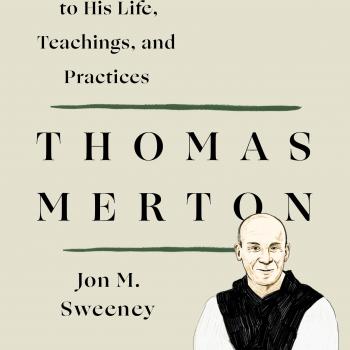
"He Confuses a Lot of People" — Jon...

Questions After a Retreat: What Books to Read,...

Dreams, Songs, and Sorrow: Three Celtic Poets to...
TRENDING AT PATHEOS Contemplative

Handy Contemplative Practices for Political Spaces
A Spiritually Grounded Presence In order to bring a spiritually grounded presence...

Halloween: The Holiday of Loving Your Neighbor
All Hallows Eve Is Halloween the least Christian holiday in America, or...

Can Love Be Saved? Some Thoughts on the...
Happy Valentine's Day! I recently published a post on Patreon called Can...

"This Loving, Uniting Embrace": the Holy Ordinary
Today's guest post is by Mark Longhurst, author of The Holy Ordinary:...

How Are We Called to Live?: More About...
How Are We Called to Live? Many of us struggle with discerning...

A Spiritual Practice of Reading: Join Us Online
A Spiritual Practice of Reading A healthy spiritual practice of reading is...
view all Contemplative blogs
Ad-Free & Subscriber Log-In Subscription Support
- About Us
- 2026 Calendar
- Videos
- Podcasts
- Library of World Religions
- Faith In Media Tracker
- Advertise With Us
- Write for Us
- Privacy Policy
- Terms of Service
- Do Not Sell My Data
- Contact Us
- Radiant Digital
- Manage Newsletter Subscriptions
- Unsubscribe From Notifications
- Sitemap
Copyright 2008-2026, Patheos. All rights reserved.
Subscription Support Ad-Free & Subscriber Log-In
Follow Patheos