
BuddhistCatholicContemplativeEvangelicalGeneral ChristianHinduJewishLatter-day SaintMuslimNew VisionsProgressive Christian
Beliefs
- Buddhist
- Catholic
- Contemplative
- Evangelical
- General Christian
- Hindu
- Jewish
- Latter-day Saint
- More Voices
- Muslim
- New Visions
- Pagan
- Progressive Christian
Topics
- Religion News
- Food and Religion
- Sports and Religion
- Religious Art
- Religious Music and Entertainment
- Religious Events
- History and Religion
- Style and Religion
- Politics and Religion
- Women in Religion
- Recreation Outdoors and Religion
- Business Finance and Religion
- Careers Workplace and Religion
- Education and Religion
- Family Parenting and Religion
- Health Fitness and Religion
- Home and Religion
- Relationships and Religion
- Technology and Religion
- Travel and Religion
Columnists
- Buddhist Columnists
- Business Finance and Religion Columnists
- Careers Workplace and Religion Columnists
- Catholic Columnists
- Contemplative Columnists
- Education and Religion Columnists
- Evangelists Columnists
- Family Parenting and Religion Columnists
- General Christian Columnists
- Health Fitness and Religion Columnists
- Hindu Columnists
- History and Religion Columnists
- Home and Religion Columnists
- Jewish Columnists
- More Voices Columnists
- Latter Day Columnists
- Muslim Columnists
- New Visions Columnists
- Nonreligious Columnists
- Pagan Columnists
- Politics and Religion Columnists
- Progressive Columnists
- Recreation Outdoors and Religion Columnists
- Relationships and Religion Columnists
- Religion News Columnists
- Religious Art Columnists
- Religious Events Columnists
- Religious Music and Entertainment Columnists
- Sports and Religion Columnists
- Style and Religion Columnists
- Technology and Religion Columnists
- Travel and Religion Columnists
- Women in Religion Columnists
Resource Library
- 2026 Calendar
- Library of World Religions
- The 100 Most Holy Places on Earth
- Patheos Answers
- Podcasts
- Videos
- Faith Leaders Database
- Anglican Episcopalian
- Bahai
- Baptist
- Buddhism
- Christianity
- Confucianism
- Eastern Orthodoxy
- Hinduism
- Holiness and Pentecostal
- ISKCON
- Islam
- Judaism
- Lutheran
- Methodist
- The Church of Jesus Christ of Latter-day Saints
- New Age
- Paganism
- Presbytarian and Reformed
- Protestantism
- Religion Behind the Scenes
- Roman Catholic
- Scientology
- Shia Islam
- Sikhism
- Sufism
- Sunni Islam
- Taoism
- Zen
- See all religions
Research Tools
 Ad-Free & Subscriber Log-In Subscription Support
Ad-Free & Subscriber Log-In Subscription Support
Follow Patheos 

- Trending:
- Forgiveness
- |
- Marriage
- |
- Consciousness
- |
- Death Penalty
- |
- Election
- |
- Halloween

- Home
- Contemplative
- Discover the Stories of the Sufis — Wisdom for Today
Discover the Stories of the Sufis — Wisdom for Today
Last updated on: July 8, 2018 at 5:56 pm by Guest Contributor
Discover the Stories of the Sufis — Wisdom for Today 2018-07-08T17:56:58-04:00 Guest Contributor
Patheos Explore the world's faith through different perspectives on religion and spirituality! Patheos has the views of the prevalent religions and spiritualities of the world.
Today’s guest post is by Neil Douglas-Klotz, author of The Little Book of Sufi Stories.
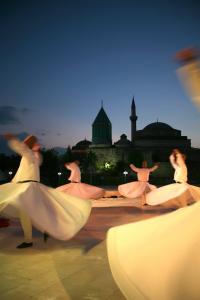
Watch ’em whirl.
What’s the story with Sufis today?
Sufis, usually called the mystics of Islam, are best known in the West through the popular love poetry of Jelaluddin Rumi, the 13thcentury Persian mystic.
Yet an internet search of “Sufi news” over the past year reveals that Sufis are just as present today as they were eight centuries ago and are playing a major role in the culture wars and political struggles within Islam around the world.
- In Tunisia, women are guarding Sufi shrines, forty of which have been destroyed by fundamentalists in the past five years.
- In Bangladesh, Sufi bloggers have been targeted and assassinated by fundamentalists, who accuse them of heresy. Some Sufi groups there have formed their own political parties and sit in parliament to protect their interests.
- The Supreme Council of Sufi Orders in Egypt backed the re-election of President Abdel Fattah al-Sisi in recent elections in the hope that he would protect them from jihadist groups.
- In Morocco, the government of King Mohammed VI officially supports the Sufi orders and shrines in order to promote the values of love and harmony and, in his words, to“block radicalism and terrorism.”
- In Pakistan, where a number of Sufi shrines have been attacked in recent years, a major news media headline recently read “Can Sufi gatherings change extremist mindsets?
- In India, a major pop music movement called “Sufiana” aims to promote peace and harmony melding traditional and modern musical styles.
I could go on, but you probably get the idea. These stories escape the mainstream media in the West, which consciously or unconsciously tends to promote the view of Islam as monolithic, uncompromising and dangerous. It is anything but this. In reality, Islam is as diverse as any religion on the planet today, and dividing it simplistically between fundamentalists and modernizers or liberals and conservatives oversimplifies a very complex reality.
Sufism, the “Soul of Islam”
In my forty-year association with and study of various Sufis around the world, I found that many of them feel that they are the “soul of Islam,” and that Islam has been stolen from them. According to the Tunisian president of the Islamic World Union of Sufism, Shaykh Mazen Cherif, “We don’t think of our way of worshipping and remembering God as Sufism or mysticism, it is just Islam. Sufism here unites, it doesn’t divide.”
For centuries, it was the same in most of the Islamic parts of the world. This only began to change in the latter half of the 20thcentury, a process chronicled in Karen Armstrong’s book The Battle for God; Fundamentalism in Judaism, Christianity and Islam. Community service, scientific exploration, cultural harmony and a high tolerance for paradox and diversity have typified the hundreds of Sufi movements and groups worldwide ever since individual Muslims — women and men — began to form loose organizations in the 10thcentury.
Besides the poetry of Rumi, some people recognize Sufi music, like that of the late Nusrat Fateh Ali Khan, or the graceful ritual of the Turkish Mevlevi or “whirling” dervishes. Not all Sufis use poetry, music or dance-like ritual, of course. But virtually all use “teaching stories,” which is why I undertook to re-tell some of these stories for the 21stcentury. Nowhere else can one find the Sufi ethos of tolerance for diversity as well as wisdom about how to live with it so elegantly conveyed.
Why Sufism Matters
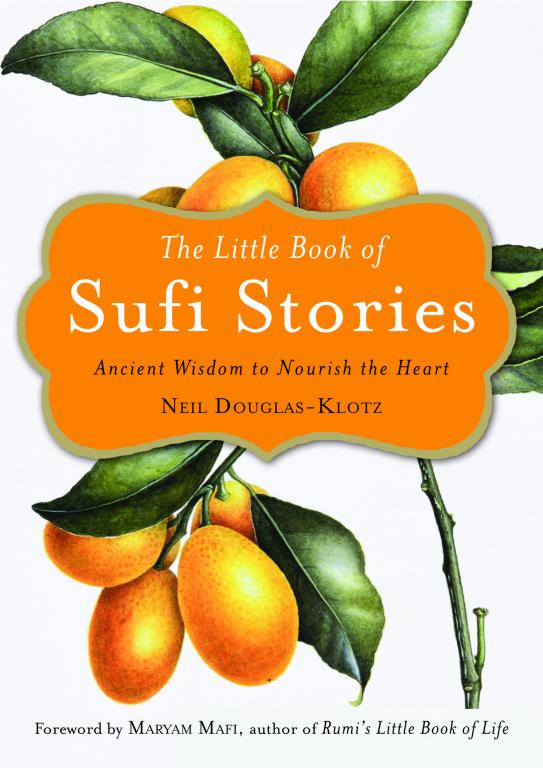 We have so many things to engage our attention these days: 24-hour rolling news, social networks, streaming videos and multiplex films. You might ask: is there any room left for the humble Sufi story? Allow me to make the case.
First, let’s deal with our culture’s obsession with news and “facts.” As the great American storyteller Mark Twain once said, there are three categories of untruth: lies, damn lies and statistics. As we experience every day, different people see and remember different things. Even video can be edited and altered.
As distinguished from facts, alternative facts and news (fake or otherwise), the Sufi story presents us with something else: true fiction. These timeless stories reveal something very deep about the way we experience and create different realities out of the stuff of life. Like life, characters in these stories appear and disappear for no apparent reason, the good are not always rewarded, and the evil are not always punished. No trigger warnings occur.
Many of the best stories simply mirror back to us our own absurd habits of thought. Some stories are long, some little better than one-liners. For instance:
The wise fool Mullah Nasruddin was often losing his donkey. Once while he was looking for it, he was walking through town, singing and giving thanks to God.
“Why are you so joyful, Mullah?” his friends asked him. “We thought you had lost your favorite donkey.”
“I did, friends,” responded Mullah. “But at least I wasn’t riding it at the time. If I had been, I would be lost, too!”
As to our engagement with the entertainment industry, the Sufi story cannot, of course, compete with the special effects of the digital age. But a Sufi teacher telling a story never sets out to simply perform or entertain. Each telling of a story is unique and creates a spontaneous community. Within this community, the storyteller must respond to the moment, not give a rehearsed performance.
Learning by “Unlearning”
Traditionally, when mystics and students gather, the teacher intersperses a story with a spiritual practice or meditation that could lead them all to the doorway of an experience that illuminates an unhelpful pattern of thought or behavior, a process that Sufis call “unlearning.” With enough unlearning, a person could actually become a human being, they say.
Yet if mere self-improvement were the goal, why tell stories when we have so many valuable self-help methods to transform our lives? The further we go into the “self,” however, the more we find that logical systems don’t help very much. Most of our human life doesn’t obey even the most complex algorithms that artificial intelligence can conceive (witness the quixotic ups and downs of the stock market if you doubt this).
When a Sufi tells a story, no PowerPoint is used, no bullet-pointed thought-nuggets are conveyed to be studiously notated. These stories cannot be diced, sliced, parsed or interpreted for their metaphoric or allegorical meaning. In fact, if you tell a Sufi story well, to interpret it would kill it. If I tell you that such and such a character means this, the bird is the soul, the donkey is our ego… blah blah blah. It’s all nonsense.
Like a Zen koan, a real Sufi story allows a person’s innate wisdom to arise from the inside. And wisdom (unlike its poor cousin, the fact or supposed fact) cannot be given like a pill to the merely rational, cognitive side of our minds. That part of our mind—useful in many situations—fixates on a supposed meaning, ideal or principle, then strolls away very happily, completely unchanged in its depths.
In those depths lie all the important feelings, inklings, habits and passions that control most of our lives. When only the modern, surface part of our hearts and minds gets involved, even a story told by a Buddha can turn into a tale heard by an idiot, signifying nothing.
Rather than add to our storehouse of learned information or facts, these stories can help us break down the mental-emotional patterns that keep us from feeling as free and fulfilled as we might. In a moment, a Sufi story can offer a *hah?*that changes into an *aha!*We may then find ourselves in a different inner world, less controlled yet richer, more like wild nature.
As Rumi says:
The inner being of a
human being
is wild nature, a jungle.
If you are aware of yourself as
part of the divine breath,
be very aware
when you travel inside.
In this sense, these stories function almost exactly opposite to the computer algorithms of social media, which feed back to us things that reinforce what we already like (or think we like).
Finally, as the German novelist and storyteller Hermann Hesse once wrote, the great stories of humanity—like fairy tales, Hasidic stories, Celtic stories, Zen stories and Sufi stories—provide us with incomparable examples of the “genetic history of the soul.” We share this depth of soul with all human beings. So hearing, reading and telling all these stories, while “not news,” can help bring us closer together, re-creating our all-too-fragile sense of human community.
Neil Douglas-Klotz is the author of The Little Book of Sufi Stories, as well as the bestselling Sufi Book of Life. He has also written books on the Aramaic words of Jesus, including The Hidden Gospel and Prayers of the Cosmos.
Enjoy reading this blog?
Click here to become a patron.

Previous Post
May 26, 2018
Learning to Love the "Habit" of Spirituality
Next Post

June 8, 2018 Secrets of the Sacred Heart
Browse Our Archives
Select a Category Activism Announcements Art Books Catholicism Celtic Christianity Christian mysticism Christianity Contemplation Current events Etc. Family humor interfaith dialogue Interfaith Wisdom Interspirituality Lay Cistercians Living the Faith Meditation movies Mysticism Mystics nature Poetry Reviews Scripture silence Spirituality Uncategorized Writing
Select a Month February 2025 January 2025 November 2024 September 2024 August 2024 July 2024 June 2024 May 2024 March 2024 January 2024 December 2023 November 2023 August 2023 June 2023 April 2023 March 2023 February 2023 January 2023 December 2022 November 2022 October 2022 September 2022 August 2022 July 2022 June 2022 May 2022 April 2022 February 2022 January 2022 December 2021 November 2021 October 2021 September 2021 August 2021 July 2021 June 2021 May 2021 April 2021 March 2021 February 2021 January 2021 December 2020 November 2020 October 2020 September 2020 August 2020 July 2020 June 2020 May 2020 April 2020 March 2020 February 2020 January 2020 December 2019 November 2019 October 2019 September 2019 August 2019 July 2019 June 2019 May 2019 April 2019 March 2019 February 2019 January 2019 December 2018 November 2018 October 2018 September 2018 August 2018 July 2018 June 2018 May 2018 April 2018 March 2018 February 2018 January 2018 December 2017 November 2017 October 2017 September 2017 August 2017 July 2017 June 2017 May 2017 April 2017 March 2017 February 2017 January 2017 December 2016 November 2016 October 2016 September 2016 August 2016 July 2016 June 2016 May 2016 March 2016 February 2016 January 2016 December 2015 November 2015 October 2015 September 2015 August 2015 July 2015 June 2015 May 2015 April 2015 March 2015 February 2015 January 2015 December 2014 November 2014 October 2014 September 2014 August 2014 July 2014 June 2014 May 2014 April 2014 March 2014 February 2014 January 2014 December 2013 October 2013 September 2013 July 2013 May 2013 January 2013 December 2012 November 2012 August 2012 July 2012 June 2012 March 2012 December 2011 September 2011 October 2010 August 2010 March 2010 September 2009 July 2008 January 2008 December 2007 September 2007 February 2007 January 2007 December 2004
Follow Us!
TAKE THE
Religious Wisdom Quiz
How many stones did David take to fight Goliath?
Select your answer to see how you score.
5 3 4 7
Support this
Column


Related posts from Carl McColman

"This Loving, Uniting Embrace": the Holy Ordinary

I Believe Prayer Changes Things. Here's a Few...

If You Worship an Angry God, You'll Be...

The Difference Between Apophatic and Kataphatic Spirituality
TRENDING AT PATHEOS Contemplative

Handy Contemplative Practices for Political Spaces
A Spiritually Grounded Presence In order to bring a spiritually grounded presence...

Halloween: The Holiday of Loving Your Neighbor
All Hallows Eve Is Halloween the least Christian holiday in America, or...

Can Love Be Saved? Some Thoughts on the...
Happy Valentine's Day! I recently published a post on Patreon called Can...

"This Loving, Uniting Embrace": the Holy Ordinary
Today's guest post is by Mark Longhurst, author of The Holy Ordinary:...

How Are We Called to Live?: More About...
How Are We Called to Live? Many of us struggle with discerning...

A Spiritual Practice of Reading: Join Us Online
A Spiritual Practice of Reading A healthy spiritual practice of reading is...
view all Contemplative blogs
Ad-Free & Subscriber Log-In Subscription Support
- About Us
- 2026 Calendar
- Videos
- Podcasts
- Library of World Religions
- Faith In Media Tracker
- Advertise With Us
- Write for Us
- Privacy Policy
- Terms of Service
- Do Not Sell My Data
- Contact Us
- Radiant Digital
- Manage Newsletter Subscriptions
- Unsubscribe From Notifications
- Sitemap
Copyright 2008-2026, Patheos. All rights reserved.
Subscription Support Ad-Free & Subscriber Log-In
Follow Patheos