
BuddhistCatholicContemplativeEvangelicalGeneral ChristianHinduJewishLatter-day SaintMuslimNew VisionsProgressive Christian
Beliefs
- Buddhist
- Catholic
- Contemplative
- Evangelical
- General Christian
- Hindu
- Jewish
- Latter-day Saint
- More Voices
- Muslim
- New Visions
- Pagan
- Progressive Christian
Topics
- Religion News
- Food and Religion
- Sports and Religion
- Religious Art
- Religious Music and Entertainment
- Religious Events
- History and Religion
- Style and Religion
- Politics and Religion
- Women in Religion
- Recreation Outdoors and Religion
- Business Finance and Religion
- Careers Workplace and Religion
- Education and Religion
- Family Parenting and Religion
- Health Fitness and Religion
- Home and Religion
- Relationships and Religion
- Technology and Religion
- Travel and Religion
Columnists
- Buddhist Columnists
- Business Finance and Religion Columnists
- Careers Workplace and Religion Columnists
- Catholic Columnists
- Contemplative Columnists
- Education and Religion Columnists
- Evangelists Columnists
- Family Parenting and Religion Columnists
- General Christian Columnists
- Health Fitness and Religion Columnists
- Hindu Columnists
- History and Religion Columnists
- Home and Religion Columnists
- Jewish Columnists
- More Voices Columnists
- Latter Day Columnists
- Muslim Columnists
- New Visions Columnists
- Nonreligious Columnists
- Pagan Columnists
- Politics and Religion Columnists
- Progressive Columnists
- Recreation Outdoors and Religion Columnists
- Relationships and Religion Columnists
- Religion News Columnists
- Religious Art Columnists
- Religious Events Columnists
- Religious Music and Entertainment Columnists
- Sports and Religion Columnists
- Style and Religion Columnists
- Technology and Religion Columnists
- Travel and Religion Columnists
- Women in Religion Columnists
Resource Library
- 2026 Calendar
- Library of World Religions
- The 100 Most Holy Places on Earth
- Patheos Answers
- Podcasts
- Videos
- Faith Leaders Database
- Anglican Episcopalian
- Bahai
- Baptist
- Buddhism
- Christianity
- Confucianism
- Eastern Orthodoxy
- Hinduism
- Holiness and Pentecostal
- ISKCON
- Islam
- Judaism
- Lutheran
- Methodist
- The Church of Jesus Christ of Latter-day Saints
- New Age
- Paganism
- Presbytarian and Reformed
- Protestantism
- Religion Behind the Scenes
- Roman Catholic
- Scientology
- Shia Islam
- Sikhism
- Sufism
- Sunni Islam
- Taoism
- Zen
- See all religions
Research Tools
 Ad-Free & Subscriber Log-In Subscription Support
Ad-Free & Subscriber Log-In Subscription Support
Follow Patheos 

- Trending:
- Forgiveness
- |
- Marriage
- |
- Consciousness
- |
- Death Penalty
- |
- Election
- |
- Halloween

- Home
- Contemplative
- God’s Guidance, Engraved on Our Hearts (Lectio Divina Diligens for the Fifth Sunday of Lent)
God’s Guidance, Engraved on Our Hearts (Lectio Divina Diligens for the Fifth Sunday of Lent)
Last updated on: March 15, 2018 at 5:01 am by Carl "Skye" McColman
God’s Guidance, Engraved on Our Hearts (Lectio Divina Diligens for the Fifth Sunday of Lent) 2018-03-14T17:31:21-04:00 Carl "Skye" McColman
Patheos Explore the world's faith through different perspectives on religion and spirituality! Patheos has the views of the prevalent religions and spiritualities of the world.
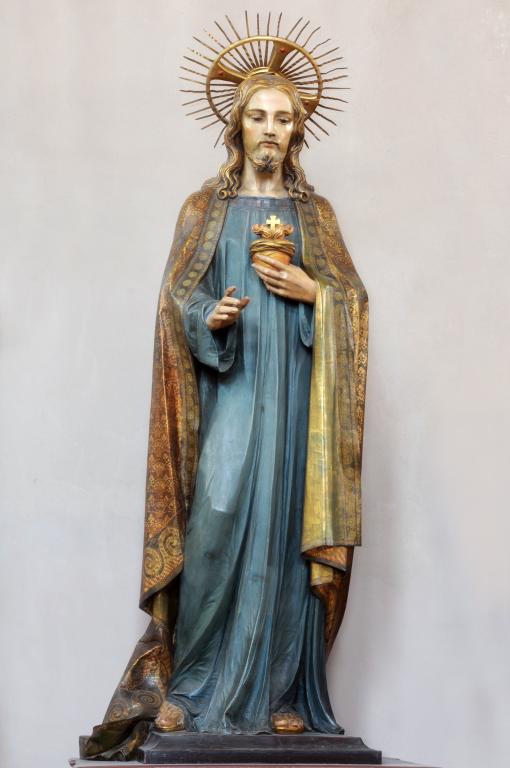
Statue of the Sacred Heart by Ludwig Moroder (1914). Photo by Wolfgang Moroder.
Our Lenten journey continues with a twist on Lectio Divina I’m calling Lectio Divina Diligens. Click on the link to read about this idea, if you’re not familiar with it.
March 18 marks the fifth Sunday of Lent — the last Sunday before Palm Sunday. This week let’s reflect on the first reading, found in Jeremiah 31:31-34.
Lectio — reading
See, days are coming—oracle of the Lord—when I will make a new covenant with the house of Israel and the house of Judah. It will not be like the covenant I made with their ancestors the day I took them by the hand to lead them out of the land of Egypt. They broke my covenant, though I was their master—oracle of the Lord. But this is the covenant I will make with the house of Israel after those days—oracle of the Lord. I will place my law within them, and write it upon their hearts; I will be their God, and they shall be my people. They will no longer teach their friends and relatives, “Know the Lord!” Everyone, from least to greatest, shall know me—oracle of the Lord—for I will forgive their iniquity and no longer remember their sin.
Investigatio — research
If you’re like me, you love the idea of a fresh start. When I used to work in bookstores, our annual inventory always marked a new beginning: we reconciled any shortages that came about because of error or shoplifting, and began our new fiscal year with a sense of confidence that we knew what was in the store, what it was worth, and what resources we had available to work for a profitable year to come.
It seems to me that this idea of a “new covenant” operates the same way. When we confess our sins to God, we are in effect taking inventory — examining our conscience, just like retailers examine their shelves to see what’s there and what’s not. That examination gives us a baseline, where we can tally up our profit and loss (in retail) or turn to God for a frank acknowledgement of our need for God’s mercy and grace (in the life of faith).
But a retailer would have no point to taking inventory if there was not a store ledger: a profit-and-loss statement that computed all the inventory acquisition, sales, and returns, to calculate how much inventory should be on the shelves. You compare what is actually in stock, to what the spreadsheet says ought to be there, to assess if the store has a problem (with shoplifting, or internal theft, or poor management).
When Jeremiah announces Gods new covenant, he includes this wonderful phrase, “I will place my law within them, and write it upon their hearts.” American Christians often have this idea that “law” and “gospel” are somehow at odds — that God’s mercy is a good thing, and the “law” is basically just an old-burden, a bunch of antiquated rules that nobody can live up to and Jesus really rendered obsolete.
I think that notion is an unfair way of thinking about law. And when we go back to the Hebrew, we get some insight into just what a wonderful promise this idea of “God’s law written on our hearts” turns out to be.
Using Verbum‘s “Exegetical Study Guide,” I see that the Hebrew word for law is תּוֹרָה (Torah) — yes, the same word that is used to describe the first five books of the Hebrew Bible, the-called books of Moses, Genesis through Deuteronomy. While the word does mean “law,” it also carries the sense of instruction, or teaching, or even customs. Indeed, in the Brown-Driver-Briggs Hebrew and English Lexicon, the definition provided for torah is “direction, instruction, law” — suggesting that “law” is less important than “direction” or “instruction” in the meaning of torah. Think less of a legal code imposed by a government, and more of the kind of instruction that a mother offers her children (indeed, torah is a feminine word in Hebrew). This calls to mind for me another feminine Hebrew word, חָכְמָה (hokmah), which means “wisdom.” If Torah provides instruction and “direction” (like guiding an arrow to its target), then hokmah suggests the fruit of experience, the wisdom that comes from life itself, a life presumably devoted to the instruction that leads us in the right direction.
So we’re getting a long way away from “law” as a kind of arcane set of rules that only places artificial limits on us! That, I would suggest, is not what God wants to write in our hearts, not at all.
Consulting my trusty Collegeville Bible Commentary, I find this wonderful bit of insight: “the new covenant … will be successful because it will be God and God alone who will put into the hearts of the people the power to respond with love. We call this power “grace,” and as the books of the New Testament, especially the Pauline letters and John’s Gospel, insist, it comes to us along with forgiveness of sins through faith in Jesus who died for love of us.” (Emphasis mine).
In the new covenant, God writes in our heart instructions for how to live according to the love of God — how to respond, by grace, to the call of love in our lives. That’s a law I can live with!
Meditatio — reflection
I love all the language of the heart that dances through sacred scripture. In Ecclesiastes, God is said to put timelessness or eternity in the human heart (Ecclesiastes 3:11); and in his letter to the Romans, Paul proclaims that “the love of God has been poured out into our hearts through the holy Spirit that has been given to us” (Romans 5:5). And don’t leave wisdom out — Proverbs 2:10 promises wisdom, too, has a place in the human heart. And thanks to Jeremiah, we can also trust that Torah — God’s instructions, God’s direction — can also be engraved in our hearts.
It seems to me that if our hearts contain the Holy Spirt, and the love of God, and the silence of eternity, and wisdom, and the guidance/instruction/direction of Torah — wow. Our hearts are truly a gift, and truly the means by which we can learn and follow God’s way in our lives.
That’s not to say our hearts are infallible (I know mine isn’t), and that we don’t need the wisdom and guidance of other hearts — our parents, our priests, our teachers, our spiritual companions, our elders in prayer. But such guidance is meant to be a “heart speaks to heart” situation, where the love of the mentor/parent/guide calls forth to the love embedded in our hearts, so that we might in grace and understanding, and more fully respond to the grace of God which calls to our hearts.
Oratio — response
God, what a marvelous gift the human heart is! And what a treasure, to think that you choose to engrave in our hearts your guidance, your instruction, your ability to discern the difference between right and wrong. Teach us to hunger for the Torah in our hearts. Teach us to look for it and to listen to it. Help us to recognize in the engraving of our heart, that you are always with us.
Contemplatio — rest
Please join with me at a time that is appropriate for you, to simply rest in the silent presence of God, knowing that God loves you and me and all creation — whether we can feel it or not.
This is the sixth of a series of Lenten devotional posts, written in a spirit of Lectio Divina Diligens — lectio divina (sacred, meditative reading) combined with a contemplative, “diligent” approach to scriptural interpretation. Research into the interpretation of scripture is performed using Verbum.
Enjoy reading this blog?
Click here to become a patron.


Next Post

March 20, 2018 What to Do When Prayer Gets Dull
Browse Our Archives
Select a Category Activism Announcements Art Books Catholicism Celtic Christianity Christian mysticism Christianity Contemplation Current events Etc. Family humor interfaith dialogue Interfaith Wisdom Interspirituality Lay Cistercians Living the Faith Meditation movies Mysticism Mystics nature Poetry Reviews Scripture silence Spirituality Uncategorized Writing
Select a Month February 2025 January 2025 November 2024 September 2024 August 2024 July 2024 June 2024 May 2024 March 2024 January 2024 December 2023 November 2023 August 2023 June 2023 April 2023 March 2023 February 2023 January 2023 December 2022 November 2022 October 2022 September 2022 August 2022 July 2022 June 2022 May 2022 April 2022 February 2022 January 2022 December 2021 November 2021 October 2021 September 2021 August 2021 July 2021 June 2021 May 2021 April 2021 March 2021 February 2021 January 2021 December 2020 November 2020 October 2020 September 2020 August 2020 July 2020 June 2020 May 2020 April 2020 March 2020 February 2020 January 2020 December 2019 November 2019 October 2019 September 2019 August 2019 July 2019 June 2019 May 2019 April 2019 March 2019 February 2019 January 2019 December 2018 November 2018 October 2018 September 2018 August 2018 July 2018 June 2018 May 2018 April 2018 March 2018 February 2018 January 2018 December 2017 November 2017 October 2017 September 2017 August 2017 July 2017 June 2017 May 2017 April 2017 March 2017 February 2017 January 2017 December 2016 November 2016 October 2016 September 2016 August 2016 July 2016 June 2016 May 2016 March 2016 February 2016 January 2016 December 2015 November 2015 October 2015 September 2015 August 2015 July 2015 June 2015 May 2015 April 2015 March 2015 February 2015 January 2015 December 2014 November 2014 October 2014 September 2014 August 2014 July 2014 June 2014 May 2014 April 2014 March 2014 February 2014 January 2014 December 2013 October 2013 September 2013 July 2013 May 2013 January 2013 December 2012 November 2012 August 2012 July 2012 June 2012 March 2012 December 2011 September 2011 October 2010 August 2010 March 2010 September 2009 July 2008 January 2008 December 2007 September 2007 February 2007 January 2007 December 2004
Follow Us!
TAKE THE
Religious Wisdom Quiz
Which book of the Bible contains the most chapters of any prophetic book?
Select your answer to see how you score.
Ezekiel Daniel Isaiah Jeremiah
Support this
Column


Related posts from Carl McColman

"This Loving, Uniting Embrace": the Holy Ordinary

I Believe Prayer Changes Things. Here's a Few...

If You Worship an Angry God, You'll Be...

The Difference Between Apophatic and Kataphatic Spirituality
TRENDING AT PATHEOS Contemplative

Handy Contemplative Practices for Political Spaces
A Spiritually Grounded Presence In order to bring a spiritually grounded presence...

Halloween: The Holiday of Loving Your Neighbor
All Hallows Eve Is Halloween the least Christian holiday in America, or...

Can Love Be Saved? Some Thoughts on the...
Happy Valentine's Day! I recently published a post on Patreon called Can...

"This Loving, Uniting Embrace": the Holy Ordinary
Today's guest post is by Mark Longhurst, author of The Holy Ordinary:...

How Are We Called to Live?: More About...
How Are We Called to Live? Many of us struggle with discerning...

A Spiritual Practice of Reading: Join Us Online
A Spiritual Practice of Reading A healthy spiritual practice of reading is...
view all Contemplative blogs
Ad-Free & Subscriber Log-In Subscription Support
- About Us
- 2026 Calendar
- Videos
- Podcasts
- Library of World Religions
- Faith In Media Tracker
- Advertise With Us
- Write for Us
- Privacy Policy
- Terms of Service
- Do Not Sell My Data
- Contact Us
- Radiant Digital
- Manage Newsletter Subscriptions
- Unsubscribe From Notifications
- Sitemap
Copyright 2008-2026, Patheos. All rights reserved.
Subscription Support Ad-Free & Subscriber Log-In
Follow Patheos