
BuddhistCatholicContemplativeEvangelicalGeneral ChristianHinduJewishLatter-day SaintMuslimNew VisionsProgressive Christian
Beliefs
- Buddhist
- Catholic
- Contemplative
- Evangelical
- General Christian
- Hindu
- Jewish
- Latter-day Saint
- More Voices
- Muslim
- New Visions
- Pagan
- Progressive Christian
Topics
- Religion News
- Food and Religion
- Sports and Religion
- Religious Art
- Religious Music and Entertainment
- Religious Events
- History and Religion
- Style and Religion
- Politics and Religion
- Women in Religion
- Recreation Outdoors and Religion
- Business Finance and Religion
- Careers Workplace and Religion
- Education and Religion
- Family Parenting and Religion
- Health Fitness and Religion
- Home and Religion
- Relationships and Religion
- Technology and Religion
- Travel and Religion
Columnists
- Buddhist Columnists
- Business Finance and Religion Columnists
- Careers Workplace and Religion Columnists
- Catholic Columnists
- Contemplative Columnists
- Education and Religion Columnists
- Evangelists Columnists
- Family Parenting and Religion Columnists
- General Christian Columnists
- Health Fitness and Religion Columnists
- Hindu Columnists
- History and Religion Columnists
- Home and Religion Columnists
- Jewish Columnists
- More Voices Columnists
- Latter Day Columnists
- Muslim Columnists
- New Visions Columnists
- Nonreligious Columnists
- Pagan Columnists
- Politics and Religion Columnists
- Progressive Columnists
- Recreation Outdoors and Religion Columnists
- Relationships and Religion Columnists
- Religion News Columnists
- Religious Art Columnists
- Religious Events Columnists
- Religious Music and Entertainment Columnists
- Sports and Religion Columnists
- Style and Religion Columnists
- Technology and Religion Columnists
- Travel and Religion Columnists
- Women in Religion Columnists
Resource Library
- 2026 Calendar
- Library of World Religions
- The 100 Most Holy Places on Earth
- Patheos Answers
- Podcasts
- Videos
- Faith Leaders Database
- Anglican Episcopalian
- Bahai
- Baptist
- Buddhism
- Christianity
- Confucianism
- Eastern Orthodoxy
- Hinduism
- Holiness and Pentecostal
- ISKCON
- Islam
- Judaism
- Lutheran
- Methodist
- The Church of Jesus Christ of Latter-day Saints
- New Age
- Paganism
- Presbytarian and Reformed
- Protestantism
- Religion Behind the Scenes
- Roman Catholic
- Scientology
- Shia Islam
- Sikhism
- Sufism
- Sunni Islam
- Taoism
- Zen
- See all religions
Research Tools
 Ad-Free & Subscriber Log-In Subscription Support
Ad-Free & Subscriber Log-In Subscription Support
Follow Patheos 

- Trending:
- Forgiveness
- |
- Marriage
- |
- Consciousness
- |
- Death Penalty
- |
- Election
- |
- Halloween

- Home
- Contemplative
- What is a “Mountaintop Experience” Really Like? (Lectio Divina Diligens for the Second Sunday of Lent)
What is a “Mountaintop Experience” Really Like? (Lectio Divina Diligens for the Second Sunday of Lent)
Last updated on: March 2, 2018 at 11:01 am by Carl "Skye" McColman
What is a “Mountaintop Experience” Really Like? (Lectio Divina Diligens for the Second Sunday of Lent) 2018-03-02T11:01:27-04:00 Carl "Skye" McColman
Patheos Explore the world's faith through different perspectives on religion and spirituality! Patheos has the views of the prevalent religions and spiritualities of the world.
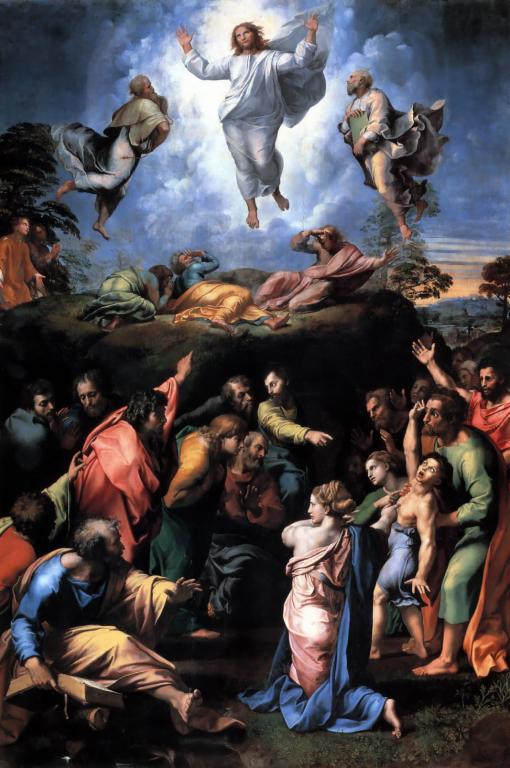
The Transfiguration by Raphael, ca. 1520.
Our journey through Lent continues with my experiment in Lectio Divina Diligens. Click on the link to read about this idea, if you’re not familiar with it.
Today let’s look at the readings for the Second Sunday in Lent, particularly the Gospel Reading, Mark 9:2-10. It’s the story of the Transfiguration.
Lectio — reading
After six days Jesus took Peter, James, and John and led them up a high mountain apart by themselves. And he was transfigured before them, and his clothes became dazzling white, such as no fuller on earth could bleach them. Then Elijah appeared to them along with Moses, and they were conversing with Jesus. Then Peter said to Jesus in reply, “Rabbi, it is good that we are here! Let us make three tents: one for you, one for Moses, and one for Elijah.” He hardly knew what to say, they were so terrified. Then a cloud came, casting a shadow over them; then from the cloud came a voice, “This is my beloved Son. Listen to him.” Suddenly, looking around, they no longer saw anyone but Jesus alone with them.
As they were coming down from the mountain, he charged them not to relate what they had seen to anyone, except when the Son of Man had risen from the dead. So they kept the matter to themselves, questioning what rising from the dead meant.
Investigatio — research
On the first Sunday of Lent we follow Jesus into the desert, for his forty day fast/vision quest — culminating in the three-fold temptation Jesus experiences (and overcomes, thanks to his reliance on the Word of God rather than the beguiles of his tempter).
This week our reading is no less dramatic, but not quite as conflict-driven. We move from the desert to the mountaintop, where Jesus, accompanied by his close friends/inner circle of Peter, James and John, undergoes the Transfiguration.
Verbum (the application I use for Bible study and scripture commentary) offers a number of ways to learn more about this powerful but enigmatic passage. Today I’m going to look at what scripture scholar N.T. Wright has to say about the passage, quoting from his book Mark for Everyone:
What was the inner reality of Jesus’ work? He was continuing and completing the tasks of the great prophet Elijah, and, behind him, of the greatest prophet of old, Moses himself… Now they reappear, with the veil of ordinariness drawn back for a moment, and Jesus is with them, shining with a brilliant light.
People are often fuzzy about what this means. It isn’t a revelation of Jesus’ divinity; if it were, that would make Elijah and Moses divine too, which Mark certainly doesn’t want us to think. Once again, Mark believes in Jesus’ divinity, but hasn’t yet told us why. Rather… this is a sign of Jesus being entirely caught up with, bathed in, the love, power and kingdom of God, so that it transforms his whole being with light, in the way that music transforms words that are sung. This is the sign that Jesus is not just indulging in fantasies about God’s kingdom, but that he is speaking and doing the truth. It’s the sign that he is indeed the true prophet, the true Messiah.
Try to avoid the temptation to think about this story “scientifically.” How did the prophets appear? What caused the light to shine? These kinds of questions miss the point. Read this story for its spiritual message: in the words of the Collegeville Bible Commentary, “When [the disciples] see him conversing with Elijah and Moses, they are awe-struck at the realization that Jesus is the fulfillment of the prophets (Elijah) and of all the law (Moses).”
Meditatio — reflection
I love the painting of the Transfiguration by Raphael, where all the disciples are shown — most of them at the bottom of the mountain, but the three who accompanied Jesus to the mountaintop are also seen, reclining in wonder (or fear). Meanwhile, Christ appears to be levitating, between and slightly above Moses and Elijah, who gaze at him in rapt awe. If Moses symbolizes “law” and Elijah “prophecy,” then this image makes clear that both of these essential currents of Old Testament spirituality are united and fulfilled in Christ. Christ is the new law — the one who brings structure and order to the universe. Christ is also the culmination of the prophets, those who speaks God’s word of liberation and salvation.
Human nature being what it is, it seems to me that many people tend to prefer either a structured approach to life or a free-wheeling approach. Some of us want a clear-cut, black-and-white, by-the-book way of doing things — even faith. These are the “Moses” people. Others want to emphasize not the rules but the exceptions, not limitations but possibilities, and feel that tradition should never trump innovation. These are the “Elijah” people.
The Transfiguration calls us out of our comfort zones — which ones we may inhabit — to recognize that Christ represents the fulfillment of both law and art, both tradition and prophecy, both structure and liberty. This may sound paradoxical, but remember what Colossians says: “in him all things hold together.” (Colossians 1:17)
Join with me and reflect on Moses and Elijah. Which one do you feel more comfortable with? What does it mean to suggest that in Christ, both the law and the prophets will find union and integration? How can play out in your life?
Oratio — response
God, you have created us in your image and likeness. You have said that we are the light of the world, just as you are the light of the world. Let your light shine through us. Teach us to embody both your life-giving law and your vast, loving, prophetic liberation. Help us to find you in the mountaintop moments just as surely as we seek you in the desert. With confidence in the name of Christ we pray. Amen.
Contemplatio — rest
Please join with me at a time that is appropriate for you, to simply rest in the silent presence of God, knowing that God loves you and me and all creation — whether we can feel it or not.
This is the third of a series of Lenten devotional posts, written in a spirit of Lectio Divina Diligens — lectio divina (sacred, meditative reading) combined with a contemplative, “diligent” approach to scriptural interpretation. Research into the interpretation of scripture is performed using Verbum.
Enjoy reading this blog?
Click here to become a patron.


Next Post

February 26, 2018 Hospitality, Heart-to-Heart
Browse Our Archives
Select a Category Activism Announcements Art Books Catholicism Celtic Christianity Christian mysticism Christianity Contemplation Current events Etc. Family humor interfaith dialogue Interfaith Wisdom Interspirituality Lay Cistercians Living the Faith Meditation movies Mysticism Mystics nature Poetry Reviews Scripture silence Spirituality Uncategorized Writing
Select a Month February 2025 January 2025 November 2024 September 2024 August 2024 July 2024 June 2024 May 2024 March 2024 January 2024 December 2023 November 2023 August 2023 June 2023 April 2023 March 2023 February 2023 January 2023 December 2022 November 2022 October 2022 September 2022 August 2022 July 2022 June 2022 May 2022 April 2022 February 2022 January 2022 December 2021 November 2021 October 2021 September 2021 August 2021 July 2021 June 2021 May 2021 April 2021 March 2021 February 2021 January 2021 December 2020 November 2020 October 2020 September 2020 August 2020 July 2020 June 2020 May 2020 April 2020 March 2020 February 2020 January 2020 December 2019 November 2019 October 2019 September 2019 August 2019 July 2019 June 2019 May 2019 April 2019 March 2019 February 2019 January 2019 December 2018 November 2018 October 2018 September 2018 August 2018 July 2018 June 2018 May 2018 April 2018 March 2018 February 2018 January 2018 December 2017 November 2017 October 2017 September 2017 August 2017 July 2017 June 2017 May 2017 April 2017 March 2017 February 2017 January 2017 December 2016 November 2016 October 2016 September 2016 August 2016 July 2016 June 2016 May 2016 March 2016 February 2016 January 2016 December 2015 November 2015 October 2015 September 2015 August 2015 July 2015 June 2015 May 2015 April 2015 March 2015 February 2015 January 2015 December 2014 November 2014 October 2014 September 2014 August 2014 July 2014 June 2014 May 2014 April 2014 March 2014 February 2014 January 2014 December 2013 October 2013 September 2013 July 2013 May 2013 January 2013 December 2012 November 2012 August 2012 July 2012 June 2012 March 2012 December 2011 September 2011 October 2010 August 2010 March 2010 September 2009 July 2008 January 2008 December 2007 September 2007 February 2007 January 2007 December 2004
Follow Us!
TAKE THE
Religious Wisdom Quiz
What was the name of the place where bitter water was made sweet?
Select your answer to see how you score.
Sinai Marah Elim Rephidim
Support this
Column


Related posts from Carl McColman

New From Encountering Silence: Exploring the Lost History...
The Wrath of God and Wishful Thinking (or,...

The Point Behind "Be Still and Know"
Joyful Penitence and a Continuous Lent
TRENDING AT PATHEOS Contemplative

Handy Contemplative Practices for Political Spaces
A Spiritually Grounded Presence In order to bring a spiritually grounded presence...

Halloween: The Holiday of Loving Your Neighbor
All Hallows Eve Is Halloween the least Christian holiday in America, or...

Can Love Be Saved? Some Thoughts on the...
Happy Valentine's Day! I recently published a post on Patreon called Can...

"This Loving, Uniting Embrace": the Holy Ordinary
Today's guest post is by Mark Longhurst, author of The Holy Ordinary:...

How Are We Called to Live?: More About...
How Are We Called to Live? Many of us struggle with discerning...

A Spiritual Practice of Reading: Join Us Online
A Spiritual Practice of Reading A healthy spiritual practice of reading is...
view all Contemplative blogs
Ad-Free & Subscriber Log-In Subscription Support
- About Us
- 2026 Calendar
- Videos
- Podcasts
- Library of World Religions
- Faith In Media Tracker
- Advertise With Us
- Write for Us
- Privacy Policy
- Terms of Service
- Do Not Sell My Data
- Contact Us
- Radiant Digital
- Manage Newsletter Subscriptions
- Unsubscribe From Notifications
- Sitemap
Copyright 2008-2026, Patheos. All rights reserved.
Subscription Support Ad-Free & Subscriber Log-In
Follow Patheos