
BuddhistCatholicContemplativeEvangelicalGeneral ChristianHinduJewishLatter-day SaintMuslimNew VisionsProgressive Christian
Beliefs
- Buddhist
- Catholic
- Contemplative
- Evangelical
- General Christian
- Hindu
- Jewish
- Latter-day Saint
- More Voices
- Muslim
- New Visions
- Pagan
- Progressive Christian
Topics
- Religion News
- Food and Religion
- Sports and Religion
- Religious Art
- Religious Music and Entertainment
- Religious Events
- History and Religion
- Style and Religion
- Politics and Religion
- Women in Religion
- Recreation Outdoors and Religion
- Business Finance and Religion
- Careers Workplace and Religion
- Education and Religion
- Family Parenting and Religion
- Health Fitness and Religion
- Home and Religion
- Relationships and Religion
- Technology and Religion
- Travel and Religion
Columnists
- Buddhist Columnists
- Business Finance and Religion Columnists
- Careers Workplace and Religion Columnists
- Catholic Columnists
- Contemplative Columnists
- Education and Religion Columnists
- Evangelists Columnists
- Family Parenting and Religion Columnists
- General Christian Columnists
- Health Fitness and Religion Columnists
- Hindu Columnists
- History and Religion Columnists
- Home and Religion Columnists
- Jewish Columnists
- More Voices Columnists
- Latter Day Columnists
- Muslim Columnists
- New Visions Columnists
- Nonreligious Columnists
- Pagan Columnists
- Politics and Religion Columnists
- Progressive Columnists
- Recreation Outdoors and Religion Columnists
- Relationships and Religion Columnists
- Religion News Columnists
- Religious Art Columnists
- Religious Events Columnists
- Religious Music and Entertainment Columnists
- Sports and Religion Columnists
- Style and Religion Columnists
- Technology and Religion Columnists
- Travel and Religion Columnists
- Women in Religion Columnists
Resource Library
- 2026 Calendar
- Library of World Religions
- The 100 Most Holy Places on Earth
- Patheos Answers
- Podcasts
- Videos
- Faith Leaders Database
- Anglican Episcopalian
- Bahai
- Baptist
- Buddhism
- Christianity
- Confucianism
- Eastern Orthodoxy
- Hinduism
- Holiness and Pentecostal
- ISKCON
- Islam
- Judaism
- Lutheran
- Methodist
- The Church of Jesus Christ of Latter-day Saints
- New Age
- Paganism
- Presbytarian and Reformed
- Protestantism
- Religion Behind the Scenes
- Roman Catholic
- Scientology
- Shia Islam
- Sikhism
- Sufism
- Sunni Islam
- Taoism
- Zen
- See all religions
Research Tools
 Ad-Free & Subscriber Log-In Subscription Support
Ad-Free & Subscriber Log-In Subscription Support
Follow Patheos 

- Trending:
- Forgiveness
- |
- Marriage
- |
- Consciousness
- |
- Death Penalty
- |
- Election
- |
- Halloween

- Home
- Contemplative
- Contemplating the Trinity
Contemplating the Trinity
Last updated on: February 13, 2018 at 12:39 am by Carl "Skye" McColman
Contemplating the Trinity 2018-02-13T00:39:16-04:00 Carl "Skye" McColman
Patheos Explore the world's faith through different perspectives on religion and spirituality! Patheos has the views of the prevalent religions and spiritualities of the world.
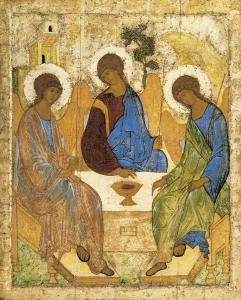
Rublev’s Icon of the Holy Trinity (15th century)
The heart of Christian spirituality is the Mystery of the Holy Trinity.
This is the ancient wisdom teaching that God is one God, in three persons: Father/Creator, Son/Redeemer, and Spirit/Sanctifier.
We call ourselves “Christians” because we follow the 2nd Person of the Trinity: Jesus, the Christ. But it would be just as accurate — some might say even more accurate — to call ourselves Trinitarians, the people of faith in this Triune God.
The Trinity is controversial: Jews and Muslims reject this way of experiencing God, and even among many Christians it remains, well, a mystery (pardon the pun). Cynics dismiss the Trinity as a compromise that early Christians came up with, to reconcile their faith in Christ with their insistence, inherited from Judaism, that God is One.
It is not my goal to argue the philosophical merits of the Trinity — I would much rather refer you to people far more eloquent than I am (like Karl Rahner or Saint Augustine). Rather, I want us to reflect on the spirituality of the Blessed Trinity.
A growing understanding of the Trinity in our time, which has roots going all the way back to the early centuries of the Church, is simply this: The Trinity makes sense because a three-person God is a God whose very nature is love and relationship.
In other words, what matters about the Trinity is not the “threeness” or the “oneness” or even the logical challenges of parsing out God’s nature(s), God’s person(s), God’s oneness, so forth and so on. All of that philosophical posturing really misses the point.
The point is to approach the Trinity from the heart.
We worship a Trinity because God is a God of love, and in the relationships between Yahweh, Yeshua, and Ruach — between the Father, the Christ, and the Holy Spirit — we find the heart of love: the lover, the beloved, and love itself, eternally pouring forth like a joyful dance, from each of the persons, to each of the persons, and through each of the persons.
The Love that Gives Itself Away
And the joy of the love of the Trinity? It doesn’t stop there: God in turn shares that ever-flowing love, lavishly and joyfully, with all of creation.
The Bible teaches that we “mere mortals” are created in the image and likeness of God, which means we are created in the image and likeness of Love: ever capable of being the lover, the beloved, and love itself, and therefore to give ourselves in love to one another. The Bible also teaches that we are the temples of the Holy Spirit, which means all the love that flows from us and to us and in us ultimately has its origin in God.
Furthermore, us mere mortals are called to be the Body of Christ — we participate in Jesus’s ongoing body-ness; indeed, now that Christ has ascended, we are it — we are the Body of Christ, still present on earth. But because we are the body of Christ, we (collectively but also individually) are partakers of the Divine Nature (2 Peter 1:4), which means we dance the very dance of the love of God: by virtue of being baptized into Christ, we are one with Christ, therefore one with God.
In other words, the heart of Christianity — and, therefore, Christian spirituality — is recognizing the gift of Divine Love which has already been given to us, from the God who is Lover/Beloved/Love, and who pours that love to us and through us, to others and therefore to the entirety of creation.
Now, we can also talk about all the ways we resist and reject that gift of love — that gets into the theology of sin, fallenness, the need for repentance, the call to holiness, and so forth. That’s all important stuff — but it also tends to be the kind of stuff that many Christians over-focus on, so I’ll leave that conversation aside for now.
Praying to the Triune God
For now, I want to talk about prayer and the Holy Trinity, and especially contemplative prayer and the Trinity. How do we pray to the God who is Love/Lover/Beloved? How do we contemplate this God, this God who is not elsewhere, who is more present to us than we are to ourselves?
To answer this question, I’d like to propose three ways of thinking about — and encountering — God, right here in our own bodies. These three ways of encountering God correspond to the Three Persons of the Holy Trinity. Remember, these are not three “different” Gods, rather simply three different ways of encountering the Three Persons (the “Three Relators”) of God.
We encounter the Father, the Creator, the God-who-is-bigger-than-the-universe, in our own bodies through the gift of silence.
We encounter the Son, Jesus the Christ, the Redeemer, the Word of God who-became-one-of-us, in our own bodies through the very gift of our embodiment.
We encounter the Holy Spirit, the rushing mighty wind who is the Breath of God, who Christ gave to his disciples by breathing upon them (John 20:22), we encounter this Spirit of God in our own bodies through the gift of breath.
Silence is the ikon of the presence of God the Creator. Remember, an ikon is not the same thing as an idol: it’s not a substitute for God, but rather a created object through which we encounter the uncreated God. The silence of creation — including the silence within our own hearts, a silence deeper than all our thoughts and feelings and mental chatter — this silence is a gift from God to us, that brings eternity into our hearts (Ecclesiastes 3:11), that reminds us of the deep silence into which God spoke the first words of creation, the silence that keeps us humble because we can never fully comprehend God or put God into words (or thoughts). The Bible instructs us to keep silence before God (Habakkuk 2:20), so when we keep silence, we place ourselves in the presence of God the Father.
The human body is the ikon of the presence of Christ the Son of God. “The Word became flesh and dwelt among us” (John 1:14). Christians worship Christ because he is the incarnation — God-made-flesh. So when we seek Christ in our own hearts, it is our very bodies that testify to his presence in our lives. The body is not evil, or an illusion, or something to be ashamed of our gotten rid of — on the contrary, it is a gift from God, to be cherished, cared for, and honored as the grounding of our own “incarnation.” Saint Paul bluntly states “Christ will be exalted in my body” (Philippians 1:20) — so when we embrace our very embodiment, we place ourselves in the presence of God the Son.
Your very breath is the ikon of the presence of the Holy Spirit of God. As I’ve already mentioned, the body is the temple of the Holy Spirit (I Corinthians 3:16, 6:19) — but if the body is the temple of the Spirit, then the breath is the altar on which we sacrifice all to the Spirit who is Love. The very word “Spirit” is related to breath — see the link between inspiration and respiration — and this is true not only in English, but also in Hebrew, Greek, Latin, and other languages as well. “Breathe on me, breath of God” goes the old hymn — we know that to breathe is to live (a euphemism for dying is “he breathed his last”), and all life comes from God, so when we embrace our very breath, we place ourselves in the presence of God the Holy Spirit.
Praying the Prayer of Contemplative Awareness
Contemplative prayer, at heart, is simply a prayer-of-awareness. In a nutshell, it is a prayer of “paying attention to God” — at a level deeper than words, than thoughts, than the imagination. Sometimes praying with words, or thoughts, or feelings, or the imagination is important and beautiful. But sometimes we have to lay all those things aside and encounter God directly, in our bodies, in silence, in our breath. We pray to simply place ourselves in God’s presence — and to bask in God’s light and love, no matter what we consciously experience.
Contemplative prayer is the prayer of awareness of silence. Here I commend to you Martin Laird’s wise book Into the Silent Land. We have difficulty simply being silent, and many people actually fear silence or find it makes them deeply uncomfortable. But silence is gentle and serene, so it’s not so much the silence we fear, but our very selves. Learning to place our attention on silence (and not on the ongoing drama in our minds) is the heart of contemplative practice. When we learn to be still and know God (Psalm 46:10), we discover that silence is always in us — and is the doorway through which we encounter God, and God encounters us.
Contemplative prayer is the prayer of awareness of embodiment. Here I commend to you the writings of Anthony de Mello, beginning with his book Sadhana: A Way to God. Perhaps the reason why so many of us find silence fearful and uncomfortable is because we haven’t yet learned how to be present in our own skin. Part of this, frankly, is religion’s own fault: we have for too long endured that tired dualism that says spirit is good, but matter (including the human body) is inferior or even bad. But that is not the gospel! Christ taught us to heal our eyes so that our bodies would be filled with light (Matthew 6:22) — and the healed eye is an eye that sees “singly” which is to say non-dually, i.e. a contemplative eye: in the words of Meister Eckhart, “the eye with which I see God is the eye with which God sees me.” When we honor our body, and learn to rest in simple awareness of our embodiment, that gentle awareness becomes the doorway through which we encounter Christ, and Christ encounters us.
Contemplative prayer is the prayer of awareness of breath. For this dimension of contemplation I commend to you the classic Russian Orthodox text The Way of a Pilgrim. The Orthodox prayer of the heart — Lord Jesus Christ, Son of God, Have Mercy on Me — is an invitation to synchronize our prayer with our breath. Another book that looks at breath-as-prayer is David Frenette’s The Path of Centering Prayer — or, for that matter, Martin Laird’s book. Christians often mistakenly assume that breath work is an eastern practice, something associated with Yoga or Zen but not Christianity. Yet we see, especially in the Orthodox churches, a deep recognition that mindful breathing is a way of praying to the Holy Spirit. Breathe in the love of God; breathe out compassion and care for others. Continue indefinitely. When we maintain awareness of our breath, we encounter the Holy Spirit, and the Holy Spirit encounters us.
Contemplating the Trinity
Be silent. Be embodied. Breathe.
Do these three things, and you are contemplating the presence of the Holy Trinity in your life, right here, right now. Without words, without feelings or distractions, without complicated theology or academic abstraction, simply be present, be silent, be embodied, and breathe. And continue.
God is love. God is lover and beloved and the love flowing therein. You are the image and likeness of God. In silence, you are the lover. In your body, you are the beloved. In your breath, you are Love.
Now, my friend: go and set the world on fire.
Want to read more on the Trinity? Check out these resources:
- Anne Hunt, The Trinity: Insights from the Mystics
- Aristotle Papanikolaou, Being With God: Trinity, Apophaticism, and Divine-Human Communion
- Catherine Mowry LaCugna, God For Us: The Trinity and Christian Life
- Cynthia Bourgeault, The Holy Trinity and the Law of Three
- Karl Rahner, The Trinity
- Michael Downey, Altogether Gift: A Trinitarian Spirituality
- Richard Rohr and Mike Morrell, The Divine Dance: The Trinity and Your Transformation
Enjoy reading this blog?
Click here to become a patron.

Previous Post
January 2, 2018
Expanding our Minds: Recovering Contemplation In Pursuit of Wisdom
Next Post

January 11, 2018 Everyone is Called to Union with God
Browse Our Archives
Select a Category Activism Announcements Art Books Catholicism Celtic Christianity Christian mysticism Christianity Contemplation Current events Etc. Family humor interfaith dialogue Interfaith Wisdom Interspirituality Lay Cistercians Living the Faith Meditation movies Mysticism Mystics nature Poetry Reviews Scripture silence Spirituality Uncategorized Writing
Select a Month February 2025 January 2025 November 2024 September 2024 August 2024 July 2024 June 2024 May 2024 March 2024 January 2024 December 2023 November 2023 August 2023 June 2023 April 2023 March 2023 February 2023 January 2023 December 2022 November 2022 October 2022 September 2022 August 2022 July 2022 June 2022 May 2022 April 2022 February 2022 January 2022 December 2021 November 2021 October 2021 September 2021 August 2021 July 2021 June 2021 May 2021 April 2021 March 2021 February 2021 January 2021 December 2020 November 2020 October 2020 September 2020 August 2020 July 2020 June 2020 May 2020 April 2020 March 2020 February 2020 January 2020 December 2019 November 2019 October 2019 September 2019 August 2019 July 2019 June 2019 May 2019 April 2019 March 2019 February 2019 January 2019 December 2018 November 2018 October 2018 September 2018 August 2018 July 2018 June 2018 May 2018 April 2018 March 2018 February 2018 January 2018 December 2017 November 2017 October 2017 September 2017 August 2017 July 2017 June 2017 May 2017 April 2017 March 2017 February 2017 January 2017 December 2016 November 2016 October 2016 September 2016 August 2016 July 2016 June 2016 May 2016 March 2016 February 2016 January 2016 December 2015 November 2015 October 2015 September 2015 August 2015 July 2015 June 2015 May 2015 April 2015 March 2015 February 2015 January 2015 December 2014 November 2014 October 2014 September 2014 August 2014 July 2014 June 2014 May 2014 April 2014 March 2014 February 2014 January 2014 December 2013 October 2013 September 2013 July 2013 May 2013 January 2013 December 2012 November 2012 August 2012 July 2012 June 2012 March 2012 December 2011 September 2011 October 2010 August 2010 March 2010 September 2009 July 2008 January 2008 December 2007 September 2007 February 2007 January 2007 December 2004
Follow Us!
TAKE THE
Religious Wisdom Quiz
What animal did fed Elijah?
Select your answer to see how you score.
Doves Sparrows Ravens Eagles
Support this
Column


Related posts from Carl McColman

Four Dimensions of Mindfulness and Centering Prayer
A Contemplative Reflection on the Death of Christ

LSD, Anxiety, and Contemplation: Can Psychedelic Therapy Support...

Discover the Three Forms of Contemplation, according to...
TRENDING AT PATHEOS Contemplative

Handy Contemplative Practices for Political Spaces
A Spiritually Grounded Presence In order to bring a spiritually grounded presence...

Halloween: The Holiday of Loving Your Neighbor
All Hallows Eve Is Halloween the least Christian holiday in America, or...

Can Love Be Saved? Some Thoughts on the...
Happy Valentine's Day! I recently published a post on Patreon called Can...

"This Loving, Uniting Embrace": the Holy Ordinary
Today's guest post is by Mark Longhurst, author of The Holy Ordinary:...

How Are We Called to Live?: More About...
How Are We Called to Live? Many of us struggle with discerning...

A Spiritual Practice of Reading: Join Us Online
A Spiritual Practice of Reading A healthy spiritual practice of reading is...
view all Contemplative blogs
Ad-Free & Subscriber Log-In Subscription Support
- About Us
- 2026 Calendar
- Videos
- Podcasts
- Library of World Religions
- Faith In Media Tracker
- Advertise With Us
- Write for Us
- Privacy Policy
- Terms of Service
- Do Not Sell My Data
- Contact Us
- Radiant Digital
- Manage Newsletter Subscriptions
- Unsubscribe From Notifications
- Sitemap
Copyright 2008-2026, Patheos. All rights reserved.
Subscription Support Ad-Free & Subscriber Log-In
Follow Patheos