
BuddhistCatholicContemplativeEvangelicalGeneral ChristianHinduJewishLatter-day SaintMuslimNew VisionsProgressive Christian
Beliefs
- Buddhist
- Catholic
- Contemplative
- Evangelical
- General Christian
- Hindu
- Jewish
- Latter-day Saint
- More Voices
- Muslim
- New Visions
- Pagan
- Progressive Christian
Topics
- Religion News
- Food and Religion
- Sports and Religion
- Religious Art
- Religious Music and Entertainment
- Religious Events
- History and Religion
- Style and Religion
- Politics and Religion
- Women in Religion
- Recreation Outdoors and Religion
- Business Finance and Religion
- Careers Workplace and Religion
- Education and Religion
- Family Parenting and Religion
- Health Fitness and Religion
- Home and Religion
- Relationships and Religion
- Technology and Religion
- Travel and Religion
Columnists
- Buddhist Columnists
- Business Finance and Religion Columnists
- Careers Workplace and Religion Columnists
- Catholic Columnists
- Contemplative Columnists
- Education and Religion Columnists
- Evangelists Columnists
- Family Parenting and Religion Columnists
- General Christian Columnists
- Health Fitness and Religion Columnists
- Hindu Columnists
- History and Religion Columnists
- Home and Religion Columnists
- Jewish Columnists
- More Voices Columnists
- Latter Day Columnists
- Muslim Columnists
- New Visions Columnists
- Nonreligious Columnists
- Pagan Columnists
- Politics and Religion Columnists
- Progressive Columnists
- Recreation Outdoors and Religion Columnists
- Relationships and Religion Columnists
- Religion News Columnists
- Religious Art Columnists
- Religious Events Columnists
- Religious Music and Entertainment Columnists
- Sports and Religion Columnists
- Style and Religion Columnists
- Technology and Religion Columnists
- Travel and Religion Columnists
- Women in Religion Columnists
Resource Library
- 2026 Calendar
- Library of World Religions
- The 100 Most Holy Places on Earth
- Patheos Answers
- Podcasts
- Videos
- Faith Leaders Database
- Anglican Episcopalian
- Bahai
- Baptist
- Buddhism
- Christianity
- Confucianism
- Eastern Orthodoxy
- Hinduism
- Holiness and Pentecostal
- ISKCON
- Islam
- Judaism
- Lutheran
- Methodist
- The Church of Jesus Christ of Latter-day Saints
- New Age
- Paganism
- Presbytarian and Reformed
- Protestantism
- Religion Behind the Scenes
- Roman Catholic
- Scientology
- Shia Islam
- Sikhism
- Sufism
- Sunni Islam
- Taoism
- Zen
- See all religions
Research Tools
 Ad-Free & Subscriber Log-In Subscription Support
Ad-Free & Subscriber Log-In Subscription Support
Follow Patheos 

- Trending:
- Forgiveness
- |
- Marriage
- |
- Consciousness
- |
- Death Penalty
- |
- Election
- |
- Halloween

- Home
- Contemplative
- The Call to Move “Beyond” What is Safe and Familiar
The Call to Move “Beyond” What is Safe and Familiar
Last updated on: July 8, 2018 at 5:56 pm by Guest Contributor
The Call to Move “Beyond” What is Safe and Familiar 2018-07-08T17:56:59-04:00 Guest Contributor
Patheos Explore the world's faith through different perspectives on religion and spirituality! Patheos has the views of the prevalent religions and spiritualities of the world.

Image credit: Shutterstock.
Today’s post is by guest contributor Mark S. Burrows, who is a poet and an authority on the great medieval mystic, Meister Eckhart.
We live our lives, much of the time, within safe boundaries. It feels better to us. And, to be frank, who does not wish to be safe? Those who find themselves facing bodily threat, or illness, know that such matters allow little room for sentimentality. Safe is safe, period; our “fight or flight” reflex, rooted deep in the most ancient part of the brain, testifies to this, whether we will it or not.
What, then, does it mean to open ourselves to what is “beyond” what we can know? Beyond what we can manage or control?
If safety is rooted in one part of our brain, then the will to explore — the desire to discover what is new— also operates, and powerfully, in a different part. Meister Eckhart knew about both of these in his own way, and was wise enough not to play the one off against the other. Perhaps because in his times, life seemed much more uncertain for the masses, closer to the bone perhaps, nearer to death in the midst of things. Safety did not seem to be a right, but rather a gift — as indeed it is, as many in our times also know.
What rings like a leitmotiv through Eckhart’s writings, perhaps for this very reason, is the need to move beyond the familiar. This is true for our image of God, of course. But it is as true for our self-image, and for what we expect from or project on others. In fact, Eckhart goes so far as to imagine that there is no “why” in God. No unsettled questions. No unneeded argument. God simply is, just as we ourselves simply are. Even when our lives are not simple!
Eckhart knew this as love.
Simply this, even when it is not so simple, because we complicate it in our thinking — about God, about ourselves, about others.
Love is. It is we who are becoming.
What would happen, though, if we relinquished our need to understand, and sought rather to rest in love? And, in this rest, sought to love all that we have, and are?
And what if, in learning to love beyond our expectations, we learned to let go, little by little, of the excess we think we need in our lives—and in our relationships with others? What if that letting-go created space in our hearts for love, to be in love, beyond what we can do or manage or expect?
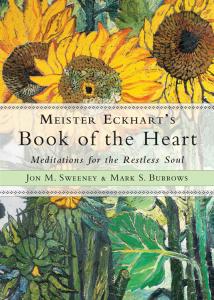
Meister Eckhart’s Book of the Heart
Living in this “beyond” is a persistent theme in Meister Eckhart’s writings.
Living in the “beyond” is the source of our freedom. The heart of our joy. The means of our happiness.
We sought to give it voice with the following words, taken from a sermon inspired by the description of the apostle Paul rising from the ground and “seeing nothing” (Acts 9.8).
No-thing. Only love, the Meister suggests. Only God, in all that is. Only every-thing, in love.
Here, then, is “The One Nameless Truth”:
You, nameless God, want to form
Yourself in me and give yourself
to me, not as I think or want or will
but rather as You are, beyond all
thinking and wanting and willing
in the one nameless truth of Love.
Mark S. Burrows is the author, with Jon M. Sweeney, of a recently released book, Meister Eckhart’s Book of the Heart: Meditations for the Restless Soul, from which the above poem is taken. A scholar of mysticism and a poet, he teaches theology and literature at the Protestant University of Applied Sciences in Bochum, Germany. A volume of his poems is forthcoming in 2018:**** The Chance of Home.****
Enjoy reading this blog?
Click here to become a patron.

Stay in touch! Connect with Carl McColman on Facebook:

Next Post

December 13, 2017 Fundamentalism versus Contemplation
Browse Our Archives
Select a Category Activism Announcements Art Books Catholicism Celtic Christianity Christian mysticism Christianity Contemplation Current events Etc. Family humor interfaith dialogue Interfaith Wisdom Interspirituality Lay Cistercians Living the Faith Meditation movies Mysticism Mystics nature Poetry Reviews Scripture silence Spirituality Uncategorized Writing
Select a Month February 2025 January 2025 November 2024 September 2024 August 2024 July 2024 June 2024 May 2024 March 2024 January 2024 December 2023 November 2023 August 2023 June 2023 April 2023 March 2023 February 2023 January 2023 December 2022 November 2022 October 2022 September 2022 August 2022 July 2022 June 2022 May 2022 April 2022 February 2022 January 2022 December 2021 November 2021 October 2021 September 2021 August 2021 July 2021 June 2021 May 2021 April 2021 March 2021 February 2021 January 2021 December 2020 November 2020 October 2020 September 2020 August 2020 July 2020 June 2020 May 2020 April 2020 March 2020 February 2020 January 2020 December 2019 November 2019 October 2019 September 2019 August 2019 July 2019 June 2019 May 2019 April 2019 March 2019 February 2019 January 2019 December 2018 November 2018 October 2018 September 2018 August 2018 July 2018 June 2018 May 2018 April 2018 March 2018 February 2018 January 2018 December 2017 November 2017 October 2017 September 2017 August 2017 July 2017 June 2017 May 2017 April 2017 March 2017 February 2017 January 2017 December 2016 November 2016 October 2016 September 2016 August 2016 July 2016 June 2016 May 2016 March 2016 February 2016 January 2016 December 2015 November 2015 October 2015 September 2015 August 2015 July 2015 June 2015 May 2015 April 2015 March 2015 February 2015 January 2015 December 2014 November 2014 October 2014 September 2014 August 2014 July 2014 June 2014 May 2014 April 2014 March 2014 February 2014 January 2014 December 2013 October 2013 September 2013 July 2013 May 2013 January 2013 December 2012 November 2012 August 2012 July 2012 June 2012 March 2012 December 2011 September 2011 October 2010 August 2010 March 2010 September 2009 July 2008 January 2008 December 2007 September 2007 February 2007 January 2007 December 2004
Follow Us!
TAKE THE
Religious Wisdom Quiz
Who built two gold calves, leading Israel into idolatry after the split?
Select your answer to see how you score.
Solomon Rehoboam Josiah Jeroboam
Support this
Column


Related posts from Carl McColman

"This Loving, Uniting Embrace": the Holy Ordinary

I Believe Prayer Changes Things. Here's a Few...

You don't have to become a monk to...

If You Worship an Angry God, You'll Be...
TRENDING AT PATHEOS Contemplative

Handy Contemplative Practices for Political Spaces
A Spiritually Grounded Presence In order to bring a spiritually grounded presence...

Halloween: The Holiday of Loving Your Neighbor
All Hallows Eve Is Halloween the least Christian holiday in America, or...

Can Love Be Saved? Some Thoughts on the...
Happy Valentine's Day! I recently published a post on Patreon called Can...

"This Loving, Uniting Embrace": the Holy Ordinary
Today's guest post is by Mark Longhurst, author of The Holy Ordinary:...

How Are We Called to Live?: More About...
How Are We Called to Live? Many of us struggle with discerning...

A Spiritual Practice of Reading: Join Us Online
A Spiritual Practice of Reading A healthy spiritual practice of reading is...
view all Contemplative blogs
Ad-Free & Subscriber Log-In Subscription Support
- About Us
- 2026 Calendar
- Videos
- Podcasts
- Library of World Religions
- Faith In Media Tracker
- Advertise With Us
- Write for Us
- Privacy Policy
- Terms of Service
- Do Not Sell My Data
- Contact Us
- Radiant Digital
- Manage Newsletter Subscriptions
- Unsubscribe From Notifications
- Sitemap
Copyright 2008-2026, Patheos. All rights reserved.
Subscription Support Ad-Free & Subscriber Log-In
Follow Patheos