
BuddhistCatholicContemplativeEvangelicalGeneral ChristianHinduJewishLatter-day SaintMuslimNew VisionsProgressive Christian
Beliefs
- Buddhist
- Catholic
- Contemplative
- Evangelical
- General Christian
- Hindu
- Jewish
- Latter-day Saint
- More Voices
- Muslim
- New Visions
- Pagan
- Progressive Christian
Topics
- Religion News
- Food and Religion
- Sports and Religion
- Religious Art
- Religious Music and Entertainment
- Religious Events
- History and Religion
- Style and Religion
- Politics and Religion
- Women in Religion
- Recreation Outdoors and Religion
- Business Finance and Religion
- Careers Workplace and Religion
- Education and Religion
- Family Parenting and Religion
- Health Fitness and Religion
- Home and Religion
- Relationships and Religion
- Technology and Religion
- Travel and Religion
Columnists
- Buddhist Columnists
- Business Finance and Religion Columnists
- Careers Workplace and Religion Columnists
- Catholic Columnists
- Contemplative Columnists
- Education and Religion Columnists
- Evangelists Columnists
- Family Parenting and Religion Columnists
- General Christian Columnists
- Health Fitness and Religion Columnists
- Hindu Columnists
- History and Religion Columnists
- Home and Religion Columnists
- Jewish Columnists
- More Voices Columnists
- Latter Day Columnists
- Muslim Columnists
- New Visions Columnists
- Nonreligious Columnists
- Pagan Columnists
- Politics and Religion Columnists
- Progressive Columnists
- Recreation Outdoors and Religion Columnists
- Relationships and Religion Columnists
- Religion News Columnists
- Religious Art Columnists
- Religious Events Columnists
- Religious Music and Entertainment Columnists
- Sports and Religion Columnists
- Style and Religion Columnists
- Technology and Religion Columnists
- Travel and Religion Columnists
- Women in Religion Columnists
Resource Library
- 2026 Calendar
- Library of World Religions
- The 100 Most Holy Places on Earth
- Patheos Answers
- Podcasts
- Videos
- Faith Leaders Database
- Anglican Episcopalian
- Bahai
- Baptist
- Buddhism
- Christianity
- Confucianism
- Eastern Orthodoxy
- Hinduism
- Holiness and Pentecostal
- ISKCON
- Islam
- Judaism
- Lutheran
- Methodist
- The Church of Jesus Christ of Latter-day Saints
- New Age
- Paganism
- Presbytarian and Reformed
- Protestantism
- Religion Behind the Scenes
- Roman Catholic
- Scientology
- Shia Islam
- Sikhism
- Sufism
- Sunni Islam
- Taoism
- Zen
- See all religions
Research Tools
 Ad-Free & Subscriber Log-In Subscription Support
Ad-Free & Subscriber Log-In Subscription Support
Follow Patheos 

- Trending:
- Forgiveness
- |
- Marriage
- |
- Consciousness
- |
- Death Penalty
- |
- Election
- |
- Halloween

- Home
- Contemplative
- What Can We Learn from that Foolish St. Francis?
What Can We Learn from that Foolish St. Francis?
Last updated on: July 8, 2018 at 5:56 pm by Guest Contributor
What Can We Learn from that Foolish St. Francis? 2018-07-08T17:56:59-04:00 Guest Contributor
Patheos Explore the world's faith through different perspectives on religion and spirituality! Patheos has the views of the prevalent religions and spiritualities of the world.
Today’s guest contributor is Jon M. Sweeney, author of The Saint Francis Holy Fool Prayer Book. Read Jon’s previous post on Saint Francis here: What Do Gene Kelly and St. Francis Have in Common?**
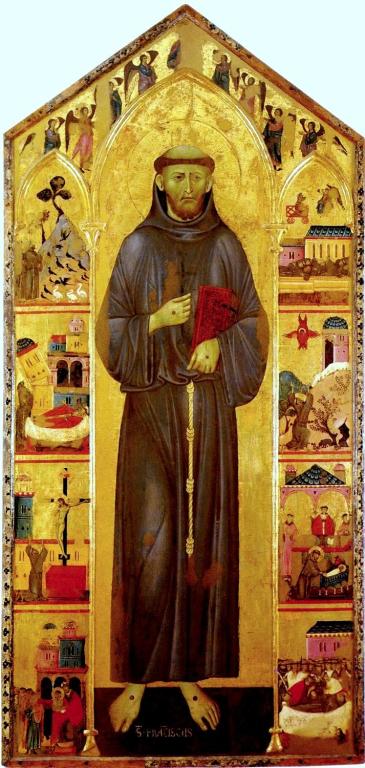
Guido di Graciano. St. Francis & Stories from His Life, ca. 1270. Public domain
What a Fool Francis Was.
When Francis of Assisi acted like a fool 800 years ago, they called him pazzo. That’s Italian for crazy. So we can’t avoid terms like “crazy” and “dumb” – words that make us understandably uncomfortable – when talking about holy fools.
See my previous post, in which I told the story of my daughter disliking Singing in the Rain because Gene Kelly was being “dumb.”
The adjective actually made Francis quite happy. He knew if folks call you “crazy” or a “fool,” you must be doing something right.
The foolishness of Francis’s life and actions is difficult to explain if you use only rational or pragmatic ways of understanding:
- Like when he stripped naked in front of a crowd in order to give everything in the world that belonged to his father back to him.
- Or when he began preaching to birds after people didn’t seem to pay much heed to his words.
- Or when he scolded some of those birds for not listening carefully enough and chirping too loudly during Mass.
- Or when he joined a friend in deliberately humiliating himself—Francis had punished the friend by holy obedience (he was, by then, the friend’s religious superior) for refusing to preach the Gospel. The punishment was for him to go and preach in his underwear. A few minutes later, Francis chastised himself for being too severe on his friend, and repented by stripping down himself and joining him in the pulpit.
Why would someone do these things? They don’t exactly make sense, do they? And yet, somehow, they did, and do.
When Francis, Brother Juniper, and other early Franciscans were becoming fools for Christ, there were also professional fools that hired in noble and royal courts, or traveling from town to town, that were entertainers and truth-tellers. They were thought to possess a wisdom that came of being detached from normal ways of the world. They never stopped reminding their audiences that the world will lie to you, deceive you with false appearances; that the world may seem rational but actually it is mad.
You see such a troupe in Shakespeare’s Hamlet, for instance (act 5, scene 1); they are the grave diggers who appear after Ophelia’s suicide, bantering about death, love, and the meaning of life.
It was often the hired fool, dressed in motley silliness, juggling and telling stories, who was allowed to make jokes at the expense of the mighty. A common person wouldn’t dare say things that a fool could say with impunity. A fool flouted conventions, poked fun at niceties, and got away with it because he was feebleminded—either by pretense, or in reality. They were often regarded as medieval prophets, able to see or understand things that others couldn’t.
Francis and Juniper appreciated these fools and emulated them when they became, as Francis himself put it, “Jugglers for God.”
Fools Know the Truth
They would entertain crowds before they’d preach. They would sing and dance in such a ways that people sometimes thought they were drunk. The early Franciscans gained more followers to the way of Jesus than any spiritual movement ever had before.
They knew that the trouble with the world isn’t that the world is bad, but that we allow the world to tell us who we ought to be. A fool knows that the Gospel is alternative, not mainstream.
Remember the Beatitudes? How many people do you know who go seeking meekness, hunger, and peace instead of influence, satiety, and power? Francis and Juniper and the others were all about reminding people that following Jesus meant upholding alternative values, and how it’s nearly impossible to uphold them by being “normal” (another word that makes us uncomfortable) in a world committed to things as they are.
Those who know the truth sometimes have to be fools in order to communicate it. This is why the prophet Isaiah walked naked and barefoot for years (Isaiah 20), why the prophet Hosea married a harlot in order to make a point about faithfulness (Hosea 1), and why Jeremiah smashed a clay pot when God told him to forcefully make a point (Jeremiah 19). These are examples of being foolish to capture attention—or to subvert established authority.
Neither Isaiah nor Hosea cared a wit about their reputations. They cared, instead, about changing minds. Likewise, for Francis and Juniper, being a fool was not only a way of discipleship, but an act of protest. They wanted people to see the truth, and sometimes we wear such thick blinders that we need to be startled to attention before we can see through them.
An example from the life of Brother Juniper
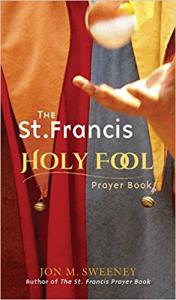 This is the sort of thing they would do…
After Juniper’s reputation had become well-known for holy deeds, there came a time when he needed to travel to Rome. There were Romans who knew Juniper was coming to their city and they wanted to go out to meet him.
When Juniper saw them on the road ahead, he wanted none of their devotion. He began to ponder how to turn their expectations, and this greeting, around.
Then Juniper saw two boys playing on a seesaw, which they’d made by setting a board of wood over the top of a log. Juniper asked the boys if he could join in their play. Soon, Juniper’s arms were in the air and he was laughing like a child.
The crowd of expectant Romans saw this and they began to come closer. They wanted to take Juniper into the city, to honor him, and show him where a man of holiness could lie down and rest after such a journey.
But Juniper kept on playing. The people were gobsmacked.
As Juniper laughed and waved his arms, the people were trying to reverence and greet him as the holy man they knew he was supposed to be. But Juniper wanted to turn their reverencing into mocking and scorn.
“He’s a fool,” one of the Romans finally said. Others were not sure. But, as Juniper kept on playing with the boys on the seesaw rather than listening to the crowd that had come to greet him, the Romans slowly wandered away disappointed. It was only then that Juniper stopped seesawing and made his way, quietly, on his own, to the friary in Rome.
Stories like this reveal a side of the spiritual life we don’t often see today: how foolishness can reveal the authentic, mystical heart of faith in ways that the world cannot comprehend.
Celebrate more of Saint Francis’s tomfoolery by reading The Saint Francis Holy Fool Prayer Book.**
Enjoy reading this blog?
Click here to become a patron.

Stay in touch! Connect with Carl McColman on Facebook:

Next Post
November 21, 2017 Twelve Insightful Quotations from the Great Christian Mystics
Browse Our Archives
Select a Category Activism Announcements Art Books Catholicism Celtic Christianity Christian mysticism Christianity Contemplation Current events Etc. Family humor interfaith dialogue Interfaith Wisdom Interspirituality Lay Cistercians Living the Faith Meditation movies Mysticism Mystics nature Poetry Reviews Scripture silence Spirituality Uncategorized Writing
Select a Month February 2025 January 2025 November 2024 September 2024 August 2024 July 2024 June 2024 May 2024 March 2024 January 2024 December 2023 November 2023 August 2023 June 2023 April 2023 March 2023 February 2023 January 2023 December 2022 November 2022 October 2022 September 2022 August 2022 July 2022 June 2022 May 2022 April 2022 February 2022 January 2022 December 2021 November 2021 October 2021 September 2021 August 2021 July 2021 June 2021 May 2021 April 2021 March 2021 February 2021 January 2021 December 2020 November 2020 October 2020 September 2020 August 2020 July 2020 June 2020 May 2020 April 2020 March 2020 February 2020 January 2020 December 2019 November 2019 October 2019 September 2019 August 2019 July 2019 June 2019 May 2019 April 2019 March 2019 February 2019 January 2019 December 2018 November 2018 October 2018 September 2018 August 2018 July 2018 June 2018 May 2018 April 2018 March 2018 February 2018 January 2018 December 2017 November 2017 October 2017 September 2017 August 2017 July 2017 June 2017 May 2017 April 2017 March 2017 February 2017 January 2017 December 2016 November 2016 October 2016 September 2016 August 2016 July 2016 June 2016 May 2016 March 2016 February 2016 January 2016 December 2015 November 2015 October 2015 September 2015 August 2015 July 2015 June 2015 May 2015 April 2015 March 2015 February 2015 January 2015 December 2014 November 2014 October 2014 September 2014 August 2014 July 2014 June 2014 May 2014 April 2014 March 2014 February 2014 January 2014 December 2013 October 2013 September 2013 July 2013 May 2013 January 2013 December 2012 November 2012 August 2012 July 2012 June 2012 March 2012 December 2011 September 2011 October 2010 August 2010 March 2010 September 2009 July 2008 January 2008 December 2007 September 2007 February 2007 January 2007 December 2004
Follow Us!
TAKE THE
Religious Wisdom Quiz
What did Jesus do right after being baptized?
Select your answer to see how you score.
Started preaching Visited the temple Returned to Galilee Went into the wilderness
Support this
Column


Related posts from Carl McColman

You don't have to become a monk to...

Mysticism, Faith, and "Knowing" God's Will


Contemplative Books to Read and Savor During Advent...
TRENDING AT PATHEOS Contemplative

Handy Contemplative Practices for Political Spaces
A Spiritually Grounded Presence In order to bring a spiritually grounded presence...

Halloween: The Holiday of Loving Your Neighbor
All Hallows Eve Is Halloween the least Christian holiday in America, or...

Can Love Be Saved? Some Thoughts on the...
Happy Valentine's Day! I recently published a post on Patreon called Can...

"This Loving, Uniting Embrace": the Holy Ordinary
Today's guest post is by Mark Longhurst, author of The Holy Ordinary:...

How Are We Called to Live?: More About...
How Are We Called to Live? Many of us struggle with discerning...

A Spiritual Practice of Reading: Join Us Online
A Spiritual Practice of Reading A healthy spiritual practice of reading is...
view all Contemplative blogs
Ad-Free & Subscriber Log-In Subscription Support
- About Us
- 2026 Calendar
- Videos
- Podcasts
- Library of World Religions
- Faith In Media Tracker
- Advertise With Us
- Write for Us
- Privacy Policy
- Terms of Service
- Do Not Sell My Data
- Contact Us
- Radiant Digital
- Manage Newsletter Subscriptions
- Unsubscribe From Notifications
- Sitemap
Copyright 2008-2026, Patheos. All rights reserved.
Subscription Support Ad-Free & Subscriber Log-In
Follow Patheos