
BuddhistCatholicContemplativeEvangelicalGeneral ChristianHinduJewishLatter-day SaintMuslimNew VisionsProgressive Christian
Beliefs
- Buddhist
- Catholic
- Contemplative
- Evangelical
- General Christian
- Hindu
- Jewish
- Latter-day Saint
- More Voices
- Muslim
- New Visions
- Pagan
- Progressive Christian
Topics
- Religion News
- Food and Religion
- Sports and Religion
- Religious Art
- Religious Music and Entertainment
- Religious Events
- History and Religion
- Style and Religion
- Politics and Religion
- Women in Religion
- Recreation Outdoors and Religion
- Business Finance and Religion
- Careers Workplace and Religion
- Education and Religion
- Family Parenting and Religion
- Health Fitness and Religion
- Home and Religion
- Relationships and Religion
- Technology and Religion
- Travel and Religion
Columnists
- Buddhist Columnists
- Business Finance and Religion Columnists
- Careers Workplace and Religion Columnists
- Catholic Columnists
- Contemplative Columnists
- Education and Religion Columnists
- Evangelists Columnists
- Family Parenting and Religion Columnists
- General Christian Columnists
- Health Fitness and Religion Columnists
- Hindu Columnists
- History and Religion Columnists
- Home and Religion Columnists
- Jewish Columnists
- More Voices Columnists
- Latter Day Columnists
- Muslim Columnists
- New Visions Columnists
- Nonreligious Columnists
- Pagan Columnists
- Politics and Religion Columnists
- Progressive Columnists
- Recreation Outdoors and Religion Columnists
- Relationships and Religion Columnists
- Religion News Columnists
- Religious Art Columnists
- Religious Events Columnists
- Religious Music and Entertainment Columnists
- Sports and Religion Columnists
- Style and Religion Columnists
- Technology and Religion Columnists
- Travel and Religion Columnists
- Women in Religion Columnists
Resource Library
- 2026 Calendar
- Library of World Religions
- The 100 Most Holy Places on Earth
- Patheos Answers
- Podcasts
- Videos
- Faith Leaders Database
- Anglican Episcopalian
- Bahai
- Baptist
- Buddhism
- Christianity
- Confucianism
- Eastern Orthodoxy
- Hinduism
- Holiness and Pentecostal
- ISKCON
- Islam
- Judaism
- Lutheran
- Methodist
- The Church of Jesus Christ of Latter-day Saints
- New Age
- Paganism
- Presbytarian and Reformed
- Protestantism
- Religion Behind the Scenes
- Roman Catholic
- Scientology
- Shia Islam
- Sikhism
- Sufism
- Sunni Islam
- Taoism
- Zen
- See all religions
Research Tools
 Ad-Free & Subscriber Log-In Subscription Support
Ad-Free & Subscriber Log-In Subscription Support
Follow Patheos 

- Trending:
- Forgiveness
- |
- Marriage
- |
- Consciousness
- |
- Death Penalty
- |
- Election
- |
- Halloween

- Home
- Contemplative
- Why Experience Is Not the Foundation of (All) Spirituality
Why Experience Is Not the Foundation of (All) Spirituality
Last updated on: October 6, 2017 at 3:00 pm by Carl "Skye" McColman
Why Experience Is Not the Foundation of (All) Spirituality 2017-10-06T15:00:19-04:00 Carl "Skye" McColman
Patheos Explore the world's faith through different perspectives on religion and spirituality! Patheos has the views of the prevalent religions and spiritualities of the world.
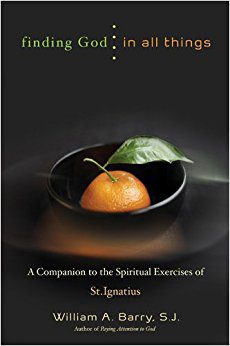
Finding God in All Things
I’ve been reading a book by William A. Barry, a Jesuit priest who is an authority on spiritual direction. The book, Finding God in All Things, is a companion to the Spiritual Exercises of St. Ignatius. If you’re not familiar with it, the Spiritual Exercises are the foundation of Ignatian (Jesuit) spirituality, which emphasizes fostering a loving, intimate relationship with God as the principle and foundation of a mature and healthy spiritual life.
In chapter two of his book, Fr. Barry talks about the importance of a meaningful and life-defining experience that can orient our lives toward — to use traditional language — knowing, loving, serving and enjoying God. He notes that such an experience must be real — not an abstract idea or figment of the imagination — and universal enough that it is a common experience for all humanity.
He goes on to describe a variety of authors, both spiritual and literary, who describe such experiences. This does not have to be explicitly religious, which is to say, an “experience of God” — it could be an experience of life-defining love, or a sense of meaningful longing for “I-know-not-what,” or even just a profound intuition of the basic rightness or goodness of things.
On the surface, I can relate to this idea: that experience is the foundation of spirituality. After all, I had one such experience when I was sixteen years old, at a Lutheran youth retreat — it was a profound, life-altering sense of God’s presence and infinite, unconditional love (you can read about it here). Based on conversations I’ve had with therapists, it’s my understanding that such “mystical awakenings” are not that uncommon, particularly among adolescents.
So I understand how this emphasis on a life-defining experience of God can seem really important to people seeking a meaningful spiritual life. Indeed, it is almost a commonplace to say, “I don’t want dogma, I want an experience of God.”
Alas, this emphasis on experience flies in the face of my formation as a Lay Cistercian — and, indeed, of my knowledge of a major stream in the history of Christian mysticism.
Not All “Experiences” Are Created Equal
If we base spirituality on experience, then this is the question that keeps nagging at me: what about all the people who don’t have (or even who just can’t recall) such “unitive” experiences?
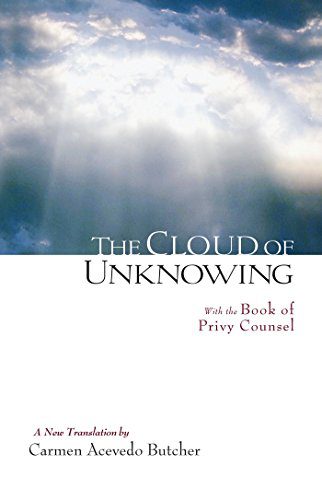
The Cloud of Unknowing, which points us away from an “experience” of God.
I think it’s dangerous to say that experience should be the necessary foundation for spiritual growth, because if we do, where does that leave a person who doesn’t have such an experience? Are they just out of luck, spiritually speaking? Should they just “imagine” it? Or pretend? I think trying to force an experience of God is a trap — and the great medieval manual of contemplation, The Cloud of Unknowing, even suggests that people who try to “manufacture” religious experience are “the devil’s contemplatives”!
Here’s the crux of the matter. The apophatic (image-less) tradition of Christian spirituality — also known as “negative mysticism,” the tradition exemplified by Pseudo-Dionysius, Meister Eckhart, The Cloud of Unknowing and John of the Cross — emphasizes the hiddenness and unknowability of God, the mystery of God, the fact that it is far easier for human beings to say what God is not than to say with any finality what God is.
So the apophatic tradition takes as its “principle and foundation” not an experience of God, but rather an acknowledgement of God’s essential mystery. God’s hiddenness, if you will. This is why Saint Paul says we are justified by faith — not by “experience.”
After all, experiences can be absent, or can be deceiving. An experience of God may be nothing more than an overactive imagination, or it might even be a projection of one’s own ego ideal onto the heavens — an experience of a “god” who is really just my ego, writ large across the cosmos! Of course, we can hope that effective spiritual direction would help a person to recognize when a purported spiritual experience is actually ego-driven rather than God-inspired. But that still leaves unanswered the question: what about people who simply do not have (or do not recall having) such powerful, experiential encounters with God?
Even though I myself had quite a remarkable “awakening experience” as a youth, subsequent to that I became involved in evangelical/charismatic spirituality. In the circles I moved, there was tremendous emphasis on experience. To be saved, you had to have an experience of accepting Christ as your personal savior. To be considered baptized in the Holy Spirit, you had to have an experience of receiving charismatic gifts, particularly the gift of speaking in tongues.
I discovered, to my dismay, that people would actually coach newcomers on how to speak in tongues. If it were a genuine gift from God, wouldn’t a person simply receive the gift — and not have to be coached on it? And if it really were meant for everyone, is it fair to call it a gift? To hear my charismatic friends describe spiritual experiences, it sounded like something people felt entitled to receive. And what is to be done about the persons who “fake” the experience, just to fit in with the tribe or to feel good about themselves?
So back to Ignatius and the Spiritual Exercises. I recognize that experience is a key element of Ignatian spirituality. But I think I’m going to hold on to my monastic recognition that sometimes God meets us in the lack of any discernible experience. That leads to the dark night of faith — the cloud of unknowing — and it has its own treasures (and its own challenges). I do not write this to attack Ignatian spirituality, but rather simply to acknowledge that every system of spirituality has its limitations — which would explain why, over the centuries, God has graced the human family with many different approaches to spiritual formation and spiritual living.
Enjoy reading this blog?
Click here to become a patron.

Stay in touch! Connect with Carl McColman on Facebook:
Previous Post

October 2, 2017
"No Moment of Silence" — Why Boycotting Silence is A Mistake
Browse Our Archives
Select a Category Activism Announcements Art Books Catholicism Celtic Christianity Christian mysticism Christianity Contemplation Current events Etc. Family humor interfaith dialogue Interfaith Wisdom Interspirituality Lay Cistercians Living the Faith Meditation movies Mysticism Mystics nature Poetry Reviews Scripture silence Spirituality Uncategorized Writing
Select a Month February 2025 January 2025 November 2024 September 2024 August 2024 July 2024 June 2024 May 2024 March 2024 January 2024 December 2023 November 2023 August 2023 June 2023 April 2023 March 2023 February 2023 January 2023 December 2022 November 2022 October 2022 September 2022 August 2022 July 2022 June 2022 May 2022 April 2022 February 2022 January 2022 December 2021 November 2021 October 2021 September 2021 August 2021 July 2021 June 2021 May 2021 April 2021 March 2021 February 2021 January 2021 December 2020 November 2020 October 2020 September 2020 August 2020 July 2020 June 2020 May 2020 April 2020 March 2020 February 2020 January 2020 December 2019 November 2019 October 2019 September 2019 August 2019 July 2019 June 2019 May 2019 April 2019 March 2019 February 2019 January 2019 December 2018 November 2018 October 2018 September 2018 August 2018 July 2018 June 2018 May 2018 April 2018 March 2018 February 2018 January 2018 December 2017 November 2017 October 2017 September 2017 August 2017 July 2017 June 2017 May 2017 April 2017 March 2017 February 2017 January 2017 December 2016 November 2016 October 2016 September 2016 August 2016 July 2016 June 2016 May 2016 March 2016 February 2016 January 2016 December 2015 November 2015 October 2015 September 2015 August 2015 July 2015 June 2015 May 2015 April 2015 March 2015 February 2015 January 2015 December 2014 November 2014 October 2014 September 2014 August 2014 July 2014 June 2014 May 2014 April 2014 March 2014 February 2014 January 2014 December 2013 October 2013 September 2013 July 2013 May 2013 January 2013 December 2012 November 2012 August 2012 July 2012 June 2012 March 2012 December 2011 September 2011 October 2010 August 2010 March 2010 September 2009 July 2008 January 2008 December 2007 September 2007 February 2007 January 2007 December 2004
Follow Us!
TAKE THE
Religious Wisdom Quiz
I brought musicians and singers to serve before the ark, establishing worship in Israel. Who am I?
Select your answer to see how you score.
Solomon David Heman Asaph
Support this
Column


Related posts from Carl McColman

"This Loving, Uniting Embrace": the Holy Ordinary

I Believe Prayer Changes Things. Here's a Few...

If You Worship an Angry God, You'll Be...

The Difference Between Apophatic and Kataphatic Spirituality
TRENDING AT PATHEOS Contemplative

Handy Contemplative Practices for Political Spaces
A Spiritually Grounded Presence In order to bring a spiritually grounded presence...

Halloween: The Holiday of Loving Your Neighbor
All Hallows Eve Is Halloween the least Christian holiday in America, or...

Can Love Be Saved? Some Thoughts on the...
Happy Valentine's Day! I recently published a post on Patreon called Can...

"This Loving, Uniting Embrace": the Holy Ordinary
Today's guest post is by Mark Longhurst, author of The Holy Ordinary:...

How Are We Called to Live?: More About...
How Are We Called to Live? Many of us struggle with discerning...

A Spiritual Practice of Reading: Join Us Online
A Spiritual Practice of Reading A healthy spiritual practice of reading is...
view all Contemplative blogs
Ad-Free & Subscriber Log-In Subscription Support
- About Us
- 2026 Calendar
- Videos
- Podcasts
- Library of World Religions
- Faith In Media Tracker
- Advertise With Us
- Write for Us
- Privacy Policy
- Terms of Service
- Do Not Sell My Data
- Contact Us
- Radiant Digital
- Manage Newsletter Subscriptions
- Unsubscribe From Notifications
- Sitemap
Copyright 2008-2026, Patheos. All rights reserved.
Subscription Support Ad-Free & Subscriber Log-In
Follow Patheos