
BuddhistCatholicContemplativeEvangelicalGeneral ChristianHinduJewishLatter-day SaintMuslimNew VisionsProgressive Christian
Beliefs
- Buddhist
- Catholic
- Contemplative
- Evangelical
- General Christian
- Hindu
- Jewish
- Latter-day Saint
- More Voices
- Muslim
- New Visions
- Pagan
- Progressive Christian
Topics
- Religion News
- Food and Religion
- Sports and Religion
- Religious Art
- Religious Music and Entertainment
- Religious Events
- History and Religion
- Style and Religion
- Politics and Religion
- Women in Religion
- Recreation Outdoors and Religion
- Business Finance and Religion
- Careers Workplace and Religion
- Education and Religion
- Family Parenting and Religion
- Health Fitness and Religion
- Home and Religion
- Relationships and Religion
- Technology and Religion
- Travel and Religion
Columnists
- Buddhist Columnists
- Business Finance and Religion Columnists
- Careers Workplace and Religion Columnists
- Catholic Columnists
- Contemplative Columnists
- Education and Religion Columnists
- Evangelists Columnists
- Family Parenting and Religion Columnists
- General Christian Columnists
- Health Fitness and Religion Columnists
- Hindu Columnists
- History and Religion Columnists
- Home and Religion Columnists
- Jewish Columnists
- More Voices Columnists
- Latter Day Columnists
- Muslim Columnists
- New Visions Columnists
- Nonreligious Columnists
- Pagan Columnists
- Politics and Religion Columnists
- Progressive Columnists
- Recreation Outdoors and Religion Columnists
- Relationships and Religion Columnists
- Religion News Columnists
- Religious Art Columnists
- Religious Events Columnists
- Religious Music and Entertainment Columnists
- Sports and Religion Columnists
- Style and Religion Columnists
- Technology and Religion Columnists
- Travel and Religion Columnists
- Women in Religion Columnists
Resource Library
- 2026 Calendar
- Library of World Religions
- The 100 Most Holy Places on Earth
- Patheos Answers
- Podcasts
- Videos
- Faith Leaders Database
- Anglican Episcopalian
- Bahai
- Baptist
- Buddhism
- Christianity
- Confucianism
- Eastern Orthodoxy
- Hinduism
- Holiness and Pentecostal
- ISKCON
- Islam
- Judaism
- Lutheran
- Methodist
- The Church of Jesus Christ of Latter-day Saints
- New Age
- Paganism
- Presbytarian and Reformed
- Protestantism
- Religion Behind the Scenes
- Roman Catholic
- Scientology
- Shia Islam
- Sikhism
- Sufism
- Sunni Islam
- Taoism
- Zen
- See all religions
Research Tools
 Ad-Free & Subscriber Log-In Subscription Support
Ad-Free & Subscriber Log-In Subscription Support
Follow Patheos 

- Trending:
- Forgiveness
- |
- Marriage
- |
- Consciousness
- |
- Death Penalty
- |
- Election
- |
- Halloween

- Home
- Contemplative
- What is the Relationship Between Contemplation and Privilege?
What is the Relationship Between Contemplation and Privilege?
Last updated on: September 21, 2017 at 3:32 pm by Carl "Skye" McColman
What is the Relationship Between Contemplation and Privilege? 2017-09-21T15:32:14-04:00 Carl "Skye" McColman
Patheos Explore the world's faith through different perspectives on religion and spirituality! Patheos has the views of the prevalent religions and spiritualities of the world.
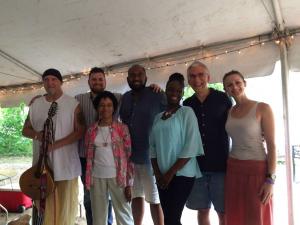
The Speakers at the “Wisdom Camp” of the Wild Goose Festival, July 2017. This is what contemplative community, at its best, looks like.
We live in a moment in history when, finally, our global human family seems to be starting to truly wrestle with the problems associated with systemic oppression — including racism, sexism, classism, and other ways in which we create social distinctions, or limit people’s freedom or opportunity, merely on the basis of their identity. There’s still much work to be done, but compared to where we were 50 or 100 years ago, it seems like progress is being made, however slowly.
This, I believe, is inspired by the leading of the Holy Spirit, for God is a God of love and justice.
Part of the challenge of dismantling oppression is that it also requires that we dismantle privilege. In other words, we cannot fully address the ways in which certain groups of people have been wronged without also coming to grips with the fact that other groups have benefited from the injustice.
That’s what we mean when we talk about privilege — as in white privilege, or male privilege, or heterosexual privilege. Privilege refers to the ways in which social structures benefit some people at the expense of others.
This may be a controversial topic to some, but probably mostly to those who are currently the beneficiaries of this or that dimension of privilege. Part of the nature of social privilege is that it tends to be invisible to those who benefit from it. As a wonderful banner I saw at the Wild Goose Festival so succinctly puts it, “White privilege: if you can’t see it, that means you’ve got it!”
Many of us, though, do see it, and because of our commitment to Christian values, we want a world where privilege no longer hurts those who lack it.
What does this have to do with contemplation?
I have been connected to the Christian contemplative movement in North America for over thirty years now. Over the years, I have seen that many (not all, but many) participants in the contemplative prayer movement tend to be white, educated, and affluent — in other words, people of privilege. That’s not across the board, of course, but it’s a pattern that I have noticed again and again.
Maybe this is more prevalent because I live in the south, but when I’ve spoken or led retreats in other parts of the country, it often seems that even there, the same types of folks keep showing up. Folks who, frankly, look and talk like me.
Some of this may have to do with the demographics of Christianity in America. Contemplation seems often to be most warmly embraced either by liberal Protestants — Episcopalians, Methodists, Presbyterians, and so forth — or by progressive Catholics, folks who are familiar with the writings of contemplatives like Thomas Merton, Henri Nouwen, or Richard Rohr. And since mainstream Protestants and liberal Catholics tend to be white, educated, and affluent… well, you get the picture.
It’s been said that 11 AM on Sunday morning is the most segregated hour of the week (that’s something that all Christians should be praying about — and I suspect these prayers need to be prayers of repentance!). And because the heritage of contemplation comes to us through western European Christianity (many of the great mystics whom I often write about on this blog come from either England, Germany, France or Spain), and then has been accepted primarily by white Christians in North America, then it’s no surprise that the Christian contemplative community here in America continues to look very white/European.
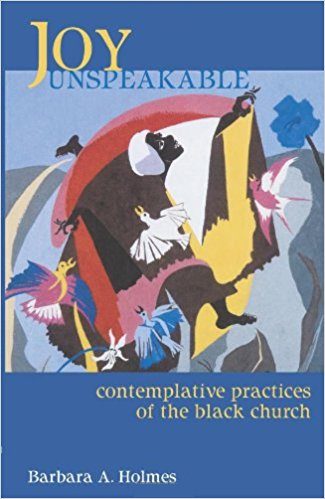
Joy Unspeakable
Thankfully, if we look at the history of Christian spirituality as a whole, we can see that there’s nothing inherently white or Euro-centric about the mystics or the contemplatives. Great mystics come from Africa, Asia Minor, and the Middle East just as much as they do from Europe (let us never forget that St. Augustine was African), and in our time, Thea Bowman and Howard Thurman are just two examples of contemplatives of color who lived here in America. In recent years, Barbara A. Holmes published a book exploring the contemplative spirituality of African Americans called Joy Unspeakable.
Even though many American contemplatives appear to be persons of privilege, there’s an irony at play here: simply this, that to engage in a sustained contemplative practice is likely to make a person more aware that privilege is a problem (maybe that’s wishful thinking on my part, but again my experience is that contemplatives tend to be people very much committed to working for greater equality and the dismantling of social oppression).
The problem is not that privileged people are drawn to contemplation. The problem, as I see it, is that the contemplative community has not yet found a way to step beyond its privileged pedigree and become a more truly multi-cultural and diverse community of contemplatives. I don’t have a formula for how we can make this happen. But it’s on my heart that this is something we should all be praying about, and be in discernment about. So I’m writing this post to invite you to pray and discern with me.
I pray that contemplatives, both individually and communally, will find ways to invite and include people who come from different social backgrounds than themselves — whether that means a different race, a different ethnicity, a different economic background or educational level, or even a different sexual orientation or religious identity.
Reaching out to the “other” can feel scary. And yet, we worship a God who calls us to love our neighbors — all our neighbors. So contemplatives really can do no less.
Enjoy reading this blog?
Click here to become a patron.

Stay in touch! Connect with Carl McColman on Facebook:
Previous Post
September 4, 2017
Imagine Thomas Merton Teaching You a Class on Christian Mysticism...
Next Post

September 10, 2017 Waiting for the Storm
Browse Our Archives
Select a Category Activism Announcements Art Books Catholicism Celtic Christianity Christian mysticism Christianity Contemplation Current events Etc. Family humor interfaith dialogue Interfaith Wisdom Interspirituality Lay Cistercians Living the Faith Meditation movies Mysticism Mystics nature Poetry Reviews Scripture silence Spirituality Uncategorized Writing
Select a Month February 2025 January 2025 November 2024 September 2024 August 2024 July 2024 June 2024 May 2024 March 2024 January 2024 December 2023 November 2023 August 2023 June 2023 April 2023 March 2023 February 2023 January 2023 December 2022 November 2022 October 2022 September 2022 August 2022 July 2022 June 2022 May 2022 April 2022 February 2022 January 2022 December 2021 November 2021 October 2021 September 2021 August 2021 July 2021 June 2021 May 2021 April 2021 March 2021 February 2021 January 2021 December 2020 November 2020 October 2020 September 2020 August 2020 July 2020 June 2020 May 2020 April 2020 March 2020 February 2020 January 2020 December 2019 November 2019 October 2019 September 2019 August 2019 July 2019 June 2019 May 2019 April 2019 March 2019 February 2019 January 2019 December 2018 November 2018 October 2018 September 2018 August 2018 July 2018 June 2018 May 2018 April 2018 March 2018 February 2018 January 2018 December 2017 November 2017 October 2017 September 2017 August 2017 July 2017 June 2017 May 2017 April 2017 March 2017 February 2017 January 2017 December 2016 November 2016 October 2016 September 2016 August 2016 July 2016 June 2016 May 2016 March 2016 February 2016 January 2016 December 2015 November 2015 October 2015 September 2015 August 2015 July 2015 June 2015 May 2015 April 2015 March 2015 February 2015 January 2015 December 2014 November 2014 October 2014 September 2014 August 2014 July 2014 June 2014 May 2014 April 2014 March 2014 February 2014 January 2014 December 2013 October 2013 September 2013 July 2013 May 2013 January 2013 December 2012 November 2012 August 2012 July 2012 June 2012 March 2012 December 2011 September 2011 October 2010 August 2010 March 2010 September 2009 July 2008 January 2008 December 2007 September 2007 February 2007 January 2007 December 2004
Follow Us!
TAKE THE
Religious Wisdom Quiz
Which Christian group practices foot washing as an ordinance?
Select your answer to see how you score.
Baptists Methodists Catholics Anabaptists
Support this
Column


Related posts from Carl McColman

"This Loving, Uniting Embrace": the Holy Ordinary

Four Dimensions of Mindfulness and Centering Prayer

I Believe Prayer Changes Things. Here's a Few...

If You Worship an Angry God, You'll Be...
TRENDING AT PATHEOS Contemplative

Handy Contemplative Practices for Political Spaces
A Spiritually Grounded Presence In order to bring a spiritually grounded presence...

Halloween: The Holiday of Loving Your Neighbor
All Hallows Eve Is Halloween the least Christian holiday in America, or...

Can Love Be Saved? Some Thoughts on the...
Happy Valentine's Day! I recently published a post on Patreon called Can...

"This Loving, Uniting Embrace": the Holy Ordinary
Today's guest post is by Mark Longhurst, author of The Holy Ordinary:...

How Are We Called to Live?: More About...
How Are We Called to Live? Many of us struggle with discerning...

A Spiritual Practice of Reading: Join Us Online
A Spiritual Practice of Reading A healthy spiritual practice of reading is...
view all Contemplative blogs
Ad-Free & Subscriber Log-In Subscription Support
- About Us
- 2026 Calendar
- Videos
- Podcasts
- Library of World Religions
- Faith In Media Tracker
- Advertise With Us
- Write for Us
- Privacy Policy
- Terms of Service
- Do Not Sell My Data
- Contact Us
- Radiant Digital
- Manage Newsletter Subscriptions
- Unsubscribe From Notifications
- Sitemap
Copyright 2008-2026, Patheos. All rights reserved.
Subscription Support Ad-Free & Subscriber Log-In
Follow Patheos