
BuddhistCatholicContemplativeEvangelicalGeneral ChristianHinduJewishLatter-day SaintMuslimNew VisionsProgressive Christian
Beliefs
- Buddhist
- Catholic
- Contemplative
- Evangelical
- General Christian
- Hindu
- Jewish
- Latter-day Saint
- More Voices
- Muslim
- New Visions
- Pagan
- Progressive Christian
Topics
- Religion News
- Food and Religion
- Sports and Religion
- Religious Art
- Religious Music and Entertainment
- Religious Events
- History and Religion
- Style and Religion
- Politics and Religion
- Women in Religion
- Recreation Outdoors and Religion
- Business Finance and Religion
- Careers Workplace and Religion
- Education and Religion
- Family Parenting and Religion
- Health Fitness and Religion
- Home and Religion
- Relationships and Religion
- Technology and Religion
- Travel and Religion
Columnists
- Buddhist Columnists
- Business Finance and Religion Columnists
- Careers Workplace and Religion Columnists
- Catholic Columnists
- Contemplative Columnists
- Education and Religion Columnists
- Evangelists Columnists
- Family Parenting and Religion Columnists
- General Christian Columnists
- Health Fitness and Religion Columnists
- Hindu Columnists
- History and Religion Columnists
- Home and Religion Columnists
- Jewish Columnists
- More Voices Columnists
- Latter Day Columnists
- Muslim Columnists
- New Visions Columnists
- Nonreligious Columnists
- Pagan Columnists
- Politics and Religion Columnists
- Progressive Columnists
- Recreation Outdoors and Religion Columnists
- Relationships and Religion Columnists
- Religion News Columnists
- Religious Art Columnists
- Religious Events Columnists
- Religious Music and Entertainment Columnists
- Sports and Religion Columnists
- Style and Religion Columnists
- Technology and Religion Columnists
- Travel and Religion Columnists
- Women in Religion Columnists
Resource Library
- 2026 Calendar
- Library of World Religions
- The 100 Most Holy Places on Earth
- Patheos Answers
- Podcasts
- Videos
- Faith Leaders Database
- Anglican Episcopalian
- Bahai
- Baptist
- Buddhism
- Christianity
- Confucianism
- Eastern Orthodoxy
- Hinduism
- Holiness and Pentecostal
- ISKCON
- Islam
- Judaism
- Lutheran
- Methodist
- The Church of Jesus Christ of Latter-day Saints
- New Age
- Paganism
- Presbytarian and Reformed
- Protestantism
- Religion Behind the Scenes
- Roman Catholic
- Scientology
- Shia Islam
- Sikhism
- Sufism
- Sunni Islam
- Taoism
- Zen
- See all religions
Research Tools
 Ad-Free & Subscriber Log-In Subscription Support
Ad-Free & Subscriber Log-In Subscription Support
Follow Patheos 

- Trending:
- Forgiveness
- |
- Marriage
- |
- Consciousness
- |
- Death Penalty
- |
- Election
- |
- Halloween

- Home
- Contemplative
- How Should A Christian Respond When a Friend Becomes Interested in Witchcraft and Magic?
How Should A Christian Respond When a Friend Becomes Interested in Witchcraft and Magic?
Last updated on: December 22, 2018 at 12:54 am by Carl "Skye" McColman
How Should A Christian Respond When a Friend Becomes Interested in Witchcraft and Magic? 2018-12-22T00:54:51-04:00 Carl "Skye" McColman
Patheos Explore the world's faith through different perspectives on religion and spirituality! Patheos has the views of the prevalent religions and spiritualities of the world.

Neopaganism: more than just dancing by moonlight…
As long-standing readers of this blog know, I have not always been a Catholic; I embraced Catholicism in 2004 after a Protestant upbringing and then about a seven-year stint in which I followed a neopagan spiritual path. Indeed, I wrote a number of books about paganism, a fact I discussed in an earlier blog post, You Wrote Books About Paganism? These days, my work as a writer is primarily geared toward Christians, but I do not consider myself hostile to paganism (the Catholic tradition has always taught, even before Vatican II, that Catholics should respect what is good and true and beautiful in other religious traditions).
But just because I am not hostile to paganism, does not mean that I do not have opinions about paganism — including some criticisms. Today’s post, inspired by an email I received from a reader recently, looks at some of those criticisms. The reader wrote to me because a friend of hers, who is a Christian, is exploring magic and witchcraft, and she is not sure how to respond to this. So she turned to me for my thoughts on that question.
The Reader Writes:
I have a dear friend who is a follower of Christ and also has a fascination with magic and witchcraft. At this point, they have not pursued their interest but I know it continues to be a draw for them. I was just wondering if you have any concerns, thoughts, or wisdom to share concerning whether or not a Christian should pursue the magic arts. I personally don’t have any experience with this and feel it would be helpful to seek wisdom from someone who does. I care about this person deeply and don’t want them to get hurt. Thank you for your time!
My response:
Thanks for reaching out. Many Christians find magic and witchcraft interesting or appealing. I imagine there are many reasons why this is so. By the same token, other Christians are drawn to explore Hinduism or Buddhism or other traditional religions. All of this falls under the umbrella terms “interfaith dialogue” or “inter-religious dialogue” or “interspirituality.” I do believe God calls some of us to function like bridges between the different faith traditions, in the interest of promoting understanding and unity as much as we are able. There are very real cultural and values differences between the different faith traditions, that should not be glossed over. Even so, it’s important to remember that we are all human beings, we share the same planet, and it is important we learn how to love one another, without violence and without constantly trying to control or change each other.
But to your specific question. I think the first question your friend needs to wrestle with: are they thinking about leaving Christianity altogether? It’s one thing to be a Christian with a lively interest in another tradition (like I described above), and another thing to change one’s spiritual path altogether. I think having clarity about their intentions (which may mean doing some deep inner work, so that they are aware of what is driving them, even subconsciously) is really important. God loves us whether we remain Christian or not, but of course the decision to change one’s spiritual path should not be made lightly, as it can have real repercussions with one’s family and social network.
If your friend is clear that they want to remain Christian, but still wants to learn more about magic and witchcraft, then I would recommend reading a few books on the topic. Ronald Hutton’s The Triumph of the Moon is very important; it’s academic but easy to read, and it is the most balanced and in-depth history of modern witchcraft and paganism that I have come across. So I think that is a “must read.” Another classic is Starhawk’s The Spiral Dance, which looks at witchcraft from a feminist perspective. Finally, at the risk of a bit of shameless self-promotion let me suggest my own When Someone You Love is Wiccan, which I wrote back when I was still a practicing pagan. In fact, that might be a good book for you to read, especially if your friend does go ahead and begin to practice witchcraft.
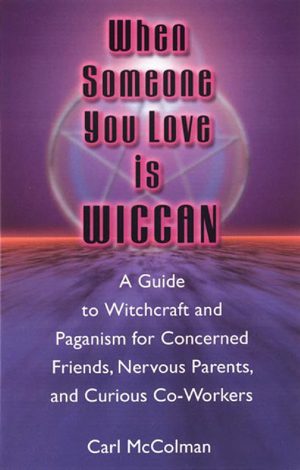
“When Someone You Love is Wiccan” by Carl McColman
These books are all sympathetic to witchcraft and magic. To try to keep things balanced, normally I would also recommend one or two books that take a more critical view, but unfortunately most of the anti-witchcraft books, at least that I know of, are very poorly written, usually from a fundamentalist Christian perspective. I think anyone with an open mind who reads those books would think “gee, witchcraft sounds better than Christianity!” Fundamentalism is NOT the answer to magic or witchcraft.
So maybe I should give you (and your friend) just a few thoughts to be able to think about magic and witchcraft objectively. In writing this, it is not my purpose to gratuitously attack or denounce paganism. Rather, I am trying simply to be honest about my own concerns. I think anyone who explores the topic needs to have a balanced perspective, and so I offer these points in the interest of that balance.
My Honest Concerns
First of all, I would caution anyone interested in magic to think carefully about the basic premise: that you can use spiritual power to attain your goals. On the surface, that sounds like a good thing: after all, isn’t the purpose of life to be happy and make the most of it? My question would be: where is the balance? If my life is all about just making myself happy, isn’t that ultimately rather narcissistic? Isn’t love more important than wish-fulfillment? For example: let’s say I want a new lover, so I cast a love spell to get that person. They show up. I may have a torrid love affair but in the back of my mind I’ll always be wondering if the person really loves me, or if they are just bound to me by the spell. In other words, if I hadn’t cast the spell, would they have still come into my life? If so, then the spell was unnecessary; but if not, then that means the “love” is not real, it’s just a product of the spell.
The story of King Midas applies here. Magic promises to make us happy, but it seems there is always a catch. And I think the “catch” ultimately is this: that getting our wishes fulfilled is not the ultimate path to happiness. That path is the path of love, not power.
There are all these spell books on the market, filled with spells to lose weight, make more money, become more attractive, get a lover, get lots of lovers (!), find the perfect job, boost self-confidence, etc. etc. etc. At the end of the day, it seems like “it’s all about me.” That’s why I think it’s narcissistic. Love, on the other hand, focusses not on how to make myself happy, but rather how to build happy relationships, which means balancing my own needs with the needs of my friends, my spouse, my neighbors, co-workers, etc.
So I came to see that magic is really unnecessary, as long as I have dedicated my life to becoming a more loving person. When I realized that, that’s when I started to let go of witchcraft and return to Christianity.
Now, some people will say that witchcraft, and especially paganism, is more about spirituality than magic. It’s about reverencing the earth and the Divine Feminine (the Goddess). And I think for some people this is really true. And I think Christianity, historically, has done a poor job at acknowledging that God encompasses both masculinity and femininity — the Goddess in many ways is a “reaction” against the hyper-masculinity of traditional Christian ideas about God. Likewise, I think because Christianity has tended to emphasize heaven above earth, paganism’s emphasis on venerating the earth is a similar reaction agains the excesses of Christianity.
But here’s my question: if witchcraft/paganism venerates the Goddess and the Earth as a reaction against Christianity’s emphasis on the Father God and heaven, doesn’t that make modern-day paganism simply a protest movement against Christianity? And if that’s the case, perhaps what Christians need to be doing, instead of becoming witches, we need to be cultivating a healthier form of Christianity: one that acknowledges that the earth is good (but without worshipping it), and that acknowledges that God ultimately is our Mother as much as our Father.
What is most important, for you and your friend, and really for any Christian who feels drawn to magic or witchcraft, is to remember simply this: that God is Love, that God loves us very much and wants what is best for us. I think many Christians turn to magic and witchcraft because they have been hurt by Christianity or have found Christianity to be boring and stifling. That certainly happens. But I believe when Christianity fails to live up to its own mystical beauty, the answer is not to abandon Christianity for another path, but rather to discover the beauty and wonder that lives at the heart of true Christian mysticism.
I’ll keep you and your friend in my prayers. Please pray for me as well.
A Final Word
Finally, here are a few thoughts specifically for the reader, and for anyone who is facing a situation where a Christian loved one is turning away from Christianity to explore a different religion or spirituality.
It can be scary when a friend or loved one explores a new or different religious tradition, and even scarier if he or she abandons their old faith to embrace something new. Christians sometimes feel as if their friend’s soul is now in eternal danger, and therefore may try to dissuade the friend from their spiritual exploration. But such efforts often backfire: they too easily come across as fear-mongering and controlling, if not judgmental.
If your friend thinks you are trying to frighten or control them, they may cut off your friendship. So I think it’s important for Christians to focus on loving our friends, which leads to a delicate balancing act. Sure, it’s only fair that we express our misgivings when a friend abandons Christianity: but we need to own that this is our misgivings. “It saddens me to think that you and I will no longer be doing ministry together, or going to church together, or studying the history of Christian spirituality together.” Maybe even take it further: “It even scares me a little to think of you embracing a different type of spirituality.”
Always finish with: “But I want you to know that I love you and I want us to remain friends, and I hope you’ll feel like you can talk to me without judgment or condemnation. And if I say or do anything that seems to be judgmental, please call me on it — after all, I’m only human!” I think what people who abandon Christianity need from Christians, more than anything else, is love — we need to be conduits of God’s love and grace to the world, which is after all our mission as people who recognize we are created in God’s image and likeness.
So if you feel sad, or afraid, because someone you love has embraced a non-Christian form of spirituality, own your feelings as your feelings. And then take a look at your own relationship with God. Do you harbor any secret fears that God will reject your friend now that they’ve changed paths? Do you see God primarily as wrathful and judgmental? Or do you recognize that God is love, which means that even when someone says “no” to God (directly or indirectly), God still loves them, unconditionally? Those are good questions for Christians to explore; as we become more secure in God’s love, we become more capable of relating with compassion and clarity to those whose spirituality is different from our own.
Enjoy reading this blog?
Click here to become a patron.

Previous Post
August 10, 2017
How do Contemplatives Share the Gospel with Others?
Next Post

August 16, 2017 Charlottesville
Browse Our Archives
Select a Category Activism Announcements Art Books Catholicism Celtic Christianity Christian mysticism Christianity Contemplation Current events Etc. Family humor interfaith dialogue Interfaith Wisdom Interspirituality Lay Cistercians Living the Faith Meditation movies Mysticism Mystics nature Poetry Reviews Scripture silence Spirituality Uncategorized Writing
Select a Month February 2025 January 2025 November 2024 September 2024 August 2024 July 2024 June 2024 May 2024 March 2024 January 2024 December 2023 November 2023 August 2023 June 2023 April 2023 March 2023 February 2023 January 2023 December 2022 November 2022 October 2022 September 2022 August 2022 July 2022 June 2022 May 2022 April 2022 February 2022 January 2022 December 2021 November 2021 October 2021 September 2021 August 2021 July 2021 June 2021 May 2021 April 2021 March 2021 February 2021 January 2021 December 2020 November 2020 October 2020 September 2020 August 2020 July 2020 June 2020 May 2020 April 2020 March 2020 February 2020 January 2020 December 2019 November 2019 October 2019 September 2019 August 2019 July 2019 June 2019 May 2019 April 2019 March 2019 February 2019 January 2019 December 2018 November 2018 October 2018 September 2018 August 2018 July 2018 June 2018 May 2018 April 2018 March 2018 February 2018 January 2018 December 2017 November 2017 October 2017 September 2017 August 2017 July 2017 June 2017 May 2017 April 2017 March 2017 February 2017 January 2017 December 2016 November 2016 October 2016 September 2016 August 2016 July 2016 June 2016 May 2016 March 2016 February 2016 January 2016 December 2015 November 2015 October 2015 September 2015 August 2015 July 2015 June 2015 May 2015 April 2015 March 2015 February 2015 January 2015 December 2014 November 2014 October 2014 September 2014 August 2014 July 2014 June 2014 May 2014 April 2014 March 2014 February 2014 January 2014 December 2013 October 2013 September 2013 July 2013 May 2013 January 2013 December 2012 November 2012 August 2012 July 2012 June 2012 March 2012 December 2011 September 2011 October 2010 August 2010 March 2010 September 2009 July 2008 January 2008 December 2007 September 2007 February 2007 January 2007 December 2004
Follow Us!
TAKE THE
Religious Wisdom Quiz
Who became king after David and built the first Temple in Jerusalem?
Select your answer to see how you score.
Rehoboam Adonijah Solomon Absalom
Support this
Column


Related posts from Carl McColman

Interspirituality and Cultural Appropriation, or, How to Expand...
"Do I stay Christian?" A Conversation with Brian...

Putting the “Christian” into “Christian Mysticism”
The Problem with Christianity in a Nutshell
TRENDING AT PATHEOS Contemplative

Handy Contemplative Practices for Political Spaces
A Spiritually Grounded Presence In order to bring a spiritually grounded presence...

Halloween: The Holiday of Loving Your Neighbor
All Hallows Eve Is Halloween the least Christian holiday in America, or...

Can Love Be Saved? Some Thoughts on the...
Happy Valentine's Day! I recently published a post on Patreon called Can...

"This Loving, Uniting Embrace": the Holy Ordinary
Today's guest post is by Mark Longhurst, author of The Holy Ordinary:...

How Are We Called to Live?: More About...
How Are We Called to Live? Many of us struggle with discerning...

A Spiritual Practice of Reading: Join Us Online
A Spiritual Practice of Reading A healthy spiritual practice of reading is...
view all Contemplative blogs
Ad-Free & Subscriber Log-In Subscription Support
- About Us
- 2026 Calendar
- Videos
- Podcasts
- Library of World Religions
- Faith In Media Tracker
- Advertise With Us
- Write for Us
- Privacy Policy
- Terms of Service
- Do Not Sell My Data
- Contact Us
- Radiant Digital
- Manage Newsletter Subscriptions
- Unsubscribe From Notifications
- Sitemap
Copyright 2008-2026, Patheos. All rights reserved.
Subscription Support Ad-Free & Subscriber Log-In
Follow Patheos