
BuddhistCatholicContemplativeEvangelicalGeneral ChristianHinduJewishLatter-day SaintMuslimNew VisionsProgressive Christian
Beliefs
- Buddhist
- Catholic
- Contemplative
- Evangelical
- General Christian
- Hindu
- Jewish
- Latter-day Saint
- More Voices
- Muslim
- New Visions
- Pagan
- Progressive Christian
Topics
- Religion News
- Food and Religion
- Sports and Religion
- Religious Art
- Religious Music and Entertainment
- Religious Events
- History and Religion
- Style and Religion
- Politics and Religion
- Women in Religion
- Recreation Outdoors and Religion
- Business Finance and Religion
- Careers Workplace and Religion
- Education and Religion
- Family Parenting and Religion
- Health Fitness and Religion
- Home and Religion
- Relationships and Religion
- Technology and Religion
- Travel and Religion
Columnists
- Buddhist Columnists
- Business Finance and Religion Columnists
- Careers Workplace and Religion Columnists
- Catholic Columnists
- Contemplative Columnists
- Education and Religion Columnists
- Evangelists Columnists
- Family Parenting and Religion Columnists
- General Christian Columnists
- Health Fitness and Religion Columnists
- Hindu Columnists
- History and Religion Columnists
- Home and Religion Columnists
- Jewish Columnists
- More Voices Columnists
- Latter Day Columnists
- Muslim Columnists
- New Visions Columnists
- Nonreligious Columnists
- Pagan Columnists
- Politics and Religion Columnists
- Progressive Columnists
- Recreation Outdoors and Religion Columnists
- Relationships and Religion Columnists
- Religion News Columnists
- Religious Art Columnists
- Religious Events Columnists
- Religious Music and Entertainment Columnists
- Sports and Religion Columnists
- Style and Religion Columnists
- Technology and Religion Columnists
- Travel and Religion Columnists
- Women in Religion Columnists
Resource Library
- 2026 Calendar
- Library of World Religions
- The 100 Most Holy Places on Earth
- Patheos Answers
- Podcasts
- Videos
- Faith Leaders Database
- Anglican Episcopalian
- Bahai
- Baptist
- Buddhism
- Christianity
- Confucianism
- Eastern Orthodoxy
- Hinduism
- Holiness and Pentecostal
- ISKCON
- Islam
- Judaism
- Lutheran
- Methodist
- The Church of Jesus Christ of Latter-day Saints
- New Age
- Paganism
- Presbytarian and Reformed
- Protestantism
- Religion Behind the Scenes
- Roman Catholic
- Scientology
- Shia Islam
- Sikhism
- Sufism
- Sunni Islam
- Taoism
- Zen
- See all religions
Research Tools
 Ad-Free & Subscriber Log-In Subscription Support
Ad-Free & Subscriber Log-In Subscription Support
Follow Patheos 

- Trending:
- Forgiveness
- |
- Marriage
- |
- Consciousness
- |
- Death Penalty
- |
- Election
- |
- Halloween

- Home
- Contemplative
- Saint Brigid (Part Two)
Saint Brigid (Part Two)
Last updated on: December 19, 2018 at 1:25 am by Carl "Skye" McColman
Saint Brigid (Part Two) 2018-12-19T01:25:47-04:00 Carl "Skye" McColman
Patheos Explore the world's faith through different perspectives on religion and spirituality! Patheos has the views of the prevalent religions and spiritualities of the world.
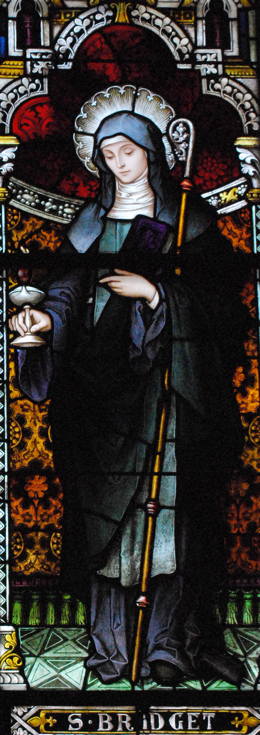
St. Brigid of Kildare Stained Glass (photo by Fran McColman), St. Joseph’s Catholic Church, Macon, GA.
This is the second of a two-part series on Saint Brigid. Click here to read part one.
As the abbess of Kildare, Brigid soon became renowned for her holiness and spiritual leadership. The stories told about her are both charming and illuminating. Perhaps my favorite story about Brigid involves the season of Lent, the 40-day period before Easter when Christians fast in preparation for their high holy days. The story goes that Brigid, and two other nuns from Kildare were traveling during the Lenten season, and at nightfall came to the estate of a pagan chieftain, who offered them hospitality for the night. As the three sisters sat down to share a meal with their host, they were surprised to see that their plates were filled with pork. Without a second’s thought, both of the younger nuns protested, saying that their rule of life would not permit them to eat meat during Lent. Upon hearing this, Brigid stood up, grabbed each of the younger women by their arms, and escorted them out the front door of the house. She returned to the table and said to the dumbfounded pagan lord, “My apologies, good sir. My sisters are under the mistaken impression that their fast matters more than your hospitality.”
One fascinating story involves Sister Dara, a blind nun who asked for Brigid’s prayers. The saint obliged, and Sr. Dara’s eyesight was indeed miraculously restored. But the nun discovered, to her dismay, that the ability to see physically actually hindered her mystical ability to “see” God in her soul. Distraught, the nun asked Brigid to pray for her again — only this time, to reverse the healing of her eyes, thereby consigning her to the beauty of darkness — a beauty in which the supernatural light of God shone.
But don’t make the mistake of thinking that all of Brigid’s miracles are pious in nature. Perhaps the most surprising — and yet, profoundly Celtic — story, only mentioned briefly in The Irish Life of Brigid, of a woman from Kells who “hated” her husband — after Brigid intervened with prayers and some blessed holy water, the woman “loved him passionately.” Some have interpreted this to suggest that Brigid is a patron saint for those who suffer from sexual dysfunction! That may be reading a bit much into the text, but we can safely assume that Brigid’s ability to heal includes, at least for the couple from Kells, the ability to help a husband and wife to love, joyfully and passionately.
Another charming story tells of Brigid’s compassionate understanding of justice — along with her love for nature. The king of Munster had a special pet fox, that had been trained to perform tricks. One day the fox got loose from the palace, and ran off into the woods, where a local hunter killed the beast. When the king found out what had happened, he angrily had the man imprisoned. Hearing of this, Brigid herself went into the woods and found a wild fox; she prayed over it and the animal became docile, allowing her to carry it to the palace. She presented the fox to the king, claiming there had been a mistake and the hunter must have killed some other fox. To everyone’s delight, the new fox even performed all the same tricks as the old one! Mollified, the king released the hunter from prison. Sadly for him, though, once Brigid and the hunter left the palace, the fox itself reverted to its wild nature and ran off into the woods!
Some stories also link Brigid to other well-known saints of her time. One tradition suggests that she was baptized by Patrick himself; which is not entirely unbelievable, given that Patrick is said to have lived into the second half of the fifth century, whereas Brigid was born circa 451. But the most charming encounter between Brigid and another saint involved Brendan the Navigator. Legend holds that the two knew of each other, and one time Brendan traveled from the west of Ireland to Kildare to meet the renowned abbess. When he arrived at her home, Brigid had been out in the fields tending to the sheep, and was caught in a rainstorm while returning to the abbey. When she arrived, the sun came back out, and she took off her soaked cloak and hung it to dry on a sunbeam, shining into her room. Surprised at this, Brendan took off his own cloak and placed it next to hers on the sunbeam — only to have it fall down onto the floor. Again he tried to hang it on the sunbeam, and again it fell. When it fell for the third time, he asked Brigid why here cloak hung on the sunbeam. With a twinkle in her eyes, she said, “All things are possible with prayer.”
Brigid was also known as the “foster-mother of Christ.” I suspect this may have something to do with the esteem by which she was held among the early Celtic Christians — no woman was more honored except Mary herself (indeed, the Celts sometimes referred to Brigid as “the Mary of the Gaels”). Since Mary was Christ’s actual mother, wouldn’t it make sense for the second most saintly woman in all Christendom to be the Lord’s foster-mother? A variation of this was that Brigid was Christ’s wet-nurse, which seems to hearken back to the association between Brigid (or the goddess Brigit) and milk.
Of course, charming as these folktales might be, it doesn’t take much of a grasp of history to recognize that Brigid was born about 475 years too late to actually be Christ’s wet-nurse or foster-mother — let alone the unlikelihood that an Irish woman could care for a baby born in Palestine. Never mind — the legend goes on to suggest that angels actually came to Brigit and carried her over the miles from Ireland to the Holy Land — simultaneously traveling backwards in time! — To deliver her safely to her calling to nurture Jesus in his infancy.
The Scottish painter John Duncan (1866-1945) captured a striking image of the angels carrying Brigid across the sea in his painting Saint Bride (1913), now on display in the Scottish National Gallery. Colorful and dramatic, with seagulls and a seal accompanying the heavenly beings (who look like they are on loan from a pre-Raphaelite painting), while Brigid, dressed in white with flowing long red hair, rests in their arms, eyes closed and hands folded in prayer. It’s a fanciful image, but striking in its almost otherworldly beauty.
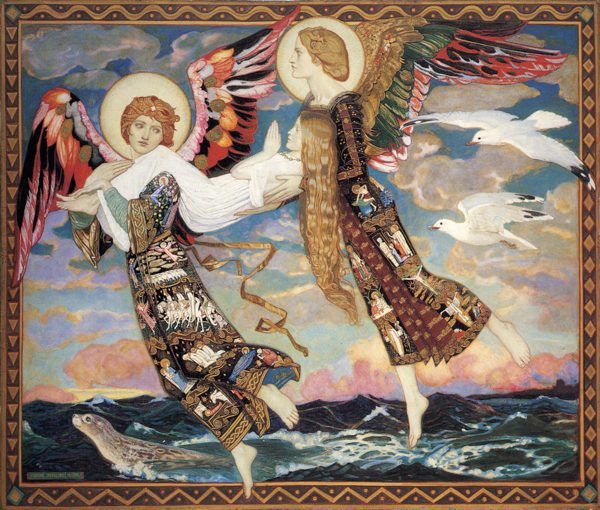
Saint Bride (1913) by Scottish Painter John Duncan (public domain)
One of the most striking stories surrounding Brigid — and her community of nuns in Kildare — involves the tending of a sacred fire. According to Gerald of Wales, who visited Kildare in the twelfth century (centuries after Brigid’s life), the nuns kept an eternal flame burning in Brigid’s honor. The flame was tended on a twenty-day cycle, with one of nineteen different nuns keeping the flame burning for a 24-hour period. On the twentieth day the flame was left unattended for the saint herself to watch over it, and Gerald reported that the flame never went out even when left in Brigid’s care. Of course, Gerald would have had to take the nun’s word for it, as men were not allowed in the building where the flame was kept lit.
The parallels between this and pagan practices — such as the Vestal Virgins, who kept a sacred flame lit for the goddess Vesta in Rome — are obvious, and apparently bishops occasionally would instruct the nuns to extinguish the flame; but the nuns would relight it as soon as they could. It is possible that the flame was kept lit up until the time of King Henry VIII, who suppressed the monasteries as part of his program of religious reform. However, nuns in Ireland today re-lit the flame in 1993, and it continues to burn in Kildare today.
I’ve saved my favorite Brigid story for last. A poem/prayer, attributed to Brigid but probably written sometime around the tenth century, embodies a joyful, earthy and playful spirituality. Many translations and versions of this prayer have been made over the years; here’s my paraphrase:
I want to give a lake of beer to God almighty,
And may the heavenly host imbibe there eternally.
I’d love the Heavenly host to live, and dance, and sing with me,
And whatever they want, I’d give to them, even casks of misery.
Radiant cups of love I’ll give to them, my heart more than full,
And pitchers of mercy as well, for every one to swill.
I would make Heaven a cheerful place, where happy hearts dwell,
I’d make every one satisfied — and may Jesus love me as well.
May all the hosts of heaven gather from every land and place,
The women I’ll greet with special joy, the Marys of fame and grace.
All of God’s lovers will join me there, by the lake of ale;
With each sip we drink a prayer to God, for ever life so hale.
Some folktales associated with Brigid suggest that she could miraculously turn water into beer. Apparently turning water into wine was a miracle reserved for Christ alone, but Brigid could do the next best thing!
So what are we to make of Brigid today? What can we say about her, apart from the legends, folktales and vestigial pagan myths? One way to answer that question might be to consider the ministry of the Brigidine Sisters, a Catholic women’s order founded in Ireland in 1807. This is the community of sisters who still live in Kildare, where they maintain the sacred flame, operate a retreat center, and sponsor a festival dedicated to Brigid each year at the time of her feast day on February 1. The festival focusses on issues related to peacemaking and justice. I can’t help but think that Brigid approves of her sacred flame still burning with an eye to hospitality, reconciliation, and community. Perhaps when we work to foster greater justice and mercy in our own communities — wherever we may live — the spirit of Celtic wisdom is embodied in our lives and our actions.
Enjoy reading this blog?
Click here to become a patron.

Previous Post
June 6, 2017
Sacred Rhythms: How Monastic Spirituality Can Nurture Your Walk with God
Next Post

June 8, 2017 The Heart of Celtic Spirituality is Hospitality
Browse Our Archives
Select a Category Activism Announcements Art Books Catholicism Celtic Christianity Christian mysticism Christianity Contemplation Current events Etc. Family humor interfaith dialogue Interfaith Wisdom Interspirituality Lay Cistercians Living the Faith Meditation movies Mysticism Mystics nature Poetry Reviews Scripture silence Spirituality Uncategorized Writing
Select a Month February 2025 January 2025 November 2024 September 2024 August 2024 July 2024 June 2024 May 2024 March 2024 January 2024 December 2023 November 2023 August 2023 June 2023 April 2023 March 2023 February 2023 January 2023 December 2022 November 2022 October 2022 September 2022 August 2022 July 2022 June 2022 May 2022 April 2022 February 2022 January 2022 December 2021 November 2021 October 2021 September 2021 August 2021 July 2021 June 2021 May 2021 April 2021 March 2021 February 2021 January 2021 December 2020 November 2020 October 2020 September 2020 August 2020 July 2020 June 2020 May 2020 April 2020 March 2020 February 2020 January 2020 December 2019 November 2019 October 2019 September 2019 August 2019 July 2019 June 2019 May 2019 April 2019 March 2019 February 2019 January 2019 December 2018 November 2018 October 2018 September 2018 August 2018 July 2018 June 2018 May 2018 April 2018 March 2018 February 2018 January 2018 December 2017 November 2017 October 2017 September 2017 August 2017 July 2017 June 2017 May 2017 April 2017 March 2017 February 2017 January 2017 December 2016 November 2016 October 2016 September 2016 August 2016 July 2016 June 2016 May 2016 March 2016 February 2016 January 2016 December 2015 November 2015 October 2015 September 2015 August 2015 July 2015 June 2015 May 2015 April 2015 March 2015 February 2015 January 2015 December 2014 November 2014 October 2014 September 2014 August 2014 July 2014 June 2014 May 2014 April 2014 March 2014 February 2014 January 2014 December 2013 October 2013 September 2013 July 2013 May 2013 January 2013 December 2012 November 2012 August 2012 July 2012 June 2012 March 2012 December 2011 September 2011 October 2010 August 2010 March 2010 September 2009 July 2008 January 2008 December 2007 September 2007 February 2007 January 2007 December 2004
Follow Us!
TAKE THE
Religious Wisdom Quiz
Which of their sons did Adam and Eve lose first?
Select your answer to see how you score.
Abel Cain Seth Japheth
Support this
Column


Related posts from Carl McColman
Register for the "Celtic Spirituality School" — Yearlong...

Explore Celtic Spirituality with "Spirituality and Practice" Online...

Celtic Spirituality, Celtic Prayer, and the Promises of...

Miann: The Ardent Desire for God
TRENDING AT PATHEOS Contemplative

Handy Contemplative Practices for Political Spaces
A Spiritually Grounded Presence In order to bring a spiritually grounded presence...

Halloween: The Holiday of Loving Your Neighbor
All Hallows Eve Is Halloween the least Christian holiday in America, or...

Can Love Be Saved? Some Thoughts on the...
Happy Valentine's Day! I recently published a post on Patreon called Can...

"This Loving, Uniting Embrace": the Holy Ordinary
Today's guest post is by Mark Longhurst, author of The Holy Ordinary:...

How Are We Called to Live?: More About...
How Are We Called to Live? Many of us struggle with discerning...

A Spiritual Practice of Reading: Join Us Online
A Spiritual Practice of Reading A healthy spiritual practice of reading is...
view all Contemplative blogs
Ad-Free & Subscriber Log-In Subscription Support
- About Us
- 2026 Calendar
- Videos
- Podcasts
- Library of World Religions
- Faith In Media Tracker
- Advertise With Us
- Write for Us
- Privacy Policy
- Terms of Service
- Do Not Sell My Data
- Contact Us
- Radiant Digital
- Manage Newsletter Subscriptions
- Unsubscribe From Notifications
- Sitemap
Copyright 2008-2026, Patheos. All rights reserved.
Subscription Support Ad-Free & Subscriber Log-In
Follow Patheos