
BuddhistCatholicContemplativeEvangelicalGeneral ChristianHinduJewishLatter-day SaintMuslimNew VisionsProgressive Christian
Beliefs
- Buddhist
- Catholic
- Contemplative
- Evangelical
- General Christian
- Hindu
- Jewish
- Latter-day Saint
- More Voices
- Muslim
- New Visions
- Pagan
- Progressive Christian
Topics
- Religion News
- Food and Religion
- Sports and Religion
- Religious Art
- Religious Music and Entertainment
- Religious Events
- History and Religion
- Style and Religion
- Politics and Religion
- Women in Religion
- Recreation Outdoors and Religion
- Business Finance and Religion
- Careers Workplace and Religion
- Education and Religion
- Family Parenting and Religion
- Health Fitness and Religion
- Home and Religion
- Relationships and Religion
- Technology and Religion
- Travel and Religion
Columnists
- Buddhist Columnists
- Business Finance and Religion Columnists
- Careers Workplace and Religion Columnists
- Catholic Columnists
- Contemplative Columnists
- Education and Religion Columnists
- Evangelists Columnists
- Family Parenting and Religion Columnists
- General Christian Columnists
- Health Fitness and Religion Columnists
- Hindu Columnists
- History and Religion Columnists
- Home and Religion Columnists
- Jewish Columnists
- More Voices Columnists
- Latter Day Columnists
- Muslim Columnists
- New Visions Columnists
- Nonreligious Columnists
- Pagan Columnists
- Politics and Religion Columnists
- Progressive Columnists
- Recreation Outdoors and Religion Columnists
- Relationships and Religion Columnists
- Religion News Columnists
- Religious Art Columnists
- Religious Events Columnists
- Religious Music and Entertainment Columnists
- Sports and Religion Columnists
- Style and Religion Columnists
- Technology and Religion Columnists
- Travel and Religion Columnists
- Women in Religion Columnists
Resource Library
- 2026 Calendar
- Library of World Religions
- The 100 Most Holy Places on Earth
- Patheos Answers
- Podcasts
- Videos
- Faith Leaders Database
- Anglican Episcopalian
- Bahai
- Baptist
- Buddhism
- Christianity
- Confucianism
- Eastern Orthodoxy
- Hinduism
- Holiness and Pentecostal
- ISKCON
- Islam
- Judaism
- Lutheran
- Methodist
- The Church of Jesus Christ of Latter-day Saints
- New Age
- Paganism
- Presbytarian and Reformed
- Protestantism
- Religion Behind the Scenes
- Roman Catholic
- Scientology
- Shia Islam
- Sikhism
- Sufism
- Sunni Islam
- Taoism
- Zen
- See all religions
Research Tools
 Ad-Free & Subscriber Log-In Subscription Support
Ad-Free & Subscriber Log-In Subscription Support
Follow Patheos 

- Trending:
- Forgiveness
- |
- Marriage
- |
- Consciousness
- |
- Death Penalty
- |
- Election
- |
- Halloween

- Home
- Contemplative
- Saint Brigid (Part One)
Saint Brigid (Part One)
Last updated on: December 19, 2018 at 1:23 am by Carl "Skye" McColman
Saint Brigid (Part One) 2018-12-19T01:23:10-04:00 Carl "Skye" McColman
Patheos Explore the world's faith through different perspectives on religion and spirituality! Patheos has the views of the prevalent religions and spiritualities of the world.
Patrick may be the best known of the Celtic saints, but for many people, the heart of the Celtic tradition belongs to Brigid.
Born in the middle of the fifth century, Brigid is according to legend the daughter of a pagan chief and his Christian slave. The story goes that Brigid’s mother worked in the dairy of her master’s household, and that she gave birth at dawn on the morning of February 1, precisely at the moment she was stepping over the threshold into the dairy.
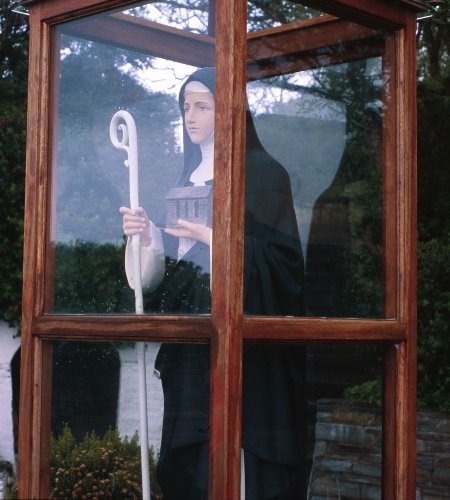
Statue of St. Brigid, Liscannor, Ireland. Photo by Carl McColman
So Brigid is very much a child of the thresholds: she was born neither in the day or the night, neither the winter nor the spring (February 1 corresponds to an ancient pagan holiday that marked the change of the seasons), neither indoors nor outdoors, neither slave nor free, neither pagan nor Christian. But you could turn this around and say that Brigid encompasses all of the above. She is a figure of inclusivity and hospitality.
The beginning of February corresponds to the pagan holiday of Imbolc, one of the four great agricultural festivals of the pre-Christian Celts. Perhaps it is no surprise that the goddess whose cult was most associated with Imbolc was Brigit, the daughter of the great father-god, An Dagda. An Dagda was a “Santa Claus” figure, an archetype of abundance and generosity, a big fat man with a jolly disposition who represented the desire of the ancient Celts for prosperity and abundance. So it’s not surprising that Brigit (the goddess) also had a reputation as a prosperity-deity, and those qualities spilled over onto Brigid (the Saint).
Some historians even question if there ever was a Saint Brigid. Sir James Frazer, author of The Golden Bough, famously wrote “it is obvious that St. Bride, or St. Bridget, is an old heathen goddess of fertility, disguised in a threadbare Christian cloak. Probably she is no other than Brigit, the Celtic goddess of fire and apparently of the crops.” That may be a bit unfair. Perhaps it makes just as much sense to see the historical Brigid as either a woman named for the pagan goddess who embraced Christianity, or perhaps even a priestess of Brigit who embraced the spirituality of Christ. But this is all speculation. In the mists of what we do not know, the line separating Brigit-the-goddess and Brigid-the-saint is barely discernible. And perhaps that’s the way things should be.
Anyway, the folklore surrounding Saint Brigid is rich and evocative. She embraced the spirituality of her mother, and even as a little girl developed a reputation for generosity and hospitality, particularly to the poor. She worked in the kitchen, where apparently she would give food or milk or whatever she could spare to any beggar who happened to stop by. We can assume that word got out among those who relied on the kindness of strangers, and her opportunities for giving would have become more, rather than less, frequent. So the story goes that eventually her father forbade her from giving any more food away. One day her put her in charge of frying some strips of bacon, and the story goes that an emaciated hound appeared at the back door to the kitchen. Overcome with compassion for the stray, Brigid immediately gave the dog three of the five strips of bacon she was cooking (and which her father had counted just a few minutes earlier). Realizing her disobedience, she then prayed over the remaining bacon, and when he father stepped into the kitchen to check on her a few minutes later, he was stunned to find seven slices of bacon in the pan, rather than the original five!
Imbolc was a festival honoring the lactation of the farm animals, and Brigid has a lot of associations with milk — beginning with her mother’s work in the dairy and her own birth on the dairy threshold. As a child, she would be put in charge of churning the butter, and she would divide the butter into thirteen parts, representing Christ and the 12 apostles. The “Christ” portion she would give to the poor, saying “I feed the poor in the name of Christ, for Christ is in the body of every poor person.” She would pray over the churning as she worked, and legend has it that she could fill all the vessels of the region with the butter she churned! Even as an adult, Brigid was associated with an otherworldly cow — milky white but with red ears — that gave an endless supply of milk.
Despite these miracles of abundance associated with her, her father soon grew tired of the girl giving so much away, and so he resolved to marry her off (or sell her off as a slave, depending on which version of the story you hear). He took her to the high king, and left her sitting in his wagon with his own arms (a chieftain would have to disarm before presenting himself before the king). As her father consulted with the king, Brigid, waiting obediently in her father’s wagon, soon saw a beggar walking along the road. She had nothing to give him… but her father’s sword, which she promptly handed over, instructing the poor man to go straight into town and sell it promptly. Eventually her father and the king came out to see the girl, but when he noticed his sword was missing, he asked Brigid what happened, and no sooner had she said “there was this beggar…” when he raised his hand to strike her in anger. The king intervened, saying “This young lady is too holy to live under my roof, I am not worthy of her.” Although what he may have been thinking was something like “I’ll not have her giving away my possessions!”
As she grew up, Brigid discerned a call to enter religious life, but her father had different ideas. He would arrange for potential suitors to come visit the attractive young woman. Finally she took matters into her own hands — literally. One day when a suitor arrived, before presenting herself to her caller, Brigid gouged one of her eyes out of its socket, using only her bare hands. Presenting herself to the youth, he understandably turned away in horror. Once he left, Brigid promptly healed her eye, and the defiance in her gaze made her father understand that she simply would not stand for marriage. So with his reluctant blessing she left home to establish her monastic community in Cill Dara — what is now known as Kildare — or “the Cell of the Oak” (Perhaps the oak is another pre-Christian allusion, suggesting the tree traditionally venerated by druids).
Numerous remarkable folktales surround the establishment of the monastery in Kildare. One of the most remarkable involves how Brigid came to possess the lands for her community. She turned to the local chieftain and asked for land. He was not a particularly generous fellow, so he rather rudely suggested she could have as much land as her mantle could cover. Undeterred, Brigid took of her cloak and threw it on the ground — and the garment magically grew and grew until it covered nearly 5000 acres! Indeed, this land became known as the Curragh, and it remains common land where livestock is raised and racehorses are trained.
Soon it came time for the Bishop to come and consecrate Brigid as the abbess of her community (like other Celtic monasteries, the community in Kildare included both men and women, making Brigid a woman with spiritual authority over men — a remarkable status for the church of the 5th century). The old bishop, Mél, came to Cill Dara with an acolyte, and performed the consecration ritual outdoors (presumably under the oak tree for which Cill Dara is named). Just as he began to pray, a gust of wind blew the pages of his missal, turning from the blessing of an abbess to the consecration of a bishop. Despite the protestations of the acolyte, Bishop Mél recited the words of episcopal consecration over the young nun. When finally the acolyte pointed out his error, the phlegmatic bishop assumed that it must have been the doing of the Holy Spirit.
Even into the present day, Brigid is typically depicted in icons or statuary has holding a bishop’s crozier. Of course, the crozier is also the staff of an abbot (or abbess), so in itself it doesn’t signify much, but it does seem to reinforce the idea that this saint was not only an abbess, but even a kind of proto-female bishop!
This is the first of a two-part series on Saint Brigid. Click here to read part two.
Enjoy reading this blog?
Click here to become a patron.

Previous Post
May 30, 2017
Beyond the Green Beer: Getting to Know Saint Patrick
Next Post
June 6, 2017 Sacred Rhythms: How Monastic Spirituality Can Nurture Your Walk with God
Browse Our Archives
Select a Category Activism Announcements Art Books Catholicism Celtic Christianity Christian mysticism Christianity Contemplation Current events Etc. Family humor interfaith dialogue Interfaith Wisdom Interspirituality Lay Cistercians Living the Faith Meditation movies Mysticism Mystics nature Poetry Reviews Scripture silence Spirituality Uncategorized Writing
Select a Month February 2025 January 2025 November 2024 September 2024 August 2024 July 2024 June 2024 May 2024 March 2024 January 2024 December 2023 November 2023 August 2023 June 2023 April 2023 March 2023 February 2023 January 2023 December 2022 November 2022 October 2022 September 2022 August 2022 July 2022 June 2022 May 2022 April 2022 February 2022 January 2022 December 2021 November 2021 October 2021 September 2021 August 2021 July 2021 June 2021 May 2021 April 2021 March 2021 February 2021 January 2021 December 2020 November 2020 October 2020 September 2020 August 2020 July 2020 June 2020 May 2020 April 2020 March 2020 February 2020 January 2020 December 2019 November 2019 October 2019 September 2019 August 2019 July 2019 June 2019 May 2019 April 2019 March 2019 February 2019 January 2019 December 2018 November 2018 October 2018 September 2018 August 2018 July 2018 June 2018 May 2018 April 2018 March 2018 February 2018 January 2018 December 2017 November 2017 October 2017 September 2017 August 2017 July 2017 June 2017 May 2017 April 2017 March 2017 February 2017 January 2017 December 2016 November 2016 October 2016 September 2016 August 2016 July 2016 June 2016 May 2016 March 2016 February 2016 January 2016 December 2015 November 2015 October 2015 September 2015 August 2015 July 2015 June 2015 May 2015 April 2015 March 2015 February 2015 January 2015 December 2014 November 2014 October 2014 September 2014 August 2014 July 2014 June 2014 May 2014 April 2014 March 2014 February 2014 January 2014 December 2013 October 2013 September 2013 July 2013 May 2013 January 2013 December 2012 November 2012 August 2012 July 2012 June 2012 March 2012 December 2011 September 2011 October 2010 August 2010 March 2010 September 2009 July 2008 January 2008 December 2007 September 2007 February 2007 January 2007 December 2004
Follow Us!
TAKE THE
Religious Wisdom Quiz
Which empire conquered the Northern Kingdom of Israel?
Select your answer to see how you score.
Assyrian Babylonian Egyptian Persian
Support this
Column


Related posts from Carl McColman
Register for the "Celtic Spirituality School" — Yearlong...
Explore Celtic Spirituality with "Spirituality and Practice" Online...

Celtic Spirituality, Celtic Prayer, and the Promises of...

Miann: The Ardent Desire for God
TRENDING AT PATHEOS Contemplative

Handy Contemplative Practices for Political Spaces
A Spiritually Grounded Presence In order to bring a spiritually grounded presence...

Halloween: The Holiday of Loving Your Neighbor
All Hallows Eve Is Halloween the least Christian holiday in America, or...

Can Love Be Saved? Some Thoughts on the...
Happy Valentine's Day! I recently published a post on Patreon called Can...

"This Loving, Uniting Embrace": the Holy Ordinary
Today's guest post is by Mark Longhurst, author of The Holy Ordinary:...

How Are We Called to Live?: More About...
How Are We Called to Live? Many of us struggle with discerning...

A Spiritual Practice of Reading: Join Us Online
A Spiritual Practice of Reading A healthy spiritual practice of reading is...
view all Contemplative blogs
Ad-Free & Subscriber Log-In Subscription Support
- About Us
- 2026 Calendar
- Videos
- Podcasts
- Library of World Religions
- Faith In Media Tracker
- Advertise With Us
- Write for Us
- Privacy Policy
- Terms of Service
- Do Not Sell My Data
- Contact Us
- Radiant Digital
- Manage Newsletter Subscriptions
- Unsubscribe From Notifications
- Sitemap
Copyright 2008-2026, Patheos. All rights reserved.
Subscription Support Ad-Free & Subscriber Log-In
Follow Patheos