
BuddhistCatholicContemplativeEvangelicalGeneral ChristianHinduJewishLatter-day SaintMuslimNew VisionsProgressive Christian
Beliefs
- Buddhist
- Catholic
- Contemplative
- Evangelical
- General Christian
- Hindu
- Jewish
- Latter-day Saint
- More Voices
- Muslim
- New Visions
- Pagan
- Progressive Christian
Topics
- Religion News
- Food and Religion
- Sports and Religion
- Religious Art
- Religious Music and Entertainment
- Religious Events
- History and Religion
- Style and Religion
- Politics and Religion
- Women in Religion
- Recreation Outdoors and Religion
- Business Finance and Religion
- Careers Workplace and Religion
- Education and Religion
- Family Parenting and Religion
- Health Fitness and Religion
- Home and Religion
- Relationships and Religion
- Technology and Religion
- Travel and Religion
Columnists
- Buddhist Columnists
- Business Finance and Religion Columnists
- Careers Workplace and Religion Columnists
- Catholic Columnists
- Contemplative Columnists
- Education and Religion Columnists
- Evangelists Columnists
- Family Parenting and Religion Columnists
- General Christian Columnists
- Health Fitness and Religion Columnists
- Hindu Columnists
- History and Religion Columnists
- Home and Religion Columnists
- Jewish Columnists
- More Voices Columnists
- Latter Day Columnists
- Muslim Columnists
- New Visions Columnists
- Nonreligious Columnists
- Pagan Columnists
- Politics and Religion Columnists
- Progressive Columnists
- Recreation Outdoors and Religion Columnists
- Relationships and Religion Columnists
- Religion News Columnists
- Religious Art Columnists
- Religious Events Columnists
- Religious Music and Entertainment Columnists
- Sports and Religion Columnists
- Style and Religion Columnists
- Technology and Religion Columnists
- Travel and Religion Columnists
- Women in Religion Columnists
Resource Library
- 2026 Calendar
- Library of World Religions
- The 100 Most Holy Places on Earth
- Patheos Answers
- Podcasts
- Videos
- Faith Leaders Database
- Anglican Episcopalian
- Bahai
- Baptist
- Buddhism
- Christianity
- Confucianism
- Eastern Orthodoxy
- Hinduism
- Holiness and Pentecostal
- ISKCON
- Islam
- Judaism
- Lutheran
- Methodist
- The Church of Jesus Christ of Latter-day Saints
- New Age
- Paganism
- Presbytarian and Reformed
- Protestantism
- Religion Behind the Scenes
- Roman Catholic
- Scientology
- Shia Islam
- Sikhism
- Sufism
- Sunni Islam
- Taoism
- Zen
- See all religions
Research Tools
 Ad-Free & Subscriber Log-In Subscription Support
Ad-Free & Subscriber Log-In Subscription Support
Follow Patheos 

- Trending:
- Forgiveness
- |
- Marriage
- |
- Consciousness
- |
- Death Penalty
- |
- Election
- |
- Halloween

- Home
- Contemplative
- Holy Wells: “Icons” of Celtic Spirituality
Holy Wells: “Icons” of Celtic Spirituality
Last updated on: January 2, 2018 at 5:45 pm by Carl "Skye" McColman
Holy Wells: “Icons” of Celtic Spirituality 2018-01-02T17:45:36-04:00 Carl "Skye" McColman
Patheos Explore the world's faith through different perspectives on religion and spirituality! Patheos has the views of the prevalent religions and spiritualities of the world.
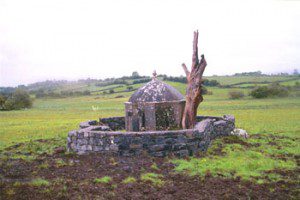
A Holy Well in the west of Ireland (the water source is inside the building). Photo by Carl McColman
In my last post I made several references to Holy Wells as thin places. From the Chalice Well in western England, to Tobernault in northwest Ireland, to countless wells throughout the Celtic lands dedicated to St. Brigid or other much loved saints — Holy Wells (water sources that serve as places of prayer and veneration) are icons of the Celtic spirit.
There is no “standard” Holy Well — they come in many forms. Some are wells are in the traditional sense, complete with round walls surrounding them and a bucket with a rope. But many others feature different kinds of water sources. Many are springs, or even waterfalls that emerge from underground, and I’ve even seen one that is merely a crevice in a rock where rain water stands. What they all share in common — and what separates them from ordinary or mundane water sources — is their sacred function as places where people go to pray, to worship, to intercede, and to seek healing. Some Holy Wells are legendary for their healing properties; many have particular reputations: one is renowned for healing headaches, while another one nearby might be known for curing toothaches. Especially in lands with large Catholic populations like most of Ireland, many wells are dedicated to a saint, often a local holy man or woman who may not even be recognized as a canonized saint by the church at large. Of course, a good portion of wells have a particular association with saints of renown, especially St. Mary and St. Brigid. I don’t know if anyone has done a particular study on Holy Wells, but my sense is that far more are dedicated to women saints than to men — but “men’s” wells do exist.
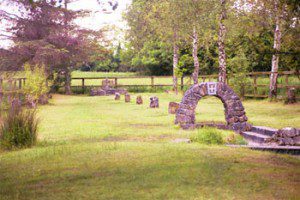
St. Brigid’s Well, Kildare, Ireland. The Well is in the rear of the picture. Visitors are encourgaged to pray a decade of the Rosary at each of the small stones leading to the well. (Photo by Carl McColman)
People come to Holy Wells for the water of course, treating it with the same respect that any Catholic would treat water from a shrine like Lourdes. Some Holy Wells even feature cups with signs encouraging visitors to take a drink. But there’s more to your average Holy Well than just the water it yields. Often wells have “patterns” associated with them: formal procedures for praying at the well, usually involving the Rosary or other formal prayers and a particular route to walk while praying (for example, moving clockwise around the well 9 times). Some wells even have signs that instruct the first-time visitor how to properly follow the pattern at the well.
Many “accessories” to holy wells can be found at various sites. Some have human-made adornments: statues, gardens, walls, crosses, huts or shelters, all meant to give the well a sense of spiritual reverence as well as a feeling of being well cared-for; indeed, many holy wells are located in beautifully tended grounds that function as a small park. Many wells are accompanied by a tree that has come to be venerated alongside the well; some of these trees are covered with clooties, small rags or strips of cloth that have been tied to the tree as a type of prayer remembrance. The legend of the clooties holds that they “carry” the prayers of the person who first tied them to the tree; as the clootie is slowly broken down by the elements over time, the prayers are “released” — almost like a time-released pill.
I must confess to feeling some ambivalence about clooties myself. While they clearly represent an ancient folk custom and are inspiring for the prayer and devotion they represent, on the other hand a tree covered by clooties could be hurt or even killed by all the tightly knotted strips of cloth. I’m not sure that God — or, for that matter, the ancient Celtic saints — truly want prayers when they are expressed at the expense of an innocent tree!
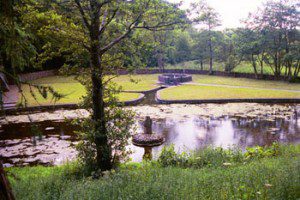
An Irish Holy Well dedicated to St. Patrick (photo by Carl McColman)
Something else often found at holy wells: coins. Traditionally, the coins would have been tossed into the well, a custom that very likely has pre-Christian roots. Archaeology has shown that the ancient Celts would make offerings to their pagan gods by sacrificing valuable metal items to bodies of water — entire hoards of votive offerings have been excavated from rivers, including swords, torques, shields, and other items fashioned from metals like silver or bronze or even gold. Although some of these items are clearly valuable from their composition of precious metals, scholars suspect that the armaments offered as sacrifices to the rivers were actually made for ritual purposes (a shield made of silver or gold likely was too valuable and not practical enough for use in a real battle). The ritual sacrifice of votive offerings leaves us with more questions than answers, but it suggests that the pre-Christian Celts saw water sources as sacred, and perhaps even as portals to the “otherworld” — the realm the gods and the ancestors. By making offerings, the ancients were giving gifts to their spiritual allies, hoping in turn for blessings, a fruitful harvest, or triumph in battle.
It’s easy to see how the folk practice of tossing a coin into a wishing well is a vestige of the ancient forms of sacrifice. This has even extended to fountains (the next time you visit a shopping mall or an airport, stop and look at the fountains — they will likely contain hundreds of pennies and nickels and other coins, tossed in by passersby who were making a wish or simply re-enacting an ancient practice (or, making a donation, since the owners of many fountains now designate their “take” to a worthy cause). Some Holy Wells even have coin boxes installed next to the water source — which may make good ecological sense, since throwing the coins into the well could compromise the quality of the water.
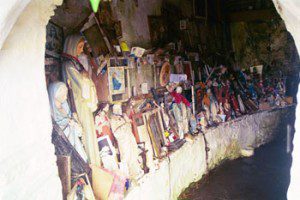
Votive offerings at St. Brigid’s Well, Liscannor (photo by Carl McColman)
Other wells, for example St. Brigid’s Well near Liscannor in County Clare, Ireland, are renowned for various other “sacrificial” objects left at the well: candles, rosaries, holy cards, or for that matter dolls, pictures of loved ones, or even a pair of crutches. These “votive offerings” symbolize the prayers of the persons who visited the well.
One time I was leading a small group of American pilgrims through Ireland, and we stopped to pray at one of the Holy Wells near Kildare. While we were there, a local family came by to offer their own prayers, and one member of our group struck up a conversation with them. They were actually there to offer thanks — they had been praying at the well for their mother, who had been diagnosed with cancer, and they had recently received the good news that the cancer was in remission. So of course they returned to the place of their intercession to offer a new prayer of gratitude.
I suppose some people might look at the folk practices associated with Holy Wells — tying ribbons to trees, executing precise actions while praying, treating the water with special reverence — and dismiss it all as only so much superstition. But I want to make the case for looking at Holy Wells not with the cold eyes of scientific skepticism, but rather the compassionate eyes that see value in tradition and myth and wonder.
Prayer is not magic, and traditional practices associated with prayer — like visiting a sacred water source — do not imbue the prayer with any more “power” than any other type of prayer might contain. So why go to all the fuss, of visiting a well, or following the pattern, or treating the water with reverence? To answer that question I think we have to go back to the idea of the Thin Place. Some places have a special ability to bring us face to face with the mystery of eternity. That mystery is always present in our lives! But we do not always pay attention to it.
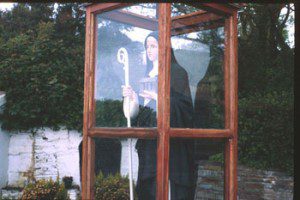
Statue of St. Brigid at the Holy Well dedicated to her in Liscannor. She’s kept in glass to protect her from the elements. (Photo by Carl McColman)
So we go to visit a place traditionally regarded as sacred, like a Holy Well, to help us pay attention. We perform the rituals associated with such a place: drinking the water, following the pattern, leaving a coin or some other votive object to symbolize our prayer, to help us pay attention. By joining in to long-standing folk customs associated with Holy Wells, we are joining in with people from generation after generation who have found comfort and inspiration by coming to these special places to pray and to praise.
So are Holy Wells “Celtic”? Not in any strict sense — the veneration of water sources can be found in many cultures around the world. But I think it’s no accident that Holy Wells are so visible in the Celtic lands. They are icons of the Celtic spirit, which means that I see in Holy Wells the gifts of Celtic wisdom: a recognition of God’s presence in nature and the ordinary stuff of life, the importance of regular prayer, a sense that spirituality is not something reserved just for Church or Sundays, but is intimately a part of everyday life. And since many Holy Wells do have associations with Celtic saints like Brigid or Patrick or Cuthbert, the Wells reinforce the sense of communion and connection that living spiritual seekers today can find with the great Celtic saints of old.
Enjoy reading this blog?
Click here to become a patron.

Stay in touch! Connect with Carl McColman on Facebook:
Previous Post

May 12, 2017
Thin Places: Are they Celtic, pre-Celtic, or Universal?
Next Post
May 16, 2017 "Even the Depths of God" — A Brief Meditation
Browse Our Archives
Select a Category Activism Announcements Art Books Catholicism Celtic Christianity Christian mysticism Christianity Contemplation Current events Etc. Family humor interfaith dialogue Interfaith Wisdom Interspirituality Lay Cistercians Living the Faith Meditation movies Mysticism Mystics nature Poetry Reviews Scripture silence Spirituality Uncategorized Writing
Select a Month February 2025 January 2025 November 2024 September 2024 August 2024 July 2024 June 2024 May 2024 March 2024 January 2024 December 2023 November 2023 August 2023 June 2023 April 2023 March 2023 February 2023 January 2023 December 2022 November 2022 October 2022 September 2022 August 2022 July 2022 June 2022 May 2022 April 2022 February 2022 January 2022 December 2021 November 2021 October 2021 September 2021 August 2021 July 2021 June 2021 May 2021 April 2021 March 2021 February 2021 January 2021 December 2020 November 2020 October 2020 September 2020 August 2020 July 2020 June 2020 May 2020 April 2020 March 2020 February 2020 January 2020 December 2019 November 2019 October 2019 September 2019 August 2019 July 2019 June 2019 May 2019 April 2019 March 2019 February 2019 January 2019 December 2018 November 2018 October 2018 September 2018 August 2018 July 2018 June 2018 May 2018 April 2018 March 2018 February 2018 January 2018 December 2017 November 2017 October 2017 September 2017 August 2017 July 2017 June 2017 May 2017 April 2017 March 2017 February 2017 January 2017 December 2016 November 2016 October 2016 September 2016 August 2016 July 2016 June 2016 May 2016 March 2016 February 2016 January 2016 December 2015 November 2015 October 2015 September 2015 August 2015 July 2015 June 2015 May 2015 April 2015 March 2015 February 2015 January 2015 December 2014 November 2014 October 2014 September 2014 August 2014 July 2014 June 2014 May 2014 April 2014 March 2014 February 2014 January 2014 December 2013 October 2013 September 2013 July 2013 May 2013 January 2013 December 2012 November 2012 August 2012 July 2012 June 2012 March 2012 December 2011 September 2011 October 2010 August 2010 March 2010 September 2009 July 2008 January 2008 December 2007 September 2007 February 2007 January 2007 December 2004
Follow Us!
TAKE THE
Religious Wisdom Quiz
Which book follows Psalms in the Bible?
Select your answer to see how you score.
Song of Solomon Proverbs Ecclesiastes Job
Support this
Column


Related posts from Carl McColman
Register for the "Celtic Spirituality School" — Yearlong...

Explore Celtic Spirituality with "Spirituality and Practice" Online...
Celtic Spirituality, Celtic Prayer, and the Promises of...

Miann: The Ardent Desire for God
TRENDING AT PATHEOS Contemplative

Handy Contemplative Practices for Political Spaces
A Spiritually Grounded Presence In order to bring a spiritually grounded presence...

Halloween: The Holiday of Loving Your Neighbor
All Hallows Eve Is Halloween the least Christian holiday in America, or...

Can Love Be Saved? Some Thoughts on the...
Happy Valentine's Day! I recently published a post on Patreon called Can...

"This Loving, Uniting Embrace": the Holy Ordinary
Today's guest post is by Mark Longhurst, author of The Holy Ordinary:...

How Are We Called to Live?: More About...
How Are We Called to Live? Many of us struggle with discerning...

A Spiritual Practice of Reading: Join Us Online
A Spiritual Practice of Reading A healthy spiritual practice of reading is...
view all Contemplative blogs
Ad-Free & Subscriber Log-In Subscription Support
- About Us
- 2026 Calendar
- Videos
- Podcasts
- Library of World Religions
- Faith In Media Tracker
- Advertise With Us
- Write for Us
- Privacy Policy
- Terms of Service
- Do Not Sell My Data
- Contact Us
- Radiant Digital
- Manage Newsletter Subscriptions
- Unsubscribe From Notifications
- Sitemap
Copyright 2008-2026, Patheos. All rights reserved.
Subscription Support Ad-Free & Subscriber Log-In
Follow Patheos