
BuddhistCatholicContemplativeEvangelicalGeneral ChristianHinduJewishLatter-day SaintMuslimNew VisionsProgressive Christian
Beliefs
- Buddhist
- Catholic
- Contemplative
- Evangelical
- General Christian
- Hindu
- Jewish
- Latter-day Saint
- More Voices
- Muslim
- New Visions
- Pagan
- Progressive Christian
Topics
- Religion News
- Food and Religion
- Sports and Religion
- Religious Art
- Religious Music and Entertainment
- Religious Events
- History and Religion
- Style and Religion
- Politics and Religion
- Women in Religion
- Recreation Outdoors and Religion
- Business Finance and Religion
- Careers Workplace and Religion
- Education and Religion
- Family Parenting and Religion
- Health Fitness and Religion
- Home and Religion
- Relationships and Religion
- Technology and Religion
- Travel and Religion
Columnists
- Buddhist Columnists
- Business Finance and Religion Columnists
- Careers Workplace and Religion Columnists
- Catholic Columnists
- Contemplative Columnists
- Education and Religion Columnists
- Evangelists Columnists
- Family Parenting and Religion Columnists
- General Christian Columnists
- Health Fitness and Religion Columnists
- Hindu Columnists
- History and Religion Columnists
- Home and Religion Columnists
- Jewish Columnists
- More Voices Columnists
- Latter Day Columnists
- Muslim Columnists
- New Visions Columnists
- Nonreligious Columnists
- Pagan Columnists
- Politics and Religion Columnists
- Progressive Columnists
- Recreation Outdoors and Religion Columnists
- Relationships and Religion Columnists
- Religion News Columnists
- Religious Art Columnists
- Religious Events Columnists
- Religious Music and Entertainment Columnists
- Sports and Religion Columnists
- Style and Religion Columnists
- Technology and Religion Columnists
- Travel and Religion Columnists
- Women in Religion Columnists
Resource Library
- 2026 Calendar
- Library of World Religions
- The 100 Most Holy Places on Earth
- Patheos Answers
- Podcasts
- Videos
- Faith Leaders Database
- Anglican Episcopalian
- Bahai
- Baptist
- Buddhism
- Christianity
- Confucianism
- Eastern Orthodoxy
- Hinduism
- Holiness and Pentecostal
- ISKCON
- Islam
- Judaism
- Lutheran
- Methodist
- The Church of Jesus Christ of Latter-day Saints
- New Age
- Paganism
- Presbytarian and Reformed
- Protestantism
- Religion Behind the Scenes
- Roman Catholic
- Scientology
- Shia Islam
- Sikhism
- Sufism
- Sunni Islam
- Taoism
- Zen
- See all religions
Research Tools
 Ad-Free & Subscriber Log-In Subscription Support
Ad-Free & Subscriber Log-In Subscription Support
Follow Patheos 

- Trending:
- Forgiveness
- |
- Marriage
- |
- Consciousness
- |
- Death Penalty
- |
- Election
- |
- Halloween

- Home
- Contemplative
- Following the Good Shepherd
Following the Good Shepherd
Last updated on: December 19, 2018 at 12:35 am by Carl "Skye" McColman
Following the Good Shepherd 2018-12-19T00:35:21-04:00 Carl "Skye" McColman
Patheos Explore the world's faith through different perspectives on religion and spirituality! Patheos has the views of the prevalent religions and spiritualities of the world.
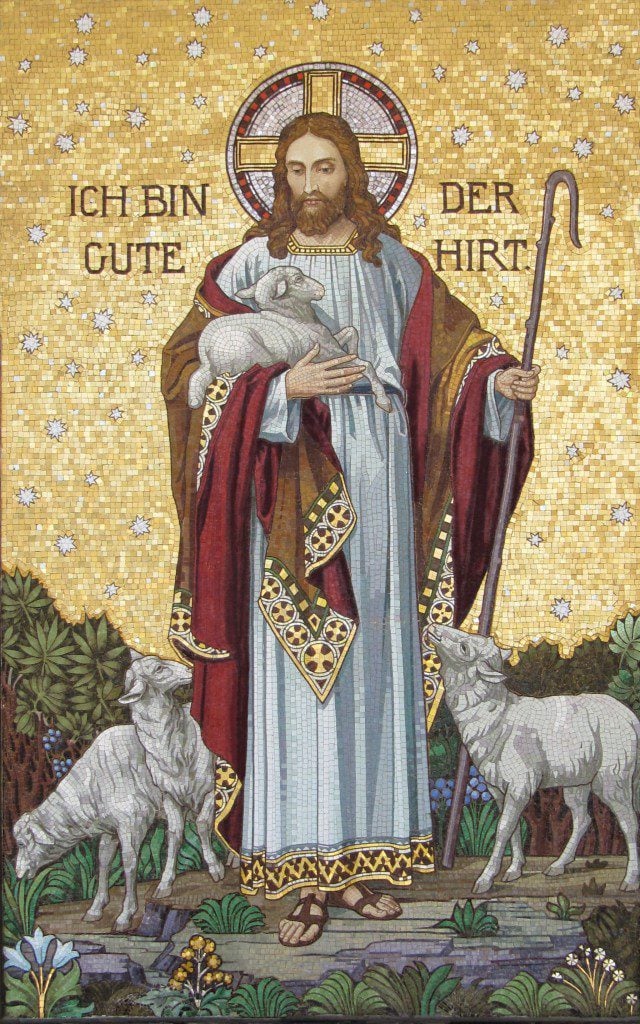
Christ the Good Shepherd; Kufstein Cemetery, Austria. 19th century. Public domain.
A Meditation for Good Shepherd Sunday (May 7, 2017)
So I suppose the obvious topic for a reflection on Good Shepherd Sunday is… well… sheep!
But I am not a farmer, I have never lived on a farm, in fact I don’t know that I have ever lived particularly near a farm. I’m a vegetarian, so I don’t eat mutton. Really, my knowledge of sheep pretty much begins and ends with a couple of nice wool sweaters that I own. And in Georgia, you don’t even need to wear those very often!
But I’m not just trying to make a few feeble jokes here. What I’d like to do is talk about a challenge that many of us face more often than we may care to admit: sometimes, the lessons that come to us from the treasury of the Bible may very well speak to us in a language that we don’t readily understand.
I’m not just talking about Hebrew, Greek, or Aramaic; after all, you can take classes at your local seminary to learn the Biblical languages, or you can be like me, and master them just enough to be dangerous. No, it’s more than just an unfamiliar tongue that we must contend with. The stories, and poetry, and wisdom sayings, and other writings that comprise our Holy Bible come to us from a culture, and a time, that is very much unlike our own.
And yet, we sing, “Alleluia, Lord, to whom shall we go? You have the words of eternal life. Alleluia, alleluia.” If we believe, and I certainly do, that the Bible has the words of eternal life, then what are we to do when we call Jesus the Good Shepherd, but we don’t even know sheep? Or Jesus tells us his yoke is easy, but we’ve never worked with a real yoke?
But there’s more at stake here than the colorful imagery from the gospels. What do we do with the Apostle Paul, whom we call the first great theologian, and yet he tells us that gay people deserve to die, or that wives should submit to their husbands?
What do we do when Jesus curses the fig tree? Or praises the unjust steward? Or tells us that camels will have an easier time getting through the eye of a needle than a rich person trying to get into heaven?
You know, I don’t like to think about it, but my very-middle-class-American income makes me, by global standards, actually a pretty wealthy guy.
And what scares me even more is this: how many ways do I miss the point of scripture, when I’m not even aware that I’m doing so? In other words, how many ways, over the centuries, have we lost or changed certain ways of thinking, certain ways of understanding kinship and hospitality and time, insights into eternity and into compassion and even into the human heart and mind, that have left certain passages in scripture just obscure? Difficult to understand? Or worse yet, easy to misunderstand?
So how do we relate to the strangeness, the challenge, the mystery of scripture?
I have three thoughts. And interestingly enough, they all come from… surprise! Today’s lessons.
The lesson from the Acts of the Apostles teaches us that community really matters in the Christian life. We can’t do it alone. We can’t be saved all by ourselves, we can’t become holy all by ourselves, we can’t live a good and happy and fulfilling life all by ourselves. It simply isn’t possible. In fact, Acts makes some pretty radical statements about being non-attached to our resources, living in an economy based on generosity and sharing.
Pretty radical stuff. What would our world look like, if we measured wealth not by how much we have accumulated, but by how much we give away? It’s a great question… but for now, let’s just focus on the importance of community. And what did the community do: they taught one another, they enjoyed one another’s companionship, they prayed together, and they worshiped together.
Luke, the author of Acts, doesn’t talk about them going to seminary, or getting advanced degrees in theology! And I don’t mean to knock the importance of a good education. But I think we can learn from this passage not only that scripture needs to be interpreted in community, but that such interpretation can only happen in the context of much prayer and worship.
If you want to know how to read the scripture, first learn how to pray the scripture.
And we learn how to pray the scripture — and to interpret the text — together. In community.
Our second lesson, from Saint Peter, sounds suspiciously like the Beatitudes, which has been the topic of our retreat this weekend. Peter mentions sheep and shepherds at the end of this lesson, which is probably why it was chosen for today’s readings. But really, I think we find the true heart of this lesson in how “Beatitudinal” it is.
If you endure when you do right and suffer for it, you have God’s approval. For to this you have been called, because Christ also suffered for you, leaving you an example, so that you should follow in his steps.
I don’t know about you, but to me that sure sounds like
Blessed are those who are persecuted for righteousness’ sake, for theirs is the kingdom of heaven. “Blessed are you when people revile you and persecute you and utter all kinds of evil against you falsely[a] on my account. Rejoice and be glad, for your reward is great in heaven, for in the same way they persecuted the prophets who were before you.
Isn’t it fascinating how Jesus pivots here? He goes from speaking abstractly, in the third person: “Blessed are THOSE” — and makes it personal, speaking directly to his audience: “Blessed are YOU.” Because Jesus is all about relationship, and what a lot of us fail to realize is that Jesus wants a relationship with you… and you… and you… and me, and you… with all of us. And that’s a personal relationship. It cannot be systematized, or codified.
But back to the lesson. What does Saint Peter teach us about how to dance with the mystery of Scripture? I think the message here is very simply this: that the key to receiving the wisdom of scripture lies not so much in how much we understand, but in how we choose to live. We can’t think our way into heaven. But in our hearts, we can receive the love which has already promised to carry us there.
And that leads to our third lesson, from the Gospel of John, where Jesus compares himself to the gate through which the sheep move to safety. He doesn’t call himself the Good Shepherd in this Gospel reading, but if you kept on reading the Gospel of John, he says so in the very next verse. “I am the Good Shepherd.” Trust me: today is still “Good Shepherd Sunday.” At least that’s what Wikipedia says.
So I don’t know much about sheep — or shepherds, or gates that lead to sheep-pens for that matter — but here’s what I see in this Gospel reading. That at the end of the day, what really makes us Christian is not thinking all the right thoughts — even though sound doctrine is of course important — or even behaving all the right ways — after all, Jesus remarked that the prostitutes and the tax collectors will be leading this parade.
Yes, holiness is important, just like sound doctrine is important — but most important of all is faith, and faith is a relationship. The sheep obey Jesus not because they’re stupid, not because they’ve been trained the right way, but because they know his voice. They trust him. Their faith is based on the relationship.
And it’s in that context of relationship that Jesus is the gate, the gate that opens to new life. We walk through that gate, even though we don’t have it all figured out, because we trust in Jesus. We know he is worth trusting, even when we’re not sure where the path is heading.
This reminds me of a wonderful prayer by Thomas Merton, which many of you will already know. And if you don’t know this prayer, listen to it, because it is filled with wisdom.
MY LORD GOD, I have no idea where I am going. I do not see the road ahead of me. I cannot know for certain where it will end. Nor do I really know myself, and the fact that I think that I am following your will does not mean that I am actually doing so. But I believe that the desire to please you does in fact please you. And I hope I have that desire in all that I am doing. I hope that I will never do anything apart from that desire. And I know that if I do this you will lead me by the right road though I may know nothing about it. Therefore will I trust you always though I may seem to be lost and in the shadow of death. I will not fear, for you are ever with me, and you will never leave me to face my perils alone.
In the end we have to acknowledge that even if you master all the Biblical languages, and become an expert on the philosophy and culture and beliefs and values of the Biblical world, and you get five PhDs in sacred theology and scripture studies and hermeneutics and heuristics and so forth and whatnot — guess what? Scripture will still be a mystery to you. It had better be! It had better be a mystery to you, because the minute it stops being a mystery to you is the minute when you think you no longer need God. And may God forbid that any of us ever reach that moment.
Yes, my friends, at the end of the day, the mystery, the incomprehensibility, the strangeness of scripture, is a profound gift to us all. Because we are left with saying “I don’t know.” We are left with saying “I believe, help my unbelief.” We are left with saying “I’m not much smarter than a farm animal.” “I sure need God to lead me.” Just like a sheep.
Amen.
N.B. The above homily was delivered on Sunday, May 7, 2017 at the annual retreat for the Worker Sisters and Brothers of the Holy Spirit, an Episcopal/ecumenical religious order. Here are the lessons for this homily:
Acts 2:42-47
Psalm 23
1 Peter 2:19-25
John 10:1-10
Enjoy reading this blog?
Click here to become a patron.

Worker Brothers and Sisters of the Holy Spirit
Previous Post

May 4, 2017
Compline — Prayer for the Closing of the Day
Next Post
May 8, 2017 How Julian of Norwich Changed My Life
Browse Our Archives
Select a Category Activism Announcements Art Books Catholicism Celtic Christianity Christian mysticism Christianity Contemplation Current events Etc. Family humor interfaith dialogue Interfaith Wisdom Interspirituality Lay Cistercians Living the Faith Meditation movies Mysticism Mystics nature Poetry Reviews Scripture silence Spirituality Uncategorized Writing
Select a Month February 2025 January 2025 November 2024 September 2024 August 2024 July 2024 June 2024 May 2024 March 2024 January 2024 December 2023 November 2023 August 2023 June 2023 April 2023 March 2023 February 2023 January 2023 December 2022 November 2022 October 2022 September 2022 August 2022 July 2022 June 2022 May 2022 April 2022 February 2022 January 2022 December 2021 November 2021 October 2021 September 2021 August 2021 July 2021 June 2021 May 2021 April 2021 March 2021 February 2021 January 2021 December 2020 November 2020 October 2020 September 2020 August 2020 July 2020 June 2020 May 2020 April 2020 March 2020 February 2020 January 2020 December 2019 November 2019 October 2019 September 2019 August 2019 July 2019 June 2019 May 2019 April 2019 March 2019 February 2019 January 2019 December 2018 November 2018 October 2018 September 2018 August 2018 July 2018 June 2018 May 2018 April 2018 March 2018 February 2018 January 2018 December 2017 November 2017 October 2017 September 2017 August 2017 July 2017 June 2017 May 2017 April 2017 March 2017 February 2017 January 2017 December 2016 November 2016 October 2016 September 2016 August 2016 July 2016 June 2016 May 2016 March 2016 February 2016 January 2016 December 2015 November 2015 October 2015 September 2015 August 2015 July 2015 June 2015 May 2015 April 2015 March 2015 February 2015 January 2015 December 2014 November 2014 October 2014 September 2014 August 2014 July 2014 June 2014 May 2014 April 2014 March 2014 February 2014 January 2014 December 2013 October 2013 September 2013 July 2013 May 2013 January 2013 December 2012 November 2012 August 2012 July 2012 June 2012 March 2012 December 2011 September 2011 October 2010 August 2010 March 2010 September 2009 July 2008 January 2008 December 2007 September 2007 February 2007 January 2007 December 2004
Follow Us!
TAKE THE
Religious Wisdom Quiz
Which queen visited Solomon to test his wisdom?
Select your answer to see how you score.
Queen Jezebel Queen Esther Queen Vashti Queen of Sheba
Support this
Column


Related posts from Carl McColman

LSD, Anxiety, and Contemplation: Can Psychedelic Therapy Support...

Finding Your Perfect Prayer Posture
Advice for Contemplatives looking for a Spiritual Community...
A Reason Why Liturgy Matters: "Like Staring Out...
TRENDING AT PATHEOS Contemplative

Handy Contemplative Practices for Political Spaces
A Spiritually Grounded Presence In order to bring a spiritually grounded presence...

Halloween: The Holiday of Loving Your Neighbor
All Hallows Eve Is Halloween the least Christian holiday in America, or...

Can Love Be Saved? Some Thoughts on the...
Happy Valentine's Day! I recently published a post on Patreon called Can...

"This Loving, Uniting Embrace": the Holy Ordinary
Today's guest post is by Mark Longhurst, author of The Holy Ordinary:...

How Are We Called to Live?: More About...
How Are We Called to Live? Many of us struggle with discerning...

A Spiritual Practice of Reading: Join Us Online
A Spiritual Practice of Reading A healthy spiritual practice of reading is...
view all Contemplative blogs
Ad-Free & Subscriber Log-In Subscription Support
- About Us
- 2026 Calendar
- Videos
- Podcasts
- Library of World Religions
- Faith In Media Tracker
- Advertise With Us
- Write for Us
- Privacy Policy
- Terms of Service
- Do Not Sell My Data
- Contact Us
- Radiant Digital
- Manage Newsletter Subscriptions
- Unsubscribe From Notifications
- Sitemap
Copyright 2008-2026, Patheos. All rights reserved.
Subscription Support Ad-Free & Subscriber Log-In
Follow Patheos