
BuddhistCatholicContemplativeEvangelicalGeneral ChristianHinduJewishLatter-day SaintMuslimNew VisionsProgressive Christian
Beliefs
- Buddhist
- Catholic
- Contemplative
- Evangelical
- General Christian
- Hindu
- Jewish
- Latter-day Saint
- More Voices
- Muslim
- New Visions
- Pagan
- Progressive Christian
Topics
- Religion News
- Food and Religion
- Sports and Religion
- Religious Art
- Religious Music and Entertainment
- Religious Events
- History and Religion
- Style and Religion
- Politics and Religion
- Women in Religion
- Recreation Outdoors and Religion
- Business Finance and Religion
- Careers Workplace and Religion
- Education and Religion
- Family Parenting and Religion
- Health Fitness and Religion
- Home and Religion
- Relationships and Religion
- Technology and Religion
- Travel and Religion
Columnists
- Buddhist Columnists
- Business Finance and Religion Columnists
- Careers Workplace and Religion Columnists
- Catholic Columnists
- Contemplative Columnists
- Education and Religion Columnists
- Evangelists Columnists
- Family Parenting and Religion Columnists
- General Christian Columnists
- Health Fitness and Religion Columnists
- Hindu Columnists
- History and Religion Columnists
- Home and Religion Columnists
- Jewish Columnists
- More Voices Columnists
- Latter Day Columnists
- Muslim Columnists
- New Visions Columnists
- Nonreligious Columnists
- Pagan Columnists
- Politics and Religion Columnists
- Progressive Columnists
- Recreation Outdoors and Religion Columnists
- Relationships and Religion Columnists
- Religion News Columnists
- Religious Art Columnists
- Religious Events Columnists
- Religious Music and Entertainment Columnists
- Sports and Religion Columnists
- Style and Religion Columnists
- Technology and Religion Columnists
- Travel and Religion Columnists
- Women in Religion Columnists
Resource Library
- 2026 Calendar
- Library of World Religions
- The 100 Most Holy Places on Earth
- Patheos Answers
- Podcasts
- Videos
- Faith Leaders Database
- Anglican Episcopalian
- Bahai
- Baptist
- Buddhism
- Christianity
- Confucianism
- Eastern Orthodoxy
- Hinduism
- Holiness and Pentecostal
- ISKCON
- Islam
- Judaism
- Lutheran
- Methodist
- The Church of Jesus Christ of Latter-day Saints
- New Age
- Paganism
- Presbytarian and Reformed
- Protestantism
- Religion Behind the Scenes
- Roman Catholic
- Scientology
- Shia Islam
- Sikhism
- Sufism
- Sunni Islam
- Taoism
- Zen
- See all religions
Research Tools
 Ad-Free & Subscriber Log-In Subscription Support
Ad-Free & Subscriber Log-In Subscription Support
Follow Patheos 

- Trending:
- Forgiveness
- |
- Marriage
- |
- Consciousness
- |
- Death Penalty
- |
- Election
- |
- Halloween

- Home
- Contemplative
- Why I Love the Carmina Gadelica (Despite Its Flaws)
Why I Love the Carmina Gadelica (Despite Its Flaws)
Last updated on: February 6, 2018 at 7:56 am by Carl "Skye" McColman
Why I Love the Carmina Gadelica (Despite Its Flaws) 2018-02-06T07:56:43-04:00 Carl "Skye" McColman
Patheos Explore the world's faith through different perspectives on religion and spirituality! Patheos has the views of the prevalent religions and spiritualities of the world.
You are the joy of all joyous things,
You are the light of the beam of the sun,
You are the door of the chief of hospitality,
You are the surpassing star of guidance,
You are the step of the deer of the hill,
You are the step of the steed of the plain,
You are the grace of the swan of swimming,
You are the loveliness of all lovely desires.
— “The Invocation of the Graces”
from the Carmina Gadelica
(modernized language)
I recently have acquired a copy of the latest edition of the Carmina Gadelica: Hymns and Incantations Collected in Highlands and Islands of Scotland. And it’s beautiful.
One of the great classics of Celtic literature, this tome (the one-volume edition is almost 700 pages long!) is a compendium of what was originally a six-volume collection of oral folklore, prayers, chants, incantations, hymns, blessings, and poems that an amateur folklorist named Alexander Carmichael collected in Gaelic-speaking Scotland over a fifty-year period starting around 1860.
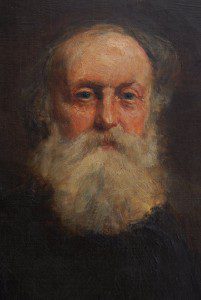
Portrait of Alexander Carmichael by William Skeoch Cumming
It is a record of the heart of Celtic Christianity, not as a theory found in libraries or classrooms, but as a lived spirituality of people who practiced an ancestral way of life, attuned to the rhythms of nature and the wisdom of their ancestors.
Carmichael was an exciseman — in other words, a tax collector — for the British government, working in Scotland. But like St. Matthew in the New Testament, he used his unpopular career as a springboard to doing something very good. Even 150 years ago, it was apparent that the old Gaelic culture in Scotland was vanishing. The old Celtic tongue was already in decline (today only about 57,000 people speak Gaelic in Scotland, and only a fraction of those speak it fluently), and when a language dies, an entire culture dies.
Carmichael realized this, so he began to document the oral tradition of the Gaelic people — a process of amateur folklore that would lead, eventually, to the Carmina.
Unfortunately, Carmichael was not a trained anthropologist, and did not observe rigorous methods for carefully preserving the material he collected. In fact, the evidence points in almost the opposite direction: that the material preserved in the Carmina, far from being preserved exactly as it was first collected by Carmichael, was in fact edited or adapted for publication. As Wikipedia notes,
Eventually, Carmichael’s editing methods were roundly challenged in 1976 with the publication of Hamish Robertson’s article in Scottish Gaelic Studies, “Studies in Carmichael’s Carmina Gadelica“. Having searched for manuscript copies of charms appearing in the third and fourth volumes, Robertson accused Carmichael of meddling with, altering, and polishing original texts: ‘hardly one had not been touched up in some way, sometimes quite drastically’.
Following Robertson’s critique, even defenders of Carmichael came to admit that much “of the first three volumes of the Carmina must be taken as a literary and not as a literal presentation of Gaelic folklore.”[1]
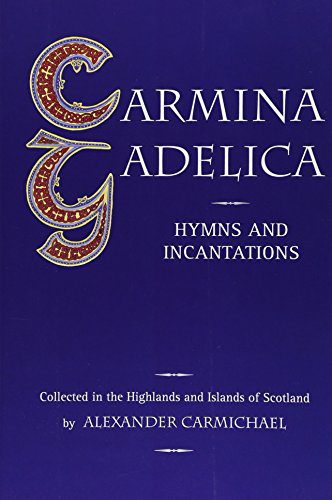
Carmina Gadelica (2015 Edition)
So think of the Carmina Gadelica as a fantasia on Gaelic spiritual folklore. We can lament all the wisdom of the Gaelic-speaking people that has been lost, both because of the decline of that ancient Celtic language, and also because Carmichael was not as careful a folklorist as we might hope.
But if we let go of the idea that the Carmina Gadelica is supposed to be some sort of pristine collection of long-lost folklore, and accept it for what it is: as one person’s vision of how traditional Celtic spirituality continued to shape the minds and hearts of Scottish folk, well into the 19th and even early 20th centuries — then we realize that it’s still a treasure.
In the original six volumes (some edited by Carmichael, others by his daughter or students of his), the prayers, poems and songs were presented in both Gaelic and English. The one-volume edition from Lindisfarne Books only presents the English text. If you speak (or are learning) Gaelic, you might want to find the bilingual edition, but it’s out of print and can easily set you back $700 or more for the entire set. So for those of us whose appreciation of Celtic spirituality is framed by our lack of fluency in a Celtic tongue, the one-volume edition is more than adequate.
With over 550 prayers, poems, songs, runes, incantations, invocations, words of healing, protection charms, and other texts, the Carmina offers a glimpse into a spirituality shaped by the land and sea of the Scottish highlands and islands, deeply Christian, yet also inclusive of old pagan ways, such as fairy lore. Here you will find prayers for almost any routine task that a farmer or a fisherman or homemaker might use: prayers to bless the milking of the cow, the lighting of a fire, the coming of the new moon, the undertaking of a journey.
What emerges is a sense of a people who lived with one foot securely grounded on the good earth, and the other reaching with trust and joy into a mystical place where God is not elsewhere.
Here’s another little snippet for you:
I am bathing my face
In the mild rays of the sun,
As Mary bathed Christ
In the rich milk of Egypt.Sweetness be in my mouth,
Wisdom be in my speech,
The love the fair Mary gave her Son
Be in the heart of all flesh for me.
I don’t think the latest edition is newly typeset from the first one-volume edition published in 1992. But it has a gorgeous new cover and is printed on a lovely paper that makes the text a delight to read. So if you were like me and your old copy of the Carmina had gotten pretty dog-eared, or if you have not yet explored this Celtic treasure from Scotland of old, then now’s the time to check it out.
Just be prepared: this is not a book you read. It’s a book you pray.
_
[1] https://en.wikipedia.org/wiki/Carmina_Gadelica
Enjoy reading this blog?
Click here to become a patron.

Previous Post

April 3, 2017
Books I Recommend (On Various Topics)
Next Post

April 7, 2017 Compass Points for the Spiritual Life (Video)
Browse Our Archives
Select a Category Activism Announcements Art Books Catholicism Celtic Christianity Christian mysticism Christianity Contemplation Current events Etc. Family humor interfaith dialogue Interfaith Wisdom Interspirituality Lay Cistercians Living the Faith Meditation movies Mysticism Mystics nature Poetry Reviews Scripture silence Spirituality Uncategorized Writing
Select a Month February 2025 January 2025 November 2024 September 2024 August 2024 July 2024 June 2024 May 2024 March 2024 January 2024 December 2023 November 2023 August 2023 June 2023 April 2023 March 2023 February 2023 January 2023 December 2022 November 2022 October 2022 September 2022 August 2022 July 2022 June 2022 May 2022 April 2022 February 2022 January 2022 December 2021 November 2021 October 2021 September 2021 August 2021 July 2021 June 2021 May 2021 April 2021 March 2021 February 2021 January 2021 December 2020 November 2020 October 2020 September 2020 August 2020 July 2020 June 2020 May 2020 April 2020 March 2020 February 2020 January 2020 December 2019 November 2019 October 2019 September 2019 August 2019 July 2019 June 2019 May 2019 April 2019 March 2019 February 2019 January 2019 December 2018 November 2018 October 2018 September 2018 August 2018 July 2018 June 2018 May 2018 April 2018 March 2018 February 2018 January 2018 December 2017 November 2017 October 2017 September 2017 August 2017 July 2017 June 2017 May 2017 April 2017 March 2017 February 2017 January 2017 December 2016 November 2016 October 2016 September 2016 August 2016 July 2016 June 2016 May 2016 March 2016 February 2016 January 2016 December 2015 November 2015 October 2015 September 2015 August 2015 July 2015 June 2015 May 2015 April 2015 March 2015 February 2015 January 2015 December 2014 November 2014 October 2014 September 2014 August 2014 July 2014 June 2014 May 2014 April 2014 March 2014 February 2014 January 2014 December 2013 October 2013 September 2013 July 2013 May 2013 January 2013 December 2012 November 2012 August 2012 July 2012 June 2012 March 2012 December 2011 September 2011 October 2010 August 2010 March 2010 September 2009 July 2008 January 2008 December 2007 September 2007 February 2007 January 2007 December 2004
Follow Us!
TAKE THE
Religious Wisdom Quiz
True or False: Solomon asked God for wisdom rather than wealth or long life.
Select your answer to see how you score.
TRUE FALSE
Support this
Column


Related posts from Carl McColman

Explore Celtic Spirituality with "Spirituality and Practice" Online...
Want to Learn About Zen? Here's a Book...

Can Practices from Multiple Faith Traditions Help Us...
Imagine Thomas Merton Teaching You a Class on...
TRENDING AT PATHEOS Contemplative

Handy Contemplative Practices for Political Spaces
A Spiritually Grounded Presence In order to bring a spiritually grounded presence...

Halloween: The Holiday of Loving Your Neighbor
All Hallows Eve Is Halloween the least Christian holiday in America, or...

Can Love Be Saved? Some Thoughts on the...
Happy Valentine's Day! I recently published a post on Patreon called Can...

"This Loving, Uniting Embrace": the Holy Ordinary
Today's guest post is by Mark Longhurst, author of The Holy Ordinary:...

How Are We Called to Live?: More About...
How Are We Called to Live? Many of us struggle with discerning...

A Spiritual Practice of Reading: Join Us Online
A Spiritual Practice of Reading A healthy spiritual practice of reading is...
view all Contemplative blogs
Ad-Free & Subscriber Log-In Subscription Support
- About Us
- 2026 Calendar
- Videos
- Podcasts
- Library of World Religions
- Faith In Media Tracker
- Advertise With Us
- Write for Us
- Privacy Policy
- Terms of Service
- Do Not Sell My Data
- Contact Us
- Radiant Digital
- Manage Newsletter Subscriptions
- Unsubscribe From Notifications
- Sitemap
Copyright 2008-2026, Patheos. All rights reserved.
Subscription Support Ad-Free & Subscriber Log-In
Follow Patheos