
BuddhistCatholicContemplativeEvangelicalGeneral ChristianHinduJewishLatter-day SaintMuslimNew VisionsProgressive Christian
Beliefs
- Buddhist
- Catholic
- Contemplative
- Evangelical
- General Christian
- Hindu
- Jewish
- Latter-day Saint
- More Voices
- Muslim
- New Visions
- Pagan
- Progressive Christian
Topics
- Religion News
- Food and Religion
- Sports and Religion
- Religious Art
- Religious Music and Entertainment
- Religious Events
- History and Religion
- Style and Religion
- Politics and Religion
- Women in Religion
- Recreation Outdoors and Religion
- Business Finance and Religion
- Careers Workplace and Religion
- Education and Religion
- Family Parenting and Religion
- Health Fitness and Religion
- Home and Religion
- Relationships and Religion
- Technology and Religion
- Travel and Religion
Columnists
- Buddhist Columnists
- Business Finance and Religion Columnists
- Careers Workplace and Religion Columnists
- Catholic Columnists
- Contemplative Columnists
- Education and Religion Columnists
- Evangelists Columnists
- Family Parenting and Religion Columnists
- General Christian Columnists
- Health Fitness and Religion Columnists
- Hindu Columnists
- History and Religion Columnists
- Home and Religion Columnists
- Jewish Columnists
- More Voices Columnists
- Latter Day Columnists
- Muslim Columnists
- New Visions Columnists
- Nonreligious Columnists
- Pagan Columnists
- Politics and Religion Columnists
- Progressive Columnists
- Recreation Outdoors and Religion Columnists
- Relationships and Religion Columnists
- Religion News Columnists
- Religious Art Columnists
- Religious Events Columnists
- Religious Music and Entertainment Columnists
- Sports and Religion Columnists
- Style and Religion Columnists
- Technology and Religion Columnists
- Travel and Religion Columnists
- Women in Religion Columnists
Resource Library
- 2026 Calendar
- Library of World Religions
- The 100 Most Holy Places on Earth
- Patheos Answers
- Podcasts
- Videos
- Faith Leaders Database
- Anglican Episcopalian
- Bahai
- Baptist
- Buddhism
- Christianity
- Confucianism
- Eastern Orthodoxy
- Hinduism
- Holiness and Pentecostal
- ISKCON
- Islam
- Judaism
- Lutheran
- Methodist
- The Church of Jesus Christ of Latter-day Saints
- New Age
- Paganism
- Presbytarian and Reformed
- Protestantism
- Religion Behind the Scenes
- Roman Catholic
- Scientology
- Shia Islam
- Sikhism
- Sufism
- Sunni Islam
- Taoism
- Zen
- See all religions
Research Tools
 Ad-Free & Subscriber Log-In Subscription Support
Follow Patheos 

- Trending:
- Advent
- |
- Forgiveness
- |
- Thanksgiving
- |
- Election
- |
- Seasonal Holidays
- |
- Marriage

- Home
- Contemplative
- A Closer Look at the Scrutinies: How an Ancient Rite Remains Relevant Today
A Closer Look at the Scrutinies: How an Ancient Rite Remains Relevant Today
Last updated on: December 15, 2018 at 3:58 pm by Carl "Skye" McColman
A Closer Look at the Scrutinies: How an Ancient Rite Remains Relevant Today 2018-12-15T15:58:31-04:00 Carl "Skye" McColman
Patheos Explore the world's faith through different perspectives on religion and spirituality! Patheos has the views of the prevalent religions and spiritualities of the world.
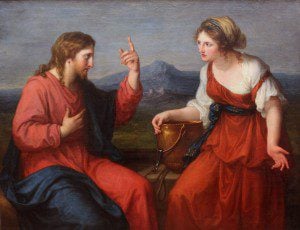
“Christ and the Woman at the Well” by Angelica Kauffman (1741–1807)
On the 3rd, 4th, and 5th Sundays of Lent, Catholic Churches with adults preparing to be baptized at the Easter Vigil will perform three successive rites called “the Scrutinies.” These rites, with roots dating back to the early Church, are part of a larger process called the Rite of Christian Initiation for Adults.
If you’re not familiar with these rites, they might feel like an unnecessary add-on to the Sunday Mass. But oneeds you understand the history and the theology behind the Scrutinies, you can see that they are not only ancient rites, but profoundly meaningful.
Each Scrutiny takes place during a Sunday Mass, and is thematically linked to the Gospel reading for that Mass (more on that later). The persons preparing for the sacraments (“the Elect”), along with their sponsors, bow or kneel before the celebrant and the assembly, who pray for them silently and with a series of intercessions. Culminating in a prayer of cleansing and protection with the laying-on-of-hands, each Scrutiny is a step in preparing the Elect for the celebration and initiation soon to come.
Understanding the Scrutinies
So what, exactly, are the Scrutinies? What is their spiritual meaning?
To answer this question, begin by considering the name of these rites. To put something under scrutiny means to examine it carefully. But what does this have to do with preparing for Christian initiation?
The etymology of the word is maybe partially helpful — it has a connotation of pawing through trash, looking for something valuable. We’ve all heard stories of someone throwing away a winning lottery ticket, only to spend hours or days at the landfill, trying to find that precious piece of paper.
Despite centuries of stern language in Christianity about the depravity of sinful humanity, I don’t believe God sees us as garbage! We are created in God’s image and likeness, after all. But I still think the etymology of scrutiny is partially helpful because of this notion of seeking out what is valuable.
A Catholic educator I know compares the Scrutinies to reading a contract or examining a house you are thinking of buying. Yes, it’s a close, critical look — but it’s looking for what is valuable.
When an editor offers me a publishing contract, I don’t read it with the idea of finding all the reasons I should turn it down. On the contrary, I’m looking primarily for what is valuable about the contract — and if there are any issues, I see those as matters for further negotiation, not deal-killers.
Same thing with having a house inspection before closing: as long as the house is basically sound, any problems discovered in the inspection are simply matters for insuring that the transaction is fair to all parties involved.
So the Scrutinies are God’s way of taking a close, loving look at the Elect. God does not scrutinize us (or baptismal candidates) in order to find everything that’s wrong with them, but to celebrate all that is beautiful and good and true in them.
And, as in the mundane examples given above — to identify those areas that stand in need of ongoing care and conversion (hardly a surprise, here, since the Catholic faith acknowledges that we are all “sinners” — broken and wounded — in some way).
Insight from the Gospel Readings
To take our understanding of the Scrutinies further, let’s look at the Gospel readings assigned for the Mass where a Scrutiny occurs. The three Scrutinies occur over a three week period (3rd, 4th, and 5th Sundays in Lent), so we have three Gospel readings to consider.
First Scrutiny: Jesus Encounters the Woman at the Well (John 4:5-42). Jesus breaks social convention to speak to a Samaritan woman he encounters at a well, in their conversation, he offers her living water. He says, “Whoever drinks the water I shall give will never thirst; the water I shall give will become a spring of water welling up to eternal life.”
Second Scrutiny: Jesus Heals a Man Born Blind (John 9:1-41). On a Sabbath day, Jesus heals a man blind since birth, so that God’s glory may be revealed in him. While this gets Jesus into trouble with the religious authorities, it’s a powerful story demonstrating Jesus’s words: “I am the light of the world” and as such, he calls this man form darkness to light.
Third Scrutiny: Jesus Raises Lazarus from the Dead (John 11:1-45). An emotional and moving story, Jesus comes to the home of his friends Mary and Martha, distraught over the recent passing of their brother. He calls the dead man to literally rise from the tomb — a call from death to new life. Jesus says, “Did I not tell you that if you believe you will see the glory of God?”
From sin to repentance, from thirst to satisfaction; from illness to health; from darkness to light; from death to new life. Jesus encounters three people in these Gospels, and they are changed forever.
He calls forth exactly what they need, whether it is forgiveness, or sight, or life. In so doing, he rocks their worlds. And the message for us: if we open our hearts to him, he’ll rock our worlds, too.
Encountering Christ Through the Scrutinies
So in the Scrutinies, Jesus encounters us. It’s not about us, it’s about him. He is the one doing the scrutinizing!
Jesus “scrutinizes” us, and finds all that is valuable within us. He also reveals to us the ways in which we are hurting, or sick, or sinful — but this is not to reject us, but to call us to new life and to healing.
I said up above that the Scrutinies culminate with a prayer of protection and cleansing. The traditional word for this prayer is exorcism. Talk about a big, scary word! We need to put all the horror movie clichés out of our mind when talking about the Scrutinies. These prayers are simply ways of calling on God — and trusting in God’s power — not only to affirm what is good within us, but to dispel whatever holds us back or causes us to resist grace and goodness in our lives.
Scrutinies are intended for those who are preparing for the Sacraments of Initiation: not only Baptism, but also Confirmation and Communion. But if you have already been baptized and are at a Mass with a Scrutiny, please join in praying for the Elect. And listen to the words of the intercessions and the prayers, and reflect on their meaning for your life, too. Just because you and I are already baptized does not mean we no longer need for Jesus to search us and behold us! Let the Scrutinies call you to the living waters, to the light, to new life. Let them call you to a closer walk with Christ.
Enjoy reading this blog?
Click here to become a patron.

Previous Post
March 15, 2017
Why Silence Matters (Video)
Next Post

March 20, 2017 Talking to Christine Valters Paintner about the Wisdom of the Body
Browse Our Archives
Select a Category Activism Announcements Art Books Catholicism Celtic Christianity Christian mysticism Christianity Contemplation Current events Etc. Family humor interfaith dialogue Interfaith Wisdom Interspirituality Lay Cistercians Living the Faith Meditation movies Mysticism Mystics nature Poetry Reviews Scripture silence Spirituality Uncategorized Writing
Select a Month February 2025 January 2025 November 2024 September 2024 August 2024 July 2024 June 2024 May 2024 March 2024 January 2024 December 2023 November 2023 August 2023 June 2023 April 2023 March 2023 February 2023 January 2023 December 2022 November 2022 October 2022 September 2022 August 2022 July 2022 June 2022 May 2022 April 2022 February 2022 January 2022 December 2021 November 2021 October 2021 September 2021 August 2021 July 2021 June 2021 May 2021 April 2021 March 2021 February 2021 January 2021 December 2020 November 2020 October 2020 September 2020 August 2020 July 2020 June 2020 May 2020 April 2020 March 2020 February 2020 January 2020 December 2019 November 2019 October 2019 September 2019 August 2019 July 2019 June 2019 May 2019 April 2019 March 2019 February 2019 January 2019 December 2018 November 2018 October 2018 September 2018 August 2018 July 2018 June 2018 May 2018 April 2018 March 2018 February 2018 January 2018 December 2017 November 2017 October 2017 September 2017 August 2017 July 2017 June 2017 May 2017 April 2017 March 2017 February 2017 January 2017 December 2016 November 2016 October 2016 September 2016 August 2016 July 2016 June 2016 May 2016 March 2016 February 2016 January 2016 December 2015 November 2015 October 2015 September 2015 August 2015 July 2015 June 2015 May 2015 April 2015 March 2015 February 2015 January 2015 December 2014 November 2014 October 2014 September 2014 August 2014 July 2014 June 2014 May 2014 April 2014 March 2014 February 2014 January 2014 December 2013 October 2013 September 2013 July 2013 May 2013 January 2013 December 2012 November 2012 August 2012 July 2012 June 2012 March 2012 December 2011 September 2011 October 2010 August 2010 March 2010 September 2009 July 2008 January 2008 December 2007 September 2007 February 2007 January 2007 December 2004
Follow Us!
TAKE THE
Religious Wisdom Quiz
Who was the Roman emperor during Jesus’ birth?
Select your answer to see how you score.
Caesar Augustus Nero Herod Tiberius
Support this
Column


Related posts from Carl McColman
A Great Mystical Book — With a Surprising...
How do I choose a contemplative lay order?...
What's the Best Church for Contemplative Christians?
Less than 12% of the Catholic Catechism is...
TRENDING AT PATHEOS Contemplative

Handy Contemplative Practices for Political Spaces
A Spiritually Grounded Presence In order to bring a spiritually grounded presence...

Halloween: The Holiday of Loving Your Neighbor
All Hallows Eve Is Halloween the least Christian holiday in America, or...

Can Love Be Saved? Some Thoughts on the...
Happy Valentine's Day! I recently published a post on Patreon called Can...
"This Loving, Uniting Embrace": the Holy Ordinary
Today's guest post is by Mark Longhurst, author of The Holy Ordinary:...
How Are We Called to Live?: More About...
How Are We Called to Live? Many of us struggle with discerning...

A Spiritual Practice of Reading: Join Us Online
A Spiritual Practice of Reading A healthy spiritual practice of reading is...
view all Contemplative blogs
Ad-Free & Subscriber Log-In Subscription Support
- About Us
- 2026 Calendar
- Videos
- Podcasts
- Library of World Religions
- Faith In Media Tracker
- Advertise With Us
- Write for Us
- Privacy Policy
- Terms of Service
- Do Not Sell My Data
- Contact Us
- Radiant Digital
- Manage Newsletter Subscriptions
- Unsubscribe From Notifications
- Sitemap
Copyright 2008-2026, Patheos, part of the Radiant Digital network of media brands. All rights reserved.
Subscription Support Ad-Free & Subscriber Log-In
Follow Patheos