
BuddhistCatholicContemplativeEvangelicalGeneral ChristianHinduJewishLatter-day SaintMuslimNew VisionsProgressive Christian
Beliefs
- Buddhist
- Catholic
- Contemplative
- Evangelical
- General Christian
- Hindu
- Jewish
- Latter-day Saint
- More Voices
- Muslim
- New Visions
- Pagan
- Progressive Christian
Topics
- Religion News
- Food and Religion
- Sports and Religion
- Religious Art
- Religious Music and Entertainment
- Religious Events
- History and Religion
- Style and Religion
- Politics and Religion
- Women in Religion
- Recreation Outdoors and Religion
- Business Finance and Religion
- Careers Workplace and Religion
- Education and Religion
- Family Parenting and Religion
- Health Fitness and Religion
- Home and Religion
- Relationships and Religion
- Technology and Religion
- Travel and Religion
Columnists
- Buddhist Columnists
- Business Finance and Religion Columnists
- Careers Workplace and Religion Columnists
- Catholic Columnists
- Contemplative Columnists
- Education and Religion Columnists
- Evangelists Columnists
- Family Parenting and Religion Columnists
- General Christian Columnists
- Health Fitness and Religion Columnists
- Hindu Columnists
- History and Religion Columnists
- Home and Religion Columnists
- Jewish Columnists
- More Voices Columnists
- Latter Day Columnists
- Muslim Columnists
- New Visions Columnists
- Nonreligious Columnists
- Pagan Columnists
- Politics and Religion Columnists
- Progressive Columnists
- Recreation Outdoors and Religion Columnists
- Relationships and Religion Columnists
- Religion News Columnists
- Religious Art Columnists
- Religious Events Columnists
- Religious Music and Entertainment Columnists
- Sports and Religion Columnists
- Style and Religion Columnists
- Technology and Religion Columnists
- Travel and Religion Columnists
- Women in Religion Columnists
Resource Library
- 2026 Calendar
- Library of World Religions
- The 100 Most Holy Places on Earth
- Patheos Answers
- Podcasts
- Videos
- Faith Leaders Database
- Anglican Episcopalian
- Bahai
- Baptist
- Buddhism
- Christianity
- Confucianism
- Eastern Orthodoxy
- Hinduism
- Holiness and Pentecostal
- ISKCON
- Islam
- Judaism
- Lutheran
- Methodist
- The Church of Jesus Christ of Latter-day Saints
- New Age
- Paganism
- Presbytarian and Reformed
- Protestantism
- Religion Behind the Scenes
- Roman Catholic
- Scientology
- Shia Islam
- Sikhism
- Sufism
- Sunni Islam
- Taoism
- Zen
- See all religions
Research Tools
 Ad-Free & Subscriber Log-In Subscription Support
Ad-Free & Subscriber Log-In Subscription Support
Follow Patheos 

- Trending:
- Forgiveness
- |
- Marriage
- |
- Consciousness
- |
- Death Penalty
- |
- Election
- |
- Halloween

- Home
- Contemplative
- Taqiya, Suspicion, and the Sermon on the Mount (What happened when a Catholic Church invited a Muslim grandmother to visit)
Taqiya, Suspicion, and the Sermon on the Mount (What happened when a Catholic Church invited a Muslim grandmother to visit)
Last updated on: January 2, 2018 at 5:15 pm by Carl "Skye" McColman
Taqiya, Suspicion, and the Sermon on the Mount (What happened when a Catholic Church invited a Muslim grandmother to visit) 2018-01-02T17:15:27-04:00 Carl "Skye" McColman
Patheos Explore the world's faith through different perspectives on religion and spirituality! Patheos has the views of the prevalent religions and spiritualities of the world.
 The other night a Muslim woman spoke at my church. Her name is Moina Shaiq, originally from Pakistan, now living in the Bay Area of California. She has a ministry called, simply enough, Meet a Muslim. A mother and grandmother, she has lived in America now almost 40 years.
Through “Meet a Muslim” she offers to connect with people of other faiths for dialogue and conversation. She had spoken at the Disciples of Christ Church across the street from our parish, and the minister there recommended her to our parochial vicar, and so she came to visit us.
About 150 parishioners, students, and other interested folks showed up. The evening began with our pastor, Fr. Mark, reading the paragraph from the Vatican II document Nostra Aetate about the positive esteem that Catholics have for Muslims. Then he introduced Moina, who spoke briefly about herself, why she launched this effort (in the wake of the San Bernardino shootings last year), and a basic overview of Islam, before opening the floor up for questions.
Most people seemed genuinely interested in learning more. Several thanked her for her courage to come to a Catholic Church to talk about her faith. Some of the questions were pointed, especially as people wondered about issues such as the status of women in Islam or the relationship between faith and politics in Muslim majority nations, but generally the tone was civil and focussed on simply hearing what this Muslim woman had to say.
Generally, but not entirely. One belligerent man loudly insisted that Muslims were taught to lie in order to propagate their faith. To back up his allegation, he invoked the concept of taqiya — an Arabic word that literally means “prudence,” and that refers to the permissibility of denying one’s faith or beliefs in order to avoid persecution. It’s a defensive concept — but it has been misinterpreted by extremist critics of Islam to imply that Muslims will do, or say, anything to advance the cause of their religion.
“So why should I believe you?” he practically shouted.
Here’s what this implies: “Muslims are committed to violently overthrowing Christianity. Of course, if Muslims are up-front about this, Christians will unite against them. Therefore, Muslims pretend to want peace and harmony, which will lull foolish Christians into accepting them, but then as soon as they have a majority of the population, down comes the boom and Christians become the persecuted minority.”
In other words, taqiya has become a code-word among people suspicious of Islam, to mean “Muslims can never be trusted.”
But to think that taqiya proves Muslims cannot be trusted is not only bad scholarship (it’s simply historically untrue) — but it’s also evidence of a dualistic mindset, which impugns all Muslims as “the enemy.” It’s a form of scapegoating, and we’ve seen this before in America: believing that an entire group of people cannot be trusted has been used in the past to target Native Americans, African-Americans, communists, and… well, Catholics. But nowadays, Muslims (and, by extension, refugees from Muslim countries) are often the target of this kind of scapegoating.
As Moina Shaiq tried to patiently explain that Islam, like every other religion, is based on human civility and decency and that any Muslim child knows that lying is wrong, the man just kept trying to talk over her. When another person in the audience — a woman who teaches World Religions at a local Catholic High School — came to the speaker’s defense, pointing out that taqiyya means prudence and not duplicity, the man just began arguing with her instead.
Finally, our pastor had to intervene and ask everyone to cool down.
Throughout this exchange, Moina Shaiq maintained poise and dignity, and never took the bait to become argumentative or defensive in response to the man’s attack. Any reasonable person watching the exchange would have been impressed by her demeanor, and a bit embarrassed by the man’s bluster and obvious suspicion.
I understand that some Americans (including some American Catholics) have misgivings about the spread of Islam in America; it’s human nature to be uncomfortable with change and with cultural differences. Because terrorism related to Islamic extremism gets plenty of media airtime in our nation, it’s unfortunately too easy to have a distorted view of Islam.
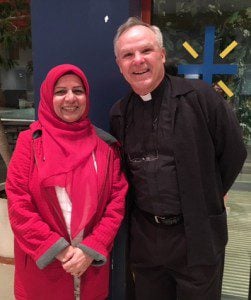
Nostra Aetate in Action
But as Moina Shaiq pointed out, “Just as the Ku Klux Klan does not represent the true teachings of Christianity, likewise ISIL does not represent the true teachings of Islam.” Therefore, I think even those who might have some misgivings, have an obligation to develop a balanced and unbiased view of Islam, and look for creating a society where people of different faiths can coexist peacefully.
Whether we like it or not, the world is now a global village, and none of the major faiths are going away. We have two choices. We can view other faiths through the lens of suspicion, seeing them as “the enemy.” The belligerent man, sadly, appears to have made that choice. But our other option is to take the path that Moina Shaiq has taken: to reach out to one another, to try to foster dialogue and conversation and to look for positive ways to create a truly multi-cultural society, which is what we’ve got anyways, so now we need to learn to embrace it positively.
Jesus insists that one of our key mandates, as his followers, is to love our neighbors. In the Sermon on the Mount, Jesus also very bluntly told us to “love our enemies.” For Catholics, this is not optional. Failure to do this is a sin. G. K. Chesterton once joked that we were told to love our neighbors and to love our enemies because very often they are the same people. That may be true enough. But I think we also have to beware of the sinful human tendency to be so suspicious of our neighbors that we turn them into “enemies,” if only in our own mind.
When we remember to love our enemies, we have taken the first step to reconciling with them; transforming them from enemies to friends. And when we remember to love our neighbors, we can, with God’s help, safeguard against making them enemies to begin with.
Enjoy reading this blog?
Click here to become a patron.

Stay in touch! Connect with Carl McColman on Facebook:
Next Post

February 15, 2017 Seven Important Bible Verses About Silence
Browse Our Archives
Select a Category Activism Announcements Art Books Catholicism Celtic Christianity Christian mysticism Christianity Contemplation Current events Etc. Family humor interfaith dialogue Interfaith Wisdom Interspirituality Lay Cistercians Living the Faith Meditation movies Mysticism Mystics nature Poetry Reviews Scripture silence Spirituality Uncategorized Writing
Select a Month February 2025 January 2025 November 2024 September 2024 August 2024 July 2024 June 2024 May 2024 March 2024 January 2024 December 2023 November 2023 August 2023 June 2023 April 2023 March 2023 February 2023 January 2023 December 2022 November 2022 October 2022 September 2022 August 2022 July 2022 June 2022 May 2022 April 2022 February 2022 January 2022 December 2021 November 2021 October 2021 September 2021 August 2021 July 2021 June 2021 May 2021 April 2021 March 2021 February 2021 January 2021 December 2020 November 2020 October 2020 September 2020 August 2020 July 2020 June 2020 May 2020 April 2020 March 2020 February 2020 January 2020 December 2019 November 2019 October 2019 September 2019 August 2019 July 2019 June 2019 May 2019 April 2019 March 2019 February 2019 January 2019 December 2018 November 2018 October 2018 September 2018 August 2018 July 2018 June 2018 May 2018 April 2018 March 2018 February 2018 January 2018 December 2017 November 2017 October 2017 September 2017 August 2017 July 2017 June 2017 May 2017 April 2017 March 2017 February 2017 January 2017 December 2016 November 2016 October 2016 September 2016 August 2016 July 2016 June 2016 May 2016 March 2016 February 2016 January 2016 December 2015 November 2015 October 2015 September 2015 August 2015 July 2015 June 2015 May 2015 April 2015 March 2015 February 2015 January 2015 December 2014 November 2014 October 2014 September 2014 August 2014 July 2014 June 2014 May 2014 April 2014 March 2014 February 2014 January 2014 December 2013 October 2013 September 2013 July 2013 May 2013 January 2013 December 2012 November 2012 August 2012 July 2012 June 2012 March 2012 December 2011 September 2011 October 2010 August 2010 March 2010 September 2009 July 2008 January 2008 December 2007 September 2007 February 2007 January 2007 December 2004
Follow Us!
TAKE THE
Religious Wisdom Quiz
Which prophet was commanded to buy a field during a siege?
Select your answer to see how you score.
Isaiah Habakkuk Jeremiah Obadiah
Support this
Column


Related posts from Carl McColman


LSD, Anxiety, and Contemplation: Can Psychedelic Therapy Support...
Contemplative Prayer Summit coming up September 23 and...

Contemplative AI: Google's "Bard" Answers My Questions About...
TRENDING AT PATHEOS Contemplative

Handy Contemplative Practices for Political Spaces
A Spiritually Grounded Presence In order to bring a spiritually grounded presence...

Halloween: The Holiday of Loving Your Neighbor
All Hallows Eve Is Halloween the least Christian holiday in America, or...

Can Love Be Saved? Some Thoughts on the...
Happy Valentine's Day! I recently published a post on Patreon called Can...

"This Loving, Uniting Embrace": the Holy Ordinary
Today's guest post is by Mark Longhurst, author of The Holy Ordinary:...

How Are We Called to Live?: More About...
How Are We Called to Live? Many of us struggle with discerning...

A Spiritual Practice of Reading: Join Us Online
A Spiritual Practice of Reading A healthy spiritual practice of reading is...
view all Contemplative blogs
Ad-Free & Subscriber Log-In Subscription Support
- About Us
- 2026 Calendar
- Videos
- Podcasts
- Library of World Religions
- Faith In Media Tracker
- Advertise With Us
- Write for Us
- Privacy Policy
- Terms of Service
- Do Not Sell My Data
- Contact Us
- Radiant Digital
- Manage Newsletter Subscriptions
- Unsubscribe From Notifications
- Sitemap
Copyright 2008-2026, Patheos. All rights reserved.
Subscription Support Ad-Free & Subscriber Log-In
Follow Patheos