
BuddhistCatholicContemplativeEvangelicalGeneral ChristianHinduJewishLatter-day SaintMuslimNew VisionsProgressive Christian
Beliefs
- Buddhist
- Catholic
- Contemplative
- Evangelical
- General Christian
- Hindu
- Jewish
- Latter-day Saint
- More Voices
- Muslim
- New Visions
- Pagan
- Progressive Christian
Topics
- Religion News
- Food and Religion
- Sports and Religion
- Religious Art
- Religious Music and Entertainment
- Religious Events
- History and Religion
- Style and Religion
- Politics and Religion
- Women in Religion
- Recreation Outdoors and Religion
- Business Finance and Religion
- Careers Workplace and Religion
- Education and Religion
- Family Parenting and Religion
- Health Fitness and Religion
- Home and Religion
- Relationships and Religion
- Technology and Religion
- Travel and Religion
Columnists
- Buddhist Columnists
- Business Finance and Religion Columnists
- Careers Workplace and Religion Columnists
- Catholic Columnists
- Contemplative Columnists
- Education and Religion Columnists
- Evangelists Columnists
- Family Parenting and Religion Columnists
- General Christian Columnists
- Health Fitness and Religion Columnists
- Hindu Columnists
- History and Religion Columnists
- Home and Religion Columnists
- Jewish Columnists
- More Voices Columnists
- Latter Day Columnists
- Muslim Columnists
- New Visions Columnists
- Nonreligious Columnists
- Pagan Columnists
- Politics and Religion Columnists
- Progressive Columnists
- Recreation Outdoors and Religion Columnists
- Relationships and Religion Columnists
- Religion News Columnists
- Religious Art Columnists
- Religious Events Columnists
- Religious Music and Entertainment Columnists
- Sports and Religion Columnists
- Style and Religion Columnists
- Technology and Religion Columnists
- Travel and Religion Columnists
- Women in Religion Columnists
Resource Library
- 2026 Calendar
- Library of World Religions
- The 100 Most Holy Places on Earth
- Patheos Answers
- Podcasts
- Videos
- Faith Leaders Database
- Anglican Episcopalian
- Bahai
- Baptist
- Buddhism
- Christianity
- Confucianism
- Eastern Orthodoxy
- Hinduism
- Holiness and Pentecostal
- ISKCON
- Islam
- Judaism
- Lutheran
- Methodist
- The Church of Jesus Christ of Latter-day Saints
- New Age
- Paganism
- Presbytarian and Reformed
- Protestantism
- Religion Behind the Scenes
- Roman Catholic
- Scientology
- Shia Islam
- Sikhism
- Sufism
- Sunni Islam
- Taoism
- Zen
- See all religions
Research Tools
 Ad-Free & Subscriber Log-In Subscription Support
Ad-Free & Subscriber Log-In Subscription Support
Follow Patheos 

- Trending:
- Forgiveness
- |
- Marriage
- |
- Consciousness
- |
- Death Penalty
- |
- Election
- |
- Halloween

- Home
- Contemplative
- Remembering the Three Dimensions of Prayer at Every Mass
Remembering the Three Dimensions of Prayer at Every Mass
Last updated on: December 16, 2018 at 8:07 am by Carl "Skye" McColman
Remembering the Three Dimensions of Prayer at Every Mass 2018-12-16T08:07:47-04:00 Carl "Skye" McColman
Patheos Explore the world's faith through different perspectives on religion and spirituality! Patheos has the views of the prevalent religions and spiritualities of the world.
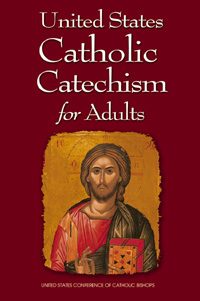
US Catechism (image courtesy US Conference of Catholic Bishops)
Do you know why Catholics make three small crosses with their thumb — on their forehead, their lips, and their hearts — at every Mass when the Gospel reading is announced?
Here is insight into this practice from the United States Catholic Catechism for Adults:
At Mass when the reading of the Gospel begins, we place the sign of the Cross on our foreheads, lips, and hearts and pray, “May the Lord be in our minds, on our lips, and in our hearts.” Lips, minds, and hearts—these symbolize three kinds of prayer: vocal, meditative, and contemplative. These modes of prayer include formal and informal paths, personal and communal expressions, popular piety, and the liturgical prayer of the Church.[1]
So the action is invocational — calling God in to our minds, our lips, and our hearts. But we invite God into our bodies because we seek intimacy with God — and the heart of such intimacy is prayer. We offer God our hearts, our minds, and our voices because we seek to grow closer to God, in all dimensions of our lives: our thoughts, our words, and our deeds. And the practice by which we seek to respond to God’s love is the practice of prayer.
There are many ways to pray, of course. And the Catechism suggests that of all the many ways we can respond to God, prayer can be usefully understood in three broad ways: vocal prayer (the prayer of our lips), meditation (the prayer of our minds), and contemplation (the prayer of our hearts). Don’t get too carried away with these distinctions — think of Scripture which speaks of “the meditation of my heart” (Psalm 19:14), so we can recognize that all types of prayer can be communicative, meditative, or contemplative. Still, in the broadest and most general sense, when we pray with our lips we are seeking to express ourselves to God (whether we are using our words or the words from a liturgy or a book); when we pray with our minds we seek to grow closer to God through the practice of meditation, and when we pray in the silence of our hearts, we seek to rest in the love of God through contemplation.
Incidentally, the Catechism agrees with me that the heart is a doorway into silence:
Unlike the busy-ness of mental life, the heart is a zone of silence.[2]
Image Courtesy Shutterstock
What I love about making the three crosses at each Mass is the implicit recognition that everyone is called to all three types of prayer. We are all called to vocal prayer (including liturgical prayer); we are all called to meditation*, and we are all called to contemplation.* Even if you prefer one form over another, you still have within yourself the capacity (and I would say the obligation) to pray in the other ways as well. Becoming a contemplative does not mean one can stop engaging in vocal or meditative prayer. Finding great joy in the Rosary of the Daily Office does not mean you can ignore the stirrings in your heart for a rich meditative prayer or the even deeper calling of silence.
What I also love about the three crosses is that they remind us that prayer, at least for Christians, is profoundly incarnational. It’s not just a head trip — even if meditation can be cerebral (but it doesn’t have to be). We are all creatures of flesh and blood, and in prayer we do not escape our embodiment — rather we pray with and through our bodies. This is not a cross to bear, but rather a profound joy. I present myself in the fullness of who I am to God. And who am I? An embodied child of God. We pray in our bodies, through our bodies, with our bodies. Our voice, in vocal prayer, emerges from our throats. The thoughts of our meditations flash in the synapses of our grey matter. And the profound stillness of contemplation emerges in the rich silence we discern within and between every beat of our hearts.
So the next time you participate in the Mass, remember to pray “May the Lord be in our minds, on our lips, and in our hearts” as you cross yourself the three times. And bear in mind that this invocation of God is a supplication to a life of prayer — in all its fullness, including meditation and contemplation.
Enjoy reading this blog?
Click here to become a patron.

Notes:
[1] United States Catholic Catechism for Adults, Kindle Locations 6808-6811
[2] ibid., Kindle Location 7093
Previous Post

August 3, 2016
Joyful Sanctity
Next Post

August 10, 2016 The Mystical Body
Browse Our Archives
Select a Category Activism Announcements Art Books Catholicism Celtic Christianity Christian mysticism Christianity Contemplation Current events Etc. Family humor interfaith dialogue Interfaith Wisdom Interspirituality Lay Cistercians Living the Faith Meditation movies Mysticism Mystics nature Poetry Reviews Scripture silence Spirituality Uncategorized Writing
Select a Month February 2025 January 2025 November 2024 September 2024 August 2024 July 2024 June 2024 May 2024 March 2024 January 2024 December 2023 November 2023 August 2023 June 2023 April 2023 March 2023 February 2023 January 2023 December 2022 November 2022 October 2022 September 2022 August 2022 July 2022 June 2022 May 2022 April 2022 February 2022 January 2022 December 2021 November 2021 October 2021 September 2021 August 2021 July 2021 June 2021 May 2021 April 2021 March 2021 February 2021 January 2021 December 2020 November 2020 October 2020 September 2020 August 2020 July 2020 June 2020 May 2020 April 2020 March 2020 February 2020 January 2020 December 2019 November 2019 October 2019 September 2019 August 2019 July 2019 June 2019 May 2019 April 2019 March 2019 February 2019 January 2019 December 2018 November 2018 October 2018 September 2018 August 2018 July 2018 June 2018 May 2018 April 2018 March 2018 February 2018 January 2018 December 2017 November 2017 October 2017 September 2017 August 2017 July 2017 June 2017 May 2017 April 2017 March 2017 February 2017 January 2017 December 2016 November 2016 October 2016 September 2016 August 2016 July 2016 June 2016 May 2016 March 2016 February 2016 January 2016 December 2015 November 2015 October 2015 September 2015 August 2015 July 2015 June 2015 May 2015 April 2015 March 2015 February 2015 January 2015 December 2014 November 2014 October 2014 September 2014 August 2014 July 2014 June 2014 May 2014 April 2014 March 2014 February 2014 January 2014 December 2013 October 2013 September 2013 July 2013 May 2013 January 2013 December 2012 November 2012 August 2012 July 2012 June 2012 March 2012 December 2011 September 2011 October 2010 August 2010 March 2010 September 2009 July 2008 January 2008 December 2007 September 2007 February 2007 January 2007 December 2004
Follow Us!
TAKE THE
Religious Wisdom Quiz
Who was swallowed by a whale (great fish)?
Select your answer to see how you score.
Jonah Abel Noah Job
Support this
Column


Related posts from Carl McColman

Four Dimensions of Mindfulness and Centering Prayer

I Believe Prayer Changes Things. Here's a Few...

Join Me for "24 Meditations for 2024"

LSD, Anxiety, and Contemplation: Can Psychedelic Therapy Support...
TRENDING AT PATHEOS Contemplative

Handy Contemplative Practices for Political Spaces
A Spiritually Grounded Presence In order to bring a spiritually grounded presence...

Halloween: The Holiday of Loving Your Neighbor
All Hallows Eve Is Halloween the least Christian holiday in America, or...

Can Love Be Saved? Some Thoughts on the...
Happy Valentine's Day! I recently published a post on Patreon called Can...

"This Loving, Uniting Embrace": the Holy Ordinary
Today's guest post is by Mark Longhurst, author of The Holy Ordinary:...

How Are We Called to Live?: More About...
How Are We Called to Live? Many of us struggle with discerning...

A Spiritual Practice of Reading: Join Us Online
A Spiritual Practice of Reading A healthy spiritual practice of reading is...
view all Contemplative blogs
Ad-Free & Subscriber Log-In Subscription Support
- About Us
- 2026 Calendar
- Videos
- Podcasts
- Library of World Religions
- Faith In Media Tracker
- Advertise With Us
- Write for Us
- Privacy Policy
- Terms of Service
- Do Not Sell My Data
- Contact Us
- Radiant Digital
- Manage Newsletter Subscriptions
- Unsubscribe From Notifications
- Sitemap
Copyright 2008-2026, Patheos. All rights reserved.
Subscription Support Ad-Free & Subscriber Log-In
Follow Patheos