
BuddhistCatholicContemplativeEvangelicalGeneral ChristianHinduJewishLatter-day SaintMuslimNew VisionsProgressive Christian
Beliefs
- Buddhist
- Catholic
- Contemplative
- Evangelical
- General Christian
- Hindu
- Jewish
- Latter-day Saint
- More Voices
- Muslim
- New Visions
- Pagan
- Progressive Christian
Topics
- Religion News
- Food and Religion
- Sports and Religion
- Religious Art
- Religious Music and Entertainment
- Religious Events
- History and Religion
- Style and Religion
- Politics and Religion
- Women in Religion
- Recreation Outdoors and Religion
- Business Finance and Religion
- Careers Workplace and Religion
- Education and Religion
- Family Parenting and Religion
- Health Fitness and Religion
- Home and Religion
- Relationships and Religion
- Technology and Religion
- Travel and Religion
Columnists
- Buddhist Columnists
- Business Finance and Religion Columnists
- Careers Workplace and Religion Columnists
- Catholic Columnists
- Contemplative Columnists
- Education and Religion Columnists
- Evangelists Columnists
- Family Parenting and Religion Columnists
- General Christian Columnists
- Health Fitness and Religion Columnists
- Hindu Columnists
- History and Religion Columnists
- Home and Religion Columnists
- Jewish Columnists
- More Voices Columnists
- Latter Day Columnists
- Muslim Columnists
- New Visions Columnists
- Nonreligious Columnists
- Pagan Columnists
- Politics and Religion Columnists
- Progressive Columnists
- Recreation Outdoors and Religion Columnists
- Relationships and Religion Columnists
- Religion News Columnists
- Religious Art Columnists
- Religious Events Columnists
- Religious Music and Entertainment Columnists
- Sports and Religion Columnists
- Style and Religion Columnists
- Technology and Religion Columnists
- Travel and Religion Columnists
- Women in Religion Columnists
Resource Library
- 2026 Calendar
- Library of World Religions
- The 100 Most Holy Places on Earth
- Patheos Answers
- Podcasts
- Videos
- Faith Leaders Database
- Anglican Episcopalian
- Bahai
- Baptist
- Buddhism
- Christianity
- Confucianism
- Eastern Orthodoxy
- Hinduism
- Holiness and Pentecostal
- ISKCON
- Islam
- Judaism
- Lutheran
- Methodist
- The Church of Jesus Christ of Latter-day Saints
- New Age
- Paganism
- Presbytarian and Reformed
- Protestantism
- Religion Behind the Scenes
- Roman Catholic
- Scientology
- Shia Islam
- Sikhism
- Sufism
- Sunni Islam
- Taoism
- Zen
- See all religions
Research Tools
 Ad-Free & Subscriber Log-In Subscription Support
Ad-Free & Subscriber Log-In Subscription Support
Follow Patheos 

- Trending:
- Forgiveness
- |
- Marriage
- |
- Consciousness
- |
- Death Penalty
- |
- Election
- |
- Halloween

- Home
- Contemplative
- Books for Beginning the Spiritual Journey
Books for Beginning the Spiritual Journey
Last updated on: December 16, 2018 at 8:16 am by Carl "Skye" McColman
Books for Beginning the Spiritual Journey 2018-12-16T08:16:02-04:00 Carl "Skye" McColman
Patheos Explore the world's faith through different perspectives on religion and spirituality! Patheos has the views of the prevalent religions and spiritualities of the world.
Here is a list of several books I recommend for spiritual seekers — especially those who are working with a spiritual director or companion.
When I recently posted a list of books for spiritual directors, I suppose it only made sense that someone would send along this request:
Thanks for putting this list together! Do you have any books that you’d recommend for “directees?”
— Seth A. (@eastcoastokie) August 15, 2016
Thank you, Seth. I’m assuming that this list of books for directees would be aimed at persons who are relatively new to intentional contemplative spirituality and to working with a spiritual companion. So most of these books are for “beginners.” Of course, when it comes to the contemplative life, there’s a real sense in which we are all, always, beginners. So folks at all stages of the spiritual life may find some or all of these books profitable to read.
The first three books are all concerned with the practice of silent prayer, whether in a general sense or in the more structured sense of centering prayer. After that I’ve listed six other titles, each of which explores a slightly different dimension of spirituality: the importance of practice, of mindfulness, of making a retreat, crafting a personal rule of life, or committing to disciplines such as sacred reading or daily liturgical prayer. Finally, I’ve rounded off the dozen with three of my own books, since they are all written for beginners and, I hope, will be useful to anyone interested in this list.
-
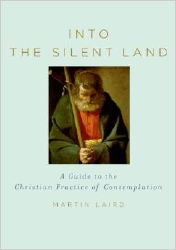
Into the Silent Land
Martin Laird, Into the Silent Land — an elegant, beautifully written, and eminently practical introduction to the Christian practice of contemplation. Laird knows the tradition and has filled this book with insightful quotations from contemplative masters, including a goodly number of Eastern Orthodox writers. Laird’s insights are particularly helpful for anyone struggling with distractions (“mental clutter”) during silent prayer.
-
Cynthia Bourgeault, Centering Prayer and Inner Awakening — this has more or less become a modern classic. Bourgeault provides a helpful overview of both the theory and practice of centering prayer, is willing to say so when she disagrees with Thomas Keating, and offers insightful commentary on how silent prayer leads us to healing and interior transformation. If you are going to read one book on centering prayer, this is it.
-
Richard Rohr, Everything Belongs — Rohr is perhaps the most popular contemplative author alive today, and several of his books could have been included on this list. But I keep going back to this introduction to contemplation as a personal favorite, and a book that I think complements Laird and Bourgeault very nicely. The title really says it all: Rohr shows us how, in the grace of the contemplative stance, we find a spirituality that is radically inclusive.
-
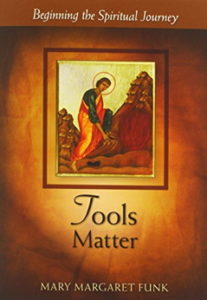
Tools Matter
Mary Margaret Funk, Tools Matter: Beginning the Spiritual Journey — one of five books on the spiritual life for beginners by this Benedictine sister; all of them are worth reading but Tools Matter is a great place to start. Funk offers insight into the wisdom of the desert fathers and mothers, particularly in regard to managing our unruly thoughts and inner chatter; then she provides a useful survey of the “tools” (practices) that contemplatives use to pray.
-
Thomas Merton, New Seeds of Contemplation — Merton may be most famous for his autobiographical writings, but this collection of devotional meditations on the contemplative life is arguably his most enduring contribution to the literature of spirituality. It’s also a great introduction to Merton himself, one of the most remarkable and important of twentieth century spiritual writers. Merton has a monk’s sensibility, but makes that worldview accessible to all.
-
Esther de Waal, Lost in Wonder: Rediscovering the Spiritual Art of Attentiveness — de Waal is known as an interpreter of both Celtic and Benedictine spirituality, but this book is a more general treatment of an important quality for spiritual living: attentiveness, or what we now call “mindfulness.” The book is structured as a kind of literary retreat, so it also speaks to the important of making a retreat as an essential spiritual practice.
-
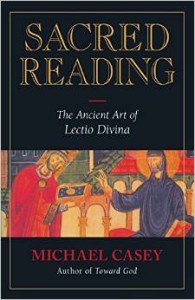
Sacred Reading
Michael Casey, Sacred Reading — monastic spirituality for centuries wove together three essential practices: contemplation, the liturgy (daily prayer), and lectio divina (“sacred reading”) or the meditative, prayerful reading of scripture. Lectio has become almost as popular in our time as silent prayer, so a number of books have appeared on the topic; many are quite good, but I keep going back to this prayerful introduction, written by my favorite living Trappist author.
-
Debra K. Farrington, Living Faith Day by Day — this is a book about crafting your own personal rule of life, inspired by the rules that govern monastic communities. Those of us who aren’t monks or nuns do not have the benefit of a shared community of spiritual practitioners, so we need tools to help us be disciplined as individuals or in families. A rule of life is a great accountability tool, and this book will help you to devise your own.
-
Arthur Boers, Day by Day These Things We Pray: Uncovering Ancient Rhythms of Prayer — liturgical prayer (the Daily Office, the Divine Office, the Liturgy of the Hours) is a vital practice of traditional Christian spirituality, but difficult to maintain outside of a monastic setting. This book, written to promote liturgical prayer to Protestants, is useful for Christians of all denominations in making the case for daily structured prayer, even if you have to pray the Office all by yourself.
-
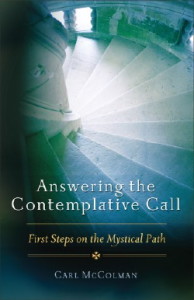
Answering the Contemplative Call
Carl McColman, Answering the Contemplative Call — this book is intended for beginners on the contemplative path, assuming no prior knowledge on the part of the reader. Using the metaphor of a journey, it surveys the elements of a beginning spiritual practice, considers the idea of spiritual awakening or transformation, and invites the reader to discover the importance of silence and of disciplined prayer.
-
Carl McColman, Befriending Silence — Can the spirituality of Trappist monks be applied to life outside the monastery? Absolutely, and this book explores what that might look like. Built around Bernard of Clairvaux’s idea that humility, compassion and contemplation are the three steps to truth, this book looks at the charisms (gifts) of Cistercian/Trappist monks and nuns, and reflects on how their cloistered spirituality could be a blessing for the rest of us.
-
Carl McColman, The Big Book of Christian Mysticism — “mysticism” is a big topic and can seem intimidating, but this book de-mystifies mysticism, showing how it is actually a very ordinary and deeply rewarding spirituality — for all people, not just saints or priests or monks or nuns. The first part of the book explores just what is mysticism, while the second part offers initial thoughts on how to embrace mystical spirituality in your day to day life.
One final thought: whether you are reading over this list for yourself or for your directee(s), I would recommend picking just one (or at the most, two) books to start with. In my experience, people drawn to the contemplative life are often book-aholics, and as an old teacher of mine was fond of saying, reading about prayer is one of our favorite ways of avoiding actually praying. Learning the balance between interesting reading and actually fostering a daily prayer discipline is an important task for early in the spiritual formation process. With that in mind, it’s better to err on the side of caution: and only take up one book (or so) at a time.
If an eager beaver finishes a book in a month, then he or she can go on to another one (and finish off the entire list in a year). But I would recommend reading all of these books slowly — savor what these writers have to say to you.
Take several months to finish off a book, and don’t start the next one until you complete the one you’re currently reading (if it turns out you really don’t like a particular book, then make the decision to stop reading it before going on to the next one).
Remember, the contemplative life is not a race! So take your time, enjoy the books you choose to read, and above all, make time every day to pray.
Do you have a favorite contemplative book for beginners that isn’t on this list? If so, please let me know — in a comment below, or on social media. Thanks!
Enjoy reading this blog?
Click here to become a patron.

Previous Post

August 10, 2016
The Mystical Body
Next Post

August 17, 2016 Proof that the Contemplative Life is Good For You
Browse Our Archives
Select a Category Activism Announcements Art Books Catholicism Celtic Christianity Christian mysticism Christianity Contemplation Current events Etc. Family humor interfaith dialogue Interfaith Wisdom Interspirituality Lay Cistercians Living the Faith Meditation movies Mysticism Mystics nature Poetry Reviews Scripture silence Spirituality Uncategorized Writing
Select a Month February 2025 January 2025 November 2024 September 2024 August 2024 July 2024 June 2024 May 2024 March 2024 January 2024 December 2023 November 2023 August 2023 June 2023 April 2023 March 2023 February 2023 January 2023 December 2022 November 2022 October 2022 September 2022 August 2022 July 2022 June 2022 May 2022 April 2022 February 2022 January 2022 December 2021 November 2021 October 2021 September 2021 August 2021 July 2021 June 2021 May 2021 April 2021 March 2021 February 2021 January 2021 December 2020 November 2020 October 2020 September 2020 August 2020 July 2020 June 2020 May 2020 April 2020 March 2020 February 2020 January 2020 December 2019 November 2019 October 2019 September 2019 August 2019 July 2019 June 2019 May 2019 April 2019 March 2019 February 2019 January 2019 December 2018 November 2018 October 2018 September 2018 August 2018 July 2018 June 2018 May 2018 April 2018 March 2018 February 2018 January 2018 December 2017 November 2017 October 2017 September 2017 August 2017 July 2017 June 2017 May 2017 April 2017 March 2017 February 2017 January 2017 December 2016 November 2016 October 2016 September 2016 August 2016 July 2016 June 2016 May 2016 March 2016 February 2016 January 2016 December 2015 November 2015 October 2015 September 2015 August 2015 July 2015 June 2015 May 2015 April 2015 March 2015 February 2015 January 2015 December 2014 November 2014 October 2014 September 2014 August 2014 July 2014 June 2014 May 2014 April 2014 March 2014 February 2014 January 2014 December 2013 October 2013 September 2013 July 2013 May 2013 January 2013 December 2012 November 2012 August 2012 July 2012 June 2012 March 2012 December 2011 September 2011 October 2010 August 2010 March 2010 September 2009 July 2008 January 2008 December 2007 September 2007 February 2007 January 2007 December 2004
Follow Us!
TAKE THE
Religious Wisdom Quiz
Who was called by God to leave his home and go to a land God would show him?
Select your answer to see how you score.
Noah Moses Abram Jacob
Support this
Column


Related posts from Carl McColman

Join Me for "24 Meditations for 2024"

LSD, Anxiety, and Contemplation: Can Psychedelic Therapy Support...

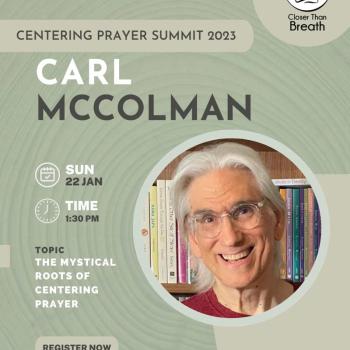
Join Me, Cynthia Bourgeault, Adam Bucko and more...
TRENDING AT PATHEOS Contemplative

Handy Contemplative Practices for Political Spaces
A Spiritually Grounded Presence In order to bring a spiritually grounded presence...

Halloween: The Holiday of Loving Your Neighbor
All Hallows Eve Is Halloween the least Christian holiday in America, or...

Can Love Be Saved? Some Thoughts on the...
Happy Valentine's Day! I recently published a post on Patreon called Can...

"This Loving, Uniting Embrace": the Holy Ordinary
Today's guest post is by Mark Longhurst, author of The Holy Ordinary:...

How Are We Called to Live?: More About...
How Are We Called to Live? Many of us struggle with discerning...

A Spiritual Practice of Reading: Join Us Online
A Spiritual Practice of Reading A healthy spiritual practice of reading is...
view all Contemplative blogs
Ad-Free & Subscriber Log-In Subscription Support
- About Us
- 2026 Calendar
- Videos
- Podcasts
- Library of World Religions
- Faith In Media Tracker
- Advertise With Us
- Write for Us
- Privacy Policy
- Terms of Service
- Do Not Sell My Data
- Contact Us
- Radiant Digital
- Manage Newsletter Subscriptions
- Unsubscribe From Notifications
- Sitemap
Copyright 2008-2026, Patheos. All rights reserved.
Subscription Support Ad-Free & Subscriber Log-In
Follow Patheos