
BuddhistCatholicContemplativeEvangelicalGeneral ChristianHinduJewishLatter-day SaintMuslimNew VisionsProgressive Christian
Beliefs
- Buddhist
- Catholic
- Contemplative
- Evangelical
- General Christian
- Hindu
- Jewish
- Latter-day Saint
- More Voices
- Muslim
- New Visions
- Pagan
- Progressive Christian
Topics
- Religion News
- Food and Religion
- Sports and Religion
- Religious Art
- Religious Music and Entertainment
- Religious Events
- History and Religion
- Style and Religion
- Politics and Religion
- Women in Religion
- Recreation Outdoors and Religion
- Business Finance and Religion
- Careers Workplace and Religion
- Education and Religion
- Family Parenting and Religion
- Health Fitness and Religion
- Home and Religion
- Relationships and Religion
- Technology and Religion
- Travel and Religion
Columnists
- Buddhist Columnists
- Business Finance and Religion Columnists
- Careers Workplace and Religion Columnists
- Catholic Columnists
- Contemplative Columnists
- Education and Religion Columnists
- Evangelists Columnists
- Family Parenting and Religion Columnists
- General Christian Columnists
- Health Fitness and Religion Columnists
- Hindu Columnists
- History and Religion Columnists
- Home and Religion Columnists
- Jewish Columnists
- More Voices Columnists
- Latter Day Columnists
- Muslim Columnists
- New Visions Columnists
- Nonreligious Columnists
- Pagan Columnists
- Politics and Religion Columnists
- Progressive Columnists
- Recreation Outdoors and Religion Columnists
- Relationships and Religion Columnists
- Religion News Columnists
- Religious Art Columnists
- Religious Events Columnists
- Religious Music and Entertainment Columnists
- Sports and Religion Columnists
- Style and Religion Columnists
- Technology and Religion Columnists
- Travel and Religion Columnists
- Women in Religion Columnists
Resource Library
- 2026 Calendar
- Library of World Religions
- The 100 Most Holy Places on Earth
- Patheos Answers
- Podcasts
- Videos
- Faith Leaders Database
- Anglican Episcopalian
- Bahai
- Baptist
- Buddhism
- Christianity
- Confucianism
- Eastern Orthodoxy
- Hinduism
- Holiness and Pentecostal
- ISKCON
- Islam
- Judaism
- Lutheran
- Methodist
- The Church of Jesus Christ of Latter-day Saints
- New Age
- Paganism
- Presbytarian and Reformed
- Protestantism
- Religion Behind the Scenes
- Roman Catholic
- Scientology
- Shia Islam
- Sikhism
- Sufism
- Sunni Islam
- Taoism
- Zen
- See all religions
Research Tools
 Ad-Free & Subscriber Log-In Subscription Support
Ad-Free & Subscriber Log-In Subscription Support
Follow Patheos 

- Trending:
- Forgiveness
- |
- Marriage
- |
- Consciousness
- |
- Death Penalty
- |
- Election
- |
- Halloween

- Home
- Contemplative
- Three Approaches to Prayer When the Dry Times Come
Three Approaches to Prayer When the Dry Times Come
Last updated on: December 13, 2018 at 12:41 pm by Carl "Skye" McColman
Three Approaches to Prayer When the Dry Times Come 2018-12-13T12:41:58-04:00 Carl "Skye" McColman
Patheos Explore the world's faith through different perspectives on religion and spirituality! Patheos has the views of the prevalent religions and spiritualities of the world.
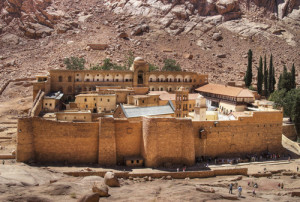
St. Catherine’s, one of the oldest Christian monasteries, is in the Sinai desert where monks have prayed for some 1500 years.
A friend of mine posed the following question recently on Facebook:
You may have written about this before but how about dry times in prayer? What to do? Does it really mean anything? Can we have an impact on it or do we patiently wait it out?
The fancy term here is “aridity.” I suspect anyone who has attempted a sustained, daily (or at least regular) practice of prayer encounters this sooner or later. A sense of dryness, as if our prayers are parched. If we pray with words (whether our own or someone else’s), it seems as if the prayers are bouncing off the ceiling. If we choose instead to settle into the silence of a more contemplative form of praying, all we encounter is fidgetiness and restless, random thoughts. “Distracted from distraction by distraction,” as T. S. Eliot put it.
So it’s a universal aspect of prayer, or at least it seems to be. The only way to dodge aridity is, well, to stop (or never start) praying. But I’m assuming anyone who is reading this blog is at least somewhat committed to prayer, so quitting is not an option.
To repeat my friend’s questions: what does this mean, and how can we respond to it?
I think the first important point is to acknowledge just how common, perhaps even universal, aridity is. What this means is that if you are experiencing dryness in your prayer, that’s a good sign — a sign you are making progress in your spiritual journey.
Think of it this way: for Moses and the Hebrew people, the path to liberation from slavery in Egypt took them through the desert. Elijah’s vocation as a prophet began with a sojourn in the wilderness. Likewise, Jesus’s earthly ministry began with his 40 days in the desert. And the very headwaters of the post-Biblical tradition of Christian contemplative and mystical spirituality began… in the desert — the deserts of Egypt, Syria, and Palestine.
If you want to be physically fit, you got to work out. If you want to master a musical instrument, it takes hours of dedicated practice. And even though spirituality is always shaped and surprised by grace, there is still a “practice” element to it — in other words, if we want to grow in our response to the love of God, our path will take us through the desert.

The Burren in Ireland (photo by “Fish Cop” — public domain)
My second thought is to recall that even the desert has its own austere beauty.
I remember the first time I travelled around Ireland, and came to a region called the Burren — the closest thing Ireland has to a desert. It’s a windswept wasteland covered by limestone which looks like what I imagine the surface of the moon to be. It’s a stark contrast to the lush, verdant landscape that we normally associate with the Emerald Isle — and yet, in its own stark way, the Burren is lovely.
I was stunned at how beautiful it was. I expected, after seeing so many picture-postcard scenes of the Irish countryside, that the Burren would just feel empty and sad. But that was not the case at all. Yes, it was empty, and I suppose it even had a sadness about it. But it was a lovely sadness, a gorgeous emptiness.
The lesson here for us as we encounter aridity in our prayer is that such times of dryness may actually be invitations to find beauty and meaning even in the emptiness, the austerity, the sense of aloneness or the sense of fidgetiness and distractedness. Most important of all, is to discover that God loves us just as we are: desert-like warts and all.
God is not just interested in a never-ending succession of happy times, where we put on a brave face or our party hats and approach prayer as just another way to greet life with a smile, no matter what’s going on inside. God wants our hearts, not our masks! God wants us precisely when we are bored, or fidgety, or restless, or distracted, or unhappy.
God wants to pour God’s love into us in whatever state we may find ourselves in. Aridity in prayer is a gentle invitation to bring our lives in their messy imperfections to the God who so dearly loves us.
Of course, part of the challenge of dryness in prayer is that we don’t feel anything — so if God is loving us through the aridity, it seems like we are the last ones to get the memo. But what we lack in awareness, we more than make up through growing in faith. Faith, by its very nature, requires times of darkness, or unknowing, or dryness, in which we get to “work out the faith muscles” — and just like a physical workout at the gym, we experience it as painful, or difficult, or fraught with resistance.
But at a level deeper than our awareness, our muscles are growing. And so it is with faith: the “resistance training” that aridity or other times of darkness or unknowing bring to us, allow our faith to grow, even at a level deeper than our conscious awareness.
So what, then, to do? When I am waist-deep in the sands of the desert, what should be my response, my “prayer game plan”?
My friend is right: the key here is patience, perseverance, and I would add, trust. Part of what makes the dry times so unpleasant is the fact that we can’t fix or manage it. So we’re invited to respond not with our American “can-do” mentality, but with something much more primal: the opportunity to simply trust in God, God’s presence, God’s work in our hearts below the threshold of our awareness.
Such trust works best when we approach it mindfully. In other words, when our prayer takes us into the desert, pay attention to the fact that you have hit a dry spell. Don’t try to fix it, or wish it away, or pray it away (as if you could). But don’t ignore it, either.
You might find yourself in a place where lamentation emerges from your heart and your lips. Alleluia! Lamentation is such a beautiful way to pray and something that our culture often forgets (because we are so busy reassuring God that we’ve got everything under control, even when all hell is actively breaking loose).
So I would recommend to anyone struggling along the path of aridity to keep these three key elements in mind:
- Trust that God is in control, that aridity is a normal aspect of a mature and serious prayer practice, and that beneath our conscious awareness, the Spirit is using such dryness to help us grow in faith and love;
- Attentiveness to the fact that what arises, arises; by being present to the darkness or dryness or distraction or unknowing, our prayer is authentic even if it doesn’t necessarily “feel” good;
- Lamentation — or whatever else arises — recognizing that God desires us to be authentic and honest in our prayer, so praying into the dryness and unknowing is perhaps the most direct path through it.
I hope this is helpful!
Do you have any suggestions for how Christians can deal with dryness or aridity in prayer? If so, please leave your thoughts as a comment to this blog post (or share with me on Facebook or Twitter). Thank you!
Enjoy reading this blog?
Click here to become a patron.

Previous Post

March 4, 2016
In Pursuit of Silence: A Quiet Movie with Much to Say

Browse Our Archives
Select a Category Activism Announcements Art Books Catholicism Celtic Christianity Christian mysticism Christianity Contemplation Current events Etc. Family humor interfaith dialogue Interfaith Wisdom Interspirituality Lay Cistercians Living the Faith Meditation movies Mysticism Mystics nature Poetry Reviews Scripture silence Spirituality Uncategorized Writing
Select a Month February 2025 January 2025 November 2024 September 2024 August 2024 July 2024 June 2024 May 2024 March 2024 January 2024 December 2023 November 2023 August 2023 June 2023 April 2023 March 2023 February 2023 January 2023 December 2022 November 2022 October 2022 September 2022 August 2022 July 2022 June 2022 May 2022 April 2022 February 2022 January 2022 December 2021 November 2021 October 2021 September 2021 August 2021 July 2021 June 2021 May 2021 April 2021 March 2021 February 2021 January 2021 December 2020 November 2020 October 2020 September 2020 August 2020 July 2020 June 2020 May 2020 April 2020 March 2020 February 2020 January 2020 December 2019 November 2019 October 2019 September 2019 August 2019 July 2019 June 2019 May 2019 April 2019 March 2019 February 2019 January 2019 December 2018 November 2018 October 2018 September 2018 August 2018 July 2018 June 2018 May 2018 April 2018 March 2018 February 2018 January 2018 December 2017 November 2017 October 2017 September 2017 August 2017 July 2017 June 2017 May 2017 April 2017 March 2017 February 2017 January 2017 December 2016 November 2016 October 2016 September 2016 August 2016 July 2016 June 2016 May 2016 March 2016 February 2016 January 2016 December 2015 November 2015 October 2015 September 2015 August 2015 July 2015 June 2015 May 2015 April 2015 March 2015 February 2015 January 2015 December 2014 November 2014 October 2014 September 2014 August 2014 July 2014 June 2014 May 2014 April 2014 March 2014 February 2014 January 2014 December 2013 October 2013 September 2013 July 2013 May 2013 January 2013 December 2012 November 2012 August 2012 July 2012 June 2012 March 2012 December 2011 September 2011 October 2010 August 2010 March 2010 September 2009 July 2008 January 2008 December 2007 September 2007 February 2007 January 2007 December 2004
Follow Us!
TAKE THE
Religious Wisdom Quiz
The name of the Lord is a fortified tower; the righteous run to it and are ____.
Select your answer to see how you score.
Uplifted Saved Hidden Protected
Support this
Column


Related posts from Carl McColman

I Believe Prayer Changes Things. Here's a Few...

LSD, Anxiety, and Contemplation: Can Psychedelic Therapy Support...

Two Types of Healing Prayer Every Christian Should...

Heart to Heart, Simple Awareness of Love
TRENDING AT PATHEOS Contemplative

Handy Contemplative Practices for Political Spaces
A Spiritually Grounded Presence In order to bring a spiritually grounded presence...

Halloween: The Holiday of Loving Your Neighbor
All Hallows Eve Is Halloween the least Christian holiday in America, or...

Can Love Be Saved? Some Thoughts on the...
Happy Valentine's Day! I recently published a post on Patreon called Can...

"This Loving, Uniting Embrace": the Holy Ordinary
Today's guest post is by Mark Longhurst, author of The Holy Ordinary:...

How Are We Called to Live?: More About...
How Are We Called to Live? Many of us struggle with discerning...

A Spiritual Practice of Reading: Join Us Online
A Spiritual Practice of Reading A healthy spiritual practice of reading is...
view all Contemplative blogs
Ad-Free & Subscriber Log-In Subscription Support
- About Us
- 2026 Calendar
- Videos
- Podcasts
- Library of World Religions
- Faith In Media Tracker
- Advertise With Us
- Write for Us
- Privacy Policy
- Terms of Service
- Do Not Sell My Data
- Contact Us
- Radiant Digital
- Manage Newsletter Subscriptions
- Unsubscribe From Notifications
- Sitemap
Copyright 2008-2026, Patheos. All rights reserved.
Subscription Support Ad-Free & Subscriber Log-In
Follow Patheos