
BuddhistCatholicContemplativeEvangelicalGeneral ChristianHinduJewishLatter-day SaintMuslimNew VisionsProgressive Christian
Beliefs
- Buddhist
- Catholic
- Contemplative
- Evangelical
- General Christian
- Hindu
- Jewish
- Latter-day Saint
- More Voices
- Muslim
- New Visions
- Pagan
- Progressive Christian
Topics
- Religion News
- Food and Religion
- Sports and Religion
- Religious Art
- Religious Music and Entertainment
- Religious Events
- History and Religion
- Style and Religion
- Politics and Religion
- Women in Religion
- Recreation Outdoors and Religion
- Business Finance and Religion
- Careers Workplace and Religion
- Education and Religion
- Family Parenting and Religion
- Health Fitness and Religion
- Home and Religion
- Relationships and Religion
- Technology and Religion
- Travel and Religion
Columnists
- Buddhist Columnists
- Business Finance and Religion Columnists
- Careers Workplace and Religion Columnists
- Catholic Columnists
- Contemplative Columnists
- Education and Religion Columnists
- Evangelists Columnists
- Family Parenting and Religion Columnists
- General Christian Columnists
- Health Fitness and Religion Columnists
- Hindu Columnists
- History and Religion Columnists
- Home and Religion Columnists
- Jewish Columnists
- More Voices Columnists
- Latter Day Columnists
- Muslim Columnists
- New Visions Columnists
- Nonreligious Columnists
- Pagan Columnists
- Politics and Religion Columnists
- Progressive Columnists
- Recreation Outdoors and Religion Columnists
- Relationships and Religion Columnists
- Religion News Columnists
- Religious Art Columnists
- Religious Events Columnists
- Religious Music and Entertainment Columnists
- Sports and Religion Columnists
- Style and Religion Columnists
- Technology and Religion Columnists
- Travel and Religion Columnists
- Women in Religion Columnists
Resource Library
- 2026 Calendar
- Library of World Religions
- The 100 Most Holy Places on Earth
- Patheos Answers
- Podcasts
- Videos
- Faith Leaders Database
- Anglican Episcopalian
- Bahai
- Baptist
- Buddhism
- Christianity
- Confucianism
- Eastern Orthodoxy
- Hinduism
- Holiness and Pentecostal
- ISKCON
- Islam
- Judaism
- Lutheran
- Methodist
- The Church of Jesus Christ of Latter-day Saints
- New Age
- Paganism
- Presbytarian and Reformed
- Protestantism
- Religion Behind the Scenes
- Roman Catholic
- Scientology
- Shia Islam
- Sikhism
- Sufism
- Sunni Islam
- Taoism
- Zen
- See all religions
Research Tools
 Ad-Free & Subscriber Log-In Subscription Support
Ad-Free & Subscriber Log-In Subscription Support
Follow Patheos 

- Trending:
- Forgiveness
- |
- Marriage
- |
- Consciousness
- |
- Death Penalty
- |
- Election
- |
- Halloween

- Home
- Contemplative
- “The Process of Being in Relationship with God”
“The Process of Being in Relationship with God”
Last updated on: December 13, 2018 at 12:03 pm by Carl "Skye" McColman
“The Process of Being in Relationship with God” 2018-12-13T12:03:55-04:00 Carl "Skye" McColman
Patheos Explore the world's faith through different perspectives on religion and spirituality! Patheos has the views of the prevalent religions and spiritualities of the world.
 Okay: to summarize…
Spirituality: the process of being in relationship with God.
Belief and Wonder: the mental and emotional qualities of being open to the possibility of Divine presence in our lives.
Culture, Ikons, Teachings/Tradition/Scripture: the stuff in our lives that carry the news of God to us; the evidence we have of God’s presence and the clues we have to help us recognize God’s presence in our own experience…
Community: the people who are our spiritual family, who support us in our opening-up to God and who help us to recognize the presence of God in nature and in culture and in ourselves.
Any questions?
Next… what is the process of forming a relationship with God? If you want to get in shape, you exercise; if you want to lose weight, you diet; if you want to get organized, you set up a filing system. So what to you do to forge a more intimate relationship with God?
Answer: you pray.
PRAYER — from the Latin word for “begging,” “requesting a favor” — arises out of a theology that focuses on the human/divine relationship in a way that stresses Divine generosity and Human neediness. Read: Matthew 7:7-11
The Christian mystical tradition, beginning with Jesus who dared to call God “Abba” — the Aramaic equivalent of “Daddy” — has boldly added a new dimension to prayer: beyond the mere transactional quality of begging or asking for favors. Christian spirituality brings a new sense of prayer as cultivating a relationship. The words “Meditation” and “Contemplation” and “Adoration,” each of which signifies a kind of prayer, illustrate this development of intimacy replacing bargaining as the central fact of prayer.
Four Requirements for prayer:
- Belief. Openness to the idea that God is interested in a closer relationship; remember, belief is not the same as the absence of doubt! It is simply a willingness to be open, a willingness to doubt your doubts, as it were.
- Discernment. Ability to identify evidence of God’s presence in your life. This requires familiarity with tradition and, almost always, involvement in a community — relationship with others who are engaged in the process of prayer and discernment, also.
- Technique. A method of prayer, a set of rules and procedures for getting down to it. It’s like a mating ritual.
- Proper setting. Just as you need a proper setting for mating rituals, well, you also need a proper setting for fostering greater intimacy with God.
Belief we’ve already covered; discernment I’m going to hold off on until we look at community more closely over the next two weeks. For now, let’s look at setting and technique.
SETTING: Prayer may happen at any time and at any place. However, some settings are naturally conducive to prayer. These include:
— personal times of silence and solitude;
— intimate settings, such as spiritual direction, pastoral counseling, or family time together;
— communal settings, best exemplified by the church community gathered in prayer;
— any situation where the opportunity exists to take a stand for God’s healing and reconciling presence in the world.
TECHNIQUE: Basically, prayer falls under two broad categories:
— DISCLOSING one’s self to God; “Saying one’s prayers” … can be formal or informal, recited or extemporaneous, and usually involves adoration, confession, intercession, petition, and thanksgiving;
— LISTENING for God’s disclosure to ourselves. Etymology of Contemplation: from Latin, con-templare, literally “with time” Listening prayer is the prayer of time spent with God.
Etymology of:
Contemplation — from the Latin, literally meaning “waiting for a sign” — I make a mistake in my book! Not “with time” but “within the temple where auguries were cast” … although it was not a horrible mistake, for the meaning of the word has a clear sense of waiting and expectancy. It’s a word implying openness, openness to awaiting the word of God. In Pagan times, this meant the augury, in a Christian context it simply means being open and waiting for the word of God which may come to us in any way, according to God’s will.
Meditation — from the Greek medesthai, to be mindful, to be thoughtful, or to plan. A different connotation than contemplation, for it implies a more active engagement with the object of meditation, whether that be scripture, or an icon, or whatever. Interestingly, with the arrival of Zen and other forms of spiritual discipline from the East, “Meditation” has taken on the connotation of “Eastern mental spiritual discipline” — however, disciplines such as Zen have more in common with contemplation than with meditation! The classic meaning of meditation would probably be best captured today in the concept of “theological reflection” — which is in itself a lovely image, for it suggests that we capture, and then reflect like a mirror, the radiance that emanates from God.
Adoration — if contemplation is a passive aspect of prayer, and meditation is a reflective aspect of prayer, then adoration is a fine example of a more active aspect of prayer. From the Latin ad- + orare, originally meaning to speak formally to, but in later Latin carrying the connotation to worship. With the connotation of worship came the sense of love or devotion, today, we can best see in this word a sense of worshipful speaking (or thinking) addressed to the Divine. In contemplation we listen for God’s word, in meditation, we reflect on God’s word, and in adoration, we speak to God.
This is different from the prayer of beseeching, which is petition. Nothing wrong with petition, but since this is a class on spirituality, and spirituality is about relationship with God,, that is not the form of prayer that I wish to emphasize! This is not the prayer of asking God for favors, or of confessing our failings to God, or of asking God to help others. Those are the prayers of petition, confession, and intercession. Adoration is simply the prayer of expressing intimacy with God, or sharing with God who we are and opening up our desire to be closer to God, to God. It’s a prayer of nakedness and vulnerability.
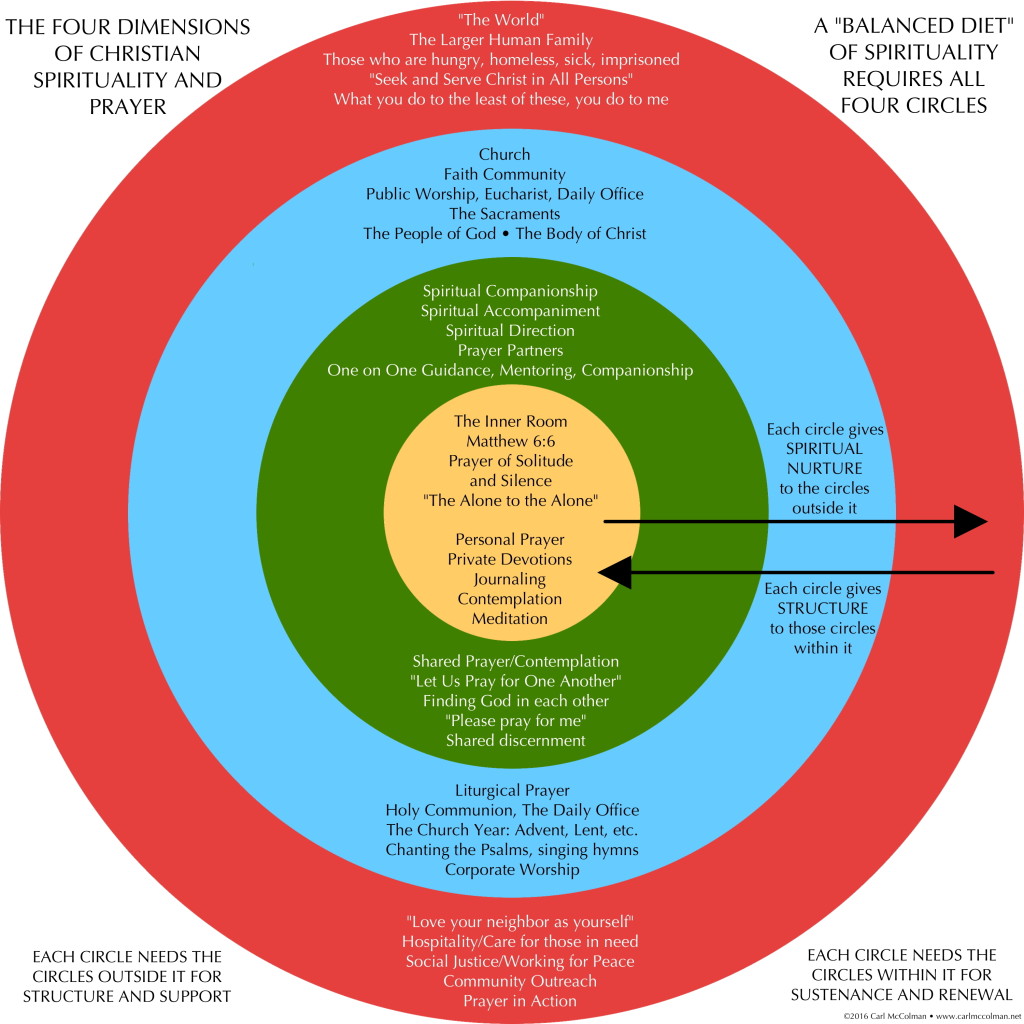
Four Dimensions of Christian Spirituality and Prayer
If enough time at end: offer four circles diagram.
“Prayer is not just a solitary activity, nor is it just a community-based activity. Indeed, prayer is the core element of spirituality, for it is the activity common to both solitary and communal expressions of the Christian life.”
My first book (seen here in its second edition), which was new when this class was taught.
This blog post consists of notes from a class on prayer that I taught probably in 1997, most likely at the Episcopal Church I attended at the time.
These notes include concepts from my first book, Spirituality, published in May 1997.
I was cleaning out my file cabinet recently and found a hard copy of these notes; I don’t have them saved anywhere, and wanted to convert them to electronic form — so I figured why not put them on my blog. I’m missing at least one page of the notes, since they begin with a summary (but I don’t have a page with the material being summarized!).
With the exception of correcting a misspelled word and inserting a missing word, I’m presenting the notes here exactly as they were typed and printed out back in the ’90s.
Incidentally, the first time I mention the etymology of contemplation (under “Technique”), it is incorrect. Notice that I correct myself in the “Etymology” section, and mention that “I made a mistake in my book!” — the book in question being Spirituality.
The “four circles diagram” illustrated the relationship between solitary prayer, spiritual direction, faith community, and service to the world: those four dimensions of spirituality existed in the diagram as four concentric circles: my contention was that the larger circles supported/gave purpose to the inner circles, while the inner circles provided spiritual sustenance to support the relationships found in the outer circles. Learn more about it here.
My apologies for the “non-linear” character of today’s post. It was fun for me to be reminded of my thoughts as I taught a class so long ago; I hope you find some of this material useful as well.
Enjoy reading this blog?
Click here to become a patron.

Butterfly photograph by Fran McColman.
Previous Post

January 28, 2016
The 2016 Presidential Candidate Prayer Challenge: Are You In?
Next Post

February 10, 2016 Books and a Film: All About Silence
Browse Our Archives
Select a Category Activism Announcements Art Books Catholicism Celtic Christianity Christian mysticism Christianity Contemplation Current events Etc. Family humor interfaith dialogue Interfaith Wisdom Interspirituality Lay Cistercians Living the Faith Meditation movies Mysticism Mystics nature Poetry Reviews Scripture silence Spirituality Uncategorized Writing
Select a Month February 2025 January 2025 November 2024 September 2024 August 2024 July 2024 June 2024 May 2024 March 2024 January 2024 December 2023 November 2023 August 2023 June 2023 April 2023 March 2023 February 2023 January 2023 December 2022 November 2022 October 2022 September 2022 August 2022 July 2022 June 2022 May 2022 April 2022 February 2022 January 2022 December 2021 November 2021 October 2021 September 2021 August 2021 July 2021 June 2021 May 2021 April 2021 March 2021 February 2021 January 2021 December 2020 November 2020 October 2020 September 2020 August 2020 July 2020 June 2020 May 2020 April 2020 March 2020 February 2020 January 2020 December 2019 November 2019 October 2019 September 2019 August 2019 July 2019 June 2019 May 2019 April 2019 March 2019 February 2019 January 2019 December 2018 November 2018 October 2018 September 2018 August 2018 July 2018 June 2018 May 2018 April 2018 March 2018 February 2018 January 2018 December 2017 November 2017 October 2017 September 2017 August 2017 July 2017 June 2017 May 2017 April 2017 March 2017 February 2017 January 2017 December 2016 November 2016 October 2016 September 2016 August 2016 July 2016 June 2016 May 2016 March 2016 February 2016 January 2016 December 2015 November 2015 October 2015 September 2015 August 2015 July 2015 June 2015 May 2015 April 2015 March 2015 February 2015 January 2015 December 2014 November 2014 October 2014 September 2014 August 2014 July 2014 June 2014 May 2014 April 2014 March 2014 February 2014 January 2014 December 2013 October 2013 September 2013 July 2013 May 2013 January 2013 December 2012 November 2012 August 2012 July 2012 June 2012 March 2012 December 2011 September 2011 October 2010 August 2010 March 2010 September 2009 July 2008 January 2008 December 2007 September 2007 February 2007 January 2007 December 2004
Follow Us!
TAKE THE
Religious Wisdom Quiz
What was the primary worship language in the Bible?
Select your answer to see how you score.
Latin Hebrew Greek Aramaic
Support this
Column


Related posts from Carl McColman

"This Loving, Uniting Embrace": the Holy Ordinary

Four Dimensions of Mindfulness and Centering Prayer

Join Me for "24 Meditations for 2024"

LSD, Anxiety, and Contemplation: Can Psychedelic Therapy Support...
TRENDING AT PATHEOS Contemplative

Handy Contemplative Practices for Political Spaces
A Spiritually Grounded Presence In order to bring a spiritually grounded presence...

Halloween: The Holiday of Loving Your Neighbor
All Hallows Eve Is Halloween the least Christian holiday in America, or...

Can Love Be Saved? Some Thoughts on the...
Happy Valentine's Day! I recently published a post on Patreon called Can...

"This Loving, Uniting Embrace": the Holy Ordinary
Today's guest post is by Mark Longhurst, author of The Holy Ordinary:...

How Are We Called to Live?: More About...
How Are We Called to Live? Many of us struggle with discerning...

A Spiritual Practice of Reading: Join Us Online
A Spiritual Practice of Reading A healthy spiritual practice of reading is...
view all Contemplative blogs
Ad-Free & Subscriber Log-In Subscription Support
- About Us
- 2026 Calendar
- Videos
- Podcasts
- Library of World Religions
- Faith In Media Tracker
- Advertise With Us
- Write for Us
- Privacy Policy
- Terms of Service
- Do Not Sell My Data
- Contact Us
- Radiant Digital
- Manage Newsletter Subscriptions
- Unsubscribe From Notifications
- Sitemap
Copyright 2008-2026, Patheos. All rights reserved.
Subscription Support Ad-Free & Subscriber Log-In
Follow Patheos