
BuddhistCatholicContemplativeEvangelicalGeneral ChristianHinduJewishLatter-day SaintMuslimNew VisionsProgressive Christian
Beliefs
- Buddhist
- Catholic
- Contemplative
- Evangelical
- General Christian
- Hindu
- Jewish
- Latter-day Saint
- More Voices
- Muslim
- New Visions
- Pagan
- Progressive Christian
Topics
- Religion News
- Food and Religion
- Sports and Religion
- Religious Art
- Religious Music and Entertainment
- Religious Events
- History and Religion
- Style and Religion
- Politics and Religion
- Women in Religion
- Recreation Outdoors and Religion
- Business Finance and Religion
- Careers Workplace and Religion
- Education and Religion
- Family Parenting and Religion
- Health Fitness and Religion
- Home and Religion
- Relationships and Religion
- Technology and Religion
- Travel and Religion
Columnists
- Buddhist Columnists
- Business Finance and Religion Columnists
- Careers Workplace and Religion Columnists
- Catholic Columnists
- Contemplative Columnists
- Education and Religion Columnists
- Evangelists Columnists
- Family Parenting and Religion Columnists
- General Christian Columnists
- Health Fitness and Religion Columnists
- Hindu Columnists
- History and Religion Columnists
- Home and Religion Columnists
- Jewish Columnists
- More Voices Columnists
- Latter Day Columnists
- Muslim Columnists
- New Visions Columnists
- Nonreligious Columnists
- Pagan Columnists
- Politics and Religion Columnists
- Progressive Columnists
- Recreation Outdoors and Religion Columnists
- Relationships and Religion Columnists
- Religion News Columnists
- Religious Art Columnists
- Religious Events Columnists
- Religious Music and Entertainment Columnists
- Sports and Religion Columnists
- Style and Religion Columnists
- Technology and Religion Columnists
- Travel and Religion Columnists
- Women in Religion Columnists
Resource Library
- 2026 Calendar
- Library of World Religions
- The 100 Most Holy Places on Earth
- Patheos Answers
- Podcasts
- Videos
- Faith Leaders Database
- Anglican Episcopalian
- Bahai
- Baptist
- Buddhism
- Christianity
- Confucianism
- Eastern Orthodoxy
- Hinduism
- Holiness and Pentecostal
- ISKCON
- Islam
- Judaism
- Lutheran
- Methodist
- The Church of Jesus Christ of Latter-day Saints
- New Age
- Paganism
- Presbytarian and Reformed
- Protestantism
- Religion Behind the Scenes
- Roman Catholic
- Scientology
- Shia Islam
- Sikhism
- Sufism
- Sunni Islam
- Taoism
- Zen
- See all religions
Research Tools
 Ad-Free & Subscriber Log-In Subscription Support
Ad-Free & Subscriber Log-In Subscription Support
Follow Patheos 

- Trending:
- Forgiveness
- |
- Marriage
- |
- Consciousness
- |
- Death Penalty
- |
- Election
- |
- Halloween

- Home
- Contemplative
- John Cassian: The Leap Year Contemplative
John Cassian: The Leap Year Contemplative
Last updated on: December 13, 2018 at 12:24 pm by Carl "Skye" McColman
John Cassian: The Leap Year Contemplative 2018-12-13T12:24:37-04:00 Carl "Skye" McColman
Patheos Explore the world's faith through different perspectives on religion and spirituality! Patheos has the views of the prevalent religions and spiritualities of the world.
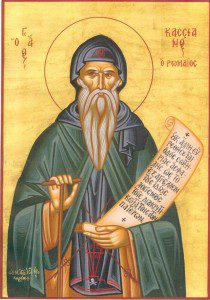
Icon of John Cassian (public domain, image courtesy of Wikipedia).
February 29 is the feast day of St. John Cassian — who, in addition to being a “leap year saint” is also one of the most important early contemplatives in the Christian tradition.
Cassian (ca. 360-435) brought monasticism — and, therefore, contemplative spirituality — from the deserts of the Middle East to Western Europe. His birthplace is uncertain, but by the 380s he was living in a monastery in Bethlehem; subsequently he left that location to travel the deserts of Egypt, where he and his spiritual friend Germanus received spiritual direction from the desert fathers.
The story of this journey, along with the wisdom the two young monks gleaned, is recorded in Cassian’s The Conferences, one of two important books he wrote toward the end of his life, after he settled in Europe (near Marseille) where he established what is generally regarded as the first European monastery. His other book, The Institutes, concerns the administration of a monastery and the “spirits” of deadly sins such as gluttony, avarice or anger.
As a record of instruction from several of the desert dwellers of the fourth century, all of Cassian’s writing is priceless, but two of the conferences specifically deal with instructions on prayer, providing one of the earliest written records of meditation instruction in the Christian faith.
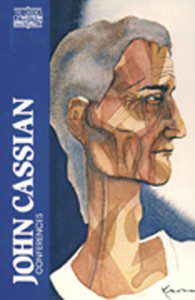
John Cassian, “The Conferences” (published by Paulist Press)
Cassian reports that Abba Isaac taught him and Germanus both the importance and the manner of contemplative prayer. “The end of every monk and the perfection of his heart direct him to constant and uninterrupted perseverance in prayer,”[i] declared the old man. Abba Isaac saw perpetual prayer as the result of a tranquil mind that has been liberated from earthly passions. He discusses different forms of prayer, including supplication, vows, intercession, and thanksgiving.
But beyond these forms of vocal prayer, “a still more sublime and exalted condition follows… fashioned by the contemplation of God alone and by fervent charity, by which the mind, having been dissolved and flung into love of him, speaks most familiarly and with particular devotion to God.” [ii] Abba Isaac goes on to point out that true prayer arises from the love of God (who first loved us) and leads to union — not only with God, but also with all others who share our devotion to Christ.
Everyone “who longs for the continual awareness of God should be in the habit of meditating on it ceaselessly in his heart, after having driven out every kind of thought”[iii] — a sentence which reveals how the ancients saw thought as emanating not from the brain, but from the heart.
But how does one “drive out every kind of thought” in order to meditate and cultivate an ongoing awareness of the presence of God? Cassian reports that Abba Isaac recommends using a verse form scripture as a continual prayer word, to be repeated continually: “O God, come to my assistance; O Lord, make haste to help me.” (Psalm 69:2, Douay-Rheims Version).[iv]
This simple meditation practice — of reciting a scripture verse repeatedly as a way to train one’s attention on God rather than on extraneous distractions — became the foundation of the Orthodox “Jesus Prayer” discipline (as celebrated in The Way of a Pilgrim and The Philokalia) and also can be seen as the earliest form of contemplative practices such as promoted by The Cloud of Unknowing or the modern-day centering prayer movement.
Prayer was not the only topic that Cassian wrote about. The Conferences include discussions of vice and virtue, spiritual knowledge, and friendship. In the conference on friendship, Cassian (quoting the desert father Abba Joseph) offers practical advice on the psychology and ethics of friendship, recognizing that true spiritual friendship must be grounded in the love of God, for God is love.
Today’s blog post is an excerpt, in slightly different from, from my book Christian Mystics: 108 Seers, Saints and Sages.
Enjoy reading this blog?
Click here to become a patron.

[i]. Cassian, John Cassian, the Conferences., p. 329.
[ii]. ibid., p. 340.
[iii]. ibid., p. 379.
[iv]. Most Protestant and newer Catholic Bibles number the Psalms differently than the Douay-Rheims version. In such versions, this verse is Psalm 70:1.
Previous Post
February 25, 2016
Is America No Longer a "Christian Nation"?
Next Post

March 1, 2016 A Memoir with a Message
Browse Our Archives
Select a Category Activism Announcements Art Books Catholicism Celtic Christianity Christian mysticism Christianity Contemplation Current events Etc. Family humor interfaith dialogue Interfaith Wisdom Interspirituality Lay Cistercians Living the Faith Meditation movies Mysticism Mystics nature Poetry Reviews Scripture silence Spirituality Uncategorized Writing
Select a Month February 2025 January 2025 November 2024 September 2024 August 2024 July 2024 June 2024 May 2024 March 2024 January 2024 December 2023 November 2023 August 2023 June 2023 April 2023 March 2023 February 2023 January 2023 December 2022 November 2022 October 2022 September 2022 August 2022 July 2022 June 2022 May 2022 April 2022 February 2022 January 2022 December 2021 November 2021 October 2021 September 2021 August 2021 July 2021 June 2021 May 2021 April 2021 March 2021 February 2021 January 2021 December 2020 November 2020 October 2020 September 2020 August 2020 July 2020 June 2020 May 2020 April 2020 March 2020 February 2020 January 2020 December 2019 November 2019 October 2019 September 2019 August 2019 July 2019 June 2019 May 2019 April 2019 March 2019 February 2019 January 2019 December 2018 November 2018 October 2018 September 2018 August 2018 July 2018 June 2018 May 2018 April 2018 March 2018 February 2018 January 2018 December 2017 November 2017 October 2017 September 2017 August 2017 July 2017 June 2017 May 2017 April 2017 March 2017 February 2017 January 2017 December 2016 November 2016 October 2016 September 2016 August 2016 July 2016 June 2016 May 2016 March 2016 February 2016 January 2016 December 2015 November 2015 October 2015 September 2015 August 2015 July 2015 June 2015 May 2015 April 2015 March 2015 February 2015 January 2015 December 2014 November 2014 October 2014 September 2014 August 2014 July 2014 June 2014 May 2014 April 2014 March 2014 February 2014 January 2014 December 2013 October 2013 September 2013 July 2013 May 2013 January 2013 December 2012 November 2012 August 2012 July 2012 June 2012 March 2012 December 2011 September 2011 October 2010 August 2010 March 2010 September 2009 July 2008 January 2008 December 2007 September 2007 February 2007 January 2007 December 2004
Follow Us!
TAKE THE
Religious Wisdom Quiz
What part of the body does the Breastplate of Righteousness protect?
Select your answer to see how you score.
The head The stomach The back The heart
Support this
Column


Related posts from Carl McColman

"This Loving, Uniting Embrace": the Holy Ordinary

Four Dimensions of Mindfulness and Centering Prayer

I Believe Prayer Changes Things. Here's a Few...

If You Worship an Angry God, You'll Be...
TRENDING AT PATHEOS Contemplative

Handy Contemplative Practices for Political Spaces
A Spiritually Grounded Presence In order to bring a spiritually grounded presence...

Halloween: The Holiday of Loving Your Neighbor
All Hallows Eve Is Halloween the least Christian holiday in America, or...

Can Love Be Saved? Some Thoughts on the...
Happy Valentine's Day! I recently published a post on Patreon called Can...

"This Loving, Uniting Embrace": the Holy Ordinary
Today's guest post is by Mark Longhurst, author of The Holy Ordinary:...

How Are We Called to Live?: More About...
How Are We Called to Live? Many of us struggle with discerning...

A Spiritual Practice of Reading: Join Us Online
A Spiritual Practice of Reading A healthy spiritual practice of reading is...
view all Contemplative blogs
Ad-Free & Subscriber Log-In Subscription Support
- About Us
- 2026 Calendar
- Videos
- Podcasts
- Library of World Religions
- Faith In Media Tracker
- Advertise With Us
- Write for Us
- Privacy Policy
- Terms of Service
- Do Not Sell My Data
- Contact Us
- Radiant Digital
- Manage Newsletter Subscriptions
- Unsubscribe From Notifications
- Sitemap
Copyright 2008-2026, Patheos. All rights reserved.
Subscription Support Ad-Free & Subscriber Log-In
Follow Patheos