
BuddhistCatholicContemplativeEvangelicalGeneral ChristianHinduJewishLatter-day SaintMuslimNew VisionsProgressive Christian
Beliefs
- Buddhist
- Catholic
- Contemplative
- Evangelical
- General Christian
- Hindu
- Jewish
- Latter-day Saint
- More Voices
- Muslim
- New Visions
- Pagan
- Progressive Christian
Topics
- Religion News
- Food and Religion
- Sports and Religion
- Religious Art
- Religious Music and Entertainment
- Religious Events
- History and Religion
- Style and Religion
- Politics and Religion
- Women in Religion
- Recreation Outdoors and Religion
- Business Finance and Religion
- Careers Workplace and Religion
- Education and Religion
- Family Parenting and Religion
- Health Fitness and Religion
- Home and Religion
- Relationships and Religion
- Technology and Religion
- Travel and Religion
Columnists
- Buddhist Columnists
- Business Finance and Religion Columnists
- Careers Workplace and Religion Columnists
- Catholic Columnists
- Contemplative Columnists
- Education and Religion Columnists
- Evangelists Columnists
- Family Parenting and Religion Columnists
- General Christian Columnists
- Health Fitness and Religion Columnists
- Hindu Columnists
- History and Religion Columnists
- Home and Religion Columnists
- Jewish Columnists
- More Voices Columnists
- Latter Day Columnists
- Muslim Columnists
- New Visions Columnists
- Nonreligious Columnists
- Pagan Columnists
- Politics and Religion Columnists
- Progressive Columnists
- Recreation Outdoors and Religion Columnists
- Relationships and Religion Columnists
- Religion News Columnists
- Religious Art Columnists
- Religious Events Columnists
- Religious Music and Entertainment Columnists
- Sports and Religion Columnists
- Style and Religion Columnists
- Technology and Religion Columnists
- Travel and Religion Columnists
- Women in Religion Columnists
Resource Library
- 2026 Calendar
- Library of World Religions
- The 100 Most Holy Places on Earth
- Patheos Answers
- Podcasts
- Videos
- Faith Leaders Database
- Anglican Episcopalian
- Bahai
- Baptist
- Buddhism
- Christianity
- Confucianism
- Eastern Orthodoxy
- Hinduism
- Holiness and Pentecostal
- ISKCON
- Islam
- Judaism
- Lutheran
- Methodist
- The Church of Jesus Christ of Latter-day Saints
- New Age
- Paganism
- Presbytarian and Reformed
- Protestantism
- Religion Behind the Scenes
- Roman Catholic
- Scientology
- Shia Islam
- Sikhism
- Sufism
- Sunni Islam
- Taoism
- Zen
- See all religions
Research Tools
 Ad-Free & Subscriber Log-In Subscription Support
Ad-Free & Subscriber Log-In Subscription Support
Follow Patheos 

- Trending:
- Forgiveness
- |
- Marriage
- |
- Consciousness
- |
- Death Penalty
- |
- Election
- |
- Halloween

- Home
- Contemplative
- Seven Blessings of Silent Prayer
Seven Blessings of Silent Prayer
Last updated on: December 13, 2018 at 12:14 pm by Carl "Skye" McColman
Seven Blessings of Silent Prayer 2018-12-13T12:14:50-04:00 Carl "Skye" McColman
Patheos Explore the world's faith through different perspectives on religion and spirituality! Patheos has the views of the prevalent religions and spiritualities of the world.
 Silent prayer — contemplative prayer, what the Catholic Catechism calls “wordless prayer in which mind and heart focus on God’s greatness and goodness in affective, loving adoration” — is an important element of a mature Christian spirituality. The Bible instructs us to “be still and know… God” (Psalm 46:10), and even promises us that “silence is praise” (Psalm 65:1, translated literally).
I thought it might be helpful to reflect on the many ways that contemplation brings blessing into our lives. I’m a little hesitant about this, because I don’t think silent prayer is meant to be goal-oriented; it is not a means to an end. In a very real way, contemplation is its own reward, and the only reason to enter into prayerful silence is for the felicity of offering ourselves and our time to God, without any “benefit” or “advantage” coming from it.
Nevertheless, in just a few minutes of reflection I came up with seven real graces that flow from a regular discipline of contemplative silence. So here is my life — but please read this with the understanding that there is only one real purpose of contemplation: to give ourselves to God. Everything else is merely a happy blessing — not a consequence, not a result — simply a grace that accompanies our response to God’s loving silence.
- Contemplation brings us into the mystery of God. The Bible acknowledges that God is a “hidden” God (Isaiah 45:15) — in other words, to the finite limitations of human mind, God seems shrouded in mystery. We can no more wrap our minds around the Holy One than an amoeba can comprehend a human. But where our logic and rationality ultimately fail us, our heart — our capacity to love and be loved — stands ready to encounter the Divine source of all Love. When we offer our prayer to God in wordless silence, we create the space within us for our heart to take the lead in prayer, receiving grace and offering adoration at a level too deep for words. We may not “understand” silence, but in our heart of hearts, we can know the God who comes to us in mystery.
- Silence teaches us to trust. It is human nature to want to be in control, in charge, on top of things. That’s certainly appropriate on a purely earthly level — but God is not subject to our management or direction. Yet how often, when we pray, do we in fact subtly try to bend God’s will to our own, rather than radically surrendering our will to God? The beauty of contemplation is that, by dispensing with words, we move into a place where we simply have no means to attempt to control God or shape our prayer to what we think is our best advantage. Stripped of all artifice of self-directed mastery, silence in prayer offers us only one option: to trust the God who loves us, hidden in the silence. We trust what we cannot see, may not feel, and certainly cannot manipulate. It’s hard, but it’s spiritually nurturing to do so.
- Contemplation allows us to pray when we have no words to pray. Christianity is a talkative religion, from the Bible to our endless lineage of hymns, sermons, liturgies, and inspirational books. But sometimes even the most eloquent person can’t find the words to express what’s going on in our hearts. Silent prayer releases us from the necessity to be “on ” all the time, to find just the right Psalm or devotional to recite, or (harder still) to be able to put into our own words what’s going on in the hidden places deep within our soul. With contemplation, we offer God our attention, our presence, our very self – without having to wrap it up in a lot of commentary. We simply rest in God’s presence, and that becomes the heart of our prayer.
- Silence helps us to imitate Christ. One of the loveliest passages in the New Testament recounts how Christ, “though he was in the form of God, did not regard equality with God something to be grasped. Rather, he emptied himself, taking the form of a slave, coming in human likeness…” (Philippians 2:6-7) — the Greek word for emptiness used here, kenosis, has become emblematic of Christ’s humble compassion in embracing humanity in the incarnation. How can we, who are already human, follow his example? In contemplation, we divest ourselves of our chattering minds, embracing silence as a kind of “emptiness” in which we make ourselves available for God. So in wordless prayer, we offer to God our desire to follow Christ in all ways — even in humility and emptiness.
- Contemplation undermines the idols of our culture. Dare I say it? Contemplation is countercultural — even (gasp) “subversive.” Our society idolizes the left hemisphere of the brain — linear logic, a way of thinking that judges everything in binary ways: this is good, that is bad; this is right, that is wrong; this is acceptable, that is forbidden. Such dualistic ways of thinking and judging influence the way we do business, politics, science, and even art and religion. Logic has its place, of course, but for society to be whole and complete, the stern judgment of abstract reason must be balanced by the holistic compassion of the heart. In silence, the heart communicates its way of knowing, and thereby prevents the black/white dualism of the mind from dominating our lives — and our faith.
- Silence is good for us, body, mind and soul. The mindfulness movement has offered a secular approach to this particular blessing. My first Christian meditation teacher used to say “meditation is something that is good for our body, our mind, and our soul.” Because in a faith context contemplation is prayer, naturally it nourishes the soul; because it invites us into a place of trust and nondual awareness (see #2 and #5 above), silence is good for our mind, and because it encourages deep relaxation and gentle awareness of our bodies, it is good for us physically as well. Indeed, this “prayer of the heart” is perhaps the most fully embodied way of praying within Christianity: a prayer where we offer our entire self to God — body as well as mind and soul.
- Contemplation fosters community. We often think of this prayer in solitary terms — “when you pray, go to your inner room, close the door, and pray to your Father in secret” (Matthew 6:6). But in many contexts, from Christian monasteries down to the centering prayer groups our out time, we see that contemplative or silent forms of prayer thrive especially well in communal settings. This is because there is something profoundly intimate and bonding when we pray silently together. Just as Eucharistic worship and the Daily Office help to form community, praying together in wordless silence also helps to foster a sense of belonging to the Body of Christ. And this works both ways: when communities pray in silence together, it helps the individuals to have a stronger commitment to contemplation.
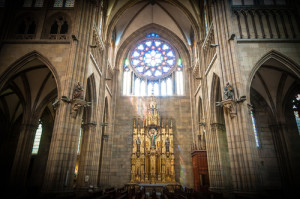 As I said above, I drew up this list fairly quickly, and so I imagine there are other blessings that could be added to this list. Can you think of ways that silent prayer has blessed you? Please leave your thoughts as a comment here on this blog, or in social media. Thank you, and may your daily practice of silent prayer thrive in the light of God’s loving grace.
Enjoy reading this blog?
Click here to become a patron.

Catechism of the Catholic Church
Previous Post
February 12, 2016
Faith, Doubt and Perseverance
Next Post

February 24, 2016 Five Essential Dimensions of Christian Prayer
Browse Our Archives
Select a Category Activism Announcements Art Books Catholicism Celtic Christianity Christian mysticism Christianity Contemplation Current events Etc. Family humor interfaith dialogue Interfaith Wisdom Interspirituality Lay Cistercians Living the Faith Meditation movies Mysticism Mystics nature Poetry Reviews Scripture silence Spirituality Uncategorized Writing
Select a Month February 2025 January 2025 November 2024 September 2024 August 2024 July 2024 June 2024 May 2024 March 2024 January 2024 December 2023 November 2023 August 2023 June 2023 April 2023 March 2023 February 2023 January 2023 December 2022 November 2022 October 2022 September 2022 August 2022 July 2022 June 2022 May 2022 April 2022 February 2022 January 2022 December 2021 November 2021 October 2021 September 2021 August 2021 July 2021 June 2021 May 2021 April 2021 March 2021 February 2021 January 2021 December 2020 November 2020 October 2020 September 2020 August 2020 July 2020 June 2020 May 2020 April 2020 March 2020 February 2020 January 2020 December 2019 November 2019 October 2019 September 2019 August 2019 July 2019 June 2019 May 2019 April 2019 March 2019 February 2019 January 2019 December 2018 November 2018 October 2018 September 2018 August 2018 July 2018 June 2018 May 2018 April 2018 March 2018 February 2018 January 2018 December 2017 November 2017 October 2017 September 2017 August 2017 July 2017 June 2017 May 2017 April 2017 March 2017 February 2017 January 2017 December 2016 November 2016 October 2016 September 2016 August 2016 July 2016 June 2016 May 2016 March 2016 February 2016 January 2016 December 2015 November 2015 October 2015 September 2015 August 2015 July 2015 June 2015 May 2015 April 2015 March 2015 February 2015 January 2015 December 2014 November 2014 October 2014 September 2014 August 2014 July 2014 June 2014 May 2014 April 2014 March 2014 February 2014 January 2014 December 2013 October 2013 September 2013 July 2013 May 2013 January 2013 December 2012 November 2012 August 2012 July 2012 June 2012 March 2012 December 2011 September 2011 October 2010 August 2010 March 2010 September 2009 July 2008 January 2008 December 2007 September 2007 February 2007 January 2007 December 2004
Follow Us!
TAKE THE
Religious Wisdom Quiz
Which book comes before Amos in the Old Testament?
Select your answer to see how you score.
Micah Hosea Joel Obadiah
Support this
Column


Related posts from Carl McColman

"This Loving, Uniting Embrace": the Holy Ordinary

Join Me for "24 Meditations for 2024"

LSD, Anxiety, and Contemplation: Can Psychedelic Therapy Support...

TRENDING AT PATHEOS Contemplative

Handy Contemplative Practices for Political Spaces
A Spiritually Grounded Presence In order to bring a spiritually grounded presence...

Halloween: The Holiday of Loving Your Neighbor
All Hallows Eve Is Halloween the least Christian holiday in America, or...

Can Love Be Saved? Some Thoughts on the...
Happy Valentine's Day! I recently published a post on Patreon called Can...

"This Loving, Uniting Embrace": the Holy Ordinary
Today's guest post is by Mark Longhurst, author of The Holy Ordinary:...

How Are We Called to Live?: More About...
How Are We Called to Live? Many of us struggle with discerning...

A Spiritual Practice of Reading: Join Us Online
A Spiritual Practice of Reading A healthy spiritual practice of reading is...
view all Contemplative blogs
Ad-Free & Subscriber Log-In Subscription Support
- About Us
- 2026 Calendar
- Videos
- Podcasts
- Library of World Religions
- Faith In Media Tracker
- Advertise With Us
- Write for Us
- Privacy Policy
- Terms of Service
- Do Not Sell My Data
- Contact Us
- Radiant Digital
- Manage Newsletter Subscriptions
- Unsubscribe From Notifications
- Sitemap
Copyright 2008-2026, Patheos. All rights reserved.
Subscription Support Ad-Free & Subscriber Log-In
Follow Patheos