
BuddhistCatholicContemplativeEvangelicalGeneral ChristianHinduJewishLatter-day SaintMuslimNew VisionsProgressive Christian
Beliefs
- Buddhist
- Catholic
- Contemplative
- Evangelical
- General Christian
- Hindu
- Jewish
- Latter-day Saint
- More Voices
- Muslim
- New Visions
- Pagan
- Progressive Christian
Topics
- Religion News
- Food and Religion
- Sports and Religion
- Religious Art
- Religious Music and Entertainment
- Religious Events
- History and Religion
- Style and Religion
- Politics and Religion
- Women in Religion
- Recreation Outdoors and Religion
- Business Finance and Religion
- Careers Workplace and Religion
- Education and Religion
- Family Parenting and Religion
- Health Fitness and Religion
- Home and Religion
- Relationships and Religion
- Technology and Religion
- Travel and Religion
Columnists
- Buddhist Columnists
- Business Finance and Religion Columnists
- Careers Workplace and Religion Columnists
- Catholic Columnists
- Contemplative Columnists
- Education and Religion Columnists
- Evangelists Columnists
- Family Parenting and Religion Columnists
- General Christian Columnists
- Health Fitness and Religion Columnists
- Hindu Columnists
- History and Religion Columnists
- Home and Religion Columnists
- Jewish Columnists
- More Voices Columnists
- Latter Day Columnists
- Muslim Columnists
- New Visions Columnists
- Nonreligious Columnists
- Pagan Columnists
- Politics and Religion Columnists
- Progressive Columnists
- Recreation Outdoors and Religion Columnists
- Relationships and Religion Columnists
- Religion News Columnists
- Religious Art Columnists
- Religious Events Columnists
- Religious Music and Entertainment Columnists
- Sports and Religion Columnists
- Style and Religion Columnists
- Technology and Religion Columnists
- Travel and Religion Columnists
- Women in Religion Columnists
Resource Library
- 2026 Calendar
- Library of World Religions
- The 100 Most Holy Places on Earth
- Patheos Answers
- Podcasts
- Videos
- Faith Leaders Database
- Anglican Episcopalian
- Bahai
- Baptist
- Buddhism
- Christianity
- Confucianism
- Eastern Orthodoxy
- Hinduism
- Holiness and Pentecostal
- ISKCON
- Islam
- Judaism
- Lutheran
- Methodist
- The Church of Jesus Christ of Latter-day Saints
- New Age
- Paganism
- Presbytarian and Reformed
- Protestantism
- Religion Behind the Scenes
- Roman Catholic
- Scientology
- Shia Islam
- Sikhism
- Sufism
- Sunni Islam
- Taoism
- Zen
- See all religions
Research Tools
 Ad-Free & Subscriber Log-In Subscription Support
Ad-Free & Subscriber Log-In Subscription Support
Follow Patheos 

- Trending:
- Forgiveness
- |
- Marriage
- |
- Consciousness
- |
- Death Penalty
- |
- Election
- |
- Halloween

- Home
- Contemplative
- Is Contemplation Dangerous?
Is Contemplation Dangerous?
Last updated on: November 27, 2018 at 12:58 am by Carl "Skye" McColman
Is Contemplation Dangerous? 2018-11-27T00:58:27-04:00 Carl "Skye" McColman
Patheos Explore the world's faith through different perspectives on religion and spirituality! Patheos has the views of the prevalent religions and spiritualities of the world.

Is contemplation the key to happiness, or a path to holiness? (Photo credit: Shutterstock)
Is contemplation dangerous? Some people think so.
This past weekend I read a book that has given me some food for thought on this subject. The Buddha Pill: Can Meditation Change You? is by Miguel Farias and Catherine Wikholm, two psychologists in England who study the idea that practices like yoga or mindfulness meditation have observable health benefits. They became involved in a study of prisoners practicing yoga — could it help them to be more at peace, or even less aggressive?
As they surveyed the scientific literature on measurable effects of meditation and yoga, Farias and Wikholm discovered that much of the research was poorly executed or subject to ambiguous interpretations. Furthermore, it seemed like many of the studies were sponsored by organizations with an interest in promoting meditation.
The Buddha Pill seems very balanced in its approach, carefully describing ways in which various studies can be interpreted to demonstrate the positive benefits of spiritual practice — but also how much of the research has led to ambiguous or inconclusive results. Media coverage, however, tends only to stress the positive evidence — it’s almost as if we have a cultural desire to believe these kinds of practices can make a measurable difference in our lives, so much so that we are willing to ignore evidence that suggests otherwise.
But as interesting as its critique of “meditation science” is, what really grabbed me in reading The Buddha Pill was a chapter provocatively titled “The Dark Side of Meditation.”
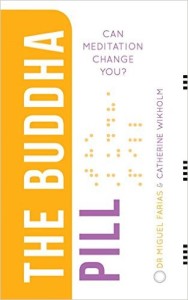
The Buddha Pill
The authors provide several anecdotal examples of people who experienced severe episodes of depression or even psychosis in the wake of engaging in intensive meditative practice. The chapter begins with the terrifying story of Aaron Alexis, a meditation practitioner who killed a dozen people at the Washington Navy Yard in 2013.
Farias and Wikholm go on to describe a 1992 study on the effect of meditation retreats, which “found that 63 per cent of [the subjects] had at least one negative effect and 7 per cent suffered profoundly adverse effects. The negative effects included anxiety, panic, depression, increased negativity, pain, feeling spaced out, confusion and disorientation.”
Wow.
We can dismiss stories like these by insisting that those who suffer negative effects from meditation must have had a pre-existing mental illness. But if meditation can make a mentally ill person worse, doesn’t that make meditation dangerous?
Maybe “dangerous” is not the best word here. I think a better word is “powerful.” Silence has the power to change us. Which means it is worthy of our respect.
With Aaron Alexis in mind, the Anglican solitary Maggie Ross wryly noted in her book Silence: A User’s Guide:
It is possible to practice meditation under the illusion that one is outside of any perceived value system, but this idea is deceptive and dangerous: meditation will intensify whatever values a person holds, whether or not they are acknowledged— and every person has a value system, positive or negative, creative or destructive. Meditation can be abused as well as used: One can meditate in order to become a more efficient killer.
Thirty years ago, I took my first class on “Christian meditation” — what we now would call silent prayer or centering prayer — while living in Washington, DC. When I signed up for the course, the application form explicitly stated that this course was not a form of therapy, and might not be appropriate for some persons based on their therapeutic needs. At the time, I remember thinking that meditation must be something powerful, something we should treat with respect.
I think that’s an important point we need to remember today, but maybe sometimes it gets lost in the “rah-rah” rhetoric of many meditation-boosters.
I’m not writing this blog post to scare anyone away from silent prayer, which I still believe is a profoundly beautiful, meaningful, and traditional way for fostering deep intimacy with God. Books like Centering Prayer and Inner Awakening or Centering Prayer and the Healing of the Unconscious have addressed the question of how to manage powerful emotions that might arise in the context of prayerful silence. So there are good resources available to help us when we encounter the power of silent prayer.
My purpose is simply to emphasize that contemplation — contemplative, silent prayer — is not something to be taken lightly.
Anything with the power to transfigure us from the inside out deserves our respect.
Here’s an interesting perspective from a friend of mine that I posted on Twitter a while back:
Is contemplative prayer dangerous? Yes! It’s dangerous the way Jesus is dangerous. — Kevin Johnson @johnsoxo
— Carl McColman (@CarlMcColman) May 17, 2015
Contemplative practice is like a power tool. If you know how to use it properly and carefully, it can make your “work” (in this case, the work of responding to the love of God) easier. But if used carelessly or improperly, it can be dangerous. When we pray in this way, we need our prayer to be grounded in the love and mercy of God. Otherwise, when we encounter the “icky stuff” deep inside us — our shadow, our sin, our fears and narcissism — it could seem overwhelming.
If you experience deep emotional distress as a result of any kind of meditative practice, immediately stop the practice, take care of yourself (avoid drugs and alcohol, don’t do anything to hurt yourself or anyone else, and ask someone you trust for help) and then seek out the care of a qualified mental health professional. This is not optional. Just like you can’t play sports if you aren’t willing to have a doctor treat you for injuries, likewise if you want to swim in the deep waters of contemplation you need to be willing to seek out appropriate mental health care, should the need arise.
I believe that the risk of this kind of emotional crisis is probably very low for those who engage in contemplative prayer or other forms of meditation for less than an hour per day. After all, the scary statistics in The Buddha Pill pertain to people who engage in intensive, multi-day meditation retreats. But no matter how low the risk may be, we need to be prepared to respond appropriately, should the need arise.
How to practice silent prayer safely
If you are interested in the practice of Christian silent prayer, here are five important steps to take to make sure your practice is spiritually safe.
- Meet regularly with a spiritual director or companion. In other words, you need someone with whom you can discuss your spiritual practice, honestly and candidly. Someone who will help you discern what’s going on if something unsettling or awe-inspiring occurs. This person will help you stay grounded and will keep you humble. And — this is difficult, but important — a good spiritual companion will help us see if we’ve gotten off track with our prayer or other spiritual practice (for example, if your spirituality is making you anxious or proud, instead of humble and compassionate).
- Actively participate in some sort of faith community. That could be a centering prayer group, an oblate or third order gathering, or even your church — but it needs to be a community of people with whom you are regularly engaged, who can answer your questions, encourage you when times are tough, or can provide a larger spiritual context for your practice.
- Maintain a daily vocal/verbal prayer practice, aside from the silence, that will help to form or deepen your spiritual values. As a Lay Cistercian, naturally I recommend praying some form of the Daily Office (see this blog post for more on that). Lectio Divina (prayerful Bible reading) is another option. The point here is to remember that in addition to immersion in silence, we need to be formed by the words, language and values of our spiritual tradition in order to become truly wise — and holy. Speaking of which…
- Commit yourself to becoming holy (by God’s grace). The purpose of Christian contemplation is not happy feelings or cool experiences, but holiness — that is to say, radical intimacy with God which will transfigure you from the inside out. In other words, practicing silent prayer or contemplation requires not just a desire to be still (as worthy as that may be), but also a larger spiritual context. For Christians, this means responding to the love of God. We are called not just to be mystics or contemplatives, but to be holy — to orient our lives to love and service and mercy. Silent prayer means more than just becoming peaceful or serene — it needs to be part of an overall life committed to becoming humble, compassionate, contrite (willing to turn away from sin) and loving — as Christ loved.
- Stay grounded: balance your interior work with good old fashioned “exterior” work. There’s a reason why Benedictine monks have as their motto Ora et Labora, which means “prayer and work.” Physical labor is a meaningful and valuable way to keep the body strong, and the mind focused on something other than its own interior drama. Even a task as simple as mowing the lawn or mopping the floor can help us remain grounded and stable. Kahlil Gibran said “Work is love made visible” — likewise, labora is ora made visible.
My sense, based on what I’ve seen over the past thirty years (and the mistakes I’ve made along the way) is that when we do these five things, we have the spiritual and social support to go as deep as possible in contemplative prayer safely and beautifully.
So is contemplative prayer dangerous? Yes, but just like a car or a chainsaw is dangerous. That doesn’t mean we shouldn’t use it, but it does mean we need to engage with it in a careful, respectful, and proper way. But when we do that, then we are in a position to be blessed by its power.
Enjoy reading this blog?
Click here to become a patron.

Do you have any other thoughts about how to practice silent prayer safely and responsibly? If so, please leave a comment below (or on social media).
Previous Post

January 13, 2016
Philippians 2 and the Heart Sūtra
Next Post
January 22, 2016 Preliminary Practices for Christian Contemplatives
Browse Our Archives
Select a Category Activism Announcements Art Books Catholicism Celtic Christianity Christian mysticism Christianity Contemplation Current events Etc. Family humor interfaith dialogue Interfaith Wisdom Interspirituality Lay Cistercians Living the Faith Meditation movies Mysticism Mystics nature Poetry Reviews Scripture silence Spirituality Uncategorized Writing
Select a Month February 2025 January 2025 November 2024 September 2024 August 2024 July 2024 June 2024 May 2024 March 2024 January 2024 December 2023 November 2023 August 2023 June 2023 April 2023 March 2023 February 2023 January 2023 December 2022 November 2022 October 2022 September 2022 August 2022 July 2022 June 2022 May 2022 April 2022 February 2022 January 2022 December 2021 November 2021 October 2021 September 2021 August 2021 July 2021 June 2021 May 2021 April 2021 March 2021 February 2021 January 2021 December 2020 November 2020 October 2020 September 2020 August 2020 July 2020 June 2020 May 2020 April 2020 March 2020 February 2020 January 2020 December 2019 November 2019 October 2019 September 2019 August 2019 July 2019 June 2019 May 2019 April 2019 March 2019 February 2019 January 2019 December 2018 November 2018 October 2018 September 2018 August 2018 July 2018 June 2018 May 2018 April 2018 March 2018 February 2018 January 2018 December 2017 November 2017 October 2017 September 2017 August 2017 July 2017 June 2017 May 2017 April 2017 March 2017 February 2017 January 2017 December 2016 November 2016 October 2016 September 2016 August 2016 July 2016 June 2016 May 2016 March 2016 February 2016 January 2016 December 2015 November 2015 October 2015 September 2015 August 2015 July 2015 June 2015 May 2015 April 2015 March 2015 February 2015 January 2015 December 2014 November 2014 October 2014 September 2014 August 2014 July 2014 June 2014 May 2014 April 2014 March 2014 February 2014 January 2014 December 2013 October 2013 September 2013 July 2013 May 2013 January 2013 December 2012 November 2012 August 2012 July 2012 June 2012 March 2012 December 2011 September 2011 October 2010 August 2010 March 2010 September 2009 July 2008 January 2008 December 2007 September 2007 February 2007 January 2007 December 2004
Follow Us!
TAKE THE
Religious Wisdom Quiz
What was the primary worship language in the Bible?
Select your answer to see how you score.
Latin Hebrew Greek Aramaic
Support this
Column


Related posts from Carl McColman

"This Loving, Uniting Embrace": the Holy Ordinary

Four Dimensions of Mindfulness and Centering Prayer

Join Me for "24 Meditations for 2024"

LSD, Anxiety, and Contemplation: Can Psychedelic Therapy Support...
TRENDING AT PATHEOS Contemplative

Handy Contemplative Practices for Political Spaces
A Spiritually Grounded Presence In order to bring a spiritually grounded presence...

Halloween: The Holiday of Loving Your Neighbor
All Hallows Eve Is Halloween the least Christian holiday in America, or...

Can Love Be Saved? Some Thoughts on the...
Happy Valentine's Day! I recently published a post on Patreon called Can...

"This Loving, Uniting Embrace": the Holy Ordinary
Today's guest post is by Mark Longhurst, author of The Holy Ordinary:...

How Are We Called to Live?: More About...
How Are We Called to Live? Many of us struggle with discerning...

A Spiritual Practice of Reading: Join Us Online
A Spiritual Practice of Reading A healthy spiritual practice of reading is...
view all Contemplative blogs
Ad-Free & Subscriber Log-In Subscription Support
- About Us
- 2026 Calendar
- Videos
- Podcasts
- Library of World Religions
- Faith In Media Tracker
- Advertise With Us
- Write for Us
- Privacy Policy
- Terms of Service
- Do Not Sell My Data
- Contact Us
- Radiant Digital
- Manage Newsletter Subscriptions
- Unsubscribe From Notifications
- Sitemap
Copyright 2008-2026, Patheos. All rights reserved.
Subscription Support Ad-Free & Subscriber Log-In
Follow Patheos