
BuddhistCatholicContemplativeEvangelicalGeneral ChristianHinduJewishLatter-day SaintMuslimNew VisionsProgressive Christian
Beliefs
- Buddhist
- Catholic
- Contemplative
- Evangelical
- General Christian
- Hindu
- Jewish
- Latter-day Saint
- More Voices
- Muslim
- New Visions
- Pagan
- Progressive Christian
Topics
- Religion News
- Food and Religion
- Sports and Religion
- Religious Art
- Religious Music and Entertainment
- Religious Events
- History and Religion
- Style and Religion
- Politics and Religion
- Women in Religion
- Recreation Outdoors and Religion
- Business Finance and Religion
- Careers Workplace and Religion
- Education and Religion
- Family Parenting and Religion
- Health Fitness and Religion
- Home and Religion
- Relationships and Religion
- Technology and Religion
- Travel and Religion
Columnists
- Buddhist Columnists
- Business Finance and Religion Columnists
- Careers Workplace and Religion Columnists
- Catholic Columnists
- Contemplative Columnists
- Education and Religion Columnists
- Evangelists Columnists
- Family Parenting and Religion Columnists
- General Christian Columnists
- Health Fitness and Religion Columnists
- Hindu Columnists
- History and Religion Columnists
- Home and Religion Columnists
- Jewish Columnists
- More Voices Columnists
- Latter Day Columnists
- Muslim Columnists
- New Visions Columnists
- Nonreligious Columnists
- Pagan Columnists
- Politics and Religion Columnists
- Progressive Columnists
- Recreation Outdoors and Religion Columnists
- Relationships and Religion Columnists
- Religion News Columnists
- Religious Art Columnists
- Religious Events Columnists
- Religious Music and Entertainment Columnists
- Sports and Religion Columnists
- Style and Religion Columnists
- Technology and Religion Columnists
- Travel and Religion Columnists
- Women in Religion Columnists
Resource Library
- 2026 Calendar
- Library of World Religions
- The 100 Most Holy Places on Earth
- Patheos Answers
- Podcasts
- Videos
- Faith Leaders Database
- Anglican Episcopalian
- Bahai
- Baptist
- Buddhism
- Christianity
- Confucianism
- Eastern Orthodoxy
- Hinduism
- Holiness and Pentecostal
- ISKCON
- Islam
- Judaism
- Lutheran
- Methodist
- The Church of Jesus Christ of Latter-day Saints
- New Age
- Paganism
- Presbytarian and Reformed
- Protestantism
- Religion Behind the Scenes
- Roman Catholic
- Scientology
- Shia Islam
- Sikhism
- Sufism
- Sunni Islam
- Taoism
- Zen
- See all religions
Research Tools
 Ad-Free & Subscriber Log-In Subscription Support
Ad-Free & Subscriber Log-In Subscription Support
Follow Patheos 

- Trending:
- Forgiveness
- |
- Marriage
- |
- Consciousness
- |
- Death Penalty
- |
- Election
- |
- Halloween

- Home
- Contemplative
- How to Find a Contemplative-Friendly Church
How to Find a Contemplative-Friendly Church
Last updated on: November 26, 2018 at 4:44 pm by Carl "Skye" McColman
How to Find a Contemplative-Friendly Church 2018-11-26T16:44:38-04:00 Carl "Skye" McColman
Patheos Explore the world's faith through different perspectives on religion and spirituality! Patheos has the views of the prevalent religions and spiritualities of the world.
Spirituality is all about love, and love only exists in relationship. Therefore, spirituality is healthiest when it is expressed in a communal way. For better or worse, this means — at least for followers of Jesus Christ and the Christian contemplative/mystical path — finding some sort of church or other faith community.
That’s not always easy. Frankly, many churches are indifferent, or even hostile, to Christian contemplation and mysticism. Many Protestant and Evangelical Christians reject mysticism and contemplation as “too Catholic.” And Christians across the spectrum, Catholic or Protestant, sometimes worry that mysticism and contemplation have more to do with non-Christian spirituality (like Buddhism or Vedanta) than with following Christ.
These ideas are misconceptions, but they exist, and that means sometimes churches can be decidedly unfriendly to contemplative seekers and aspiring mystics. So how does one find a nurturing and healthy church home?
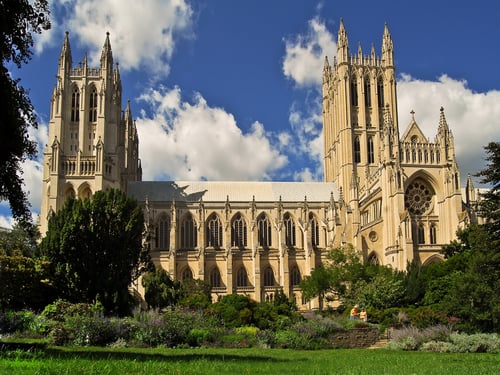
A Church is more than just a building…
A reader of this blog named Dan wrote a question along this line:
I read The Big Book of Christian Mysticism. I’m trying to start a journey in the direction of a greater spirituality. I’ve been out of the faith community for many many years. One of the tenets of your book is to join/rejoin the community of believers. There are so many churches in my town that I’m not sure where to begin. Do you know any churches that may be incorporating the principles of your book or anyone I may be able to contact to help in my search?
This is a problem centuries in the making…
As I said above, many churches will either be indifferent, or even hostile, to contemplation and mysticism. Fortunately, though, this situation is changing for the better, as more and more seminaries (where pastors are trained) begin to offer better spiritual formation for their students, and more individual Christians take it upon themselves to embraces the riches of the Christian inner life.
Much of Christianity is still in a kind of spiritual drought that historians think goes back to at least the fifteenth century, if not earlier. For a variety of historical, philosophical and theological reasons, Christianity (especially in the west) lost much of its own contemplative and mystical heritage — a heritage that for centuries had been confined primarily to monasteries, but as many monasteries became decadent or corrupt in the late middle ages, followed by the reformation which tried to do away with monasticism altogether, the precious jewel of mystical spirituality was almost entirely lost within Christianity.
Within the last 100 years or so, that’s been slowly changing. Thanks to pioneering scholars like Evelyn Underhill and Thomas Merton (who were mystics in their own right), western Christianity has begun to recognize and reclaim its lost contemplative heritage. And while it makes some Christians nervous, Christianity’s encounter with eastern religions like Buddhism has had the blessed effect of encouraging many Christians to dig deep within our own history to find our own wisdom tradition, steeped in silence, contemplation, and illuminative insight.
Now, to answer the question…
But back to Dan’s very practical, down-to-earth question: how does an ordinary person find a church where you can talk about these kinds of things without somebody looking at you like you’ve sprouted an extra head?
When I joined the Catholic Church in 2005, our pastor at the time had a large painting of Thomas Merton hanging in his office. This was a very good sign — when I brought up that I was a fan of Merton, we discussed his work enthusiastically.
So my first piece of advice is this: look for a church where at least one of the ministers or church leaders is willing to talk about contemplation and mysticism without attacking it. This means you have to be willing to chat up at least one of the pastors, and if you’re an introvert like me, that’s not always easy to do! But most pastors are friendly if not gregarious people, and gauging their interest is a good way to sense if the church as a whole is a friendly place for interior seekers.
One question to ask a minister is to see if he or she, or someone else in the congregation, has a ministry of spiritual direction. Most spiritual directors are themselves committed to contemplative living, and can help others who seek to walk along the mystical path.
However, even a pastor who is interested in contemplation does not mean the church as a whole is. When I shared with my pastor my interest in mysticism, he shook his head sadly. “Carl, we have over 1200 families in this church,” he said, “and I can count on one hand the number of people who even know about mysticism, let alone are interested in it.”
So my second piece of advice: look for a church that has either a centering prayer group or some other form of regular (weekly) offering for personal spiritual growth. You can contact contemplative organizations like Contemplative Outreach, Shalem, or the World Community for Christian Meditation to see if they can refer you to a church in your neighborhood with an active contemplative program.
My next advice is pragmatic. Don’t expect a church — any church — to “meet all your needs.” Churches are not social clubs. We join them not because they make us happy all the time, but because they are communities where we can deepen our relationship with God and learn to grow in grace. I’m not suggesting that we should be “martyrs” who join churches where we are perpetually miserable! Obviously, we need to feel comfortable and at home in our faith community — for example, if you are a strong environmentalist, you will likely feel uncomfortable in a church where members think recycling is a waste of time.
Churches, even within the same denomination, often have their own unique character: some are conservative, some liberal, some boisterous and extraverted, others quiet and introverted. Find a church with a “personality” that resonates with your own — but don’t expect the church to be perfect. And even a church that is 99% wonderful might let you down when it comes to contemplation and mysticism.
So what to do then? My advice: join that “good enough” church, and then seek your spiritual nurture elsewhere, such as at a monastery, a Jesuit center, or some other setting that exists specifically to help people grow spiritually. Many monasteries and convents have lay or oblate programs where non-monastic people can formally study spirituality with the monks or nuns. Some seminaries offer programs for spiritual growth, and retreats designed to help you grow spiritually are offered by retreat centers in every state. Googling “Christian contemplative programming” or “Christian contemplative retreats” could be a way to start.

One of my favorite churches (the Crypt Chapel at the Basilica of the National Shrine in Washington DC). Beautiful architecture can inspire — but the heart of a church is its people.
You may be wondering “If I have to go elsewhere to get spiritual nurture, why bother joining a church at all?” But that goes back to my conviction that we join a church not to get our needs met, but rather to learn to love God and others better. A church is about the whole person, not just our spiritual dimension. In church we learn to worship, how to read the Bible, how to make informed moral and ethical choices, how to appreciate good music or art or architecture, and how to serve and care for others, especially those who are in need.
Having a deep interior life supports all of these things, but it doesn’t replace them. A spiritual center like a monastery or a retreat house can really help you to become disciplined in contemplative prayer, but it doesn’t have the resources to do all the other good things that your neighborhood church does. So find a monastery where you can pray, but also find a church where you can serve.
To sum it up…
I’m sorry this is such a long post, but it’s an important question that deserves careful consideration. Finding the right church is like finding the right house or neighborhood: it’s worth taking the time to do the search right. If you’re new to a community or are returning to church after a time away, take your time to visit a variety of congregations: small and large, Catholic or Episcopal or Quaker, liberal or conservative or middle of the road, traditional music with an organ or contemporary music with a rock band.
Get to know the diversity of Christian communities — and when you find a church you like, then get to know the pastor, see what kind of ministries the church offers, and also seek spiritual resources outside the congregation. Finally, pray for guidance — God wants what’s best for you, so take time to listen for the still small voice.
Do you have any other suggestions for how someone interested in Christian mysticism or contemplation can find a church? Please leave a comment below, or on your favorite social media platform.
Enjoy reading this blog?
Click here to become a patron.

Do you have a question for me? Please send it to me using my contact form, and I’ll consider it for a future blog post. Thank you.
Previous Post

December 9, 2015
Does Union with God mean Losing Your Self?
Next Post

December 18, 2015 Catholic Meditation and Contemplative Prayer: What's the Difference?
Browse Our Archives
Select a Category Activism Announcements Art Books Catholicism Celtic Christianity Christian mysticism Christianity Contemplation Current events Etc. Family humor interfaith dialogue Interfaith Wisdom Interspirituality Lay Cistercians Living the Faith Meditation movies Mysticism Mystics nature Poetry Reviews Scripture silence Spirituality Uncategorized Writing
Select a Month February 2025 January 2025 November 2024 September 2024 August 2024 July 2024 June 2024 May 2024 March 2024 January 2024 December 2023 November 2023 August 2023 June 2023 April 2023 March 2023 February 2023 January 2023 December 2022 November 2022 October 2022 September 2022 August 2022 July 2022 June 2022 May 2022 April 2022 February 2022 January 2022 December 2021 November 2021 October 2021 September 2021 August 2021 July 2021 June 2021 May 2021 April 2021 March 2021 February 2021 January 2021 December 2020 November 2020 October 2020 September 2020 August 2020 July 2020 June 2020 May 2020 April 2020 March 2020 February 2020 January 2020 December 2019 November 2019 October 2019 September 2019 August 2019 July 2019 June 2019 May 2019 April 2019 March 2019 February 2019 January 2019 December 2018 November 2018 October 2018 September 2018 August 2018 July 2018 June 2018 May 2018 April 2018 March 2018 February 2018 January 2018 December 2017 November 2017 October 2017 September 2017 August 2017 July 2017 June 2017 May 2017 April 2017 March 2017 February 2017 January 2017 December 2016 November 2016 October 2016 September 2016 August 2016 July 2016 June 2016 May 2016 March 2016 February 2016 January 2016 December 2015 November 2015 October 2015 September 2015 August 2015 July 2015 June 2015 May 2015 April 2015 March 2015 February 2015 January 2015 December 2014 November 2014 October 2014 September 2014 August 2014 July 2014 June 2014 May 2014 April 2014 March 2014 February 2014 January 2014 December 2013 October 2013 September 2013 July 2013 May 2013 January 2013 December 2012 November 2012 August 2012 July 2012 June 2012 March 2012 December 2011 September 2011 October 2010 August 2010 March 2010 September 2009 July 2008 January 2008 December 2007 September 2007 February 2007 January 2007 December 2004
Follow Us!
TAKE THE
Religious Wisdom Quiz
What animal is commonly associated with Jesus?
Select your answer to see how you score.
Donkey Fish Lamb Lion
Support this
Column


Related posts from Carl McColman

You don't have to become a monk to...

Join Me for "24 Meditations for 2024"

LSD, Anxiety, and Contemplation: Can Psychedelic Therapy Support...

Mysticism, Faith, and "Knowing" God's Will
TRENDING AT PATHEOS Contemplative

Handy Contemplative Practices for Political Spaces
A Spiritually Grounded Presence In order to bring a spiritually grounded presence...

Halloween: The Holiday of Loving Your Neighbor
All Hallows Eve Is Halloween the least Christian holiday in America, or...

Can Love Be Saved? Some Thoughts on the...
Happy Valentine's Day! I recently published a post on Patreon called Can...

"This Loving, Uniting Embrace": the Holy Ordinary
Today's guest post is by Mark Longhurst, author of The Holy Ordinary:...

How Are We Called to Live?: More About...
How Are We Called to Live? Many of us struggle with discerning...

A Spiritual Practice of Reading: Join Us Online
A Spiritual Practice of Reading A healthy spiritual practice of reading is...
view all Contemplative blogs
Ad-Free & Subscriber Log-In Subscription Support
- About Us
- 2026 Calendar
- Videos
- Podcasts
- Library of World Religions
- Faith In Media Tracker
- Advertise With Us
- Write for Us
- Privacy Policy
- Terms of Service
- Do Not Sell My Data
- Contact Us
- Radiant Digital
- Manage Newsletter Subscriptions
- Unsubscribe From Notifications
- Sitemap
Copyright 2008-2026, Patheos. All rights reserved.
Subscription Support Ad-Free & Subscriber Log-In
Follow Patheos