
BuddhistCatholicContemplativeEvangelicalGeneral ChristianHinduJewishLatter-day SaintMuslimNew VisionsProgressive Christian
Beliefs
- Buddhist
- Catholic
- Contemplative
- Evangelical
- General Christian
- Hindu
- Jewish
- Latter-day Saint
- More Voices
- Muslim
- New Visions
- Pagan
- Progressive Christian
Topics
- Religion News
- Food and Religion
- Sports and Religion
- Religious Art
- Religious Music and Entertainment
- Religious Events
- History and Religion
- Style and Religion
- Politics and Religion
- Women in Religion
- Recreation Outdoors and Religion
- Business Finance and Religion
- Careers Workplace and Religion
- Education and Religion
- Family Parenting and Religion
- Health Fitness and Religion
- Home and Religion
- Relationships and Religion
- Technology and Religion
- Travel and Religion
Columnists
- Buddhist Columnists
- Business Finance and Religion Columnists
- Careers Workplace and Religion Columnists
- Catholic Columnists
- Contemplative Columnists
- Education and Religion Columnists
- Evangelists Columnists
- Family Parenting and Religion Columnists
- General Christian Columnists
- Health Fitness and Religion Columnists
- Hindu Columnists
- History and Religion Columnists
- Home and Religion Columnists
- Jewish Columnists
- More Voices Columnists
- Latter Day Columnists
- Muslim Columnists
- New Visions Columnists
- Nonreligious Columnists
- Pagan Columnists
- Politics and Religion Columnists
- Progressive Columnists
- Recreation Outdoors and Religion Columnists
- Relationships and Religion Columnists
- Religion News Columnists
- Religious Art Columnists
- Religious Events Columnists
- Religious Music and Entertainment Columnists
- Sports and Religion Columnists
- Style and Religion Columnists
- Technology and Religion Columnists
- Travel and Religion Columnists
- Women in Religion Columnists
Resource Library
- 2026 Calendar
- Library of World Religions
- The 100 Most Holy Places on Earth
- Patheos Answers
- Podcasts
- Videos
- Faith Leaders Database
- Anglican Episcopalian
- Bahai
- Baptist
- Buddhism
- Christianity
- Confucianism
- Eastern Orthodoxy
- Hinduism
- Holiness and Pentecostal
- ISKCON
- Islam
- Judaism
- Lutheran
- Methodist
- The Church of Jesus Christ of Latter-day Saints
- New Age
- Paganism
- Presbytarian and Reformed
- Protestantism
- Religion Behind the Scenes
- Roman Catholic
- Scientology
- Shia Islam
- Sikhism
- Sufism
- Sunni Islam
- Taoism
- Zen
- See all religions
Research Tools
 Ad-Free & Subscriber Log-In Subscription Support
Ad-Free & Subscriber Log-In Subscription Support
Follow Patheos 

- Trending:
- Forgiveness
- |
- Marriage
- |
- Consciousness
- |
- Death Penalty
- |
- Election
- |
- Halloween

- Home
- Contemplative
- Deeper into the Heart of Christ
Deeper into the Heart of Christ
Last updated on: November 26, 2018 at 4:38 pm by Carl "Skye" McColman
Deeper into the Heart of Christ 2018-11-26T16:38:36-04:00 Carl "Skye" McColman
Patheos Explore the world's faith through different perspectives on religion and spirituality! Patheos has the views of the prevalent religions and spiritualities of the world.

Christian spirituality: it’s about a new way of seeing.
Over the past year I have become interested in the topic of “Christian leadership.” People who are in a leadership position in the Christian community — whether clergy, consecrated religious, or lay leaders — who are they? What makes them leaders? Where do Christian leaders take the rest of us? How do we identify a “good” leader? That sort of thing.
It’s an interesting question, because the mark of a “good leader” in a religious sense is in many ways at odds with how leadership is understood in the secular worlds of business, politics, education, and the military.
The model for Christian leadership, of course, is Jesus of Nazareth. In some ways he fits the “worldly” models of leadership: he is confident, an effective communicator, and even his critics acknowledge he feared no one. But in other ways, he seems entirely at odds with conventional notions of leadership. He promotes nonviolence and reconciliation; he prefers people with little or no social standing to those in positions of power or prestige, and chooses parody and theater as ways to criticize earthly power (for example, riding into Jerusalem on a donkey was his way of both lauding the common people and satirizing those who display their leadership in more ostentatious ways).
In other words, Jesus as a leader turns leadership on its head. “The first shall be last, and the last first,” he proclaims, insisting that humility matters more than power, love more than force, forgiveness more than dominance.
Unfortunately, but perhaps not surprisingly, Jesus’s followers have had a rather spotty record in terms of living up to his subversive style of leadership. For every saint there are far too many sinners. Some priests and other ministers selflessly give everything to a life of service and compassion; others defile their position through sexual malfeasance, financial misconduct and narcissistic power-tripping. The worst Christian “leaders” are people like Fred Phelps or Charles Coughlin, who use their position to promote hate-filled agendas such as anti-semitism or homophobia. Just because someone is both a Christian and a leader does not guarantee that he (or she) is a Christian leader.
So what does make a Christian leader?
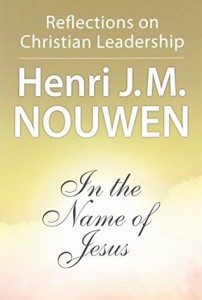
In the Name of Jesus
Henri Nouwen, in his classic book In the Name of Jesus, considers the ways that Jesus was tempted in the desert as emblematic of the kinds of temptations that can derail ministers and other leaders. Specifically, Jesus was tempted to be powerful, to be popular, and to be relevant. By rejecting these temptations, he embraced a spirituality grounded in prayer, in service, and in humility. For Nouwen, these are the marks of an authentic Christian leadership — even though such values are often dismissed, even by Christians themselves.
In the Name of Jesus is a short little book, and I commend it to anyone, not just people in leadership positions, who want a simple yet profound reflection on what constitutes the true heart of Christian discipleship.
I’d like to focus one something Nouwen says toward the end of the book, which I think is a profoundly important insight — not only into Christian leadership, but indeed in Christian spirituality in general. Nouwen says that Christian leaders need to recognize that “even the smallest event of human history” is “an opportunity to be led deeper into the heart of Christ.”
This reminds me of Julian of Norwich, who said “The fullness of joy is to behold God in all.” Perhaps the heart of Christian spirituality is not about what we think, or what dogmas or propositions we believe, or how we have managed to modify or restrict our behavior. All of those things may be important and good, but they are not the heart of spirituality. Perhaps the heart of Christianity really is recognition. I first got this idea from Cynthia Bourgeault, who writes about “Jesus as a Recognition Event” (in The Wisdom Jesus). Jesus calls us to recognize the presence of God — within him, of course, but truly within all of us (image and likeness of God, temple of the Holy Spirit). Along these same lines, Richard Rohr subtitled his book The Naked Now this way: “Learning to See as the Mystics See.”
So spirituality is about a new way of seeing. What Anglican contemplative Maggie Ross, following Julian of Norwich and the author of The Cloud of Unknowing, calls “beholding.” The fullness of joy is to behold God in all. We seek a new level of consciousness (“metanoia”) which enables us to see as the mystics see, to recognize Christ in all things and all events, and to begin to discern how every event of life — whether “good” or “bad,” significant or insignificant, political or homely — how every event offers us a way to be led deeper into the heart of Christ.
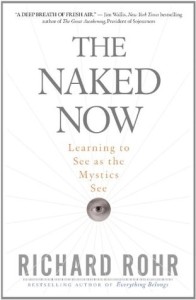
Learn to see how the mystics see
Notice Nouwen’s use of the passive voice. The Christian leader is one who allows herself or himself to be led. Really, there is only one leader within Christianity: the Holy Spirit. We are all in this together, seeking to be led by the Spirit of God. To be led deeper into the heart of Christ, deeper into that place of recognition, of beholding, of seeing the God who is always present, but who so often seems hidden (“mystical”) to us as we conduct our day-to-day lives.
Christian spirituality, contemplation, mysticism — it’s just an invitation, to a new way of seeing, to beholding, to recognizing what is already there, but we so often fail to notice: that God is not elsewhere, God is present, right here, right now, bathing us with love and grace and mercy, forgiving us, calling us to be conduits for God’s love and mercy and forgiveness to a world that so desperately needs it, even while it often resists that very love.
If you want to grow spiritually, take time to pray, to serve others, to focus more on where Christ is leading you rather than on how you can lead others. Learn to pay attention to the subtle ways you can discern God’s presence in your life. The goal is to begin to recognize that Divine presence in every corner of your life — not in order to retreat from your life into some sort of pious withdrawal, but rather so that you may live your life fully, unreservedly, filled with hope and love and the desire to serve. Pray with your eyes open, for prayer is a schooling in this new way of seeing. Expect to have to make some tough decisions, but always with a beautiful goal in mind: to be led ever more deeply into the heart of Christ.
Do all this, and you will become a Christian leader. Even if you never get ordained or ever take on an “official” role. And even if the last thing you want to be is a leader. In fact, not wanting to be a leader might be the most important qualification of all for a true Christian leader. It’s not about what you want. It’s about what you take the time to see.
Enjoy reading this blog?
Click here to become a patron.


Next Post

December 3, 2015 Bruno Barnhart (1931-2015)
Browse Our Archives
Select a Category Activism Announcements Art Books Catholicism Celtic Christianity Christian mysticism Christianity Contemplation Current events Etc. Family humor interfaith dialogue Interfaith Wisdom Interspirituality Lay Cistercians Living the Faith Meditation movies Mysticism Mystics nature Poetry Reviews Scripture silence Spirituality Uncategorized Writing
Select a Month February 2025 January 2025 November 2024 September 2024 August 2024 July 2024 June 2024 May 2024 March 2024 January 2024 December 2023 November 2023 August 2023 June 2023 April 2023 March 2023 February 2023 January 2023 December 2022 November 2022 October 2022 September 2022 August 2022 July 2022 June 2022 May 2022 April 2022 February 2022 January 2022 December 2021 November 2021 October 2021 September 2021 August 2021 July 2021 June 2021 May 2021 April 2021 March 2021 February 2021 January 2021 December 2020 November 2020 October 2020 September 2020 August 2020 July 2020 June 2020 May 2020 April 2020 March 2020 February 2020 January 2020 December 2019 November 2019 October 2019 September 2019 August 2019 July 2019 June 2019 May 2019 April 2019 March 2019 February 2019 January 2019 December 2018 November 2018 October 2018 September 2018 August 2018 July 2018 June 2018 May 2018 April 2018 March 2018 February 2018 January 2018 December 2017 November 2017 October 2017 September 2017 August 2017 July 2017 June 2017 May 2017 April 2017 March 2017 February 2017 January 2017 December 2016 November 2016 October 2016 September 2016 August 2016 July 2016 June 2016 May 2016 March 2016 February 2016 January 2016 December 2015 November 2015 October 2015 September 2015 August 2015 July 2015 June 2015 May 2015 April 2015 March 2015 February 2015 January 2015 December 2014 November 2014 October 2014 September 2014 August 2014 July 2014 June 2014 May 2014 April 2014 March 2014 February 2014 January 2014 December 2013 October 2013 September 2013 July 2013 May 2013 January 2013 December 2012 November 2012 August 2012 July 2012 June 2012 March 2012 December 2011 September 2011 October 2010 August 2010 March 2010 September 2009 July 2008 January 2008 December 2007 September 2007 February 2007 January 2007 December 2004
Follow Us!
TAKE THE
Religious Wisdom Quiz
What famous prophecy is given in Isaiah 53?
Select your answer to see how you score.
Cyrus the Great's reign Plague in Egypt The suffering servant Messiah Destruction of Edom
Support this
Column


Related posts from Carl McColman

You don't have to become a monk to...

LSD, Anxiety, and Contemplation: Can Psychedelic Therapy Support...

Mysticism, Faith, and "Knowing" God's Will

TRENDING AT PATHEOS Contemplative

Handy Contemplative Practices for Political Spaces
A Spiritually Grounded Presence In order to bring a spiritually grounded presence...

Halloween: The Holiday of Loving Your Neighbor
All Hallows Eve Is Halloween the least Christian holiday in America, or...

Can Love Be Saved? Some Thoughts on the...
Happy Valentine's Day! I recently published a post on Patreon called Can...

"This Loving, Uniting Embrace": the Holy Ordinary
Today's guest post is by Mark Longhurst, author of The Holy Ordinary:...

How Are We Called to Live?: More About...
How Are We Called to Live? Many of us struggle with discerning...

A Spiritual Practice of Reading: Join Us Online
A Spiritual Practice of Reading A healthy spiritual practice of reading is...
view all Contemplative blogs
Ad-Free & Subscriber Log-In Subscription Support
- About Us
- 2026 Calendar
- Videos
- Podcasts
- Library of World Religions
- Faith In Media Tracker
- Advertise With Us
- Write for Us
- Privacy Policy
- Terms of Service
- Do Not Sell My Data
- Contact Us
- Radiant Digital
- Manage Newsletter Subscriptions
- Unsubscribe From Notifications
- Sitemap
Copyright 2008-2026, Patheos. All rights reserved.
Subscription Support Ad-Free & Subscriber Log-In
Follow Patheos