
BuddhistCatholicContemplativeEvangelicalGeneral ChristianHinduJewishLatter-day SaintMuslimNew VisionsProgressive Christian
Beliefs
- Buddhist
- Catholic
- Contemplative
- Evangelical
- General Christian
- Hindu
- Jewish
- Latter-day Saint
- More Voices
- Muslim
- New Visions
- Pagan
- Progressive Christian
Topics
- Religion News
- Food and Religion
- Sports and Religion
- Religious Art
- Religious Music and Entertainment
- Religious Events
- History and Religion
- Style and Religion
- Politics and Religion
- Women in Religion
- Recreation Outdoors and Religion
- Business Finance and Religion
- Careers Workplace and Religion
- Education and Religion
- Family Parenting and Religion
- Health Fitness and Religion
- Home and Religion
- Relationships and Religion
- Technology and Religion
- Travel and Religion
Columnists
- Buddhist Columnists
- Business Finance and Religion Columnists
- Careers Workplace and Religion Columnists
- Catholic Columnists
- Contemplative Columnists
- Education and Religion Columnists
- Evangelists Columnists
- Family Parenting and Religion Columnists
- General Christian Columnists
- Health Fitness and Religion Columnists
- Hindu Columnists
- History and Religion Columnists
- Home and Religion Columnists
- Jewish Columnists
- More Voices Columnists
- Latter Day Columnists
- Muslim Columnists
- New Visions Columnists
- Nonreligious Columnists
- Pagan Columnists
- Politics and Religion Columnists
- Progressive Columnists
- Recreation Outdoors and Religion Columnists
- Relationships and Religion Columnists
- Religion News Columnists
- Religious Art Columnists
- Religious Events Columnists
- Religious Music and Entertainment Columnists
- Sports and Religion Columnists
- Style and Religion Columnists
- Technology and Religion Columnists
- Travel and Religion Columnists
- Women in Religion Columnists
Resource Library
- 2026 Calendar
- Library of World Religions
- The 100 Most Holy Places on Earth
- Patheos Answers
- Podcasts
- Videos
- Faith Leaders Database
- Anglican Episcopalian
- Bahai
- Baptist
- Buddhism
- Christianity
- Confucianism
- Eastern Orthodoxy
- Hinduism
- Holiness and Pentecostal
- ISKCON
- Islam
- Judaism
- Lutheran
- Methodist
- The Church of Jesus Christ of Latter-day Saints
- New Age
- Paganism
- Presbytarian and Reformed
- Protestantism
- Religion Behind the Scenes
- Roman Catholic
- Scientology
- Shia Islam
- Sikhism
- Sufism
- Sunni Islam
- Taoism
- Zen
- See all religions
Research Tools
 Ad-Free & Subscriber Log-In Subscription Support
Ad-Free & Subscriber Log-In Subscription Support
Follow Patheos 

- Trending:
- Forgiveness
- |
- Marriage
- |
- Consciousness
- |
- Death Penalty
- |
- Election
- |
- Halloween

- Home
- Contemplative
- Nine Ways to Foster a Contemplative Church
Nine Ways to Foster a Contemplative Church
Last updated on: November 26, 2018 at 4:32 pm by Carl "Skye" McColman
Nine Ways to Foster a Contemplative Church 2018-11-26T16:32:07-04:00 Carl "Skye" McColman
Patheos Explore the world's faith through different perspectives on religion and spirituality! Patheos has the views of the prevalent religions and spiritualities of the world.

Contemplation belongs in the neighborhood church
If you are the pastor of a church or parish, this post is for you. If you are not the pastor but are a member of a congregation, consider sharing this post with your pastor, especially if he or she is interested in silent prayer.
Karl Rahner, the renowned 20th century Jesuit theologian, once wrote “the Christian of the future will be a mystic or will not exist.” I interpret this to mean that Christians need more than just moral guidance and instruction in the proper way to think about God, Christ, and salvation. To be a Christian means to be transfigured from the inside out. Of course, that’s the Holy Spirit’s job — it’s a consequence of grace, not something we achieve on our own efforts. But we consent to the healing action of the Spirit in our lives, and an essential way we offer the gesture of consent is through silent, contemplative prayer.
So many of the resources available to Christians today — whether books, audio CDs, teaching DVDs, or even organizations like Contemplative Outreach or the World Community for Christian Meditation — tend to focus on providing guidance to individuals. At the most, they support the establishment of small contemplative (silent) prayer groups, that might meet in a church education room on a weeknight. Such efforts are noble and important, but overall they tend to foster this idea that silent prayer is some sort of optional activity, a kind of “spiritual extra credit” that a small number of people may choose to pursue.
The hidden assumption is that most people either do not want, are not ready for, or are not temperamentally suited for, contemplative prayer. And I think that’s simply untrue.
Recently I attended a class on Buddhist meditation at a small convent of Chinese Buddhist nuns here in Atlanta. As used as I am to Christian contemplative prayer groups (that often have only 6-10 members), I figured this would be a small, intimate gathering of folks. Boy was I wrong! The meditation hall was jam-packed — easily well over 100 people were there, on a Thursday night. Now, Buddhism in Atlanta, GA, is hardly a mainstream religion. This monastery has only a modest website and a sign on the street promoting its meditation class.
As I sat there, marveling at the sea of faces, both men and women, all races, all ages (but mostly young), I thought, “these are folks who feel that the Christian churches have nothing to offer them. And so they’ve gone elsewhere.” If Christians (especially young ones) only knew about the contemplative dimension of Christian spirituality*,* they would not be abandoning the church as rapidly as they are. And it’s the local congregation’s job to teach the Christian contemplative tradition.

Provide opportunities to worship in silence.
Think of it this way: contemplative prayer is like tithing. A tiny number of people will do most of it, and only a minority will make it a significant priority in their lives. But everyone is invited to do it, and is encouraged to it. When it comes to financial support, in a healthy congregation almost everyone gives at least something. Likewise, in a healthy congregation, everyone should have at least some opportunity to learn and practice silent prayer.
If a Christian congregation decided that tithing was “optional” or that only the spiritually advanced or genuinely willing should do it, then before long that church would be closing its doors. If a parish only talked about tithing at an optional meeting on Wednesday nights, then you can bet that the level of giving would plummet.
Karl Rahner did not say “The Christian of the future will tithe or will not exist at all.” Clearly, Rahner saw mysticism (which includes contemplative prayer) as more vital to the ongoing health of the church than pledge cards. He understood that a Christian who undergoes a meaningful interior transfiguration will be one who works and gives for the life of the Church. But it doesn’t necessarily work the other way around: just because somebody makes an offering doesn’t mean they automatically become contemplatives!
As the writer of a contemplative blog, I hear all the time from people who are drawn to silent prayer but feel like their local congregation simply does not support contemplation. It doesn’t matter what denomination you’re talking about — I hear from them all. But do you know what is just as interesting? I’ve participated in retreats and workshops with contemplative clergy, and they are frustrated because their congregations don’t seem to appreciate the importance of silence!
So friends, we have a lot of work to do. If we want to be faithful to God’s call to “be still and know” the love of God, or to St. Paul’s instruction to “pray without ceasing,” or to the prophet Habakkuk’s proclamation that “all the earth keep silence” before God — then we need more than just a culture of “contemplation for the club.” We need to be prayerfully seeking the Holy Spirit’s guidance for contemplative congregations.
I pray for this every day. I invite you to join me in this prayer. To beg of God to bless and lead our congregations to more intentionally turn to silence. This doesn’t mean that churches all become like Trappist monasteries! Churches will always be dedicated to educating children, supporting those in need, and providing worship that is prayerful and celebratory. So there will always be a “noisy” element to congregational life — and that’s a good thing. All I’m saying is that we need to foster a culture of prayerful silence as an integral part of congregational life — not an “optional” activity relegated to the middle of the week.
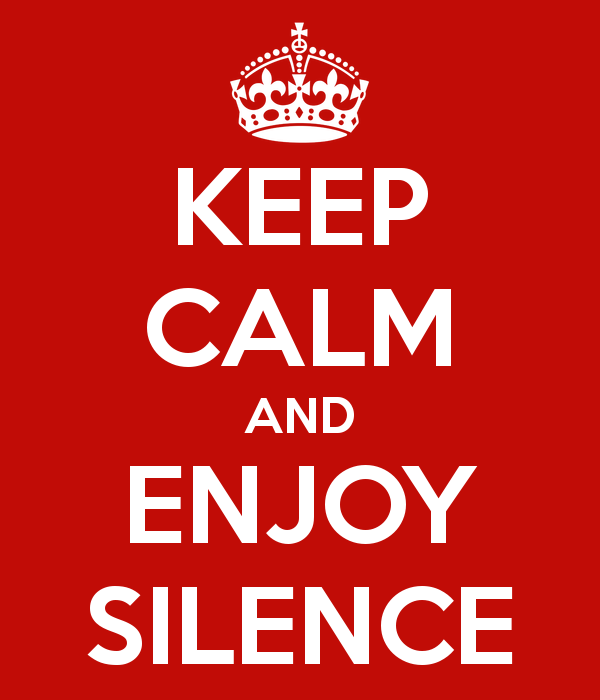
Remain Silent. Stay Calm.
But how do we do this? Here are nine ideas that I think every neighborhood church can reflect on, and hopefully, implement — as steps the congregation can take, as a congregation, to foster a contemplative dimension to their community life. This will not happen overnight (among other things, we have our cultural bias against silence and contemplation to overcome). But if a neighborhood church begins to implement even some of these initiatives, I humbly believe that God will bless their efforts.
- Cultivate contemplative leaders in the church. Ideally, this begins with the pastor. But I know that historically, Christian seminaries do very little to foster contemplation among its students. That’s changing for the better in many locations, but we still have a long way to go. So not every pastor has the formation to be a contemplative leader. And of course, lay leaders who are drawn to provide leadership in contemplative prayer need formation as well. So this won’t happen overnight — but I would strongly encourage pastors and dedicated lay leaders who recognize the need to foster contemplation in the congregation to turn to organizations like Shalem and Spiritual Directors International or others to receive training for providing spiritual guidance for both individuals and groups. If a congregation can raise up three dedicated contemplative leaders, it can work miracles. Once again, ideally the pastor will be one of these leaders, but it’s okay if they are all laity — as long as the pastor is supportive. A word here to the pastors: yes, your support is essential*. You are the leader. That doesn’t mean you have to show up at every contemplative event in your parish, but give it your blessing. Talk it up, especially to those who you know are drawn to spiritual practice. Mention it from the pulpit. The congregation looks to you for guidance — so guide them into the blessings of silent prayer.*
- Commission the congregation’s contemplative leaders (and spiritual directors) before the entire congregation. Spiritual direction (also called spiritual accompaniment) is a vital ministry in the life of any congregation: prayerful persons who are available for one-on-one guidance and instruction in contemplative prayer for those who seek to grow spiritually. But too many of the spiritual directors I’ve met feel they have little or no acknowledgment or support from their home congregations. This needs to change. Spiritual directors, whether lay or ordained, need to be commissioned by their congregation, which shows that the ministry is occurring with the knowledge and blessing of the pastor and other congregational leaders. Their names and contact information needs to be listed on the parish website and in the Sunday bulletin. Back to my tithing analogy: everyone who is a regular member of a congregation knows who the treasurer is; the contemplative leaders of a church need to have a similar profile in the community.
- Create a dedicated place for silent prayer in the church. Here is one place where Catholicism shines, in that almost every Catholic Church has an “adoration chapel” where people engage in silent prayer. It’s usually very close to the sanctuary (main worship space), accessible to all, but in a place where it’s easy to maintain silence. Every congregation needs this. Granted, protestant and evangelical churches will not practice eucharistic adoration, but they don’t need to. Such “silent prayer chapels” can be decorated with a simple icon of Christ or a plain wooden cross. The emphasis should be on silence and prayer — and the room should be a chapel, used only for silent prayer. The chapel ought to be small, for realistically only a small percentage of people will use it at any given time. But its very existence communicates to the congregation at large that contemplative prayer is a priority for the church.
- Offer instruction in contemplative prayer regularly on Sunday mornings. Maybe it doesn’t have to be every single week, depending on the size of your congregation. But it ought to be at least once or twice a year when one or more of your congregation’s contemplative leaders invite people to practice silent prayer in a group, on Sunday mornings, with guidance. At first it will be a small turnout: maybe one or two. That’s okay. As long as this is regularly offered on Sunday mornings, the congregation will recognize that this kind of spiritual practice is an important part of Christian life, and over time more and more will come to check it out.
- Have a contemplative prayer group meet during the week, but also on Sunday mornings. At first something like this will be very small, and it’s never going to be “huge.” But think of the witness — to visitors, to our children and teens — if the congregation cares enough for prayer so that every Sunday morning a group of 5 to 10 people devote an hour to silence, just praying for the congregation, for the community, for the world! And those who do it, imagine how meaningful the church worship service or mass will be, if you enter into worship after an hour of silence? Frankly, enjoy the small group while you can: once the word gets out, this Sunday morning silent prayer opportunity might be bursting at the seams.
- Foster a relationship at the congregational level with a local monastery or convent. This holds true regardless of your church’s denomination. Most monasteries and convents are Catholic, but they welcome people to visit or make retreats regardless of their denominational affiliation. And not all monasteries are Catholic: there are Orthodox, Anglican/Episcopalian, and even Lutheran monastics. Plus there are a variety of retreat houses and centers of all denominational stripes. here’s the key: whatever denomination your church is, make the effort to find a center near you that is devoted to Christian silence and daily prayer. Get to know the people there, and make it easy for the members of your congregation to know about it, and to visit it regularly.
- In addition to your Parish Fellowship Weekend, sponsor an annual Parish Retreat devoted to silence and prayer. Many churches and congregations have an annual “parish retreat” but it really should be called the “parish fellowship weekend,” because the event is filled with programming and conviviality. Those are good things, but that’s not what makes a retreat. So keep the fellowship weekend going, but in addition to it, once a year partner with your local convent, monastery or retreat house (see #6) and sponsor a retreat that is dedicated to silence, prayer, and contemplation. Realistically, only a fraction of the people who attend the fellowship weekend will come to the retreat (especially at first), and that’s okay. The goal here is not huge numbers, but spiritual depth. Quality, not quantity. Once this becomes a regular, annual offering of your congregation, supported by the pastor and other contemplative leaders, expect it to gain its own traction.
- Incorporate appropriate amounts of silence into congregational worship and meetings. Unless your community is a Quaker Meeting, I wouldn’t advise you to have twenty minutes of silence in your main worship service — but why not two or three minutes? Long enough for people to notice it. Yes, at first you’ll get pushback, but those are opportunities for formation and instruction. Such time for communal silence could happen after the scripture readings and/or the sermon, before the congregational prayers, or after the distribution of Holy Communion. A corollary to this: if you don’t already do so, make sure your congregation observes silence in the sanctuary/nave/main worship space. If people want to chat, they can do so in the foyer or narthex or outside the building. Also, encourage your congregational leadership to take time (two to three minutes) at the beginning of every committee or congregational meeting for silence. Make it a part of your church’s culture — a church that listens, a church that prays.
- Pray and work for the formation of a contemplative culture throughout your congregation. This is a major issue, so I can only touch on it here. But ultimately, being a contemplative entails more than just 20 minutes a day given to silent prayer. Contemplation is a 24/7 way of life. It characterizes everything we do, including our ministry as Christians. So for a congregation to be contemplative, it needs to be a congregation where listening is valued, where prayer is a priority, where seeking the leading of the Holy Spirit means being comfortable with mystery and ambiguity and paradox, where leadership is collegial and shared, and where lay ministry is vital to every aspect of community life. I know this raises a lot of issues about congregational leadership, church governance, etc., that I cannot address in this post, but I want to touch on it because I believe that the Christian congregation of the future will be led not by managers or supervisors, but by listeners and inspirers. If this is a topic of interest to you, for just one example check out the ministry of the Rev. Stuart Higginbotham of Grace Episcopal Church, Gainesville GA, and author of the Mindful Church Initiative Blog.
I know this is a supersized blog post, but thanks for hanging in there with it. I would love your feedback and insights. If your church, congregation, or parish working to foster contemplative spirituality? Are you doing anything different from what I’ve listed here? If so, please let me know about it, either on social media or in the comments section below. Many thanks — and keep praying in silence.
Enjoy reading this blog?
Click here to become a patron.

Previous Post
September 17, 2015
Happy St. Hildegard's Day!
Next Post

September 25, 2015 Five Things I learned from Phyllis Tickle
Browse Our Archives
Select a Category Activism Announcements Art Books Catholicism Celtic Christianity Christian mysticism Christianity Contemplation Current events Etc. Family humor interfaith dialogue Interfaith Wisdom Interspirituality Lay Cistercians Living the Faith Meditation movies Mysticism Mystics nature Poetry Reviews Scripture silence Spirituality Uncategorized Writing
Select a Month February 2025 January 2025 November 2024 September 2024 August 2024 July 2024 June 2024 May 2024 March 2024 January 2024 December 2023 November 2023 August 2023 June 2023 April 2023 March 2023 February 2023 January 2023 December 2022 November 2022 October 2022 September 2022 August 2022 July 2022 June 2022 May 2022 April 2022 February 2022 January 2022 December 2021 November 2021 October 2021 September 2021 August 2021 July 2021 June 2021 May 2021 April 2021 March 2021 February 2021 January 2021 December 2020 November 2020 October 2020 September 2020 August 2020 July 2020 June 2020 May 2020 April 2020 March 2020 February 2020 January 2020 December 2019 November 2019 October 2019 September 2019 August 2019 July 2019 June 2019 May 2019 April 2019 March 2019 February 2019 January 2019 December 2018 November 2018 October 2018 September 2018 August 2018 July 2018 June 2018 May 2018 April 2018 March 2018 February 2018 January 2018 December 2017 November 2017 October 2017 September 2017 August 2017 July 2017 June 2017 May 2017 April 2017 March 2017 February 2017 January 2017 December 2016 November 2016 October 2016 September 2016 August 2016 July 2016 June 2016 May 2016 March 2016 February 2016 January 2016 December 2015 November 2015 October 2015 September 2015 August 2015 July 2015 June 2015 May 2015 April 2015 March 2015 February 2015 January 2015 December 2014 November 2014 October 2014 September 2014 August 2014 July 2014 June 2014 May 2014 April 2014 March 2014 February 2014 January 2014 December 2013 October 2013 September 2013 July 2013 May 2013 January 2013 December 2012 November 2012 August 2012 July 2012 June 2012 March 2012 December 2011 September 2011 October 2010 August 2010 March 2010 September 2009 July 2008 January 2008 December 2007 September 2007 February 2007 January 2007 December 2004
Follow Us!
TAKE THE
Religious Wisdom Quiz
How many stones did David take to fight Goliath?
Select your answer to see how you score.
5 3 4 7
Support this
Column


Related posts from Carl McColman

Join Me for "24 Meditations for 2024"

LSD, Anxiety, and Contemplation: Can Psychedelic Therapy Support...


Discover the Three Forms of Contemplation, according to...
TRENDING AT PATHEOS Contemplative

Handy Contemplative Practices for Political Spaces
A Spiritually Grounded Presence In order to bring a spiritually grounded presence...

Halloween: The Holiday of Loving Your Neighbor
All Hallows Eve Is Halloween the least Christian holiday in America, or...

Can Love Be Saved? Some Thoughts on the...
Happy Valentine's Day! I recently published a post on Patreon called Can...

"This Loving, Uniting Embrace": the Holy Ordinary
Today's guest post is by Mark Longhurst, author of The Holy Ordinary:...

How Are We Called to Live?: More About...
How Are We Called to Live? Many of us struggle with discerning...

A Spiritual Practice of Reading: Join Us Online
A Spiritual Practice of Reading A healthy spiritual practice of reading is...
view all Contemplative blogs
Ad-Free & Subscriber Log-In Subscription Support
- About Us
- 2026 Calendar
- Videos
- Podcasts
- Library of World Religions
- Faith In Media Tracker
- Advertise With Us
- Write for Us
- Privacy Policy
- Terms of Service
- Do Not Sell My Data
- Contact Us
- Radiant Digital
- Manage Newsletter Subscriptions
- Unsubscribe From Notifications
- Sitemap
Copyright 2008-2026, Patheos. All rights reserved.
Subscription Support Ad-Free & Subscriber Log-In
Follow Patheos