
BuddhistCatholicContemplativeEvangelicalGeneral ChristianHinduJewishLatter-day SaintMuslimNew VisionsProgressive Christian
Beliefs
- Buddhist
- Catholic
- Contemplative
- Evangelical
- General Christian
- Hindu
- Jewish
- Latter-day Saint
- More Voices
- Muslim
- New Visions
- Pagan
- Progressive Christian
Topics
- Religion News
- Food and Religion
- Sports and Religion
- Religious Art
- Religious Music and Entertainment
- Religious Events
- History and Religion
- Style and Religion
- Politics and Religion
- Women in Religion
- Recreation Outdoors and Religion
- Business Finance and Religion
- Careers Workplace and Religion
- Education and Religion
- Family Parenting and Religion
- Health Fitness and Religion
- Home and Religion
- Relationships and Religion
- Technology and Religion
- Travel and Religion
Columnists
- Buddhist Columnists
- Business Finance and Religion Columnists
- Careers Workplace and Religion Columnists
- Catholic Columnists
- Contemplative Columnists
- Education and Religion Columnists
- Evangelists Columnists
- Family Parenting and Religion Columnists
- General Christian Columnists
- Health Fitness and Religion Columnists
- Hindu Columnists
- History and Religion Columnists
- Home and Religion Columnists
- Jewish Columnists
- More Voices Columnists
- Latter Day Columnists
- Muslim Columnists
- New Visions Columnists
- Nonreligious Columnists
- Pagan Columnists
- Politics and Religion Columnists
- Progressive Columnists
- Recreation Outdoors and Religion Columnists
- Relationships and Religion Columnists
- Religion News Columnists
- Religious Art Columnists
- Religious Events Columnists
- Religious Music and Entertainment Columnists
- Sports and Religion Columnists
- Style and Religion Columnists
- Technology and Religion Columnists
- Travel and Religion Columnists
- Women in Religion Columnists
Resource Library
- 2026 Calendar
- Library of World Religions
- The 100 Most Holy Places on Earth
- Patheos Answers
- Podcasts
- Videos
- Faith Leaders Database
- Anglican Episcopalian
- Bahai
- Baptist
- Buddhism
- Christianity
- Confucianism
- Eastern Orthodoxy
- Hinduism
- Holiness and Pentecostal
- ISKCON
- Islam
- Judaism
- Lutheran
- Methodist
- The Church of Jesus Christ of Latter-day Saints
- New Age
- Paganism
- Presbytarian and Reformed
- Protestantism
- Religion Behind the Scenes
- Roman Catholic
- Scientology
- Shia Islam
- Sikhism
- Sufism
- Sunni Islam
- Taoism
- Zen
- See all religions
Research Tools
 Ad-Free & Subscriber Log-In Subscription Support
Ad-Free & Subscriber Log-In Subscription Support
Follow Patheos 

- Trending:
- Forgiveness
- |
- Marriage
- |
- Consciousness
- |
- Death Penalty
- |
- Election
- |
- Halloween

- Home
- Contemplative
- Happy St. Hildegard’s Day!
Happy St. Hildegard’s Day!
Last updated on: November 26, 2018 at 4:29 pm by Carl "Skye" McColman
Happy St. Hildegard’s Day! 2018-11-26T16:29:25-04:00 Carl "Skye" McColman
Patheos Explore the world's faith through different perspectives on religion and spirituality! Patheos has the views of the prevalent religions and spiritualities of the world.
One of the most colorful and remarkable of mystics, of any age, is the irrepressible twelfth century Abbess, Hildegard of Bingen (1098-1179). Today (September 17) is her feast day.
Hildegard was a Renaissance woman who lived several centuries before the Renaissance: not only was she a mystic and visionary, but she was also an accomplished musician, an artist (or, at least, an art director), a preacher, an herbalist, a prophet, and a respected leader in the church of her day. She lived at a time when women had no channels open to them to influence public opinion or assert their own will, and yet she managed to form the right relationships with the right people in order to ensure not only that her voice would be heard, but that she would not get into trouble for speaking out. As the first major woman mystic in western Christianity, she paved the way for other women who are now regarded as some of the greatest of Christian spiritual teachers: Catherine of Siena, Julian of Norwich, Teresa of Ávila and Maria Faustina Kowalska all stand on the shoulders of this spiritual giant.
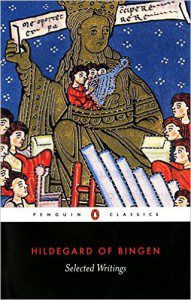
Hildegard’s Selected Writings: probably the best book to start with.
By her own admission, Hildegard was a lifelong visionary. She first encountered the Lux Vivens — or “living light” — while only three years old, and went on to write three books about her extraordinary revelations, the last one completed only a few years before she died. At first she made no effort to publicize her mystical experience, but in her forty-second year she received instructions to commit her visions to writing. Surely recognizing that women did not routinely write about their spirituality, she shrewdly appealed to Bernard of Clairvaux for advice, and he in turn appealed to the Pope, who issued a written statement approving of Hildegard’s work.
The visions themselves range from the luminously beautiful to the starkly terrifying. In her writings she combines vivid descriptions of what she saw with detailed reflections on their meaning. Part of what makes Hildegard so remarkable a figure — and appealing to us today — is that she created (or instructed one of her sister nuns to create) illuminations to illustrate many of the visions. While much of the content of her seeing is predictably religious in nature, filled with the glory of God and the depiction of Biblical stories, plenty of meaningful insight characterized her experiences. By providing both literary and visual records of her visions, Hildegard often made subtle contributions to an alternative way of seeing even the dogmas of the Church.
For example, one of her most remarkable visions was of the Holy Trinity: the Christian understanding of God as consisting of three persons, the Father, the Son and the Holy Spirit. Many efforts to depict the Trinity rely on abstract symbolism, such as a triangle imposed upon a circle. The circle represents the “unity” of the Oneness of God, while the triangle with its three points symbolizes each of the distinct “persons” of the Trinity.
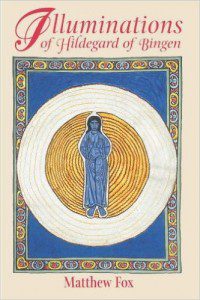
The cover of this book features Hildegard’s Sapphire Christ
By contract, Hildegard’s vision of the Trinity is both strikingly original and profoundly organic. At the center of her vision stood Christ, hands held up in a position of prayer or blessing, his entire figure colored a lovely sapphire blue. Surrounding Christ are concentric circles of what appear to be shimmering energy in gold and silver or white. In Hildegard’s own words:
I saw a bright light, and in this light the figure of a man the color of a sapphire, which was all blazing with a gentle glowing fire. And that bright light bathed the whole of the glowing fire, and the glowing fire bathed the bright light; and the bright light and the glowing fire poured over the whole human figure, so that the three were one light in one power of potential.1
The spheres of light and gold energy surrounding the Christ-figure represent the fire of the Holy Spirit and the light of the Father, embracing and upholding the body of Christ, the son of God incarnate in human form. With its emphasis on energy, the body, and embracing, Hildegard’s vision seems strikingly feminine, in contrast to the usually strictly masculine ways in which God has been depicted in Christianity.
Hildegard also describes the Trinity using the concept of the Word (following the classic idea that Jesus is the Word of God made flesh). A spoken word consists of three elements: the meaning of the word, the breath of the person who is speaking, and the physical sound of the word as it is spoken. To Hildegard, the sound represents the Father, the meaning represents the Son, and the breath represents the Holy Spirit.2
Even more striking is Hildegard’s perception of viriditas, an almost untranslatable Latin word that basically means “green power” or “life force.” In traditional Christian terms viriditas could be equated to the Holy Spirit, but it could just as easily be thought of as the energy of nature — the greening that emerges through plants, and by extension all living things. Hildegard issued warnings that God would allow humans to be punished if they misused creation — a prophecy that seems particularly apt today.
Writing in the twelfth century, Hildegard’s theology and values are steeped in the world-view of the medieval mind, which makes her writing somewhat challenging for the casual reader. But many people find their deepest connection to Hildegard through her music. In recent years many of Hildegard’s chants and hymns have been recorded; her compositions are strikingly melodic for medieval music, and make for ethereally beautiful listening.
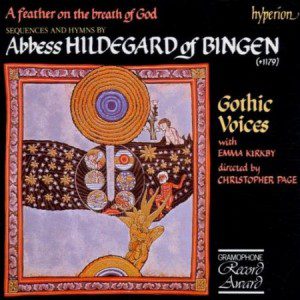
A Feather on the Breath of God
I remember as a graduate student in the early 1980s, shopping in a large book and music store in Georgetown when suddenly it seemed as if the entire shop were filled with an angel’s song. I went to the desk and discovered that the clerk was playing a record (this was before CDs were widely available) called A Feather on the Breath of God: Sequences and Hymns by Abbess Hildegard of Bingen. The soprano, Emma Kirkby, had a voice as pure and beautiful as a fine wine. That album won the Gramophone Award in 1982, and launched an explosion of interest in the music of Hildegard. The German early music ensemble Sequentia recorded all of Hildegard’s compositions, most of which were designed for use during the nuns’ worship, released in a box set of eight CDs. Other artists have taken Hildegard’s compositions and set them to arrangements of electronic or new age music, giving this ancient body of mystical music a new interpretation for our time.
While Hildegard herself did not teach prayer or meditation like many other mystics, her music is perhaps her richest contribution to spiritual seekers of our age: listening to a recording like A Feather on the Breath of God, it is easy to sense just how clearly Hildegard could gaze into what she called “the living light” of heaven.
Although it was a long time in coming, Hildegard of Bingen was finally recognized for the spiritual genius by the Catholic Church; during the pontificate of the German Pope Benedict XVI, she was canonized a saint and declared a doctor (teacher) of the church — in the year 2012, a mere 833 years after her death!
Recommended Reading: Selected Writings by Hildegard of Bingen (London: Penguin Books, 2001)
Recommended Listening: A Feather on the Breath of God: Sequences and Hymns by Abbess Hildegard of Bingen by Gothic Voices with Emma Kirkby (London: Hyperion Records, 1982)
Enjoy reading this blog?
Click here to become a patron.

1 Hildegard of Bingen, Scivias, (New York: Paulist Pres, 1990), p. 161.
2 ibid., p. 164.
Previous Post

September 16, 2015
Thirteen Characteristics of Healthy Spirituality
Next Post
September 23, 2015 Nine Ways to Foster a Contemplative Church
Browse Our Archives
Select a Category Activism Announcements Art Books Catholicism Celtic Christianity Christian mysticism Christianity Contemplation Current events Etc. Family humor interfaith dialogue Interfaith Wisdom Interspirituality Lay Cistercians Living the Faith Meditation movies Mysticism Mystics nature Poetry Reviews Scripture silence Spirituality Uncategorized Writing
Select a Month February 2025 January 2025 November 2024 September 2024 August 2024 July 2024 June 2024 May 2024 March 2024 January 2024 December 2023 November 2023 August 2023 June 2023 April 2023 March 2023 February 2023 January 2023 December 2022 November 2022 October 2022 September 2022 August 2022 July 2022 June 2022 May 2022 April 2022 February 2022 January 2022 December 2021 November 2021 October 2021 September 2021 August 2021 July 2021 June 2021 May 2021 April 2021 March 2021 February 2021 January 2021 December 2020 November 2020 October 2020 September 2020 August 2020 July 2020 June 2020 May 2020 April 2020 March 2020 February 2020 January 2020 December 2019 November 2019 October 2019 September 2019 August 2019 July 2019 June 2019 May 2019 April 2019 March 2019 February 2019 January 2019 December 2018 November 2018 October 2018 September 2018 August 2018 July 2018 June 2018 May 2018 April 2018 March 2018 February 2018 January 2018 December 2017 November 2017 October 2017 September 2017 August 2017 July 2017 June 2017 May 2017 April 2017 March 2017 February 2017 January 2017 December 2016 November 2016 October 2016 September 2016 August 2016 July 2016 June 2016 May 2016 March 2016 February 2016 January 2016 December 2015 November 2015 October 2015 September 2015 August 2015 July 2015 June 2015 May 2015 April 2015 March 2015 February 2015 January 2015 December 2014 November 2014 October 2014 September 2014 August 2014 July 2014 June 2014 May 2014 April 2014 March 2014 February 2014 January 2014 December 2013 October 2013 September 2013 July 2013 May 2013 January 2013 December 2012 November 2012 August 2012 July 2012 June 2012 March 2012 December 2011 September 2011 October 2010 August 2010 March 2010 September 2009 July 2008 January 2008 December 2007 September 2007 February 2007 January 2007 December 2004
Follow Us!
TAKE THE
Religious Wisdom Quiz
True or False: The first plague in Egypt turned the Nile River into blood.
Select your answer to see how you score.
FALSE TRUE
Support this
Column


Related posts from Carl McColman

I Believe Prayer Changes Things. Here's a Few...

You don't have to become a monk to...

LSD, Anxiety, and Contemplation: Can Psychedelic Therapy Support...

Mysticism, Faith, and "Knowing" God's Will
TRENDING AT PATHEOS Contemplative

Handy Contemplative Practices for Political Spaces
A Spiritually Grounded Presence In order to bring a spiritually grounded presence...

Halloween: The Holiday of Loving Your Neighbor
All Hallows Eve Is Halloween the least Christian holiday in America, or...

Can Love Be Saved? Some Thoughts on the...
Happy Valentine's Day! I recently published a post on Patreon called Can...

"This Loving, Uniting Embrace": the Holy Ordinary
Today's guest post is by Mark Longhurst, author of The Holy Ordinary:...

How Are We Called to Live?: More About...
How Are We Called to Live? Many of us struggle with discerning...

A Spiritual Practice of Reading: Join Us Online
A Spiritual Practice of Reading A healthy spiritual practice of reading is...
view all Contemplative blogs
Ad-Free & Subscriber Log-In Subscription Support
- About Us
- 2026 Calendar
- Videos
- Podcasts
- Library of World Religions
- Faith In Media Tracker
- Advertise With Us
- Write for Us
- Privacy Policy
- Terms of Service
- Do Not Sell My Data
- Contact Us
- Radiant Digital
- Manage Newsletter Subscriptions
- Unsubscribe From Notifications
- Sitemap
Copyright 2008-2026, Patheos. All rights reserved.
Subscription Support Ad-Free & Subscriber Log-In
Follow Patheos