
BuddhistCatholicContemplativeEvangelicalGeneral ChristianHinduJewishLatter-day SaintMuslimNew VisionsProgressive Christian
Beliefs
- Buddhist
- Catholic
- Contemplative
- Evangelical
- General Christian
- Hindu
- Jewish
- Latter-day Saint
- More Voices
- Muslim
- New Visions
- Pagan
- Progressive Christian
Topics
- Religion News
- Food and Religion
- Sports and Religion
- Religious Art
- Religious Music and Entertainment
- Religious Events
- History and Religion
- Style and Religion
- Politics and Religion
- Women in Religion
- Recreation Outdoors and Religion
- Business Finance and Religion
- Careers Workplace and Religion
- Education and Religion
- Family Parenting and Religion
- Health Fitness and Religion
- Home and Religion
- Relationships and Religion
- Technology and Religion
- Travel and Religion
Columnists
- Buddhist Columnists
- Business Finance and Religion Columnists
- Careers Workplace and Religion Columnists
- Catholic Columnists
- Contemplative Columnists
- Education and Religion Columnists
- Evangelists Columnists
- Family Parenting and Religion Columnists
- General Christian Columnists
- Health Fitness and Religion Columnists
- Hindu Columnists
- History and Religion Columnists
- Home and Religion Columnists
- Jewish Columnists
- More Voices Columnists
- Latter Day Columnists
- Muslim Columnists
- New Visions Columnists
- Nonreligious Columnists
- Pagan Columnists
- Politics and Religion Columnists
- Progressive Columnists
- Recreation Outdoors and Religion Columnists
- Relationships and Religion Columnists
- Religion News Columnists
- Religious Art Columnists
- Religious Events Columnists
- Religious Music and Entertainment Columnists
- Sports and Religion Columnists
- Style and Religion Columnists
- Technology and Religion Columnists
- Travel and Religion Columnists
- Women in Religion Columnists
Resource Library
- 2026 Calendar
- Library of World Religions
- The 100 Most Holy Places on Earth
- Patheos Answers
- Podcasts
- Videos
- Faith Leaders Database
- Anglican Episcopalian
- Bahai
- Baptist
- Buddhism
- Christianity
- Confucianism
- Eastern Orthodoxy
- Hinduism
- Holiness and Pentecostal
- ISKCON
- Islam
- Judaism
- Lutheran
- Methodist
- The Church of Jesus Christ of Latter-day Saints
- New Age
- Paganism
- Presbytarian and Reformed
- Protestantism
- Religion Behind the Scenes
- Roman Catholic
- Scientology
- Shia Islam
- Sikhism
- Sufism
- Sunni Islam
- Taoism
- Zen
- See all religions
Research Tools
 Ad-Free & Subscriber Log-In Subscription Support
Ad-Free & Subscriber Log-In Subscription Support
Follow Patheos 

- Trending:
- Forgiveness
- |
- Marriage
- |
- Consciousness
- |
- Death Penalty
- |
- Election
- |
- Halloween

- Home
- Contemplative
- Artist, Mystic, Pilgrim, Companion: An Interview with Christine Valters Paintner
Artist, Mystic, Pilgrim, Companion: An Interview with Christine Valters Paintner
Last updated on: December 5, 2018 at 5:41 pm by Carl "Skye" McColman
Artist, Mystic, Pilgrim, Companion: An Interview with Christine Valters Paintner 2018-12-05T17:41:02-04:00 Carl "Skye" McColman
Patheos Explore the world's faith through different perspectives on religion and spirituality! Patheos has the views of the prevalent religions and spiritualities of the world.

Christine Valters Paintner
Recently I had the opportunity to interview author and contemplative artist Christine Valters Paintner of the Abbey of the Arts. We talked about contemplative spirituality, pilgrimage, and her latest book, The Soul of a Pilgrim: Eight Practices for the Journey Within.
The book celebrates the spirituality of pilgrimage by identifying eight essential practices that can inform and illuminate the journeys and adventures that mark our lives. It grew out of the author’s (and her husband’s) own pilgrimage, when they relocated from the United States to Europe a few years back. If you’d like to learn more about the book, read my review on Patheos (or better yet, order a copy). Here, meanwhile, is the interview.
Can you briefly share with the readers the story of the book? Was it directly a result of your own move/pilgrimage, or what other factors may have contributed to its gestation?
Yes, it has really been the fruit of several years of embarking on what my husband and I call ancestral pilgrimages, to lands which shaped the imagination of our ancestors: Austria, England, Germany, Ireland, and Latvia. Our decision in 2012 to make a move overseas and go on a midlife adventure broke open my own deepened appreciation of pilgrimage as a metaphor for daily life. I think even further back, my own diagnosis with an autoimmune illness in my twenties, and then later mother’s sudden death in 2003 which left me bereft for a long time also contributed to my desire to see these experiences as part of something archetypal.
Now that the book is done, do you have any additional practices aside from the eight that you wish you had included? Which of the eight practices is the most powerful or meaningful for you, and why?
The practice I continue to find the most potent is the practice of being uncomfortable. Living in a foreign culture, new dimensions keep being revealed. Even in Ireland where English is spoken, we keep discovering new phrases. The heart of much of my teaching has become about cultivating this ability to stay present in the midst of strangeness and discomfort in service of widening our own capacity for responding to life’s anxieties from a place of more centeredness and compassion.
There is perhaps another whole book of practices which could also support the pilgrimage journey such as the need for silence and community. I made the intentional choice of not trying to be comprehensive or create a set of stages or steps, but rather invitations into embodied ways to live into the grace of pilgrimage with more awareness.
How do you see the relationship between pilgrimage and spiritual direction or accompaniment? For those of our readers who have a ministry of spiritual companionship, how can your book provide them with a resource for their directees?
Pilgrimage can be a very powerful metaphor for when our lives become challenging and we are thrust into difficult circumstances. Often these are the moments when someone will first seek out spiritual direction. I know in my own journey, having someone there to witness the challenges and graces was essential, and who could reflect back to me the places for growth and where I was being too hard on myself. I think the book can offer some different lenses with which to understand where on the journey the directee could be encouraged to deepen. It can be consoling when you have let go of everything familiar to know that thresholds are considered sacred moments and that moving into unknowing is an essential part of the journey toward spiritual ripening. The book offers ways to frame aspects of the journey and to see that the pilgrim is not alone in their experience.
I really appreciated your willingness to acknowledge and honor the reality that not all “pilgrimages” are voluntary or joyously embraced. How do you make sense of the relationship between suffering and being on the move? What words of hope or encouragement would you want to share with someone who is in a painful place in relationship to their journey: being evicted, or accompanying someone dying, or a pilgrimage through incarceration?
These moments that break us open and move us deeper into the radical vulnerability of being human have the opportunity for so much grace. Pilgrimage opens the possibility that we can welcome in the difficult feelings as intimately tied to our own spiritual growth. In churches we often try to move people too quickly to a place of optimism and hope. They need time to descend into the strangeness and discomfort, but to feel accompanied and accepted in that place. Sometimes this might be a part of a dark night journey, where all certainties have been stripped away. Christian tradition tells us that when this journey is made consciously and we stop trying to avoid the painful feelings, we are broken open into a deeper maturity and wisdom.
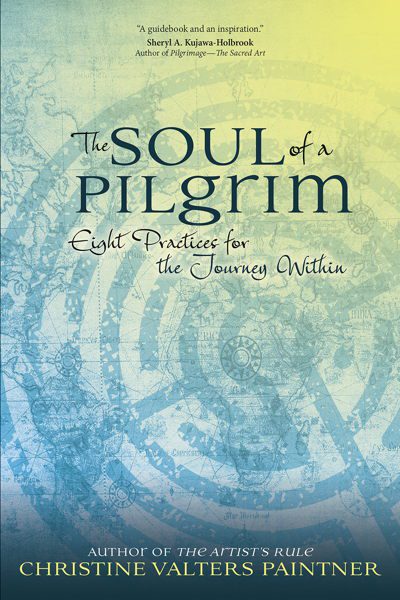
The Soul of a Pilgrim
I love the discussion of visio divina and the invitation to enter into contemplative photography as a spiritual practice of seeing. But some people may feel insecure or self-conscious when invited to create art. What would you say to the pilgrim who encounters anxiety or fear when invited to gaze contemplatively? What is the key to letting go of our inner roadblocks?
My approach to the arts is through a process-centered perspective, so instead of creating something beautiful for display, I encourage others to enter into the creative process as a form of meditation, prayer, and expression of what is happening within. In this way the act of creating is about the journey of discovery, rather than trying to create some predetermined image in our minds. We aren’t setting out to make something beautiful, which takes the pressure off. And what is created from this approach is often deeply beautiful because it becomes an expression of an inner truth.
I also encourage people to just have some fun with it. We can take our spiritual practice too seriously at times and want to achieve some kind of perfection with it. What if we just went out to create for the pure joy and experience of it the way we did when we were children?
Here’s a question born specifically of the Benedictine tradition. There’s a tension between pilgrimage which is such a universal human spiritual practice, and stability, which as you know is a core Benedictine value. How do you understand the relationship between pilgrimage and stability? How can we enter into that tension in our lives?
This is a fabulous question and really gets at the heart of why I love both the Benedictine and Celtic monastic traditions so much, because they each invite me to hold a part of this tension. For the Benedictines, stability is foundational as a way of not running away when things become difficult. For the Celtic monks, peregrinatio was a very unique kind of pilgrimage where a monk would step into a boat without oar or rudder and let the current and wind carry them to the “place of their resurrection.” It was about yielding to the Spirit and releasing control.
At the heart of this tension is our intention and what our motivation is behind either the stability or the pilgrimage. Stability can become an excuse to never take any risks, we can become too wedded to the structure and start to glorify it. Pilgrimage can become a way to run away and find more appealing prospects. Of course the desert monks cautioned that we bring ourselves wherever we go, so running away never works in the long haul.
I believe this is the kind of tension and dance that requires a really solid relationship with a soul friend or spiritual director who can help us see through our patterns. Any practice can become a way of detachment or numbing from real engagement with life. We have to be willing to keep examining and asking the questions.
What was it like collaborating with your husband? He contributes his Biblical reflection in each chapter. Can you share a little bit about the process? The inspiration to work together in this way? Will we see more collaborative work between the two of you in the future?
The journey my husband and I have made over the last three years of growing into our working relationship has been its own kind of pilgrimage within our larger journey. When we made the big move overseas, he had quit his job teaching high school and took about a year of sabbatical time to ponder his own next steps. It was during this time that we slowly started to explore how he might bring his gifts and passions to the work I was already doing with the Abbey. It has been an interesting dance as he discovers his role in the community and as I welcome in more voices. I have a book coming out on spring 2016 on the mystics, and he again has a biblical reflection in each chapter tied to the theme. He has also been offering reflections for some of our online courses, so I think it is safe to say that his role at the Abbey will continue to develop and grow.
Enjoy reading this blog?
Click here to become a patron.

Previous Post

June 17, 2015
Letter and Spirit: Thoughts and Silence?
Next Post
July 1, 2015 Principles for Contemplative Spirituality (Part One)
Browse Our Archives
Select a Category Activism Announcements Art Books Catholicism Celtic Christianity Christian mysticism Christianity Contemplation Current events Etc. Family humor interfaith dialogue Interfaith Wisdom Interspirituality Lay Cistercians Living the Faith Meditation movies Mysticism Mystics nature Poetry Reviews Scripture silence Spirituality Uncategorized Writing
Select a Month February 2025 January 2025 November 2024 September 2024 August 2024 July 2024 June 2024 May 2024 March 2024 January 2024 December 2023 November 2023 August 2023 June 2023 April 2023 March 2023 February 2023 January 2023 December 2022 November 2022 October 2022 September 2022 August 2022 July 2022 June 2022 May 2022 April 2022 February 2022 January 2022 December 2021 November 2021 October 2021 September 2021 August 2021 July 2021 June 2021 May 2021 April 2021 March 2021 February 2021 January 2021 December 2020 November 2020 October 2020 September 2020 August 2020 July 2020 June 2020 May 2020 April 2020 March 2020 February 2020 January 2020 December 2019 November 2019 October 2019 September 2019 August 2019 July 2019 June 2019 May 2019 April 2019 March 2019 February 2019 January 2019 December 2018 November 2018 October 2018 September 2018 August 2018 July 2018 June 2018 May 2018 April 2018 March 2018 February 2018 January 2018 December 2017 November 2017 October 2017 September 2017 August 2017 July 2017 June 2017 May 2017 April 2017 March 2017 February 2017 January 2017 December 2016 November 2016 October 2016 September 2016 August 2016 July 2016 June 2016 May 2016 March 2016 February 2016 January 2016 December 2015 November 2015 October 2015 September 2015 August 2015 July 2015 June 2015 May 2015 April 2015 March 2015 February 2015 January 2015 December 2014 November 2014 October 2014 September 2014 August 2014 July 2014 June 2014 May 2014 April 2014 March 2014 February 2014 January 2014 December 2013 October 2013 September 2013 July 2013 May 2013 January 2013 December 2012 November 2012 August 2012 July 2012 June 2012 March 2012 December 2011 September 2011 October 2010 August 2010 March 2010 September 2009 July 2008 January 2008 December 2007 September 2007 February 2007 January 2007 December 2004
Follow Us!
TAKE THE
Religious Wisdom Quiz
A Samaritan stopped to help a wounded man after a priest and a Levite passed by. Where was the man traveling from and to?
Select your answer to see how you score.
From Galilee to Judea From Jerusalem to Jericho From Samaria to Nazareth From Bethany to Jerusalem
Support this
Column


Related posts from Carl McColman

Join Me for "24 Meditations for 2024"

LSD, Anxiety, and Contemplation: Can Psychedelic Therapy Support...

TRENDING AT PATHEOS Contemplative

Handy Contemplative Practices for Political Spaces
A Spiritually Grounded Presence In order to bring a spiritually grounded presence...

Halloween: The Holiday of Loving Your Neighbor
All Hallows Eve Is Halloween the least Christian holiday in America, or...

Can Love Be Saved? Some Thoughts on the...
Happy Valentine's Day! I recently published a post on Patreon called Can...

"This Loving, Uniting Embrace": the Holy Ordinary
Today's guest post is by Mark Longhurst, author of The Holy Ordinary:...

How Are We Called to Live?: More About...
How Are We Called to Live? Many of us struggle with discerning...

A Spiritual Practice of Reading: Join Us Online
A Spiritual Practice of Reading A healthy spiritual practice of reading is...
view all Contemplative blogs
Ad-Free & Subscriber Log-In Subscription Support
- About Us
- 2026 Calendar
- Videos
- Podcasts
- Library of World Religions
- Faith In Media Tracker
- Advertise With Us
- Write for Us
- Privacy Policy
- Terms of Service
- Do Not Sell My Data
- Contact Us
- Radiant Digital
- Manage Newsletter Subscriptions
- Unsubscribe From Notifications
- Sitemap
Copyright 2008-2026, Patheos. All rights reserved.
Subscription Support Ad-Free & Subscriber Log-In
Follow Patheos