
BuddhistCatholicContemplativeEvangelicalGeneral ChristianHinduJewishLatter-day SaintMuslimNew VisionsProgressive Christian
Beliefs
- Buddhist
- Catholic
- Contemplative
- Evangelical
- General Christian
- Hindu
- Jewish
- Latter-day Saint
- More Voices
- Muslim
- New Visions
- Pagan
- Progressive Christian
Topics
- Religion News
- Food and Religion
- Sports and Religion
- Religious Art
- Religious Music and Entertainment
- Religious Events
- History and Religion
- Style and Religion
- Politics and Religion
- Women in Religion
- Recreation Outdoors and Religion
- Business Finance and Religion
- Careers Workplace and Religion
- Education and Religion
- Family Parenting and Religion
- Health Fitness and Religion
- Home and Religion
- Relationships and Religion
- Technology and Religion
- Travel and Religion
Columnists
- Buddhist Columnists
- Business Finance and Religion Columnists
- Careers Workplace and Religion Columnists
- Catholic Columnists
- Contemplative Columnists
- Education and Religion Columnists
- Evangelists Columnists
- Family Parenting and Religion Columnists
- General Christian Columnists
- Health Fitness and Religion Columnists
- Hindu Columnists
- History and Religion Columnists
- Home and Religion Columnists
- Jewish Columnists
- More Voices Columnists
- Latter Day Columnists
- Muslim Columnists
- New Visions Columnists
- Nonreligious Columnists
- Pagan Columnists
- Politics and Religion Columnists
- Progressive Columnists
- Recreation Outdoors and Religion Columnists
- Relationships and Religion Columnists
- Religion News Columnists
- Religious Art Columnists
- Religious Events Columnists
- Religious Music and Entertainment Columnists
- Sports and Religion Columnists
- Style and Religion Columnists
- Technology and Religion Columnists
- Travel and Religion Columnists
- Women in Religion Columnists
Resource Library
- 2026 Calendar
- Library of World Religions
- The 100 Most Holy Places on Earth
- Patheos Answers
- Podcasts
- Videos
- Faith Leaders Database
- Anglican Episcopalian
- Bahai
- Baptist
- Buddhism
- Christianity
- Confucianism
- Eastern Orthodoxy
- Hinduism
- Holiness and Pentecostal
- ISKCON
- Islam
- Judaism
- Lutheran
- Methodist
- The Church of Jesus Christ of Latter-day Saints
- New Age
- Paganism
- Presbytarian and Reformed
- Protestantism
- Religion Behind the Scenes
- Roman Catholic
- Scientology
- Shia Islam
- Sikhism
- Sufism
- Sunni Islam
- Taoism
- Zen
- See all religions
Research Tools
 Ad-Free & Subscriber Log-In Subscription Support
Ad-Free & Subscriber Log-In Subscription Support
Follow Patheos 

- Trending:
- Forgiveness
- |
- Marriage
- |
- Consciousness
- |
- Death Penalty
- |
- Election
- |
- Halloween

- Home
- Contemplative
- The Intelligent Person’s Guide to Prayer
The Intelligent Person’s Guide to Prayer
Last updated on: November 26, 2018 at 1:39 pm by Carl "Skye" McColman
The Intelligent Person’s Guide to Prayer 2018-11-26T13:39:33-04:00 Carl "Skye" McColman
Patheos Explore the world's faith through different perspectives on religion and spirituality! Patheos has the views of the prevalent religions and spiritualities of the world.
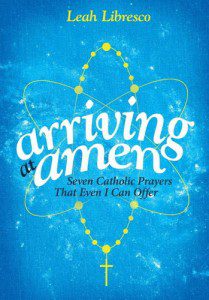
Arriving at Amen
Like so many folks in the blogosphere, I was fascinated by the story of Leah Libresco, atheist blogger who in 2012 surprised all sorts of folks by converting to Catholicism. I haven’t been a regular follower of her blog, either before or after she entered the Church, but the few times I’ve checked it out her writing struck me as articulate, intelligent and thoughtful.
So when Libresco’s first book, Arriving at Amen was published, I jumped at the chance to review it. And I’m happy to say that, for the most part, the book delighted me with its candor, quirkiness, and unusual approach to its topic. As a young woman raised in a secular environment, Libresco’s work is refreshingly free of the kind of pious language and kum-ba-yah feel-goodery that can make spiritual or religious writing dull or insufferably introspective.
Arriving at Amen, by contrast, is clever, quirky, and fresh with insight. She draws from both the arts and the sciences (a math puzzle one minute, William Shakespeare the next) to illustrate her thinking. For this reason alone, this is a book I can recommend to many people — even though it does have one significant flaw.
Instead of providing a straight-up memoir of the author’s conversion (aside from a tantalizing introduction in which she recounts her dramatic moment of accepting the existence of God), Arriving at Amen explores her new-found faith by taking a tour through “Seven Catholic Prayers that Even I Can Offer” as the subtitle puts it. The seven prayers are petition, Reconciliation, the examen, the Rosary, the Divine Office, lectio divina, and the Mass. Obviously, I’m disappointed that contemplation didn’t get its own chapter, although it does briefly show up in the lectio chapter — but more on that in a minute.
Like I said, she dishes up a fresh perspective in pretty much every chapter. Struggling to understand petition, she turns to literature to make sense of how those she prays for are the “protagonists in their own stories.” Applying her cool logical mind to the confessional, she notes how cognitive bias can undermine that sacrament of mercy. She embraces the fullness of the examen as a daily devotion to facilitate what monks call conversatio morum, or ongoing conversion/fidelity to the life of faith.
Perhaps the most brilliant chapter in this book is the one examining the Liturgy of the Hours, where Libresco’s keen mathematical mind acknowledges how this prayer unites us with others, not only across space but across time as well. It is perhaps the most cogent and thrilling explanation of the spirituality of the Divine Office that I have ever read, and something that I look forward to sharing with the Lay Cistercians I teach. It’s also encouraging to see that I’m not the only person who relies on the Divine Office App to pray the Liturgy!
Where the book makes a misstep — and, alas, a significant misstep — is with lectio divina, or “sacred reading.” Libresco never says she’s spent time in a monastery, and I suspect her lack of exposure to the Benedictines or Cistercians may have contributed to her poor understanding of this discipline. The first warning sign comes when she speculates that the four stages of lectio: reading scripture, meditation, prayer, and contemplation, “were arranged in order of increasing difficulty.” Of course, she’s speaking subjectively, but I would argue that this process is designed to move out of difficulty so that each subsequent stage of the practice requires less effort.
She then launches into a sustained discussion of the problems related to language and meaning in reading the Bible, which is quite interesting in its own way but seems to totally miss the point of lectio, which is to surrender our need to study or analyze the text and instead read it for the purpose of seeking greater intimacy with God. I’m reminded of Sheldon in “The Big Bang Theory,” the brilliant scientist who is awkward and clumsy when it comes to dating. Lectio divina requires less Sheldon and more Penny: the emphasis is not on head-smarts, but on the heart. It’s not about thinking about God, it’s about loving God and being loved by God.
Libresco admits, “Studying scripture through lectio divina is like a moral vocabulary drill.” What she doesn’t seem to understand is that lectio is something very different from study. Indeed, I wish she had just called the chapter “Bible Study” — it would have made a lot more sense, and been more consistent with what she’s actually talking about.
Her mis-handling of lectio culminates in the fact that she hardly mentions contemplation at all, even though it is the splendid end to which the entire practice of lectio divina points. And when she does mention it, she gets it wrong: “Lectio divina culminates in contemplatio because all study of Christ is ultimately directed toward the imitation of Christ.” As important as the imitation of Christ may be, it’s not what contemplation is about. Contemplation is about intimacy with Christ, something that reading the Cistercian fathers — or, for that matter, Michael Casey — would reveal.
Some people may think I’m nitpicking here. The larger point is not merely that Libresco’s book deserves only four stars instead of five, but that it illustrates just how illiterate most Catholics (indeed, most Christians) are when it comes to contemplative prayer. Frankly, the real blame goes to her editor, who should have known better. Libresco is a recent convert, after all. But it saddens me to think that some people will get a bad idea of what monastic prayer is, when they read this misbegotten chapter in an otherwise worthy book.
Enjoy reading this blog?
Click here to become a patron.

Previous Post

May 13, 2015
Contemplation and the Ocean of Presence
Next Post
May 19, 2015 Seven Lessons I'm Learning on the Grief Journey
Browse Our Archives
Select a Category Activism Announcements Art Books Catholicism Celtic Christianity Christian mysticism Christianity Contemplation Current events Etc. Family humor interfaith dialogue Interfaith Wisdom Interspirituality Lay Cistercians Living the Faith Meditation movies Mysticism Mystics nature Poetry Reviews Scripture silence Spirituality Uncategorized Writing
Select a Month February 2025 January 2025 November 2024 September 2024 August 2024 July 2024 June 2024 May 2024 March 2024 January 2024 December 2023 November 2023 August 2023 June 2023 April 2023 March 2023 February 2023 January 2023 December 2022 November 2022 October 2022 September 2022 August 2022 July 2022 June 2022 May 2022 April 2022 February 2022 January 2022 December 2021 November 2021 October 2021 September 2021 August 2021 July 2021 June 2021 May 2021 April 2021 March 2021 February 2021 January 2021 December 2020 November 2020 October 2020 September 2020 August 2020 July 2020 June 2020 May 2020 April 2020 March 2020 February 2020 January 2020 December 2019 November 2019 October 2019 September 2019 August 2019 July 2019 June 2019 May 2019 April 2019 March 2019 February 2019 January 2019 December 2018 November 2018 October 2018 September 2018 August 2018 July 2018 June 2018 May 2018 April 2018 March 2018 February 2018 January 2018 December 2017 November 2017 October 2017 September 2017 August 2017 July 2017 June 2017 May 2017 April 2017 March 2017 February 2017 January 2017 December 2016 November 2016 October 2016 September 2016 August 2016 July 2016 June 2016 May 2016 March 2016 February 2016 January 2016 December 2015 November 2015 October 2015 September 2015 August 2015 July 2015 June 2015 May 2015 April 2015 March 2015 February 2015 January 2015 December 2014 November 2014 October 2014 September 2014 August 2014 July 2014 June 2014 May 2014 April 2014 March 2014 February 2014 January 2014 December 2013 October 2013 September 2013 July 2013 May 2013 January 2013 December 2012 November 2012 August 2012 July 2012 June 2012 March 2012 December 2011 September 2011 October 2010 August 2010 March 2010 September 2009 July 2008 January 2008 December 2007 September 2007 February 2007 January 2007 December 2004
Follow Us!
TAKE THE
Religious Wisdom Quiz
Be strong and work, for I am with you. My Spirit remains among you according to what covenant?
Select your answer to see how you score.
The Abrahamic Covenant The Mosaic covenant The covenant made when Israel came out of Egypt The new covenant
Support this
Column


Related posts from Carl McColman

I Believe Prayer Changes Things. Here's a Few...

Contemplative Books to Read and Savor During Advent...
New From Encountering Silence: Exploring the Lost History...
Twelve Mystical Anthologies That Belong in Every Contemplative...
TRENDING AT PATHEOS Contemplative

Handy Contemplative Practices for Political Spaces
A Spiritually Grounded Presence In order to bring a spiritually grounded presence...

Halloween: The Holiday of Loving Your Neighbor
All Hallows Eve Is Halloween the least Christian holiday in America, or...

Can Love Be Saved? Some Thoughts on the...
Happy Valentine's Day! I recently published a post on Patreon called Can...

"This Loving, Uniting Embrace": the Holy Ordinary
Today's guest post is by Mark Longhurst, author of The Holy Ordinary:...

How Are We Called to Live?: More About...
How Are We Called to Live? Many of us struggle with discerning...

A Spiritual Practice of Reading: Join Us Online
A Spiritual Practice of Reading A healthy spiritual practice of reading is...
view all Contemplative blogs
Ad-Free & Subscriber Log-In Subscription Support
- About Us
- 2026 Calendar
- Videos
- Podcasts
- Library of World Religions
- Faith In Media Tracker
- Advertise With Us
- Write for Us
- Privacy Policy
- Terms of Service
- Do Not Sell My Data
- Contact Us
- Radiant Digital
- Manage Newsletter Subscriptions
- Unsubscribe From Notifications
- Sitemap
Copyright 2008-2026, Patheos. All rights reserved.
Subscription Support Ad-Free & Subscriber Log-In
Follow Patheos