
BuddhistCatholicContemplativeEvangelicalGeneral ChristianHinduJewishLatter-day SaintMuslimNew VisionsProgressive Christian
Beliefs
- Buddhist
- Catholic
- Contemplative
- Evangelical
- General Christian
- Hindu
- Jewish
- Latter-day Saint
- More Voices
- Muslim
- New Visions
- Pagan
- Progressive Christian
Topics
- Religion News
- Food and Religion
- Sports and Religion
- Religious Art
- Religious Music and Entertainment
- Religious Events
- History and Religion
- Style and Religion
- Politics and Religion
- Women in Religion
- Recreation Outdoors and Religion
- Business Finance and Religion
- Careers Workplace and Religion
- Education and Religion
- Family Parenting and Religion
- Health Fitness and Religion
- Home and Religion
- Relationships and Religion
- Technology and Religion
- Travel and Religion
Columnists
- Buddhist Columnists
- Business Finance and Religion Columnists
- Careers Workplace and Religion Columnists
- Catholic Columnists
- Contemplative Columnists
- Education and Religion Columnists
- Evangelists Columnists
- Family Parenting and Religion Columnists
- General Christian Columnists
- Health Fitness and Religion Columnists
- Hindu Columnists
- History and Religion Columnists
- Home and Religion Columnists
- Jewish Columnists
- More Voices Columnists
- Latter Day Columnists
- Muslim Columnists
- New Visions Columnists
- Nonreligious Columnists
- Pagan Columnists
- Politics and Religion Columnists
- Progressive Columnists
- Recreation Outdoors and Religion Columnists
- Relationships and Religion Columnists
- Religion News Columnists
- Religious Art Columnists
- Religious Events Columnists
- Religious Music and Entertainment Columnists
- Sports and Religion Columnists
- Style and Religion Columnists
- Technology and Religion Columnists
- Travel and Religion Columnists
- Women in Religion Columnists
Resource Library
- 2026 Calendar
- Library of World Religions
- The 100 Most Holy Places on Earth
- Patheos Answers
- Podcasts
- Videos
- Faith Leaders Database
- Anglican Episcopalian
- Bahai
- Baptist
- Buddhism
- Christianity
- Confucianism
- Eastern Orthodoxy
- Hinduism
- Holiness and Pentecostal
- ISKCON
- Islam
- Judaism
- Lutheran
- Methodist
- The Church of Jesus Christ of Latter-day Saints
- New Age
- Paganism
- Presbytarian and Reformed
- Protestantism
- Religion Behind the Scenes
- Roman Catholic
- Scientology
- Shia Islam
- Sikhism
- Sufism
- Sunni Islam
- Taoism
- Zen
- See all religions
Research Tools
 Ad-Free & Subscriber Log-In Subscription Support
Ad-Free & Subscriber Log-In Subscription Support
Follow Patheos 

- Trending:
- Forgiveness
- |
- Marriage
- |
- Consciousness
- |
- Death Penalty
- |
- Election
- |
- Halloween

- Home
- Contemplative
- Joyful Contemplation (No Fooling!)
Joyful Contemplation (No Fooling!)
Last updated on: December 5, 2018 at 4:47 pm by Carl "Skye" McColman
Joyful Contemplation (No Fooling!) 2018-12-05T16:47:05-04:00 Carl "Skye" McColman
Patheos Explore the world's faith through different perspectives on religion and spirituality! Patheos has the views of the prevalent religions and spiritualities of the world.

Why are all these pious people laughing? (Cover art from Between Heaven and Mirth by James Martin, artist: Anita Kunz).
If you are engaged in a serious and sustained practice of silent prayer and contemplative spirituality, then you need to be a very somber, sober, and serious person, for the mystical life is no laughing matter. . . . April Fool!
I was inspired to write about this topic not only because today is April 1, but also because of what is arguably the single most problematic topic in the Rule of Saint Benedict — laughter. Consider these tidbits:
Do not say foolish things or things that are intended to cause laughter. Do not take pleasure in excessive or unrestrained laughter. (from Chapter 4)
We condemn jokes and idle gossip and anything said to make others laugh, and we ban such things from all places: the disciple is not allowed to open his mouth to say things of this kind. (from Chapter 6)
Avoid being easily provoked to laughter, for it says in Scripture that ‘the person who raises his voice in laughter is a fool’ (Sir. 21:20)… Speak gently and without laughter, but with humility and seriousness, saying only a few, reasonable words, and not speaking in a loud voice, for as it is written, ‘The wise man is recognized by his few words.’ (from Chapter 7)
What a sourpuss!
Fortunately, nobody thinks that the Rule is inerrant, and so the most honest thing to say, is that here’s a place where Saint Benedict gets it wrong.
One way to interpret these verses is to speculate that Saint Benedict wanted to prohibit the kind of laughter that laughs at another — the laughter of derision. Which is different from the laughter of delight, which is never at another’s expense but is purely an expression of joy. Granted, this is an act of *re-*interpretation: Saint Benedict himself probably really was opposed to all types of laughter, good and bad. But I think it is a practical approach.
Thankfully, Saint Benedict notes that “This rule is only a start on the path to justice” (chapter 73) and freely invites the reader to change or adapt his schedule for praying the psalms (chapter 18), both of which suggest to me that Benedict was humble enough to understand that his ideas were hardly the last word on things. So we can re-interpret Benedict’s understanding of laughter without having to chuck the Rule in its entirety.
So my purpose in writing today is to reflect on what a healthy relationship between contemplation and laughter really can be. I’m writing especially for Benedictine oblates and Lay Cistercians and others who are not monks or nuns but who turn to Saint Benedict for spiritual guidance — although I think anyone interested in a spirituality grounded in silence and contemplation might want to reflect on this issue. What does it look like to be a joyful contemplative?
And I’ve already mentioned the important first clue: the importance of recognizing the difference between derision and delight. Contemplation is grounded in compassion, so I think it’s intuitive for contemplatives to recoil from laughter that comes at another person’s expense. Which is not to say we don’t sometimes do it. I’ll confess to have made a joke at the expense of a politician or pundit with whom I disagree. It’s an easy laugh — but it’s not an edifying one. And so I thank Saint Benedict for giving me pause to consider that laughter or playfulness comes in different forms, and not all are icons of the love of God.
But the more I discern the need to let go of the laughter that puts someone else down, the more convinced I am that a truly contemplative spirituality is nevertheless filled with healthy joy and laughter and happiness — only it’s the laughter of a smiling baby, the joy of a person in love, the happiness that emerges from an in-your-bones ability to radically trust the Love of God.
Sometimes when I am sitting in silent prayer, I break out in a big spontaneous smile. Nothing in particular causes it — it’s just a joy that wells up from deep within. It’s happiness at being alive, it’s serotonin set aflame by the presence of God, even if I don’t consciously feel such presence.
I’ve recently come across two books that I find encouraging for my conviction that contemplation is a fundamentally happy endeavor. The first, by the wonderful Jesuit author James Martin, is Between Heaven and Mirth: Why Joy, Humor and Laughter Are at the Heart of the Spiritual Life. The title really says it all; Martin weaves together his gentle writing style with plenty of stories drawn from his own life and the lives of the saints — and he is clear in showing how the root of all the goofiness and happiness is joy, which after all is one of the Fruits of the Spirit (see Galatians 5:22).
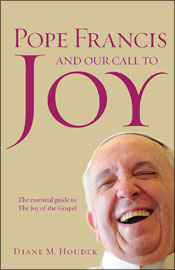
Here’s a book about Pope Francis that I haven’t read yet, but I love the cover. He knows how to smile!
This takes me to the second book that has inspired me: Pope Francis’s 2013 Apostolic Exhortation, Evangelii Gaudium: The Joy of the Gospel. The Pope, who himself is quite a smiler, emphasizes that joy is an integral characteristic of the Christian message, and that all the activities of the life of faith — from prayer to liturgy to missional activity and evangelization — need to be grounded in joy in order to be truly consistent with the Gospel. In other words, joy is not some sort of religious add-on; it’s central to the message that God loves us and wants what’s best for us. So if we get into sourpuss-land (or, for that matter, derision-ville), then something is out of joint. We need to re-calibrate our faith by the radiance of delight.
So Happy April Fool’s Day — and don’t let the sourpuss saints fool you. Be silly (I love how the word “silly” in its Germanic root is related to selig which also means “blessed”!) and fearlessly be a fool for Christ’s sake (I Corinthians 4:10). Be joyful in your faith, in your prayer, in your contemplative living. Silence is a gateway to splendor and felicity. Let the joy flow!
Is there something special you do to nurture happiness and joy in your faith journey? I’d love to hear about it — please leave a comment below.
Enjoy reading this blog?
Click here to become a patron.


Next Post

April 2, 2015 What Good is Religion? A Contemplative Perspective
Browse Our Archives
Select a Category Activism Announcements Art Books Catholicism Celtic Christianity Christian mysticism Christianity Contemplation Current events Etc. Family humor interfaith dialogue Interfaith Wisdom Interspirituality Lay Cistercians Living the Faith Meditation movies Mysticism Mystics nature Poetry Reviews Scripture silence Spirituality Uncategorized Writing
Select a Month February 2025 January 2025 November 2024 September 2024 August 2024 July 2024 June 2024 May 2024 March 2024 January 2024 December 2023 November 2023 August 2023 June 2023 April 2023 March 2023 February 2023 January 2023 December 2022 November 2022 October 2022 September 2022 August 2022 July 2022 June 2022 May 2022 April 2022 February 2022 January 2022 December 2021 November 2021 October 2021 September 2021 August 2021 July 2021 June 2021 May 2021 April 2021 March 2021 February 2021 January 2021 December 2020 November 2020 October 2020 September 2020 August 2020 July 2020 June 2020 May 2020 April 2020 March 2020 February 2020 January 2020 December 2019 November 2019 October 2019 September 2019 August 2019 July 2019 June 2019 May 2019 April 2019 March 2019 February 2019 January 2019 December 2018 November 2018 October 2018 September 2018 August 2018 July 2018 June 2018 May 2018 April 2018 March 2018 February 2018 January 2018 December 2017 November 2017 October 2017 September 2017 August 2017 July 2017 June 2017 May 2017 April 2017 March 2017 February 2017 January 2017 December 2016 November 2016 October 2016 September 2016 August 2016 July 2016 June 2016 May 2016 March 2016 February 2016 January 2016 December 2015 November 2015 October 2015 September 2015 August 2015 July 2015 June 2015 May 2015 April 2015 March 2015 February 2015 January 2015 December 2014 November 2014 October 2014 September 2014 August 2014 July 2014 June 2014 May 2014 April 2014 March 2014 February 2014 January 2014 December 2013 October 2013 September 2013 July 2013 May 2013 January 2013 December 2012 November 2012 August 2012 July 2012 June 2012 March 2012 December 2011 September 2011 October 2010 August 2010 March 2010 September 2009 July 2008 January 2008 December 2007 September 2007 February 2007 January 2007 December 2004
Follow Us!
TAKE THE
Religious Wisdom Quiz
Who played instruments in Temple?
Select your answer to see how you score.
Prophets Priests Levites Kings
Support this
Column


Related posts from Carl McColman

LSD, Anxiety, and Contemplation: Can Psychedelic Therapy Support...

Finding Your Perfect Prayer Posture

Advice for Contemplatives looking for a Spiritual Community...
A Reason Why Liturgy Matters: "Like Staring Out...
TRENDING AT PATHEOS Contemplative

Handy Contemplative Practices for Political Spaces
A Spiritually Grounded Presence In order to bring a spiritually grounded presence...

Halloween: The Holiday of Loving Your Neighbor
All Hallows Eve Is Halloween the least Christian holiday in America, or...

Can Love Be Saved? Some Thoughts on the...
Happy Valentine's Day! I recently published a post on Patreon called Can...

"This Loving, Uniting Embrace": the Holy Ordinary
Today's guest post is by Mark Longhurst, author of The Holy Ordinary:...

How Are We Called to Live?: More About...
How Are We Called to Live? Many of us struggle with discerning...

A Spiritual Practice of Reading: Join Us Online
A Spiritual Practice of Reading A healthy spiritual practice of reading is...
view all Contemplative blogs
Ad-Free & Subscriber Log-In Subscription Support
- About Us
- 2026 Calendar
- Videos
- Podcasts
- Library of World Religions
- Faith In Media Tracker
- Advertise With Us
- Write for Us
- Privacy Policy
- Terms of Service
- Do Not Sell My Data
- Contact Us
- Radiant Digital
- Manage Newsletter Subscriptions
- Unsubscribe From Notifications
- Sitemap
Copyright 2008-2026, Patheos. All rights reserved.
Subscription Support Ad-Free & Subscriber Log-In
Follow Patheos