
BuddhistCatholicContemplativeEvangelicalGeneral ChristianHinduJewishLatter-day SaintMuslimNew VisionsProgressive Christian
Beliefs
- Buddhist
- Catholic
- Contemplative
- Evangelical
- General Christian
- Hindu
- Jewish
- Latter-day Saint
- More Voices
- Muslim
- New Visions
- Pagan
- Progressive Christian
Topics
- Religion News
- Food and Religion
- Sports and Religion
- Religious Art
- Religious Music and Entertainment
- Religious Events
- History and Religion
- Style and Religion
- Politics and Religion
- Women in Religion
- Recreation Outdoors and Religion
- Business Finance and Religion
- Careers Workplace and Religion
- Education and Religion
- Family Parenting and Religion
- Health Fitness and Religion
- Home and Religion
- Relationships and Religion
- Technology and Religion
- Travel and Religion
Columnists
- Buddhist Columnists
- Business Finance and Religion Columnists
- Careers Workplace and Religion Columnists
- Catholic Columnists
- Contemplative Columnists
- Education and Religion Columnists
- Evangelists Columnists
- Family Parenting and Religion Columnists
- General Christian Columnists
- Health Fitness and Religion Columnists
- Hindu Columnists
- History and Religion Columnists
- Home and Religion Columnists
- Jewish Columnists
- More Voices Columnists
- Latter Day Columnists
- Muslim Columnists
- New Visions Columnists
- Nonreligious Columnists
- Pagan Columnists
- Politics and Religion Columnists
- Progressive Columnists
- Recreation Outdoors and Religion Columnists
- Relationships and Religion Columnists
- Religion News Columnists
- Religious Art Columnists
- Religious Events Columnists
- Religious Music and Entertainment Columnists
- Sports and Religion Columnists
- Style and Religion Columnists
- Technology and Religion Columnists
- Travel and Religion Columnists
- Women in Religion Columnists
Resource Library
- 2026 Calendar
- Library of World Religions
- The 100 Most Holy Places on Earth
- Patheos Answers
- Podcasts
- Videos
- Faith Leaders Database
- Anglican Episcopalian
- Bahai
- Baptist
- Buddhism
- Christianity
- Confucianism
- Eastern Orthodoxy
- Hinduism
- Holiness and Pentecostal
- ISKCON
- Islam
- Judaism
- Lutheran
- Methodist
- The Church of Jesus Christ of Latter-day Saints
- New Age
- Paganism
- Presbytarian and Reformed
- Protestantism
- Religion Behind the Scenes
- Roman Catholic
- Scientology
- Shia Islam
- Sikhism
- Sufism
- Sunni Islam
- Taoism
- Zen
- See all religions
Research Tools
 Ad-Free & Subscriber Log-In Subscription Support
Ad-Free & Subscriber Log-In Subscription Support
Follow Patheos 

- Trending:
- Forgiveness
- |
- Marriage
- |
- Consciousness
- |
- Death Penalty
- |
- Election
- |
- Halloween

- Home
- Contemplative
- Mary and Martha are Sisters
Mary and Martha are Sisters
Last updated on: August 22, 2018 at 5:23 pm by Carl "Skye" McColman
Mary and Martha are Sisters 2018-08-22T17:23:45-04:00 Carl "Skye" McColman
Patheos Explore the world's faith through different perspectives on religion and spirituality! Patheos has the views of the prevalent religions and spiritualities of the world.
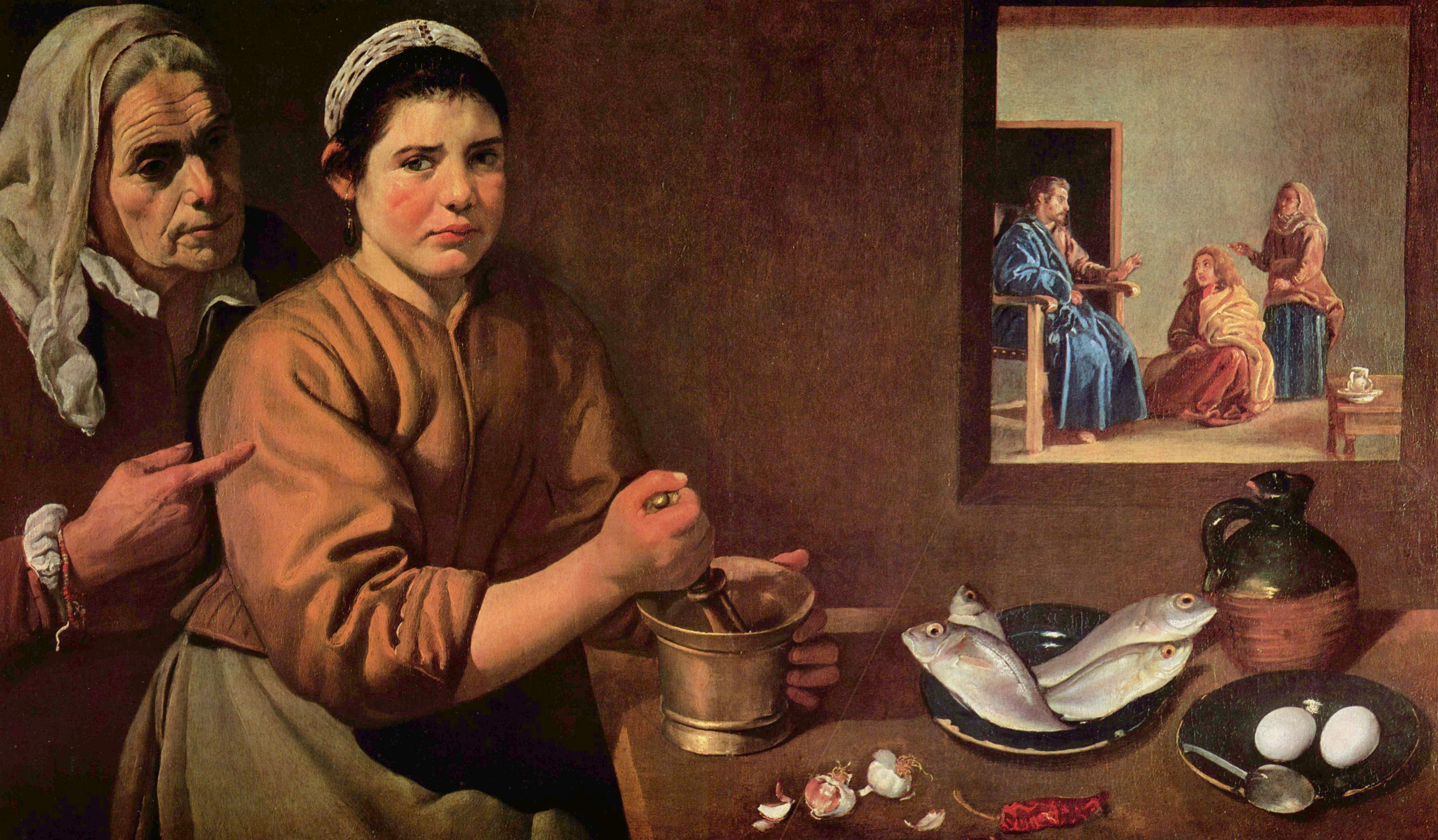
“Christ in the House of Martha and Mary” by Diego Velázquez (1618)
A sermon preached at First Baptist Church, Springfield, Ohio, on October 26, 2014
Scripture: Luke 10:38-42
When I was a little boy, my brother took me to the theater to see my first movie. It was called The Parent Trap. While younger members of the congregation may remember the 1998 version starring Lindsey Lohan, those of you who are about my age will, no doubt, agree with me that there really is only one version of this film, the 1961 version, which was originally billed as “starring Hayley Mills … and Hayley Mills!” The young British actress, decades before CGI or other modern special effects, dazzled and amused audiences around the world by playing identical twin sisters, who were separated at birth, only to suddenly bump into each other as teenagers one summer at camp. The first half hour of the film derives much of its comedy from the rivalry that erupts between Susan and Sharon, two girls who look identical, who immediately take a profound dislike for each other when they attend the same summer camp. Pranks pulled on each other escalate until an entire Saturday night dance is ruined as the girls fight.
But then something interesting happens: to discipline the girls, they are required to spend the rest of their time at camp — with each other. The camp counselor says, “Either you’ll find a way to live with each other or you’ll punish yourselves far better than I ever could.” Shortly thereafter, Susan and Sharon figure out that they are in fact sisters, separated at birth, and the rest of the movie follows their exploits as they work together to help their estranged mother and father to reconcile.
Now, I know that not all sisters — or for that matter, all brothers — can find the kind of storybook happy ending that is the trademark of a Walt Disney film. Still, the charm and the humor of a story like The Parent Trap is built on a rather universal human principle that, thankfully, is true at least much of the time: that two sisters, or for that matter two siblings of any gender, are liable to fight like cats and dogs — after all, we have a term for it: “sibling rivalry” — but underneath the squabbles and the bickering, they’re family, and at the end of the day, they love each other.
Mary and Martha of Bethany are two of more colorful “minor characters” in the Gospel story. They were sisters, and we know from the Gospel of John they had a brother named Lazarus. There has been a lot of confusion over Mary in particular. In the middle ages, Mary of Bethany was frequently confused with Mary Magdalene, although in modern times most scholars believe they are two separate figures. We know nothing about their family, if any of them were married or had children. One legend suggests that Mary and Martha were women of means, and in fact provided financial support for Jesus’s ministry. But this of course is mere legend and speculation. All we know for certain is what we see in the Bible. And the story of the sisters that we find in the tenth chapter of Luke’s Gospel has been one of the most commented upon stories in the entire Gospel.
When Jesus comes to Bethany, he arrives at Martha’s home. We do not know if Mary lived with Martha or not, the evangelist does not say. We do know that while Martha busies herself with “her many tasks,” — presumably related to hospitality for her guests — her sister sits does at the Lord’s feet and listens to what he is saying. We can assume that this is probably not a private audience, that Jesus is teaching his disciples. Mary has broken the rules of society, choosing to sit with the boys while leaving her poor sister to do all the work in the kitchen.
Needless to say, Martha gets annoyed. We might speculate that this is not the first time that Mary has opted to leave the chores to her sister, because as best we can tell, Martha does not confront Mary; no, she goes straight to Jesus. You can almost imagine what is going through Martha’s head as she marches up to the Lord. “She won’t listen to me, but maybe she will listen to him.”
In making her appeal to Jesus, Martha is not above some old fashioned guilt tripping. “Lord, do you not care that my sister has left me to do all the work by myself? Tell her then to help me.” Unfortunately for Martha, Jesus is smart enough not to get in the middle of this family squabble, so he deftly sets a boundary of his own. “Martha, Martha!” he says, repeating her name twice, presumably because he didn’t get her attention the first time. And then he simply acknowledges her. “You are worried and distracted by many things.” Three different Greek words are used to describe Martha’s state in this brief story:
- περισπάω — perispao,
- μεριμνάω — merimnao, and
- θορυβάζω — thorybazo.
Each of these words carries the connotation of anxious, troubled, worried, upset, distracted. In fact, English translations like the New Revised Standard Version render both merimnao and thorybazo as “distracted.” Martha seems to be a very distracted person.
In acknowledging that Martha is upset, Jesus surprises her because he defends her sister. “There is need of only one thing,” he muses. “Mary has chosen the better part, which will not be taken away from her.” In other words, Jesus is saying, “Martha, what really matters here? Mary has made a good choice, so don’t ask me to take it away from her.” We could possibly read this passage as Jesus putting Martha down, since she did not choose the “one thing necessary” or the “better part.” But I think Jesus is not criticizing the work she is doing, but the manner in which she is doing it. It is her distraction that he pushes against. If Jesus were here today, speaking in our contemporary colloquial language, I can imagine him saying, “Martha, CHILL!”
As I said a few minutes ago, this is a passage that has often been commented on, over the ages. In recent years it has been seen as a type of feminist parable, in which Jesus encourages Martha to step out of prescribed gender roles like her sister has spontaneously done. But in the past, Mary and Martha were understood not in terms of gender, but as metaphors for ways in which Christians respond to the Gospel in our lives.
In the fourteenth century, an anonymous book was written called The Cloud of Unknowing. It is a manual on prayer and meditation — on how Christians can learn to grow closer to God through a sustained daily discipline of meditative prayer. The classic word for this kind of prayer is contemplation. In fact, in the middle ages, when The Cloud of Unknowing was written, Christians who wanted to devote their lives to prayer and meditation often would become nuns or monks, so that the way of life found in monasteries or convents became known as “the contemplative life.” By contrast, the life of Christians who got married or otherwise lived out their faith outside of the walls of a monastery were said to live an “active life.” By the fourteenth century, this idea of an active or contemplative approach to discipleship had become a commonly understood distinction within the life of the church.
The author of The Cloud of Unknowing takes the story of Mary and Martha of Bethany and applies it to this way of understanding the faith. Martha, busy with her many tasks, symbolizes an active expression of discipleship. Mary, listening quietly as she sits at the feet of the master, represents the contemplative approach to faith.
The Cloud of Unknowing points out that it is Martha who complains about Mary, and not the other way around. Perhaps not much has changed since the fourteenth century! Activists, people who work hard to build the kingdom of God, indeed doing very good and holy work, might find it easy to criticize those who orient their lives toward a more receptive mode of spirituality. The great poet John Milton declared “They also serve who only stand and wait” — but perhaps the reason he had to put that in writing is because ours is a society that isn’t so sure about such things as meditation or contemplation or prayer. We dismiss such activities as “introspection” or “navel gazing.” A pastor of a large church in Atlanta once told me “I’m more of a practical person than a spiritual person.” I was stunned that he thought there was a difference. But apparently, that is a common idea in our society.
But the story of Mary and Martha is hardly the only case where Jesus challenges the conventional norms of society. He sleeps on a boat in the midst of a storm and takes time to pray even when he is at risk of being arrested. In fact, when we read the Gospel and pay attention, we notice that Jesus withdraws to pray again and again — usually by himself, sometimes with only two or three of his closest disciples present. No one could accuse Jesus of not having an active ministry, Jesus, who healed the sick, cured the lame, raised the dead, and cast out demons. But his ministry of service and healing was fueled by regular, solitary, and dare I say silent prayer.
Few of us are as balanced as Jesus. I dare say that if we went around the room and spoke to everyone we would find that some of us are natural Mary’s, and others are natural Martha’s. Some of us love to get in the thick of where the action is, working hard to get things done, solve problems, fix what’s broken, and right what’s wrong. At home the Marthas are the ones who are handy with tools; at work, they’re the ones you go to, to get things done. At church, you’ll find the Marthas on every committee and busy at every workday. Thank God for all the Marthas in the world, or nothing would ever, ever get done.
Meanwhile, where are the Mary’s? Now Martha might be quick to point out that Mary always seems to disappear whenever there’s work to be done. But perhaps things are not quite that simple. If you looked for her, you would find that Mary is busy praying. When there is a conflict, Mary is trying to understand all sides of the equation so that she can more wisely discern what needs to be done. When a situation seems mired down, Mary is the one least likely to try to push for a quick solution; rather she wants to take the time to make sure that a complicated process is done right the first time. Perhaps most important of all, Mary is patient — you’ll find her with a handicapped child, or a grandmother lost in the confusion of dementia. Mary understands that sometimes, you just can’t solve a problem, but you can help to make it a little bit better. And Mary understands these things because she is a woman who prays.
We run the risk when we read the story of Mary and Martha, of thinking that Jesus is taking sides here. When he says that Mary has chosen the better part, isn’t that a slap in Martha’s face? Isn’t that a way of saying that Martha’s choice is second rate, or second best? But I really don’t think that’s what Jesus was saying at all. And once again, we can turn to that medieval manual of prayer, The Cloud of Unknowing, to understand the real secret of this Gospel story.
“In this part, contemplative life and active life are linked together in spiritual kinship and made sisters, on the model of Martha and Mary,” notes The Cloud. “An active may come this high into contemplation and no higher, except very rarely and by special grace. A contemplative may come this low towards active life and no lower, except very rarely and in great necessity.” Now, I don’t think it makes sense to say that the contemplative life is higher than the active life. But scholars are pretty sure that the author of The Cloud of Unknowing was a contemplative, so naturally he was a bit biased! But we can put Mary and Martha side by side and the analogy works just as well. Mary and Martha are sisters. Like the twins in “The Parent Trap,” they are not above bickering and squabbling. But at the end of the day, they love each other — and that’s just how Jesus wants it.
Like I said, every one of us is a natural Mary or a natural Martha. So if you are a Martha where do you find your “Mary” — and vice versa? I think the answer lies within. Every one of us is naturally right-handed or naturally left-handed, but by the grace of God almost all of us have two hands to use, and sometimes we need that less-dominant hand. Our spiritual lives operate the same way. The natural Mary’s of the world know that they have to do their fair share of work. And likewise, the Martha’s of the world need to make time in their busy lives to simply be still, rest in the silence, and listen for the still small voice of God.
Jesus said “Whoever receives a child in my name, receives me.” In other words, there is a certain holiness to hospitality in the life of faith. We are called to welcome the stranger, to feed the hungry, to clothe the naked. We are called to be Martha’s. But we are also called to go into our room and pray in secret, to come aside for a while, to be still and know that God is God. In short, we are called to offer hospitality, in our hearts, to both sisters — to both the Mary and the Martha dimension of the spiritual life. If you’re a natural Mary, offering hospitality to Martha means making more of an effort to pitch in and help whenever there’s work to do. But if you’re a natural Martha, offering hospitality to Mary means taking the time to slow down, relax, let go of all your distractions and troubles and anxieties, and find that quiet place where you can listen to the stirrings in your heart and the whispers of the wind. With every breath, with every heartbeat, we can relax deeper into the presence of God, where we do not have to achieve anything, prove anything, or get anything done. We are simply called to be.
There is a verse in the Psalms — Psalm 65:1 to be exact — that historically has often been mistranslated. But several new versions of the English Bible, including The Message and the Common English Bible, get it right. If you translate the Hebrew word for word into English, the verse says, “To you, silence is praise, O God in Zion.” To you, silence is praise. What a challenging verse, especially for a society — and a religion! — as noisy as ours! After all, Christianity is a rather talkative religion — look at what I’m doing right now — and when we aren’t talking, we’re busy singing. We are a chatty bunch. And the One whom we call “the Word of God” understands and loves our words of praise. But Psalm 65 reminds us that sometimes, the best way to praise God is to SHUT UP and listen. Silence is praise! I think the reason this verse has often been mistranslated is because a lot of Bible scholars are more like Martha than Mary. But we can go back to the original Hebrew, and like Mary, we can sit at the feet of the Lord and we can be silent, and listen. This is the heart of contemplative prayer. It is a beautiful and loving way to worship God. It has been part of Christian history ever since Jesus spent forty days in the desert — we can rest assured he wasn’t talking to the Devil the entire time! — and it is available to us today.
Martha is wonderful, and we know Jesus loved her. But I am inclined to think that when Martha prays, she tells God everything that needs to get done. By contrast, when Mary prays, she listens to allow God to direct her toward what God needs to get done. I hope that every one of us, whether we are a natural Mary or a natural Martha, can find a way to pray by listening in the silence, at least for a few minutes every day. Remember, Martha and Mary are sisters. They need each other. And we need them both.
Our help is in the name of the Lord; the maker of heaven and earth. Amen.
Update, August 2018: I’ve written a new post that offers a slightly different take on the Mary & Martha story. To read it, click here.
Enjoy reading this blog?
Click here to become a patron.

Previous Post

September 28, 2014
Our Choices Determine Who We Are
Next Post
October 28, 2014 Talking about Silence: An Interview with Patrick Shen
Browse Our Archives
Select a Category Activism Announcements Art Books Catholicism Celtic Christianity Christian mysticism Christianity Contemplation Current events Etc. Family humor interfaith dialogue Interfaith Wisdom Interspirituality Lay Cistercians Living the Faith Meditation movies Mysticism Mystics nature Poetry Reviews Scripture silence Spirituality Uncategorized Writing
Select a Month February 2025 January 2025 November 2024 September 2024 August 2024 July 2024 June 2024 May 2024 March 2024 January 2024 December 2023 November 2023 August 2023 June 2023 April 2023 March 2023 February 2023 January 2023 December 2022 November 2022 October 2022 September 2022 August 2022 July 2022 June 2022 May 2022 April 2022 February 2022 January 2022 December 2021 November 2021 October 2021 September 2021 August 2021 July 2021 June 2021 May 2021 April 2021 March 2021 February 2021 January 2021 December 2020 November 2020 October 2020 September 2020 August 2020 July 2020 June 2020 May 2020 April 2020 March 2020 February 2020 January 2020 December 2019 November 2019 October 2019 September 2019 August 2019 July 2019 June 2019 May 2019 April 2019 March 2019 February 2019 January 2019 December 2018 November 2018 October 2018 September 2018 August 2018 July 2018 June 2018 May 2018 April 2018 March 2018 February 2018 January 2018 December 2017 November 2017 October 2017 September 2017 August 2017 July 2017 June 2017 May 2017 April 2017 March 2017 February 2017 January 2017 December 2016 November 2016 October 2016 September 2016 August 2016 July 2016 June 2016 May 2016 March 2016 February 2016 January 2016 December 2015 November 2015 October 2015 September 2015 August 2015 July 2015 June 2015 May 2015 April 2015 March 2015 February 2015 January 2015 December 2014 November 2014 October 2014 September 2014 August 2014 July 2014 June 2014 May 2014 April 2014 March 2014 February 2014 January 2014 December 2013 October 2013 September 2013 July 2013 May 2013 January 2013 December 2012 November 2012 August 2012 July 2012 June 2012 March 2012 December 2011 September 2011 October 2010 August 2010 March 2010 September 2009 July 2008 January 2008 December 2007 September 2007 February 2007 January 2007 December 2004
Follow Us!
TAKE THE
Religious Wisdom Quiz
Which Christian season is marked by purple, penance, and preparation before Easter?
Select your answer to see how you score.
Lent Epiphany Advent Feast of All Saints
Support this
Column


Related posts from Carl McColman

Join Me for "24 Meditations for 2024"

LSD, Anxiety, and Contemplation: Can Psychedelic Therapy Support...

TRENDING AT PATHEOS Contemplative

Handy Contemplative Practices for Political Spaces
A Spiritually Grounded Presence In order to bring a spiritually grounded presence...

Halloween: The Holiday of Loving Your Neighbor
All Hallows Eve Is Halloween the least Christian holiday in America, or...

Can Love Be Saved? Some Thoughts on the...
Happy Valentine's Day! I recently published a post on Patreon called Can...

"This Loving, Uniting Embrace": the Holy Ordinary
Today's guest post is by Mark Longhurst, author of The Holy Ordinary:...

How Are We Called to Live?: More About...
How Are We Called to Live? Many of us struggle with discerning...

A Spiritual Practice of Reading: Join Us Online
A Spiritual Practice of Reading A healthy spiritual practice of reading is...
view all Contemplative blogs
Ad-Free & Subscriber Log-In Subscription Support
- About Us
- 2026 Calendar
- Videos
- Podcasts
- Library of World Religions
- Faith In Media Tracker
- Advertise With Us
- Write for Us
- Privacy Policy
- Terms of Service
- Do Not Sell My Data
- Contact Us
- Radiant Digital
- Manage Newsletter Subscriptions
- Unsubscribe From Notifications
- Sitemap
Copyright 2008-2026, Patheos. All rights reserved.
Subscription Support Ad-Free & Subscriber Log-In
Follow Patheos