
BuddhistCatholicContemplativeEvangelicalGeneral ChristianHinduJewishLatter-day SaintMuslimNew VisionsProgressive Christian
Beliefs
- Buddhist
- Catholic
- Contemplative
- Evangelical
- General Christian
- Hindu
- Jewish
- Latter-day Saint
- More Voices
- Muslim
- New Visions
- Pagan
- Progressive Christian
Topics
- Religion News
- Food and Religion
- Sports and Religion
- Religious Art
- Religious Music and Entertainment
- Religious Events
- History and Religion
- Style and Religion
- Politics and Religion
- Women in Religion
- Recreation Outdoors and Religion
- Business Finance and Religion
- Careers Workplace and Religion
- Education and Religion
- Family Parenting and Religion
- Health Fitness and Religion
- Home and Religion
- Relationships and Religion
- Technology and Religion
- Travel and Religion
Columnists
- Buddhist Columnists
- Business Finance and Religion Columnists
- Careers Workplace and Religion Columnists
- Catholic Columnists
- Contemplative Columnists
- Education and Religion Columnists
- Evangelists Columnists
- Family Parenting and Religion Columnists
- General Christian Columnists
- Health Fitness and Religion Columnists
- Hindu Columnists
- History and Religion Columnists
- Home and Religion Columnists
- Jewish Columnists
- More Voices Columnists
- Latter Day Columnists
- Muslim Columnists
- New Visions Columnists
- Nonreligious Columnists
- Pagan Columnists
- Politics and Religion Columnists
- Progressive Columnists
- Recreation Outdoors and Religion Columnists
- Relationships and Religion Columnists
- Religion News Columnists
- Religious Art Columnists
- Religious Events Columnists
- Religious Music and Entertainment Columnists
- Sports and Religion Columnists
- Style and Religion Columnists
- Technology and Religion Columnists
- Travel and Religion Columnists
- Women in Religion Columnists
Resource Library
- 2026 Calendar
- Library of World Religions
- The 100 Most Holy Places on Earth
- Patheos Answers
- Podcasts
- Videos
- Faith Leaders Database
- Anglican Episcopalian
- Bahai
- Baptist
- Buddhism
- Christianity
- Confucianism
- Eastern Orthodoxy
- Hinduism
- Holiness and Pentecostal
- ISKCON
- Islam
- Judaism
- Lutheran
- Methodist
- The Church of Jesus Christ of Latter-day Saints
- New Age
- Paganism
- Presbytarian and Reformed
- Protestantism
- Religion Behind the Scenes
- Roman Catholic
- Scientology
- Shia Islam
- Sikhism
- Sufism
- Sunni Islam
- Taoism
- Zen
- See all religions
Research Tools
 Ad-Free & Subscriber Log-In Subscription Support
Follow Patheos 

- Trending:
- Advent
- |
- Forgiveness
- |
- Thanksgiving
- |
- Election
- |
- Seasonal Holidays
- |
- Marriage

- Home
- Contemplative
- Prologue 9
Prologue 9
Last updated on: November 30, 2018 at 7:29 pm by Carl "Skye" McColman
Prologue 9 2018-11-30T19:29:47-04:00 Carl "Skye" McColman
Patheos Explore the world's faith through different perspectives on religion and spirituality! Patheos has the views of the prevalent religions and spiritualities of the world.

This 1996 translation of the Rule of St. Benedict, by Brother Luke Dysinger, gets it right.
“Prologue 9”? What does that mean, pray tell?
It’s an allusion to the Rule of Saint Benedict, and — by a sort of happy coincidence — also to the Gospel of Saint John. Both the Rule and John are documents renowned for their prologue — and in both documents, verse 9 of the prologue is packed with meaning.
The Prologue to Saint Benedict’s Rule is itself a renowned spiritual document, a stirring cry to holiness and fervor for anyone who might seek to follow the way of Christ without compromise. But it is also a subtly mystical document, inviting Christians not only to a life of devotional fervor and penitential rectitude, but also — and perhaps, most importantly — to a transfigured life in which the seeker becomes, in the words of Saint Peter, a “partaker of the Divine Nature” (II Peter 1:4).
It is verse nine of the Prologue that tips Saint Benedict’s hand.
Here’s the original Latin:
Et apertis oculis nostris ad deificum lumen, attonitis auribus audiamus divina cotidie clamans quid nos admonet vox.
Not every translation of the Rule gets this right, but here’s probably the best literal translation…
Having opened our eyes to the deifying light, let us hear with awestruck ears what the divine voice exclaims, crying out daily to admonish us.
For Benedict, the contemplative life is not just about penance, or fasting, or self-renunciation, even though all these things are part of the life. But such austerities are always means to an end. The key to Life in Christ is that we will be transfigured into the very heart and mind of Christ. As Saint John says, “we shall be like him, for we shall see him as he is.” (I John 3:2). We shall gaze into the Light of Christ, and we shall be transfigured by this light — which is why Saint Benedict calls it deificum lumen, or the “deifying light.”
This gaze, of which both Saint Benedict and Saint John speak, is beholding — the wordless gaze of contemplation. It is the prayer of the heart, the prayer of silence which takes us beyond all knowing, all language, all interpretation, all experience.
But “Prologue 9” could also point to the ninth verse of the prologue to the Gospel of Saint John. That wasn’t the original idea I had in mind when I first thought of calling this blog “Prologue 9,” but as soon as I looked it up, I realized that the Holy Spirit was having fun with me, for serendipity seemed to be all over this particular allusion. Here is John 1:9, first in Greek, and then in a contemporary English translation.
ην το φως το αληθινον ο φωτιζει παντα ανθρωπον ερχομενον εις τον κοσμον
And now, as rendered in Bibles like the NRSV and the NABRE:
The true light, which enlightens everyone, was coming into the world.
The light which enlightens everyone. Notice: everyone. Not just the good people, not just the holy people or the righteous people or the baptized or the ones who vote and think like you do. The true light enlightens everyone. That, my friends, can only be the deifying light.
So both the “Prologue 9” of the Rule of Saint Benedict and the “Prologue 9” of Saint John’s Gospel invite us to bask on the deifying, enlightening radiance of the love of God. Isn’t this the purpose behind our faith in Christ, broken and halting though it may be? However we express our faith, however we put it into action in the world, doesn’t it always boil down to this: our halting, imperfect efforts, aided by grace, to crawl toward this light? When we pray, we seek the deifying light. When we seek to rest in the vast silence beyond all words, we are seeking the light which is so dazzling bright that it seems utter darkness to us. After all, this is a mystical (hidden light). When we try to foster virtue and eliminate vice, we do it by the grace of the true light which enlightens everyone.
I make no claims to have any more knowledge or experience of the deificum lumen than anyone else. All I claim to be is one who hungers for that light, yearns for it, thirsts for it, and believes in it. Since you have read this far, I suspect you are like me: you hunger, thirst, and yearn for this light as well. We are like heliocentric plants, turning imperfectly but insistently toward the true, deifying, sanctifying, transfiguring light: the light which, after all, enlightens everyone, the light of the God who “makes his sun rise on the bad and the good” alike (Matthew 5:45). It is the light of Jesus Christ, whom Julian of Norwich called “our endless bliss.” Yes, that’s about right.
Disclosure: The link of the book mentioned in this post leads to Amazon.com; if you make a purchase after using that link, the author of this blog receives a small commission.
Enjoy reading this blog?
Click here to become a patron.

Previous Post
July 4, 2014
Monastic Life from the Inside
Next Post
July 27, 2014 Interfaith-Friendly Christianity?
Browse Our Archives
Select a Category Activism Announcements Art Books Catholicism Celtic Christianity Christian mysticism Christianity Contemplation Current events Etc. Family humor interfaith dialogue Interfaith Wisdom Interspirituality Lay Cistercians Living the Faith Meditation movies Mysticism Mystics nature Poetry Reviews Scripture silence Spirituality Uncategorized Writing
Select a Month February 2025 January 2025 November 2024 September 2024 August 2024 July 2024 June 2024 May 2024 March 2024 January 2024 December 2023 November 2023 August 2023 June 2023 April 2023 March 2023 February 2023 January 2023 December 2022 November 2022 October 2022 September 2022 August 2022 July 2022 June 2022 May 2022 April 2022 February 2022 January 2022 December 2021 November 2021 October 2021 September 2021 August 2021 July 2021 June 2021 May 2021 April 2021 March 2021 February 2021 January 2021 December 2020 November 2020 October 2020 September 2020 August 2020 July 2020 June 2020 May 2020 April 2020 March 2020 February 2020 January 2020 December 2019 November 2019 October 2019 September 2019 August 2019 July 2019 June 2019 May 2019 April 2019 March 2019 February 2019 January 2019 December 2018 November 2018 October 2018 September 2018 August 2018 July 2018 June 2018 May 2018 April 2018 March 2018 February 2018 January 2018 December 2017 November 2017 October 2017 September 2017 August 2017 July 2017 June 2017 May 2017 April 2017 March 2017 February 2017 January 2017 December 2016 November 2016 October 2016 September 2016 August 2016 July 2016 June 2016 May 2016 March 2016 February 2016 January 2016 December 2015 November 2015 October 2015 September 2015 August 2015 July 2015 June 2015 May 2015 April 2015 March 2015 February 2015 January 2015 December 2014 November 2014 October 2014 September 2014 August 2014 July 2014 June 2014 May 2014 April 2014 March 2014 February 2014 January 2014 December 2013 October 2013 September 2013 July 2013 May 2013 January 2013 December 2012 November 2012 August 2012 July 2012 June 2012 March 2012 December 2011 September 2011 October 2010 August 2010 March 2010 September 2009 July 2008 January 2008 December 2007 September 2007 February 2007 January 2007 December 2004
Follow Us!
TAKE THE
Religious Wisdom Quiz
What does Jude say Enoch prophesied about?
Select your answer to see how you score.
The coming Messiah The end of the world The flood The Lord coming with thousands of his holy ones to judge everyone
Support this
Column


Related posts from Carl McColman
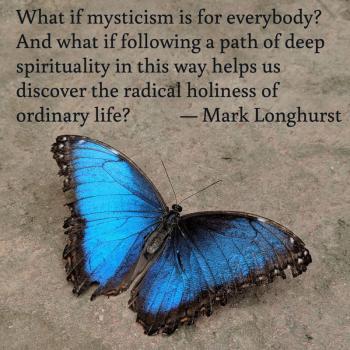
"This Loving, Uniting Embrace": the Holy Ordinary

I Believe Prayer Changes Things. Here's a Few...
If You Worship an Angry God, You'll Be...

The Difference Between Apophatic and Kataphatic Spirituality
TRENDING AT PATHEOS Contemplative

Handy Contemplative Practices for Political Spaces
A Spiritually Grounded Presence In order to bring a spiritually grounded presence...

Halloween: The Holiday of Loving Your Neighbor
All Hallows Eve Is Halloween the least Christian holiday in America, or...

Can Love Be Saved? Some Thoughts on the...
Happy Valentine's Day! I recently published a post on Patreon called Can...
"This Loving, Uniting Embrace": the Holy Ordinary
Today's guest post is by Mark Longhurst, author of The Holy Ordinary:...
How Are We Called to Live?: More About...
How Are We Called to Live? Many of us struggle with discerning...

A Spiritual Practice of Reading: Join Us Online
A Spiritual Practice of Reading A healthy spiritual practice of reading is...
view all Contemplative blogs
Ad-Free & Subscriber Log-In Subscription Support
- About Us
- 2026 Calendar
- Videos
- Podcasts
- Library of World Religions
- Faith In Media Tracker
- Advertise With Us
- Write for Us
- Privacy Policy
- Terms of Service
- Do Not Sell My Data
- Contact Us
- Radiant Digital
- Manage Newsletter Subscriptions
- Unsubscribe From Notifications
- Sitemap
Copyright 2008-2026, Patheos, part of the Radiant Digital network of media brands. All rights reserved.
Subscription Support Ad-Free & Subscriber Log-In
Follow Patheos