
BuddhistCatholicContemplativeEvangelicalGeneral ChristianHinduJewishLatter-day SaintMuslimNew VisionsProgressive Christian
Beliefs
- Buddhist
- Catholic
- Contemplative
- Evangelical
- General Christian
- Hindu
- Jewish
- Latter-day Saint
- More Voices
- Muslim
- New Visions
- Pagan
- Progressive Christian
Topics
- Religion News
- Food and Religion
- Sports and Religion
- Religious Art
- Religious Music and Entertainment
- Religious Events
- History and Religion
- Style and Religion
- Politics and Religion
- Women in Religion
- Recreation Outdoors and Religion
- Business Finance and Religion
- Careers Workplace and Religion
- Education and Religion
- Family Parenting and Religion
- Health Fitness and Religion
- Home and Religion
- Relationships and Religion
- Technology and Religion
- Travel and Religion
Columnists
- Buddhist Columnists
- Business Finance and Religion Columnists
- Careers Workplace and Religion Columnists
- Catholic Columnists
- Contemplative Columnists
- Education and Religion Columnists
- Evangelists Columnists
- Family Parenting and Religion Columnists
- General Christian Columnists
- Health Fitness and Religion Columnists
- Hindu Columnists
- History and Religion Columnists
- Home and Religion Columnists
- Jewish Columnists
- More Voices Columnists
- Latter Day Columnists
- Muslim Columnists
- New Visions Columnists
- Nonreligious Columnists
- Pagan Columnists
- Politics and Religion Columnists
- Progressive Columnists
- Recreation Outdoors and Religion Columnists
- Relationships and Religion Columnists
- Religion News Columnists
- Religious Art Columnists
- Religious Events Columnists
- Religious Music and Entertainment Columnists
- Sports and Religion Columnists
- Style and Religion Columnists
- Technology and Religion Columnists
- Travel and Religion Columnists
- Women in Religion Columnists
Resource Library
- 2026 Calendar
- Library of World Religions
- The 100 Most Holy Places on Earth
- Patheos Answers
- Podcasts
- Videos
- Faith Leaders Database
- Anglican Episcopalian
- Bahai
- Baptist
- Buddhism
- Christianity
- Confucianism
- Eastern Orthodoxy
- Hinduism
- Holiness and Pentecostal
- ISKCON
- Islam
- Judaism
- Lutheran
- Methodist
- The Church of Jesus Christ of Latter-day Saints
- New Age
- Paganism
- Presbytarian and Reformed
- Protestantism
- Religion Behind the Scenes
- Roman Catholic
- Scientology
- Shia Islam
- Sikhism
- Sufism
- Sunni Islam
- Taoism
- Zen
- See all religions
Research Tools
 Ad-Free & Subscriber Log-In Subscription Support
Ad-Free & Subscriber Log-In Subscription Support
Follow Patheos 

- Trending:
- Forgiveness
- |
- Marriage
- |
- Consciousness
- |
- Death Penalty
- |
- Election
- |
- Halloween

- Home
- Contemplative
- Lectio Divina Every Day
Lectio Divina Every Day
Last updated on: November 30, 2018 at 7:37 pm by Carl "Skye" McColman
Lectio Divina Every Day 2018-11-30T19:37:51-04:00 Carl "Skye" McColman
Patheos Explore the world's faith through different perspectives on religion and spirituality! Patheos has the views of the prevalent religions and spiritualities of the world.
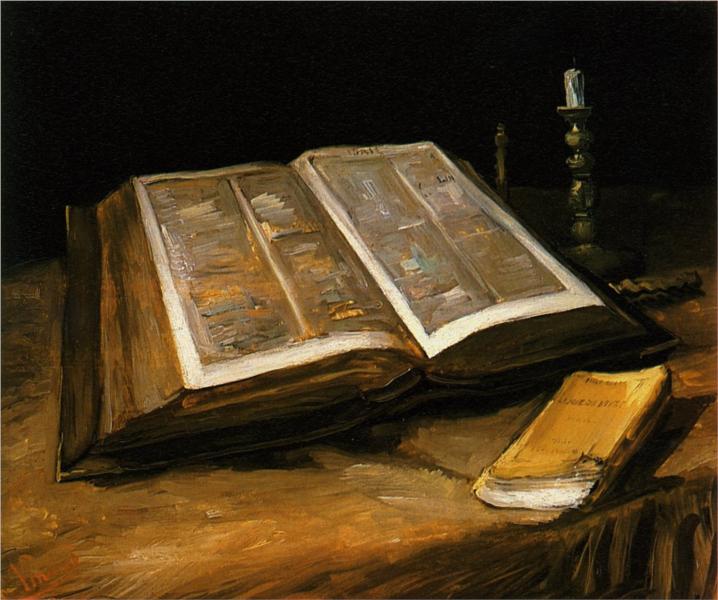
Van Gogh, Still Life with Bible, 1885.
“Love for Jesus is fed by constant meditation on the Gospels.”
— Michael Casey, OCSO
A prominent pastor who hosts an Internet podcast once interviewed me for his show, and at the close of our conversation asked me, “What is the one book you would recommend to readers as the most essential title to read, for the purpose of understanding Christian mysticism?”
Without batting an eye I said, “The Bible, of course.” I don’t think that was the answer he was expecting!
But it’s true. If you had to limit your reading to just one book, then forget Meister Eckhart, forget Julian of Norwich, forget Teresa of Avila and John of the Cross, forget The Cloud of Unknowing, forget John Ruusbroec. As wonderful as all those authors are (and, yes, I commend these books to anyone who seeks to learn about, or engage in, mystical spirituality), they are all, fundamentally, simply commentaries on sacred scripture, which is the true essential textbook for the contemplative way.
Here’s the thing to keep in mind. Christian contemplation, unlike other forms of mystical philosophy, is ultimately about a relationship: or, perhaps better said, a web of relationships. God is love. Jesus gave us four essential challenges: to love that God who is love, and to love our neighbors, as we love ourselves, and if we really take him seriously, to love even our enemies. Love God, love neighbors, love self, love enemies. Since love is the glue that holds relationships together, Christian spirituality is a spirituality of relationships. And contemplation (or mysticism) is ultimately about fostering the relationship with God, the love we seek to give back to the Source of All Love, through silence, through meditation, through prayer, through contemplation.
And this is where the Bible comes in. The words of Sacred Scripture frame and support the silence of contemplation the way that a solid foundation provides the base for a beautiful building to stand. But that’s a two way street: the nurturing silence of mindfulness gives us the freedom and non-attachment necessary to read the Bible with contemplative eyes. Silence and the Word go together like the yin and the yang comprise the Tao.
Christian spirituality rests on the relationship we forge with Christ, in response to the Love of God. And we meet Christ in many ways — in the hearts of loved ones, in the Eucharist, in those in need. Scripture, likewise, is a solid and foundational way in which we encounter Christ. Through the words of the Bible, we are invited into the living heart of Christ, and we are called to invite Him into our hearts, as well.
Many Christians approach the Bible as if it were a textbook, or worse yet, a code of law, rather than a love letter. But the mystics and contemplatives have always understoood that the Bible is first and foremost about love, which is why their favorite book in the Bible has always been The Song of Songs, the juicy love poem at the heart of the Hebrew Wisdom Literature. Yes, we can read the Bible to learn about God (textbook), or to discover and apply God’s commandments in our lives (code of law) — but both of those approaches to scripture are meant to be subordinate to the invitation into love. For God is Love.
So put aside all ideas you might have about “studying” the Bible-as-textbook or Bible-as-code-of-law. Let me invite you into an ancient way of reading the Bible, a prayerful and meditative way, that emphasizes love and relationship, and helps us to foster that intimacy with God that we crave (even if we aren’t conscious of it). This method of Bible reading is called Lectio Divina (Latin for “sacred reading”).
Lectio Divina has been a part of Christian spirituality since at least the sixth century, and perhaps long before that. It is a beautiful way to integrate four essential practices: engaging with the Word of God as encountered in sacred scripture, meditating on the graces and mysteries of faith, prayer as a way of opening the thoughts of our mind and feelings of our heart to God, and resting in the vast open presence of contemplative silence. Lectio is an integral spiritual method which effortlessly weaves these four dimensions of devotion into one meaningful daily exercise.
A short treatise called The Ladder of Monks: A Letter on the Contemplative Life, written by the Carthusian Guigo II in the twelfth century, spells out a basic process for engaging in Lectio Divina, which still is eminently useful today. The heart of the practice is not so much what we do (or even the order in which we do it), but the way we approach the text we are reading.
- Lectio — Read — the key is to read slowly, prayerfully, meditatively. Linger over the words, savoring their message for you. Do not encumber yourself with Bible commentaries or other supplemental books — save those for study time. Rather, simply find a passage, a short passage, maybe even just one or a few verses, and read them slowly, attentively, mindfully. This is not a race. Read a passage, and reread it. You can keep reading until it seems that a particular word or phrase is speaking to you, but stop then. Allow a sacred pause. Take a few relaxing breaths. Now you are ready to move to the next step:
- Meditatio — Reflect — traditionally, meditation in a Christian sense involved the process of reflecting on a word or teaching or one of the mysteries of the faith. Allow yourself to sit with the word or phrase that has spoken to you. Feel whatever feeling it elicits in you. Ponder what questions it asks of you. Perhaps you feel blessed or inspired, or confused or challenged or convicted. Simply let the Word of God speak to you. At this point, it’s less about you reading the Bible, and more about the Word of God “reading” you. Sooner or later, every conversation involves give-and-take, so at some point you’l be ready for the next step:
- Oratio — Respond — God reveals Divine Love to us through sacred scripture, and now we are asked to reveal the hidden depths of our hearts and minds to God through prayer. Of course, God already knows the hidden places in our hearts and minds, but it is a blessing to us to consciously seek to hold those secret dimensions into the Light of Love. Pray to God, in response to the words you have read and the reflections you have pondered. You don’t have to be eloquent or fancy in your prayer. It could be as simple as “God, I love you” or “Lord, today’s reading really confused me/upset me.” Be honest with God. Express your doubts, your longings, your desires, your fears, your dreams. Express adoration and devotion, of course; confess sins when that is necessary as well. Take however long you need to share your mind and heart with the God Who is Love. This doesn’t need to last forever (it might only take a minute or two). You’ll sense when you have prayed all you need to pray, at least in terms of thoughts and feelings. Then it is time for the final step:
- Contemplatio — Rest — “Be still and know that I am God,” speaks the Lord in Psalm 46; in other verses in the Psalms we are invited to let our souls rest for God in silence and even to recognize that silence itself is praise. We begin the process of Lectio Divina by seeking the Word of God through the Bible, and we end by seeking the silence of God through contemplative prayer, the prayer of restful, attentive silence. Here we “do” nothing more than breathe gently, allowing our thoughts and feelings to come and go without commentary or attachment. We can use a prayer word or verse (my favorite, again from the Psalms, is “O God, come to my assistance; O Lord, make haste to help me”) as a way of focussing our mind/heart so that we are less likely to be distracted by distractions during this period of rest. This is like a “Sabbath” prayer: we seek to grow in love of God simply by resting in God’s heart, the way a small child rests on her mother’s lap. We let go, and let God. We praise God simply by resting in silence, trusting in God’s love to hold us.
So that is the process of Lectio Divina. Monks and nuns and other Christians with a lively thirst for God have engaged in this simple prayer practice for centuries, giving some time every day to the adventure of falling ever more deeply in love with God through reading the Bible, reflecting on the Word, responding to God in prayer, and then resting in Divine Love and silence.
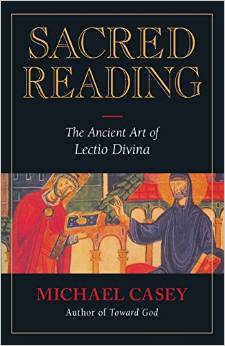
Sacred Reading
I encourage you to give it a try. Today is a good day to start. If you would like to learn more about Lectio Divina, here are a few books for further reading:
- Sacred Reading: the Ancient Art of Lectio Divina by Michael Casey, OCSO;
- Lectio Matters: Before the Burning Bush by Mary Margaret Funk;
- Too Deep for Words: Rediscovering Lectio Divina by Thelma Hall.
For a Bible, I recommend staying away from Study Bibles or Bibles filled with notes that will encourage you to approach it like a textbook rather than a love letter. My favorite Bible for Lectio is the Saints Devotional Edition, available in the New Jerusalem Bible translation or the New American Bible Revised Edition. And since I’m at the age where my eyes prefer larger type Bibles, I also enjoy using the New Revised Standard Version with Extra-Large Type (!).
Enjoy Lectio. It’s meant to be a joy, not a chore. Remember the reason for doing it: to discover the love of God, and to let that love transfigure your heart.
Enjoy reading this blog?
Click here to become a patron.

Previous Post

July 29, 2014
Beatrice of Nazareth: Seven Manners of Divine Love
Next Post

July 30, 2014 The Hidden Tradition of Christian Mysticism
Browse Our Archives
Select a Category Activism Announcements Art Books Catholicism Celtic Christianity Christian mysticism Christianity Contemplation Current events Etc. Family humor interfaith dialogue Interfaith Wisdom Interspirituality Lay Cistercians Living the Faith Meditation movies Mysticism Mystics nature Poetry Reviews Scripture silence Spirituality Uncategorized Writing
Select a Month February 2025 January 2025 November 2024 September 2024 August 2024 July 2024 June 2024 May 2024 March 2024 January 2024 December 2023 November 2023 August 2023 June 2023 April 2023 March 2023 February 2023 January 2023 December 2022 November 2022 October 2022 September 2022 August 2022 July 2022 June 2022 May 2022 April 2022 February 2022 January 2022 December 2021 November 2021 October 2021 September 2021 August 2021 July 2021 June 2021 May 2021 April 2021 March 2021 February 2021 January 2021 December 2020 November 2020 October 2020 September 2020 August 2020 July 2020 June 2020 May 2020 April 2020 March 2020 February 2020 January 2020 December 2019 November 2019 October 2019 September 2019 August 2019 July 2019 June 2019 May 2019 April 2019 March 2019 February 2019 January 2019 December 2018 November 2018 October 2018 September 2018 August 2018 July 2018 June 2018 May 2018 April 2018 March 2018 February 2018 January 2018 December 2017 November 2017 October 2017 September 2017 August 2017 July 2017 June 2017 May 2017 April 2017 March 2017 February 2017 January 2017 December 2016 November 2016 October 2016 September 2016 August 2016 July 2016 June 2016 May 2016 March 2016 February 2016 January 2016 December 2015 November 2015 October 2015 September 2015 August 2015 July 2015 June 2015 May 2015 April 2015 March 2015 February 2015 January 2015 December 2014 November 2014 October 2014 September 2014 August 2014 July 2014 June 2014 May 2014 April 2014 March 2014 February 2014 January 2014 December 2013 October 2013 September 2013 July 2013 May 2013 January 2013 December 2012 November 2012 August 2012 July 2012 June 2012 March 2012 December 2011 September 2011 October 2010 August 2010 March 2010 September 2009 July 2008 January 2008 December 2007 September 2007 February 2007 January 2007 December 2004
Follow Us!
TAKE THE
Religious Wisdom Quiz
Who said, "Lord, I believe; help my unbelief!"
Select your answer to see how you score.
The father of a sick boy Peter Mary Thomas
Support this
Column


Related posts from Carl McColman

"This Loving, Uniting Embrace": the Holy Ordinary

Four Dimensions of Mindfulness and Centering Prayer

I Believe Prayer Changes Things. Here's a Few...

Join Me for "24 Meditations for 2024"
TRENDING AT PATHEOS Contemplative

Handy Contemplative Practices for Political Spaces
A Spiritually Grounded Presence In order to bring a spiritually grounded presence...

Halloween: The Holiday of Loving Your Neighbor
All Hallows Eve Is Halloween the least Christian holiday in America, or...

Can Love Be Saved? Some Thoughts on the...
Happy Valentine's Day! I recently published a post on Patreon called Can...

"This Loving, Uniting Embrace": the Holy Ordinary
Today's guest post is by Mark Longhurst, author of The Holy Ordinary:...

How Are We Called to Live?: More About...
How Are We Called to Live? Many of us struggle with discerning...

A Spiritual Practice of Reading: Join Us Online
A Spiritual Practice of Reading A healthy spiritual practice of reading is...
view all Contemplative blogs
Ad-Free & Subscriber Log-In Subscription Support
- About Us
- 2026 Calendar
- Videos
- Podcasts
- Library of World Religions
- Faith In Media Tracker
- Advertise With Us
- Write for Us
- Privacy Policy
- Terms of Service
- Do Not Sell My Data
- Contact Us
- Radiant Digital
- Manage Newsletter Subscriptions
- Unsubscribe From Notifications
- Sitemap
Copyright 2008-2026, Patheos. All rights reserved.
Subscription Support Ad-Free & Subscriber Log-In
Follow Patheos