
BuddhistCatholicContemplativeEvangelicalGeneral ChristianHinduJewishLatter-day SaintMuslimNew VisionsProgressive Christian
Beliefs
- Buddhist
- Catholic
- Contemplative
- Evangelical
- General Christian
- Hindu
- Jewish
- Latter-day Saint
- More Voices
- Muslim
- New Visions
- Pagan
- Progressive Christian
Topics
- Religion News
- Food and Religion
- Sports and Religion
- Religious Art
- Religious Music and Entertainment
- Religious Events
- History and Religion
- Style and Religion
- Politics and Religion
- Women in Religion
- Recreation Outdoors and Religion
- Business Finance and Religion
- Careers Workplace and Religion
- Education and Religion
- Family Parenting and Religion
- Health Fitness and Religion
- Home and Religion
- Relationships and Religion
- Technology and Religion
- Travel and Religion
Columnists
- Buddhist Columnists
- Business Finance and Religion Columnists
- Careers Workplace and Religion Columnists
- Catholic Columnists
- Contemplative Columnists
- Education and Religion Columnists
- Evangelists Columnists
- Family Parenting and Religion Columnists
- General Christian Columnists
- Health Fitness and Religion Columnists
- Hindu Columnists
- History and Religion Columnists
- Home and Religion Columnists
- Jewish Columnists
- More Voices Columnists
- Latter Day Columnists
- Muslim Columnists
- New Visions Columnists
- Nonreligious Columnists
- Pagan Columnists
- Politics and Religion Columnists
- Progressive Columnists
- Recreation Outdoors and Religion Columnists
- Relationships and Religion Columnists
- Religion News Columnists
- Religious Art Columnists
- Religious Events Columnists
- Religious Music and Entertainment Columnists
- Sports and Religion Columnists
- Style and Religion Columnists
- Technology and Religion Columnists
- Travel and Religion Columnists
- Women in Religion Columnists
Resource Library
- 2026 Calendar
- Library of World Religions
- The 100 Most Holy Places on Earth
- Patheos Answers
- Podcasts
- Videos
- Faith Leaders Database
- Anglican Episcopalian
- Bahai
- Baptist
- Buddhism
- Christianity
- Confucianism
- Eastern Orthodoxy
- Hinduism
- Holiness and Pentecostal
- ISKCON
- Islam
- Judaism
- Lutheran
- Methodist
- The Church of Jesus Christ of Latter-day Saints
- New Age
- Paganism
- Presbytarian and Reformed
- Protestantism
- Religion Behind the Scenes
- Roman Catholic
- Scientology
- Shia Islam
- Sikhism
- Sufism
- Sunni Islam
- Taoism
- Zen
- See all religions
Research Tools
 Ad-Free & Subscriber Log-In Subscription Support
Ad-Free & Subscriber Log-In Subscription Support
Follow Patheos 

- Trending:
- Forgiveness
- |
- Marriage
- |
- Consciousness
- |
- Death Penalty
- |
- Election
- |
- Halloween

- Home
- Contemplative
- Requiem for a Trappist Monk
Requiem for a Trappist Monk
Last updated on: November 30, 2018 at 5:15 pm by Carl "Skye" McColman
Requiem for a Trappist Monk 2018-11-30T17:15:35-04:00 Carl "Skye" McColman
Patheos Explore the world's faith through different perspectives on religion and spirituality! Patheos has the views of the prevalent religions and spiritualities of the world.
 Rest in peace, Father Luke Kot.
Father Luke died tonight, at the age of 102.
Father Luke was the last surviving of twenty Trappist monks who, almost seventy years ago, left Gethsemani Abbey in Kentucky to take the midnight train to Georgia, arriving on a rainy day in Atlanta in March 1944 — the Feast of St. Benedict — to move into a makeshift cloister in a barn on an old plantation some thirty miles southeast of the city. From that humble beginning came the Monastery of Our Lady of the Holy Spirit, and from that rainy day on, this monastery in the deep south was Father Luke’s home.
For many years, Father Luke served the community as the monk who sewed — he made the habits, scapulars and cowls for the men in the community. In the early years of the monastery he served as the Abbot’s secretary, and in his later years as the unofficial historian of the community. Even after his hundredth birthday, he remained active working in the monastery’s welcome center, where he would make finger rosaries and greet visitors.
Five years ago I had the good fortune to interview Fr. Luke for an article that ran in the Georgia Bulletin, the Catholic newspaper for the Archdiocese of Atlanta. It was just a few months before he was to celebrate his 70th anniversary as a monk (he entered Gethsemani in 1938). As I interviewed him, it occurred to me that he would have known Thomas Merton, who entered Gethsemani in 1941, three years after Fr. Luke. So I asked him what he could recall about Merton.
“He was just another monk!” Father Luke said, matter-of-factly. Considering that Merton did not become famous until 1948 — several years after Father Luke moved to Georgia — his answer made perfect sense. Here was a man who knew Merton the monk, but who never really was exposed to Merton the celebrity.
Ironically, in his own way Fr. Luke became a celebrity, beginning in 2005 when Fr. Francis Xavier passed away, leaving Fr. Luke as the last surviving founder. His affability, sense of humor, obvious humility, and gifted ability as a storyteller made him popular among all who visited the monastery. His 100th birthday, in August 2011, was quite the event — with the monks throwing a huge party and a write-up in the Georgia Bulletin. The Lay Cistercians (of which I am a member) threw our own party for the centenarian, marking his birthday along with that of Fr. Anthony, a mere whippersnapper at 83, seventeen years his junior. Here is a video from that happy day.
Over the last year Father Luke had been markedly frail; a somber reminder that even the hardiest of bodies must eventually surrender to the silence of eternity. I’m tempted to say that it’s sad he didn’t live just ten more weeks, to see the 70th anniversary of the founding of the monastery. But that’s a silly way to look at things. Perhaps Fr. Luke decided that for the seventieth anniversary, it was high time he joined all the other founders and mark the occasion in heaven. And we who remain — the surviving monks, the Lay Cistercians and other friends of the monastery — will carry on without him, and we’ll miss him; we’ll miss his simplicity, his innocence, and his mischievous grin. But we’ll also give thanks to have known such a lovely, down-to-earth, holy man. Even if he was… well, just another monk.
Here’s the article I wrote in 2008 for which I interviewed Father Luke.
Stability Amidst Change
Georgia’s Trappist Monastery Preserves Timeless Spiritual Values
When twenty-one monks traveled by train to Georgia in the spring of 1944 to establish a new Trappist monastery, none of them dreamed that their new home would someday sit on the edge of Atlanta’s urban sprawl. At that time, Honey Creek Plantation — the 2000 acre tract of land where the monks would settle — was a cotton field in the middle of farm country. Atlanta was over thirty miles away; the nearest town, Conyers, eight miles to the north. “The monastery was on a dirt road,” remarks Fr. Luke Kot, who at 97 is the only surviving monk of the original twenty.
Today that dirt road is Georgia Highway 212, and while some small farms remain, much of the land surrounding the Monastery of the Holy Spirit is dotted with single family homes. But as much as its surroundings have changed, the monastery itself, as part of a 1500-year-old Catholic tradition, embodies stability and serenity.
“Next to the family, monasticism is the longest standing institution in the history of humankind,” notes Dom Francis Michael Stiteler, the current abbot of the Monastery of the Holy Spirit. “No matter how far back you go, wherever you find civilization you will find men and women living at a distance from the mainstream community who are pursuing the Divine — the transcendent, the bigger questions.” Such intentional communities of the spirit cut across cultural, geographic and religious boundaries. Among Christians, the earliest monasteries date back to the fourth century, when communities began to form in the deserts of Egypt and Palestine. In the sixth century, St. Benedict wrote his Rule for Monks which became the guiding document for almost all monasteries in the western church. After 1500 years it continues to inspire monastics (both men and women) throughout the church, including the monks of Conyers.
“Originally almost all Christian monasticism emphasized silence and solitude and some form of separation from the world,” notes Dom Francis Michael. Monks were, after all, seekers yearning for the heart of God, and St. Benedict envisioned monasteries as “schools of the service of God,” where monks could support one another in their common desire to more perfectly follow Christ. Even in their most austere forms, monasteries were never intended as ways to escape the world. Over the course of Christian history, monks have contributed to the church and society, through hospitals, libraries, schools, and contributions to the farming economy of Europe.
While such service has always been a valuable part of Catholic culture, throughout the centuries some monasteries have sought new ways of being faithful to the oldest values of monasticism. In 1098 the Cistercian Order emerged, seeking to follow the Rule of Benedict as authentically as possible; further reforms in the eighteenth and nineteenth centuries led to the Cistercian Order of the Strict Observance — the monastic order to which the Monastery of the Holy Spirit belongs.
In 1848 French monks came to America and founded the Abbey of Gethsemani in Kentucky. Nearly a century later, twenty monastics left Kentucky for Georgia to establish a new community following an age-old tradition. “As soon as we arrived, we unpacked our bags, set up our altar, and began our daily prayers,” notes Fr. Luke. Almost 65 years later, the monks of Conyers are still praying every day. And like monks all over the world, they welcome visitors to their church, guesthouse, and grounds, whether for a few hours or a few days. Dom Francis Michael believes that “everyone has a monk, a searcher, in themselves. A monastery provides the locus for that primal desire to express itself and to be shared.”
Enjoy reading this blog?
Click here to become a patron.

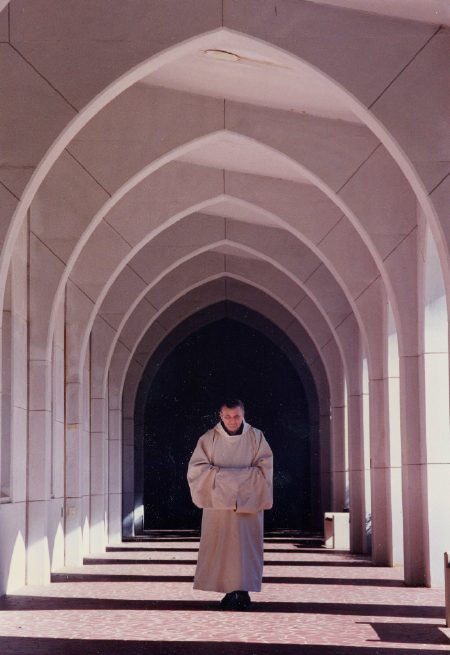
Fr. Luke
Previous Post
December 20, 2013
Preparing for the Silent Night (Conclusion)
Next Post

January 22, 2014 Seven Books I Hope to Read in 2014
Browse Our Archives
Select a Category Activism Announcements Art Books Catholicism Celtic Christianity Christian mysticism Christianity Contemplation Current events Etc. Family humor interfaith dialogue Interfaith Wisdom Interspirituality Lay Cistercians Living the Faith Meditation movies Mysticism Mystics nature Poetry Reviews Scripture silence Spirituality Uncategorized Writing
Select a Month February 2025 January 2025 November 2024 September 2024 August 2024 July 2024 June 2024 May 2024 March 2024 January 2024 December 2023 November 2023 August 2023 June 2023 April 2023 March 2023 February 2023 January 2023 December 2022 November 2022 October 2022 September 2022 August 2022 July 2022 June 2022 May 2022 April 2022 February 2022 January 2022 December 2021 November 2021 October 2021 September 2021 August 2021 July 2021 June 2021 May 2021 April 2021 March 2021 February 2021 January 2021 December 2020 November 2020 October 2020 September 2020 August 2020 July 2020 June 2020 May 2020 April 2020 March 2020 February 2020 January 2020 December 2019 November 2019 October 2019 September 2019 August 2019 July 2019 June 2019 May 2019 April 2019 March 2019 February 2019 January 2019 December 2018 November 2018 October 2018 September 2018 August 2018 July 2018 June 2018 May 2018 April 2018 March 2018 February 2018 January 2018 December 2017 November 2017 October 2017 September 2017 August 2017 July 2017 June 2017 May 2017 April 2017 March 2017 February 2017 January 2017 December 2016 November 2016 October 2016 September 2016 August 2016 July 2016 June 2016 May 2016 March 2016 February 2016 January 2016 December 2015 November 2015 October 2015 September 2015 August 2015 July 2015 June 2015 May 2015 April 2015 March 2015 February 2015 January 2015 December 2014 November 2014 October 2014 September 2014 August 2014 July 2014 June 2014 May 2014 April 2014 March 2014 February 2014 January 2014 December 2013 October 2013 September 2013 July 2013 May 2013 January 2013 December 2012 November 2012 August 2012 July 2012 June 2012 March 2012 December 2011 September 2011 October 2010 August 2010 March 2010 September 2009 July 2008 January 2008 December 2007 September 2007 February 2007 January 2007 December 2004
Follow Us!
TAKE THE
Religious Wisdom Quiz
True or False: 1 Peter teaches that believers are living stones being built into a spiritual house.
Select your answer to see how you score.
FALSE TRUE
Support this
Column


Related posts from Carl McColman

New From Encountering Silence: Exploring the Lost History...
A Great Mystical Book — With a Surprising...
How do I choose a contemplative lay order?...
Less than 12% of the Catholic Catechism is...
TRENDING AT PATHEOS Contemplative

Handy Contemplative Practices for Political Spaces
A Spiritually Grounded Presence In order to bring a spiritually grounded presence...

Halloween: The Holiday of Loving Your Neighbor
All Hallows Eve Is Halloween the least Christian holiday in America, or...

Can Love Be Saved? Some Thoughts on the...
Happy Valentine's Day! I recently published a post on Patreon called Can...

"This Loving, Uniting Embrace": the Holy Ordinary
Today's guest post is by Mark Longhurst, author of The Holy Ordinary:...

How Are We Called to Live?: More About...
How Are We Called to Live? Many of us struggle with discerning...

A Spiritual Practice of Reading: Join Us Online
A Spiritual Practice of Reading A healthy spiritual practice of reading is...
view all Contemplative blogs
Ad-Free & Subscriber Log-In Subscription Support
- About Us
- 2026 Calendar
- Videos
- Podcasts
- Library of World Religions
- Faith In Media Tracker
- Advertise With Us
- Write for Us
- Privacy Policy
- Terms of Service
- Do Not Sell My Data
- Contact Us
- Radiant Digital
- Manage Newsletter Subscriptions
- Unsubscribe From Notifications
- Sitemap
Copyright 2008-2026, Patheos. All rights reserved.
Subscription Support Ad-Free & Subscriber Log-In
Follow Patheos