
BuddhistCatholicContemplativeEvangelicalGeneral ChristianHinduJewishLatter-day SaintMuslimNew VisionsProgressive Christian
Beliefs
- Buddhist
- Catholic
- Contemplative
- Evangelical
- General Christian
- Hindu
- Jewish
- Latter-day Saint
- More Voices
- Muslim
- New Visions
- Pagan
- Progressive Christian
Topics
- Religion News
- Food and Religion
- Sports and Religion
- Religious Art
- Religious Music and Entertainment
- Religious Events
- History and Religion
- Style and Religion
- Politics and Religion
- Women in Religion
- Recreation Outdoors and Religion
- Business Finance and Religion
- Careers Workplace and Religion
- Education and Religion
- Family Parenting and Religion
- Health Fitness and Religion
- Home and Religion
- Relationships and Religion
- Technology and Religion
- Travel and Religion
Columnists
- Buddhist Columnists
- Business Finance and Religion Columnists
- Careers Workplace and Religion Columnists
- Catholic Columnists
- Contemplative Columnists
- Education and Religion Columnists
- Evangelists Columnists
- Family Parenting and Religion Columnists
- General Christian Columnists
- Health Fitness and Religion Columnists
- Hindu Columnists
- History and Religion Columnists
- Home and Religion Columnists
- Jewish Columnists
- More Voices Columnists
- Latter Day Columnists
- Muslim Columnists
- New Visions Columnists
- Nonreligious Columnists
- Pagan Columnists
- Politics and Religion Columnists
- Progressive Columnists
- Recreation Outdoors and Religion Columnists
- Relationships and Religion Columnists
- Religion News Columnists
- Religious Art Columnists
- Religious Events Columnists
- Religious Music and Entertainment Columnists
- Sports and Religion Columnists
- Style and Religion Columnists
- Technology and Religion Columnists
- Travel and Religion Columnists
- Women in Religion Columnists
Resource Library
- 2026 Calendar
- Library of World Religions
- The 100 Most Holy Places on Earth
- Patheos Answers
- Podcasts
- Videos
- Faith Leaders Database
- Anglican Episcopalian
- Bahai
- Baptist
- Buddhism
- Christianity
- Confucianism
- Eastern Orthodoxy
- Hinduism
- Holiness and Pentecostal
- ISKCON
- Islam
- Judaism
- Lutheran
- Methodist
- The Church of Jesus Christ of Latter-day Saints
- New Age
- Paganism
- Presbytarian and Reformed
- Protestantism
- Religion Behind the Scenes
- Roman Catholic
- Scientology
- Shia Islam
- Sikhism
- Sufism
- Sunni Islam
- Taoism
- Zen
- See all religions
Research Tools
 Ad-Free & Subscriber Log-In Subscription Support
Ad-Free & Subscriber Log-In Subscription Support
Follow Patheos 

- Trending:
- Forgiveness
- |
- Marriage
- |
- Consciousness
- |
- Death Penalty
- |
- Election
- |
- Halloween

- Home
- Contemplative
- On Being a Lay Cistercian
On Being a Lay Cistercian
Last updated on: November 26, 2018 at 8:30 am by Carl "Skye" McColman
On Being a Lay Cistercian 2018-11-26T08:30:16-04:00 Carl "Skye" McColman
Patheos Explore the world's faith through different perspectives on religion and spirituality! Patheos has the views of the prevalent religions and spiritualities of the world.
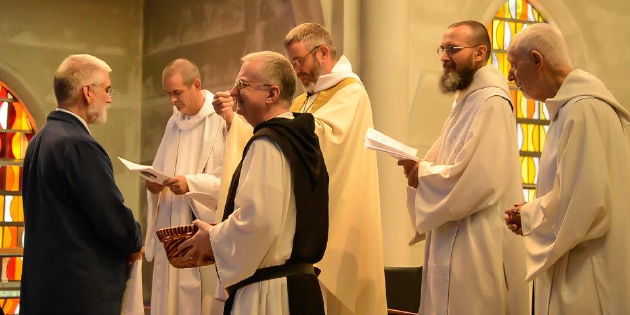
Receiving a medal from the monks after making my Lay Cistercian Life Promises, May 2012.
“Are you a monk?”
I get asked that question a lot, especially when I’m at the monastery where I work and pray and lead retreats. Perhaps it’s because of my greying hair and scruffy beard. Whatever the reason, I always see it as a compliment, but of course, I’m not a monk. So I say, “No, I’m not; I’m what is called a Lay Cistercian.”
“What’s that?” is the inevitable follow-up question.
“I’m a layperson, like any other — I have a wife and a daughter and a monthly mortgage to pay. But I do have a formal, spiritual relationship with the monastery. Lay Cistercians are people who feel called to express their Christian faith under the guidance not only of the Gospel, but also of the Rule of St. Benedict, and the charisms — the gifts — of the Cistercian monastic tradition.”
For most people, that’s enough of an explanation, and the conversation meanders on to other topics. What those people don’t realize is that, for me and my brother and sister Lay Cistercians, this explanation barely scratches the surface. Being a Lay Cistercian means something far more than just joining a club or taking up a hobby. For us, it is, indeed, a calling; a sense that God has invited us into this way of life, and blessed us with its many gifts. And while being a Lay Cistercian does not carry the same degree of sacramental/consecrated commitment that goes into becoming a monk — monks take vows, whereas Lay Cistercians make promises — those of us who do discern this calling, and make this promise, take it very seriously indeed.
Monasteries have been part of the Christian world since at least the fourth century CE. St. Benedict wrote his rule for monasteries in the early sixth century, and the Cistercian reform began in the late 11th century. Ironically, though, Lay Cistercians — communities of laypersons who affiliate with Cistercian monasteries for education, formation, and spiritual guidance — only emerged in the late twentieth century. We seem to be a postmodern phenomenon, an outgrowth of the second Vatican Council and the increasing recognition among Christians that holiness is not just for saints, but for everyone. And while most Christians recognize their path to holiness through the ordinary commitments to family, church, and work, some discern a yearning to embrace the wisdom, culture, and teachings of the monastic tradition — not to become monks or “monk-wannabes” and certainly not to engage in an ego-trip or an occasion for puffed up pride. Rather, those who sense a call to become Lay Cistercians recognize that this is a way to cultivate a committed, mature, life of faith — not “the” way, and by no means “the right” way, but simply “a” way. And for those who sense such a call, it is the best way — for us.
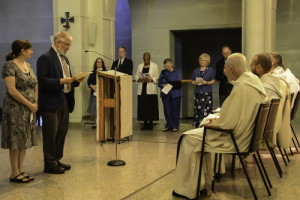
Making my promises to the monks, with my wife, Fran, at my side.
So what is involved in becoming a Lay Cistercian? First of all, it’s not something you do on your own. There will never be a “Lay Cistercians for Dummies” book with instructions on how to do-it-yourself. Just as monasteries are built on the foundation of community, so is the Lay Cistercian family. To be a Lay Cistercian means to join a community of Lay Cistercians, and by definition, a Lay Cistercian community exists in relationship with a Cistercian monastery or convent. Not all monasteries or convents have Lay Cistercian associates: some monasteries don’t want them, and that’s their prerogative. But for the ones that do, the relationship between the monastics and the Lay Cistercians is a rich and mutually rewarding connection. The monastics (from now on I’ll use this term since it encompasses both monks and nuns) teach, inspire, and guide the lay people who come to them for direction. In return, the lay associates pray with and for the monks, support the monastery through volunteer work and financial gifts, and express our appreciation by being good friends to the monastics and by seeking to share the Cistercian charism with society at large. For monastics, living within a cloister (monastic enclosure) is an experience of creating a rich and lifelong spiritual family. Lay Cistercians, therefore, function as the “extended family” — we do not live with the monks, but we love to visit.
So what is unique about the “Cistercian charism” — the gifts of the Cistercian way of life? And how do those gifts apply to laypeople, who are not now, and probably never will be, monastics themselves? Different Lay Cistercians will undoubtedly answer this question in different ways. For me, what is rich about the Cistercian charism is the fact that monastics live a life “wholly ordered to contemplation” (that’s a phrase found in their constitution). Contemplation — resting quietly, silently, in the mystery of the divine presence of God — is not just about having a meditation or centering prayer practice for twenty minutes once or twice a day (although such a discipline certainly can be important). Contemplation is a way of life. It involves simplicity, and a willingness to let go of our societal addiction to mindless consumerism and excessive busy-ness. It cherishes times of solitude and retreat, even when balanced with the overall demands of family and professional life. It recognizes that daily devotion to prayer, to the sacred reading of scripture or other holy writings, and to the unglamorous work of seeking to become truly humble and loving toward our neighbors — this is what contemplation is all about. And this is what monastics have “wholly ordered” their lives around. And so we Lay Cistercians seek to do the same, obviously adapted to the realities of life outside of the monastery cloister.
Of course, contemplation is not the only charism, or quality, associated with the Lay Cistercian path of spirituality. In 2008, an international gathering of Lay Cistercians identified a number of characteristics associated with Lay Cistercian identity. These characteristics include prayer, humility, abandonment to God, simplicity of life, hospitality, service, stability, silence, and joy. Yes, joy — Cistercian spirituality is not gloomy! For me, all of these characteristics ultimately point back to contemplation. Cistercian monastics represent a living heritage of contemplatives in western society, and so as a Lay Cistercian, I find it an honor and a privilege to pray with and learn from them.
I first began discerning whether I had a call to become a Lay Cistercian in the fall of 2006. On May 6, 2012 — almost six years later — I stood before five monks, including the abbot, of the monastery where I study, and pray, and work, and retreat, and made my prayerfully considered promise to follow the Cistercian path for life. Being a life-professed Lay Cistercian, of course, does not mean that I’m “done” with the experience of exploring Cistercian spirituality. On the contrary, the journey appears to have just begun.
Lay Cistercians know how to have fun. This video shows us celebrating the birthdays of Fr. Luke (100 years old!) and Fr. Anthony (a mere 83) in August 2011.
If you would like to learn more about Lay Cistercian spirituality, explore these links:
-
Inside the School of Charity by Trisha Day — a book about monastic spirituality by a Lay Cistercian
-
Selected articles I wrote for Patheos on Cistercian and Lay Cistercian spirituality:
Enjoy reading this blog?
Click here to become a patron.

Previous Post

May 29, 2013
Three Video Clips: Speaking of Mysticism in Portland, OR
Next Post

July 31, 2013 Contemplative Commerce
Browse Our Archives
Select a Category Activism Announcements Art Books Catholicism Celtic Christianity Christian mysticism Christianity Contemplation Current events Etc. Family humor interfaith dialogue Interfaith Wisdom Interspirituality Lay Cistercians Living the Faith Meditation movies Mysticism Mystics nature Poetry Reviews Scripture silence Spirituality Uncategorized Writing
Select a Month February 2025 January 2025 November 2024 September 2024 August 2024 July 2024 June 2024 May 2024 March 2024 January 2024 December 2023 November 2023 August 2023 June 2023 April 2023 March 2023 February 2023 January 2023 December 2022 November 2022 October 2022 September 2022 August 2022 July 2022 June 2022 May 2022 April 2022 February 2022 January 2022 December 2021 November 2021 October 2021 September 2021 August 2021 July 2021 June 2021 May 2021 April 2021 March 2021 February 2021 January 2021 December 2020 November 2020 October 2020 September 2020 August 2020 July 2020 June 2020 May 2020 April 2020 March 2020 February 2020 January 2020 December 2019 November 2019 October 2019 September 2019 August 2019 July 2019 June 2019 May 2019 April 2019 March 2019 February 2019 January 2019 December 2018 November 2018 October 2018 September 2018 August 2018 July 2018 June 2018 May 2018 April 2018 March 2018 February 2018 January 2018 December 2017 November 2017 October 2017 September 2017 August 2017 July 2017 June 2017 May 2017 April 2017 March 2017 February 2017 January 2017 December 2016 November 2016 October 2016 September 2016 August 2016 July 2016 June 2016 May 2016 March 2016 February 2016 January 2016 December 2015 November 2015 October 2015 September 2015 August 2015 July 2015 June 2015 May 2015 April 2015 March 2015 February 2015 January 2015 December 2014 November 2014 October 2014 September 2014 August 2014 July 2014 June 2014 May 2014 April 2014 March 2014 February 2014 January 2014 December 2013 October 2013 September 2013 July 2013 May 2013 January 2013 December 2012 November 2012 August 2012 July 2012 June 2012 March 2012 December 2011 September 2011 October 2010 August 2010 March 2010 September 2009 July 2008 January 2008 December 2007 September 2007 February 2007 January 2007 December 2004
Follow Us!
TAKE THE
Religious Wisdom Quiz
Who was the only disciple who was not martyred?
Select your answer to see how you score.
Thomas John James Peter
Support this
Column


Related posts from Carl McColman

I Believe Prayer Changes Things. Here's a Few...

You don't have to become a monk to...
New Online Course: the Contemplative Wisdom of "Meditations...
TRENDING AT PATHEOS Contemplative

Handy Contemplative Practices for Political Spaces
A Spiritually Grounded Presence In order to bring a spiritually grounded presence...

Halloween: The Holiday of Loving Your Neighbor
All Hallows Eve Is Halloween the least Christian holiday in America, or...

Can Love Be Saved? Some Thoughts on the...
Happy Valentine's Day! I recently published a post on Patreon called Can...

"This Loving, Uniting Embrace": the Holy Ordinary
Today's guest post is by Mark Longhurst, author of The Holy Ordinary:...

How Are We Called to Live?: More About...
How Are We Called to Live? Many of us struggle with discerning...

A Spiritual Practice of Reading: Join Us Online
A Spiritual Practice of Reading A healthy spiritual practice of reading is...
view all Contemplative blogs
Ad-Free & Subscriber Log-In Subscription Support
- About Us
- 2026 Calendar
- Videos
- Podcasts
- Library of World Religions
- Faith In Media Tracker
- Advertise With Us
- Write for Us
- Privacy Policy
- Terms of Service
- Do Not Sell My Data
- Contact Us
- Radiant Digital
- Manage Newsletter Subscriptions
- Unsubscribe From Notifications
- Sitemap
Copyright 2008-2026, Patheos. All rights reserved.
Subscription Support Ad-Free & Subscriber Log-In
Follow Patheos