
BuddhistCatholicContemplativeEvangelicalGeneral ChristianHinduJewishLatter-day SaintMuslimNew VisionsProgressive Christian
Beliefs
- Buddhist
- Catholic
- Contemplative
- Evangelical
- General Christian
- Hindu
- Jewish
- Latter-day Saint
- More Voices
- Muslim
- New Visions
- Pagan
- Progressive Christian
Topics
- Religion News
- Food and Religion
- Sports and Religion
- Religious Art
- Religious Music and Entertainment
- Religious Events
- History and Religion
- Style and Religion
- Politics and Religion
- Women in Religion
- Recreation Outdoors and Religion
- Business Finance and Religion
- Careers Workplace and Religion
- Education and Religion
- Family Parenting and Religion
- Health Fitness and Religion
- Home and Religion
- Relationships and Religion
- Technology and Religion
- Travel and Religion
Columnists
- Buddhist Columnists
- Business Finance and Religion Columnists
- Careers Workplace and Religion Columnists
- Catholic Columnists
- Contemplative Columnists
- Education and Religion Columnists
- Evangelists Columnists
- Family Parenting and Religion Columnists
- General Christian Columnists
- Health Fitness and Religion Columnists
- Hindu Columnists
- History and Religion Columnists
- Home and Religion Columnists
- Jewish Columnists
- More Voices Columnists
- Latter Day Columnists
- Muslim Columnists
- New Visions Columnists
- Nonreligious Columnists
- Pagan Columnists
- Politics and Religion Columnists
- Progressive Columnists
- Recreation Outdoors and Religion Columnists
- Relationships and Religion Columnists
- Religion News Columnists
- Religious Art Columnists
- Religious Events Columnists
- Religious Music and Entertainment Columnists
- Sports and Religion Columnists
- Style and Religion Columnists
- Technology and Religion Columnists
- Travel and Religion Columnists
- Women in Religion Columnists
Resource Library
- 2026 Calendar
- Library of World Religions
- The 100 Most Holy Places on Earth
- Patheos Answers
- Podcasts
- Videos
- Faith Leaders Database
- Anglican Episcopalian
- Bahai
- Baptist
- Buddhism
- Christianity
- Confucianism
- Eastern Orthodoxy
- Hinduism
- Holiness and Pentecostal
- ISKCON
- Islam
- Judaism
- Lutheran
- Methodist
- The Church of Jesus Christ of Latter-day Saints
- New Age
- Paganism
- Presbytarian and Reformed
- Protestantism
- Religion Behind the Scenes
- Roman Catholic
- Scientology
- Shia Islam
- Sikhism
- Sufism
- Sunni Islam
- Taoism
- Zen
- See all religions
Research Tools
 Ad-Free & Subscriber Log-In Subscription Support
Ad-Free & Subscriber Log-In Subscription Support
Follow Patheos 

- Trending:
- Forgiveness
- |
- Marriage
- |
- Consciousness
- |
- Death Penalty
- |
- Election
- |
- Halloween

- Home
- Contemplative
- Remembering John O’Donohue
Remembering John O’Donohue
Last updated on: January 5, 2008 at 8:46 am by Carl "Skye" McColman
Remembering John O’Donohue 2008-01-05T08:46:31-04:00 Carl "Skye" McColman
Patheos Explore the world's faith through different perspectives on religion and spirituality! Patheos has the views of the prevalent religions and spiritualities of the world.
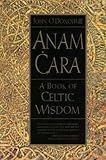
I am saddened to have learned of the passing of John O’Donohue, author of Anam Cara: A Book of Celtic Wisdom, yesterday (January 4, 2008). He died peacefully in his sleep while on holiday in France. Read the announcement on his website.
In 1999 I had the privilege to interview him for a book industry trade publication; you can read the interview below this announcement.
He was not only one of the most articulate voices of living Celtic Christianity and Celtic wisdom, but he also had a clear grasp of the beauty of Christian mysticism as well. He was a trained philosopher with a prodigious intellect. He was the only person I’ve ever met who could effortlessly and lyrically weave together allusions to Martin Heidegger, Meister Eckhart, and the Tuatha Dé Danann in a single sentence.
Rest in peace, John O’Donohue. Walk gladly in the light of Tir na n’Og.
Update: Concerning John’s final resting place, in Co. Clare, Ireland: “There have been a number of enquiries about the location of John’s funeral service and about his gravesite. The church where John’s funeral took place is in Fanore, about 12 miles from Ballyvaughan on the coast road south. During winter months it is likely only to be open at weekends for Mass. John is buried in Creggagh graveyard, about two miles further south along the coast road, just beyond O’Donoghue’s pub on the lefthand side of the road. All of John’s friends hope that respect will be shown to his gravesite and to the community and environment that John loved so well.”
Where No One or Nothing is Excluded: Irish poet and visionary John O’Donohue weaves Celtic mysticism into the miracles of everyday life.
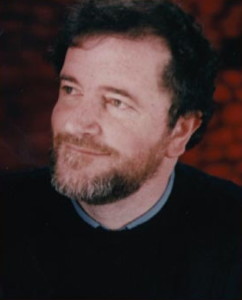
John O’Donohue
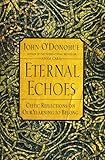
John O’Donohue is the author of several books, including Anam Cara: A Book of Celtic Wisdom and Eternal Echoes: Exploring Our Yearning to Belong. He’s also featured on several audio sets from Sounds True, including Wisdom from the Celtic World. A Catholic priest, O’Donohue’s vision brings together various strands of wisdom, including European philosophy (he’s a Hegelian scholar), Christian mysticism, and the deep native spirituality and mythology of the Celtic lands, to create lyrical insights into the role of spirituality — especially Celtic spirituality — in a world dominated by media, technology, and the gods of the shopping mall.
A tall, charming man with a constant twinkle in his eyes, John O’Donohue seems to embody the spirit of the Druids for today — not in a narrow or sectarian way, but with a spirit as large as the ocean. As we talked about the gifts Celtic spirituality brings to our generation, he balanced a lovely optimism with words of urgency and concern for the problems our society needs to address. But whether he spoke about the despair of youth, the numbness of consumerism, or the sheer poetry of the Celtic path, his words always shimmered with a sense of trust and hope in the final beauty and power of Spirit.
 Asked why he believes Celtic spirituality is so popular in our time, O’Donohue muses on the climate in our culture which has made it ripe for a spiritual renaissance. “I think there’s a huge crisis of belonging in postmodern culture. The institutions of religion have really diminished and fallen into the hands of frightened functionaries who are great custodians of the gateways but don’t really know what the landscapes are like further in towards the heart of the mystery. Politics has become synonymous with economics and the crudest form of pragmatism. Then there’s the whole homogenization of culture and consciousness in mass technology and media — although there’s a lot more interaction than there once was between people, but it’s all simulated, you know, and lacks the vitality and vigor and danger of a direct encounter with otherness. So these are some of the contexts which are creating a massive spiritual hunger.”
His keen mind zeroes in on not only what’s happening in our culture that is problematic, but even what isn’t happening, but ought to be. “What’s sad in relation to the great tradition is that, in postmodern culture, there are a lot of conversations that are not taking place. One major conversation that is not happening, and the Universities are at fault here, is the conversation between Christianity and Islam. That is one of the major unheld conversations, which if it is not held soon will cause major destruction in a few decades’ time. And another unheld conversation is the conversation between the Christian tradition and the depth and density and intensity of peoples’ spiritual search and spiritual hunger which is a new form of consciousness. So a lot of autonomous, liberated, spiritual people who no longer want to behave like infants in a parent-institution are not trying to be responsible and go on their own quest and access the wisdom traditions for themselves.”
The Celtic path — the path of pre-Christian and Christian spirituality in Ireland, Scotland, Wales, and the other lands where Celtic languages are, or once were, spoken — is one of these wisdom traditions people are now beginning to access on their own. O’Donohue sees the tradition of his homeland as well-suited for today’s global spirituality: “There is a roster of themes, insights and intuitions in Celtic consciousness and imagination that respond very well to what we’re going through now. Celtic sensibility and the Celtic imagination looked on nature not as ‘stuff’ or ‘location’ or ‘matter,’ but nature was the theatre of a variety and diversity of divine presences. Secondly, one of the great cankers and severances of the western tradition has been dualism, which separated mind from body, self from spirit, person from God and nature from the whole lot! The Celts, in some strange way, managed to preclude that kind of fissure/opening which would lead to dualism, and were able to think in a unitive consciousness and think of all these things together.”
 For O’Donohue, spirituality is intimately linked with relationship and community. His first book, Anam Cara, celebrates spiritual friendship (“anam cara” is Irish for “soul friend”) as the heart of spirituality. Published this year, Eternal Echoes looks at the theme of belonging as central to the human experience. But relationship and community are not easily manufactured — a lesson our society with its planned neighborhood subdivisions, Internet chat rooms, and other forms of “managed community” doesn’t always grasp.
O’Donohue notes, “How do we give birth to community? I don’t think we do, I don’t think we can create or manufacture community, what we have to do is to allow community to emerge. So what kind of conditions must prevail in order for real community to emerge? One of the things we need is to make some clearances for ourselves again, so that we can see the shape of our souls, and so we can see also the shape of our hungers. We are caught on a treadmill of rapidity that doesn’t allow us to pause or to see what’s going on at all. Secondly, those of us who still belong in some way to a tradition have a duty to reclaim our traditions in the name of our new hunger, and not allow the great traditions to be owned by people who are into power and control. We need to stand up and say, we are the tradition, the representatives of it now, its members and inhabitants, we have these hungers which leads to this kind of conversation, and maybe do something practical about it.”
 Community then is more than something we do to feel good — living in community carries with it the responsibility of standing up for the principles and values we hold dear. “Where are the voices of those who have a trenchant critique of where we’re going as a culture?” chides Donohue. “The media need to exercise some kind of reflexivity. They’ve set themselves up as non-elected custodians of sensationalism. There are huge questions which the media never go near. There are major wars happening in the world that you never see appearing in the media; there are major facts about all the arms that are being produced in western democracies; there are major facts about the poisoning of our earth; there are major facts about the prison system and about the death penalty . . . I think once we have reached a certain level of education and consciousness, we are incredibly privileged people, no matter how poor we might be, and we have such a duty to speak out for those who are pushed to margins and have no voice and nobody who will listen to them. We are privileged, and the duty of privilege is absolute integrity.”
Consumerism and authoritarian religion lurk in the background of O’Donohue’s books and tapes; these are the “tricksters” we must face as we journey toward our authentic selves or toward our integrity. I asked O’Donohue what he thinks we need to do, to let go of the temptations these two aspects of modern life represent: the urge to possess, and the urge to control or be controlled.
“In Eternal Echoes I talk about ‘modalities of false belonging’ — prisons in which we choose to live. These are shapes of belonging which are too small for us, or else false, and so don’t in any way challenge the potential that we have within us. Longing is this flame, this flow of presence within us, which always tries to push our belonging to more hospitable, more generous, more healing, more challenging kind of contours. If the longing dies and gets numbed, then the belonging immediately gets false. That’s the trick of consumerism.
“Consumerism’s liturgy is in service of the god of quantity and its rituals are advertising, and advertising is essentially schooling in false desire. So when you get your desire going in the wrong direction toward ‘fast food’ spirituality or whatever, then you only deepen and deepen and deepen the hunger.”
 But what is the alternative to fast food spirituality? O’Donohue suggests that we look toward eternal values and ideals. “We live in a time when most ideals have become suspect . . . An ideal is a beautiful thing, it’s the heart of all creativity, prayer, love, everything. But an ideal that is realizable is facetious and false. An ideal is there to lead you on further and further, away from the lowlands to begin to climb the mountain where you can see more and where you can be more. We need something like that, but not from religious fundamentalists, for they only want to lead you back, driven by nostalgia for a past that never existed, to manipulate and control you.”
O’Donohue becomes particularly forceful when speaking about how today’s culture, with its emphasis on shopping malls and social conformity, seems to be especially hard for children. “Youth is supposed to be a time of adventure, of danger. Those of us who grew up in the 60s had that sense that unless you’re on some sort of trip or adventure, and if the path didn’t get a bit dangerous, then you weren’t real at all. Now you look at kids and they’re all in designer wear. It’s almost like uniforms in a different mode. Most of what they get into is so prescribed in such an attractive way by the forces of consumerism that it’s very difficult to know how to really converse with them. My experience is that an awful lot of this is external; it’s show. There’re a lot of brash kinds of certainties and convictions that are paraded around. But if you actually take time to talk and listen to young people, it’s amazing how the conversation can get real, and how you can get at the underlying emotion, which is often desperation, isolation, loneliness, fear of the future, distrust of authority structures and today’s educational system, and a massive anxiety about what they’re actually going to do to improve their lives.
“The innocence — the lyrical unknowing wonder and trust of childhood — is shrinking and shrinking. Life is made of different phases–the earth, the ground, the garden. The forest of childhood is a place of rootage, so that when you went on and you grew farther into your life, you had the mystery world behind you to anchor you. I wonder, given the shrinkage of that, the impoverishment of the ground and the thinning of the anchorage, what implications will that have for these who are now children, in subsequent generations?”
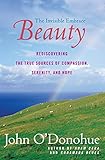 If all this sounds like gloom and doom, it is merely O’Donohue’s own attempts to offer his own “trenchant critique” of our society and why we need a spiritual renaissance. Still, he has plenty of optimism about the Celtic tradition’s role in today’s — and tomorrow’s — culture.
“The Celtic tradition offers us a sense of the freshness of spirit and the world of spirit. And also a sense of the passion of the diversities within the spiritual world, a diversity of spiritual presences, And also a kind of belonging, an embrace; that you are embraced in the great circle of belonging, in some way united with everything that is, and that you won’t fall out of that.
“Another way of saying this: the Celtic imagination represents a vision of the divine where no one or nothing is excluded and where there is a depth of imagination to allow what is uniquely individual in you, the thing that is the signature of your utmost uniqueness, to somehow coalesce without losing itself with the greater flow of spirit and nature in the world. The Celtic imagination offers the world the seeds of a new understanding of what friendship is, and rescuing our postmodern times from the absurd mathematics of acquaintance and acquaintanceship, and brings us in to that kind of embrace where there is real friendship, where otherness is not reduced but embraced as the greatest gift that anyone can give you.”
Where No One or Nothing is Excluded: An Interview with John O’Donohue originally appeared in the July 1999 issue of New Leaves.
Previous Post

December 23, 2007
Distinctive Qualities of Celtic Christianity
Next Post

July 11, 2008 The Feast of St. Benedict: Ad Deificum Lumen
Browse Our Archives
Select a Category Activism Announcements Art Books Catholicism Celtic Christianity Christian mysticism Christianity Contemplation Current events Etc. Family humor interfaith dialogue Interfaith Wisdom Interspirituality Lay Cistercians Living the Faith Meditation movies Mysticism Mystics nature Poetry Reviews Scripture silence Spirituality Uncategorized Writing
Select a Month February 2025 January 2025 November 2024 September 2024 August 2024 July 2024 June 2024 May 2024 March 2024 January 2024 December 2023 November 2023 August 2023 June 2023 April 2023 March 2023 February 2023 January 2023 December 2022 November 2022 October 2022 September 2022 August 2022 July 2022 June 2022 May 2022 April 2022 February 2022 January 2022 December 2021 November 2021 October 2021 September 2021 August 2021 July 2021 June 2021 May 2021 April 2021 March 2021 February 2021 January 2021 December 2020 November 2020 October 2020 September 2020 August 2020 July 2020 June 2020 May 2020 April 2020 March 2020 February 2020 January 2020 December 2019 November 2019 October 2019 September 2019 August 2019 July 2019 June 2019 May 2019 April 2019 March 2019 February 2019 January 2019 December 2018 November 2018 October 2018 September 2018 August 2018 July 2018 June 2018 May 2018 April 2018 March 2018 February 2018 January 2018 December 2017 November 2017 October 2017 September 2017 August 2017 July 2017 June 2017 May 2017 April 2017 March 2017 February 2017 January 2017 December 2016 November 2016 October 2016 September 2016 August 2016 July 2016 June 2016 May 2016 March 2016 February 2016 January 2016 December 2015 November 2015 October 2015 September 2015 August 2015 July 2015 June 2015 May 2015 April 2015 March 2015 February 2015 January 2015 December 2014 November 2014 October 2014 September 2014 August 2014 July 2014 June 2014 May 2014 April 2014 March 2014 February 2014 January 2014 December 2013 October 2013 September 2013 July 2013 May 2013 January 2013 December 2012 November 2012 August 2012 July 2012 June 2012 March 2012 December 2011 September 2011 October 2010 August 2010 March 2010 September 2009 July 2008 January 2008 December 2007 September 2007 February 2007 January 2007 December 2004
Follow Us!
TAKE THE
Religious Wisdom Quiz
What does "Paraclete," as used for the Holy Spirit, mean?
Select your answer to see how you score.
Friend Helper or advocate Sacrifice King
Support this
Column


Related posts from Carl McColman

LSD, Anxiety, and Contemplation: Can Psychedelic Therapy Support...
Register for the "Celtic Spirituality School" — Yearlong...
Explore Celtic Spirituality with "Spirituality and Practice" Online...

Finding Your Perfect Prayer Posture
TRENDING AT PATHEOS Contemplative

Handy Contemplative Practices for Political Spaces
A Spiritually Grounded Presence In order to bring a spiritually grounded presence...

Halloween: The Holiday of Loving Your Neighbor
All Hallows Eve Is Halloween the least Christian holiday in America, or...

Can Love Be Saved? Some Thoughts on the...
Happy Valentine's Day! I recently published a post on Patreon called Can...

"This Loving, Uniting Embrace": the Holy Ordinary
Today's guest post is by Mark Longhurst, author of The Holy Ordinary:...

How Are We Called to Live?: More About...
How Are We Called to Live? Many of us struggle with discerning...

A Spiritual Practice of Reading: Join Us Online
A Spiritual Practice of Reading A healthy spiritual practice of reading is...
view all Contemplative blogs
Ad-Free & Subscriber Log-In Subscription Support
- About Us
- 2026 Calendar
- Videos
- Podcasts
- Library of World Religions
- Faith In Media Tracker
- Advertise With Us
- Write for Us
- Privacy Policy
- Terms of Service
- Do Not Sell My Data
- Contact Us
- Radiant Digital
- Manage Newsletter Subscriptions
- Unsubscribe From Notifications
- Sitemap
Copyright 2008-2026, Patheos. All rights reserved.
Subscription Support Ad-Free & Subscriber Log-In
Follow Patheos