
BuddhistCatholicContemplativeEvangelicalGeneral ChristianHinduJewishLatter-day SaintMuslimNew VisionsProgressive Christian
Beliefs
- Buddhist
- Catholic
- Contemplative
- Evangelical
- General Christian
- Hindu
- Jewish
- Latter-day Saint
- More Voices
- Muslim
- New Visions
- Pagan
- Progressive Christian
Topics
- Religion News
- Food and Religion
- Sports and Religion
- Religious Art
- Religious Music and Entertainment
- Religious Events
- History and Religion
- Style and Religion
- Politics and Religion
- Women in Religion
- Recreation Outdoors and Religion
- Business Finance and Religion
- Careers Workplace and Religion
- Education and Religion
- Family Parenting and Religion
- Health Fitness and Religion
- Home and Religion
- Relationships and Religion
- Technology and Religion
- Travel and Religion
Columnists
- Buddhist Columnists
- Business Finance and Religion Columnists
- Careers Workplace and Religion Columnists
- Catholic Columnists
- Contemplative Columnists
- Education and Religion Columnists
- Evangelists Columnists
- Family Parenting and Religion Columnists
- General Christian Columnists
- Health Fitness and Religion Columnists
- Hindu Columnists
- History and Religion Columnists
- Home and Religion Columnists
- Jewish Columnists
- More Voices Columnists
- Latter Day Columnists
- Muslim Columnists
- New Visions Columnists
- Nonreligious Columnists
- Pagan Columnists
- Politics and Religion Columnists
- Progressive Columnists
- Recreation Outdoors and Religion Columnists
- Relationships and Religion Columnists
- Religion News Columnists
- Religious Art Columnists
- Religious Events Columnists
- Religious Music and Entertainment Columnists
- Sports and Religion Columnists
- Style and Religion Columnists
- Technology and Religion Columnists
- Travel and Religion Columnists
- Women in Religion Columnists
Resource Library
- 2026 Calendar
- Library of World Religions
- The 100 Most Holy Places on Earth
- Patheos Answers
- Podcasts
- Videos
- Faith Leaders Database
- Anglican Episcopalian
- Bahai
- Baptist
- Buddhism
- Christianity
- Confucianism
- Eastern Orthodoxy
- Hinduism
- Holiness and Pentecostal
- ISKCON
- Islam
- Judaism
- Lutheran
- Methodist
- The Church of Jesus Christ of Latter-day Saints
- New Age
- Paganism
- Presbytarian and Reformed
- Protestantism
- Religion Behind the Scenes
- Roman Catholic
- Scientology
- Shia Islam
- Sikhism
- Sufism
- Sunni Islam
- Taoism
- Zen
- See all religions
Research Tools
 Ad-Free & Subscriber Log-In Subscription Support
Ad-Free & Subscriber Log-In Subscription Support
Follow Patheos 

- Trending:
- Forgiveness
- |
- Marriage
- |
- Consciousness
- |
- Death Penalty
- |
- Election
- |
- Halloween

- Home
- More Voices
- Education and Religion
- Beyond Collapse: Cultivating a Planet for Generations
Beyond Collapse: Cultivating a Planet for Generations
Last updated on: October 18, 2024 at 10:06 am by Carl Gregg
Beyond Collapse: Cultivating a Planet for Generations 2024-10-18T10:06:52-04:00 Carl Gregg
Patheos Explore the world's faith through different perspectives on religion and spirituality! Patheos has the views of the prevalent religions and spiritualities of the world.
The subject of climate change is not particularly cheery, but it’s terribly important — especially in the wake of Hurricanes Helene and Milton, which were both supercharged by climate change. If you are interested in the data of how much worse various natural disasters are and will be due to climate change, I recommend the website climatecentral.org. They are doing some great work on crunching the numbers.
And as I began pondering the topic of **“**multiple ecosystem collapse in our time,” one article that sprang to mind was published this past February when The New York Times ran a headline that read, “Scientists Are Freaking Out About Ocean Temperatures.” Among my least favorite things are sober-minded, data-driven scientists freaking out about something. Here’s one quote from a professor at the University of Miami: “The North Atlantic has been record-breakingly warm for almost a year now. It’s just astonishing. Like, it doesn’t seem real.” Here’s another quote from a professor at the University of New South Wales: “The temperature’s just going off the charts. It’s like an omen of the future.” After Hurricanes Helene and Milton, we now have confirmation that the scientists’ warnings were quite prescient.
 Here’s a graph of what data scientists were already seeing months prior to these recent hurricanes. At the bottom, in gray, are the “Daily Sea Surface Temperatures” of all other years since 1979. In yellow, we see 2016. In orange, cresting notably above historic trends, we see last year, 2023. And well above that in red, we see this year, 2024. Extrapolating from this data, scientists have been sounding the alarm that, “the warmer waters in The Atlantic could fuel a strong and lengthy hurricane season.”
Fast-forward seven months from this article’s publication date in February, and we find Hurricane Helene devastating western North Carolina (and many other areas) to an extent that can only be called cataclysmic and apocalyptic — and Hurricane Milton carving out a destructive path — and spanning tornados — across Florida.
I have spent significant time annually in the Black Mountain and Asheville, North Carolina areas for almost four decades, and the photos and videos of the flooding have been personally devastating to see, although that’s nothing compared to the impact on those who are living through it, many of whom remain without water. Historic Biltmore Village is underwater.
According to The Washington Post, until Hurricane Helene,
Asheville…seemed like an ideal place to escape the worst effects of global warming. In recent years, media outlets and real estate agents named the city a “climate haven” because of its cooler-than-normal temperatures in the South and a location far inland from the flooding-pummeled coasts. Last year, the Asheville Citizen Times reported on worries that the city would become overcrowded from climate-change migration. Then, the flooding came. (WaPo)
The beautiful and inspiring River Arts District is now underwater. Total devastation. Entire homes floating away throughout Appalachia.
The road near the corner of Lake Eden Road and Old U.S. 70 is also destroyed., along with so many other roads in the area. It’s 1.5 miles from there to Camp Rockmont, where I spent my summers from age ten to age twenty-one. It’s also the only road to the local high school that serves more than 600 students.
These disasters are among many in a long line of examples that remind us that, when a strong consensus of scientists warns us to get serious about climate change, we need to get serious about taking action. We need the equivalent of a Green New Deal, and we needed it years ago.
The first Earth Day was more than fifty years ago, and back then we already had more than enough evidence that we needed to change our ways. The problem is not a lack of evidence; it’s the lack of political will, and the presence of greed, willful ignorance, and active disinformation. Although some people continue to ignorantly or willfully deny climate change, the writer and activist Wendell Berry is right that, “Whether we and our politicians know it or not, Nature is party to all our deals and decisions, and she has more votes, a longer memory, and a sterner sense of justice than we do.”
If you are interested in the changes we need to make in order to shift beyond multiple ecosystem collapse and toward cultivating a planet for generations, the number one recent book I would recommend remains the one I preached about this past Earth Day: Not the End of the World: How We Can Be the First Generation to Build a Sustainable Planet, by Hannah Ritchie. She is an academic at the University of Oxford. Her book is short, accessible, evidence-based, and inspiring. She covers how we could create the needed changes in seven of the multiple areas in which systemic change is needed: air pollution, climate change, deforestation, food, biodiversity loss, ocean plastics, and overfishing.
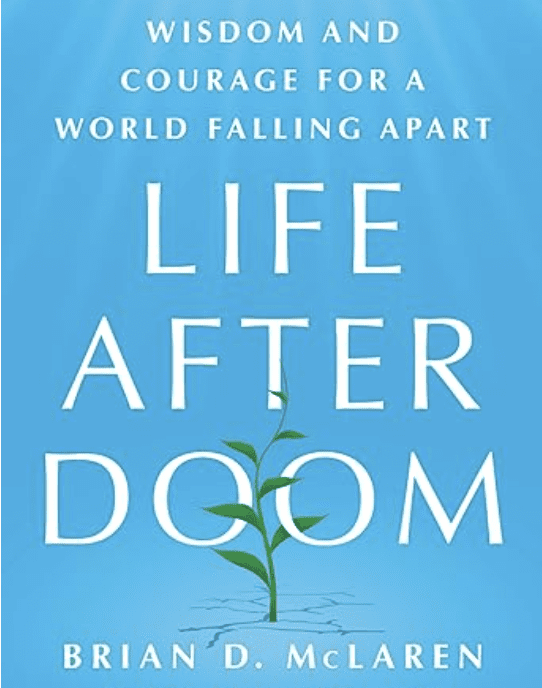
I’m tempted to return to that book for an even deeper dive, but because there is so much to say, I will bring in some additional angles. If you have already read Richie’s book, don’t stop! Here is another great book recommendation, one I’ve been reading in preparation for this sermon, called Life After Doom: Wisdom and Courage for a World Falling Apart by the author and activist Brian McLaren.
I will say that as the parent of a 16-month-old, I cannot and will not give up on doing everything I can to ensure that he inherits the beautiful, thriving, sustainable planet that he and all future generations deserve.
Is that merely my wishful thinking? Is it even possible? There are two quotes that come to mind when I consider whether we are capable of the paradigm shift needed to move from a trajectory of multi-system collapse toward cultivating a collaborative, sustainable planet for countless generations to come.
The first quote is from Fredric Jameson, who died just three weeks ago at the age of ninety. He was a professor of Comparative Literature at Duke University. Perhaps his most famous remark is that “It’s easier to imagine an end to the world than an end to capitalism.”
We need to be deeply serious about confronting the dire news of climate change and we also need to be clear that sometimes it’s easier to imagine things getting worse and worse — instead of doing the harder and even more important work of envisioning a better way.
Along the lines of helping us to more skillfully and wisely imagine possible futures, the second quote comes from the science fiction writer Ursula K. Le Guin. A decade ago in 2014, she delivered a powerful acceptance speech for the National Book Foundation’s Medal for Distinguished Contribution to American Letters, which included this quote: “We live in capitalism, its power seems inescapable — but then, so did the divine right of kings. Any human power can be resisted and changed by human beings.” She’s right. We make a tremendous strategic error anytime we limit ourselves to only what has happened before or the way things are now. Unexpected events — and our own individual and collective action — can and do sometimes turn “the arc of the universe toward justice.”
I also want to be sure to anchor these ecological reflections in our new UU values and covenant that seeks to keep love at the center. Relatedly, I appreciate the activist Derrick Jensen’s reflections about what sustains him long-term in the sometimes demoralizing struggle for climate justice. He writes:
Why am I an activist? Because I’m in love. With salmon, with trees outside my window, with baby lampreys living in sandy stream bottoms, with slender salamanders crawling through the duff. And if you love, you act to defend your beloved. Of course results matter to you, but they don’t determine whether or not you make the effort. You don’t simply hope your beloved survives and thrives. You do what it takes. If my love doesn’t cause me to protect those I love, it’s not love. (McLaren 83)
To better equip us for that collective effort, grounded in love, I will begin to move toward my conclusion by sharing with you some recommendations from EcoAmerica, a national non-profit that seeks to “build institutional leadership, public support, and political resolve for climate solutions in the United States.” If you are curious to learn more or to study their recommendations more closely, go to ecoamerica.org and click on “Resources.” The information I’m sharing with you is from their “Climate Action Guides,” but you may find some of their other resources interesting, helpful, and empowering. Specifically, I want to share with you their “5 Steps to Effective Climate Communication.”
Have any of you ever had a frustrating conversation about climate change? I certainly have. By no means will the following five steps persuade everyone you talk to, but they are some of the proven best practices to give you a better chance of having an effective and impactful dialogue.
- Start with people, stay with people. If you want people to care about climate change, care about them. Listen. Start by honoring their concerns and values, such as family, community, health, and fairness. Move from people to climate….
- Make it real. Focus on local realities everyone can see with their own eyes, like changing seasons [that are different from even the recent past]. Include a memorable fact or two from a [mutually] trusted source. Bring forward your own climate journey to personalize the issue. Stories sell, numbers numb.
- Focus on solutions and personal benefit. Many people don’t realize that power plants are shifting from coal to solar, wind, and [battery energy storage systems] — and it costs less. The best new cars and trucks coming from GM and Ford are electric. It’s not about sacrifice. Solutions are here, and they save money, create good jobs, clean our air, and protect our health and communities.
- Inspire and empower. We need to move [our neighbors] from concern to action on climate. We’re told we can’t make a difference on climate change when the opposite is true. Every day, almost everything you do — driving, eating, talking — can impact the problem and the people around you. So, ditch the doom and gloom. [Our country] can lead on climate solutions, and so can your state, town, family, and you!
- Be thoughtful when talking about climate change. Give examples, ideas, and steps they can take that are meaningful, accessible, and relevant. Be sure to stay above the fray and don’t get caught in the trap of arguing to refute false information. Keep it simple, big picture, and on what is important. End with your “ask,” encouraging your audience to act on climate.
If you’re not sure what your “ask” should be, spend some time later today (or sometime soon when you have a chance) in the “Resources” section of ecoamerica.org and notice what “ask” — what change you might ask yourself or others to make — resonates most with you in this season of your life. If any of you try this out, I’ll be interested to hear how it goes.
Education and Religion

About Carl Gregg
The Rev. Dr. Carl Gregg (he/him) has been the minister of the Unitarian Universalist Congregation of Frederick, Maryland since 2012. He holds a Doctor of Ministry and a Diploma in the Art of Spiritual Direction from San Francisco Theological Seminary, a Master of Divinity from Brite Divinity School, and a Bachelor of Arts in Religion and Philosophy (cum laude, Phi Beta Kappa) from Furman University. He has been a full-time minister since 2003, and served two previous congregations. He is an authorized Meditation Teacher through Buddhist Geeks. Carl was married in 2007 to Magin LaSov Gregg, an English professor and writer, whose work has appeared in The Washington Post, National Public Radio, The Rumpus, Bellingham Review, The Gettysburg Review, and elsewhere. They have two cats (Kol Nidre and Shamash) and a dogs (Scout). You can read more about the author here.
Previous Post
March 30, 2024
A New History of Gender: for Transgender Day of Visibility
Next Post

October 31, 2024 Slow Productivity: Peace in a Productivity-Obsessed World
Recent Comments
""Next let’s consider the similarly wide range of American religious views about reproductive justice." You ..."
“How Rights Went Wrong”: On the ..."
""
"Me too they are soooo perfectT.E1269.US\f9352CE"
An Afro-Indigenous History of the US ..."
""
“Imagining How a More Just World ..."
Browse Our Archives
Select a Category Advent Anti-Racism Archaeology Atheism Baptism Best of the Year List Book Reviews Buddhism Catholicism Christian Education Church and State Church Planting Climate Change Conscientious Objection to War Creation Spirituality Death Penalty Didache Disability Rights Discernment Easter Ecology Emergent Church Movement Empire-Critical Ethics Evolution Feminist Theology Film Reviews Gandhi Gospel of Mark Gun Control Hinduism Immigration Reform Interfaith Islam JFK Judaism Jungian Spirituality Lectionary Commentary Lent Letters to the Editor LGBT Marriage MLK Multiculturalism Mysticism Nonviolent Activism Occupy Paganism (Earth-centered Religions) Parables Paul Pluralism Politics Process Theology Quantum Physics Requiescat In Pace Seminary and Divinity School Sermon Series Retrospective Sermons Spiritual Direction Spiritual Practices Stewardship (Fundraising) The Book of J The Wheel of the Year (Paganism) Theoblogger Challenge Triathlon Uncategorized Unitarian Universalism Worship Resources Youth Ministry
Select a Month July 2026 May 2026 March 2026 November 2025 October 2025 August 2025 February 2025 December 2024 October 2024 March 2024 January 2024 December 2023 November 2023 March 2023 February 2023 January 2023 December 2022 November 2022 August 2022 March 2022 February 2022 January 2022 December 2021 September 2021 August 2021 July 2021 June 2021 May 2021 February 2021 January 2021 December 2020 August 2020 June 2020 May 2020 April 2020 March 2020 February 2020 January 2020 December 2019 November 2019 October 2019 September 2019 July 2019 June 2019 March 2019 February 2019 January 2019 December 2018 November 2018 October 2018 September 2018 June 2018 May 2018 April 2018 March 2018 February 2018 January 2018 December 2017 November 2017 October 2017 September 2017 August 2017 July 2017 June 2017 May 2017 April 2017 March 2017 February 2017 January 2017 December 2016 November 2016 October 2016 September 2016 August 2016 June 2016 May 2016 April 2016 March 2016 February 2016 January 2016 December 2015 November 2015 October 2015 September 2015 August 2015 July 2015 June 2015 May 2015 April 2015 March 2015 February 2015 January 2015 December 2014 November 2014 October 2014 August 2014 July 2014 June 2014 May 2014 April 2014 March 2014 February 2014 January 2014 December 2013 November 2013 October 2013 September 2013 August 2013 July 2013 June 2013 May 2013 April 2013 March 2013 February 2013 January 2013 December 2012 November 2012 October 2012 September 2012 August 2012 July 2012 June 2012 May 2012 April 2012 March 2012 February 2012 January 2012 December 2011 November 2011 October 2011 September 2011 August 2011 July 2011 June 2011 May 2011 April 2011 March 2011 February 2011 January 2011 December 2010 November 2010 October 2010 August 2009 July 2009 May 2009
Follow Us!
TAKE THE
Religious Wisdom Quiz
Which Gospel contains the "Sermon on the Mount"?
Select your answer to see how you score.
Mark John Matthew Luke
Related posts from Carl Gregg

Reading America at 250: A Nation Wrestles With...


Andrew Holocek on the Power of Darkness

The Stories That Shape Us: Myths, Archetypes, &...
TRENDING AT PATHEOS More Voices

Reading America at 250: A Nation Wrestles With...
As part of my own reflection on the 250th anniversary of the...

Whenever I am reading a book or listening to an argument, I...

President Trump Ban Animal Torture Videos on Facebook
Call for Stricter Regulations of Animal Abuse Content on Facebook Although President...

Draft Amendments to Address Ritual Abuse in New...
The proposed changes would make it illegal for individuals in domestic partnerships...

How Bans on LGBTQ+ Student Clubs Threaten Religious...
On June 20, 2025, the State of Texas passed Senate Bill 12....

The Truth About the Gen Z Revival
This past year, there has been a lot of media buzz surrounding...
view all More Voices blogs
What Are Your Thoughts?leave a comment
Ad-Free & Subscriber Log-In Subscription Support
- About Us
- 2026 Calendar
- Videos
- Podcasts
- Library of World Religions
- Faith In Media Tracker
- Advertise With Us
- Write for Us
- Privacy Policy
- Terms of Service
- Do Not Sell My Data
- Contact Us
- Radiant Digital
- Manage Newsletter Subscriptions
- Unsubscribe From Notifications
- Sitemap
Copyright 2008-2026, Patheos. All rights reserved.
Subscription Support Ad-Free & Subscriber Log-In
Follow Patheos