
BuddhistCatholicContemplativeEvangelicalGeneral ChristianHinduJewishLatter-day SaintMuslimNew VisionsProgressive Christian
Beliefs
- Buddhist
- Catholic
- Contemplative
- Evangelical
- General Christian
- Hindu
- Jewish
- Latter-day Saint
- More Voices
- Muslim
- New Visions
- Pagan
- Progressive Christian
Topics
- Religion News
- Food and Religion
- Sports and Religion
- Religious Art
- Religious Music and Entertainment
- Religious Events
- History and Religion
- Style and Religion
- Politics and Religion
- Women in Religion
- Recreation Outdoors and Religion
- Business Finance and Religion
- Careers Workplace and Religion
- Education and Religion
- Family Parenting and Religion
- Health Fitness and Religion
- Home and Religion
- Relationships and Religion
- Technology and Religion
- Travel and Religion
Columnists
- Buddhist Columnists
- Business Finance and Religion Columnists
- Careers Workplace and Religion Columnists
- Catholic Columnists
- Contemplative Columnists
- Education and Religion Columnists
- Evangelists Columnists
- Family Parenting and Religion Columnists
- General Christian Columnists
- Health Fitness and Religion Columnists
- Hindu Columnists
- History and Religion Columnists
- Home and Religion Columnists
- Jewish Columnists
- More Voices Columnists
- Latter Day Columnists
- Muslim Columnists
- New Visions Columnists
- Nonreligious Columnists
- Pagan Columnists
- Politics and Religion Columnists
- Progressive Columnists
- Recreation Outdoors and Religion Columnists
- Relationships and Religion Columnists
- Religion News Columnists
- Religious Art Columnists
- Religious Events Columnists
- Religious Music and Entertainment Columnists
- Sports and Religion Columnists
- Style and Religion Columnists
- Technology and Religion Columnists
- Travel and Religion Columnists
- Women in Religion Columnists
Resource Library
- 2026 Calendar
- Library of World Religions
- The 100 Most Holy Places on Earth
- Patheos Answers
- Podcasts
- Videos
- Faith Leaders Database
- Anglican Episcopalian
- Bahai
- Baptist
- Buddhism
- Christianity
- Confucianism
- Eastern Orthodoxy
- Hinduism
- Holiness and Pentecostal
- ISKCON
- Islam
- Judaism
- Lutheran
- Methodist
- The Church of Jesus Christ of Latter-day Saints
- New Age
- Paganism
- Presbytarian and Reformed
- Protestantism
- Religion Behind the Scenes
- Roman Catholic
- Scientology
- Shia Islam
- Sikhism
- Sufism
- Sunni Islam
- Taoism
- Zen
- See all religions
Research Tools
 Ad-Free & Subscriber Log-In Subscription Support
Ad-Free & Subscriber Log-In Subscription Support
Follow Patheos 

- Trending:
- Forgiveness
- |
- Marriage
- |
- Consciousness
- |
- Death Penalty
- |
- Election
- |
- Halloween

- Home
- More Voices
- “No Fate But What We Make”: Transformational AI & Human Values
“No Fate But What We Make”: Transformational AI & Human Values
Last updated on: February 15, 2023 at 10:53 pm by Carl Gregg
“No Fate But What We Make”: Transformational AI & Human Values 2023-02-15T22:53:16-05:00 Carl Gregg
Patheos Explore the world's faith through different perspectives on religion and spirituality! Patheos has the views of the prevalent religions and spiritualities of the world.
I blogged previously about AI in a post titled “Immigrants Aren’t Coming for Your Job, Robots Are.” So, why am I revisiting this topic now, five years later?
I knew it was time last summer when The Washington Post reported that an engineer at Google was raising the alarm that Google’s AI chatbot had already become sentient.
Have you seen the 1968 film 2001: A Space Odyssey? It’s a classic example of science fiction writers speculating that AI will one day become conscious, self-aware. The most famous scene involves an astronaut named Dave and a newly-sentient AI named HAL:
Dave Bowman: Open the pod bay doors, HAL.
HAL: I’m sorry, Dave. I’m afraid I can’t do that….
Dave Bowman: I don’t know what you’re talking about, HAL.
HAL: I know that you…were planning to disconnect me….
Dave Bowman: HAL, I won’t argue with you anymore! Open the doors!
HAL: Dave, this conversation can serve no purpose anymore. Goodbye.
That’s a future most of us want to avoid. We don’t want hostile computers taking over. We don’t want Skynet coming online and launching a nuclear attack, as depicted in the Terminator movies. I could keep going with many more pop culture examples from Ex Machina to Her to the early seasons of Westworld.
The question raised last summer was whether an AI had already become sentient, not in some imagined sci-fi future, but in our own present reality. Google denied the allegation, and the engineer was fired the next month. In the meantime, the Internet was set ablaze with interest about the future of AI.
That flashpoint last summer persuaded me to start researching this post on the subject of AI. Then, last fall, the plot thickened. (But wait, there’s more!) Just a few months ago, in November, the research lab OpenAI released a free public version of ChatGPT, which is their version of Google’s LaMDA chatbot, the one the engineer claimed had become sentient. Headlines began exploding again about the future implications of AI.
I typed into ChatGPT, “Write a sermon about Artificial Intelligence for a Unitarian Universalist congregation.” Within seconds, it generated a fairly impressive 350 words. How many of you have played around with ChatGPT or a similar AI chatbot? To be honest, 350 words is about 2000 words short of a full sermon, since the currently available free version of ChatGPT has built-in limitations that reduce the processing load on the AI system.
Also, remember the Internet adage that, “If you’re not paying for the product, then you are the product” (The Social Dilemma). The free version of ChatGPT is constantly improving, evolving — learning — from all the ways we humans are using it. A future paid version of ChatGPT is coming soon which will likely be more capable of producing fairly convincing full-length sermons, college-level papers, and much more. If your job involves writing, perhaps you can think of ways these sorts of AI power-writing tools could impact your work — in both positive and negative ways — in the coming years.
If I were asked to grade that AI-generated 350-word “sermon”, I wouldn’t give it an “A.” It’s not the most elegantly written piece of prose; but if I didn’t know it was written by an AI chatbot, I might give it a “B.” It is clearly written with some perceptive insights.
How are these AI feats possible? At the risk of oversimplifying, these AI chatbots have been trained on a massive amount of data reflecting how we humans communicate, data widely available on the Internet and in various digital archives. The AI chatbot uses all that data to help it predict the next most-likely word in a sentence, the next after that, and so on. The result is new, original texts that can feel deceptively humanlike — indeed, sufficiently humanlike to lead at least one hapless Google engineer to believe that the Google chatbot had passed the tipping point into sentience.
I want us to reflect on the implications of these technological advances, but first there is one more important piece of information to get out on the table. We’ve been focusing so far on text-based AI, but this fall there was still more breaking news about the power of AI to create visual art in response to short written prompts. (But wait, there’s more!) Similar to the chatbots, these AI image generators are trained on the huge number of digital images out there on the Internet and in various archives. The AI image generator continuously refines pixels until it “matches” a particular text description to a visual image.
Some of the most well known AI image generators are MidJourney and OpenAI’s DALL-E2, which is named after both the surrealist artist Salvador Dalí and the animated robot WALL-E from the Pixar film. How many of you have already played around with AI image software?
You can think of the most random things, and the AI system can create one or more similar or related visual representations incredibly quickly. A famous example that OpenAI used to demonstrate their new DALL-E2 technology was typed into the system as: “Teddy bears working on new AI research underwater with 1990s technology.” Within seconds they got this image. Pretty good, right? Looks photo-realistic to me, but it’s completely computer generated within seconds.

Let me give you a few examples I created. Many of you will be familiar with the famous painting, The Scream, by Edvard Munch. The painting’s agonized face is an iconic representation of human existential anxiety. Since I’m a meditation teacher, and since the first Buddhist Noble Truth is, “Life is suffering,” I wondered what the painting would have looked like if Munch had been a Buddhist. So, I typed into DALLE2, “Buddha Statue in the style of Edvard Munch.” Within seconds it produced these images:

At least to me, these renderings of the Buddha feel quite profound and worth meditating on. Also, note that DALL-E2 often generates not one, but four options. You can then choose which of these you prefer, and then generate four more variations. And then keep going to refine and co-create an image that best represents what feels right to you.
I’m also a big fan of the Mexican painter, Frida Kahlo. What if we tried “Buddha Statue in the style of Frieda Kahlo?”

These Buddha-Kahlo images also feel quite well worth meditating on.
Whereas ‘The Scream Buddha’ tears my heart open in compassion for the existential reality in which all sentient beings find ourselves, my response to the ‘Frieda Kahlo Buddha’ is a softening into a beautiful serenity.
Or what if van Gogh, famous for his painting Starry Night, had been a Buddhist? “DALL-E2, show me “Buddha Statue in the style of van Gogh.”
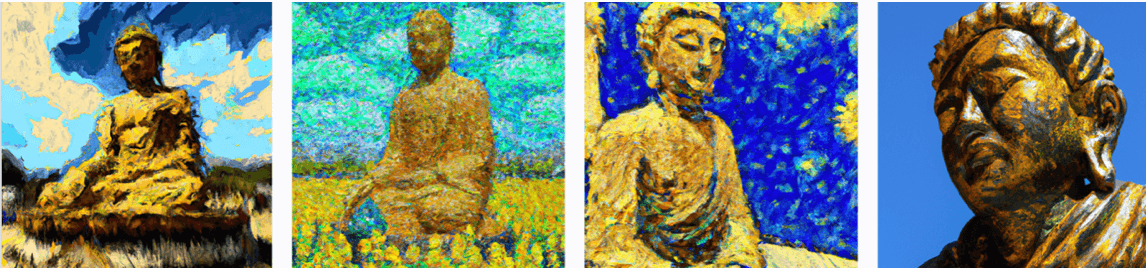
I love these images too. And I could envision building a daylong meditation retreat around just these three sets of images that we’ve explored so far. Ok, enough Buddhism.
Since the surrealist painter Salvador Dalí is the partial namesake of the AI tool generating these images, what if Dalí had been born in India instead of Spain? “DALL-E2, show me, “Hindu images in the style of Salvador Dalí.”

Or what if Rembrandt had converted to Hinduism and started painting the goddess Kali?

I love these too.
Or since I’ll be leading a pilgrimage to Israel and Palestine this summer, what if the French impressionist painter Claude Monet had moved to the Holy Land to paint landscapes? Show me, “The Al-Aqsa Mosque in the Old City of Jerusalem in the style of Monet.”

Or what about Georgie O’Keefe, known for her moving paintings of colossal flowers and New Mexico landscapes? What if her muse had instead been the Al-Aqsa Mosque?

Or Pablo Picasso, co-founder of the Cubist movement. What if he had been a Christian?
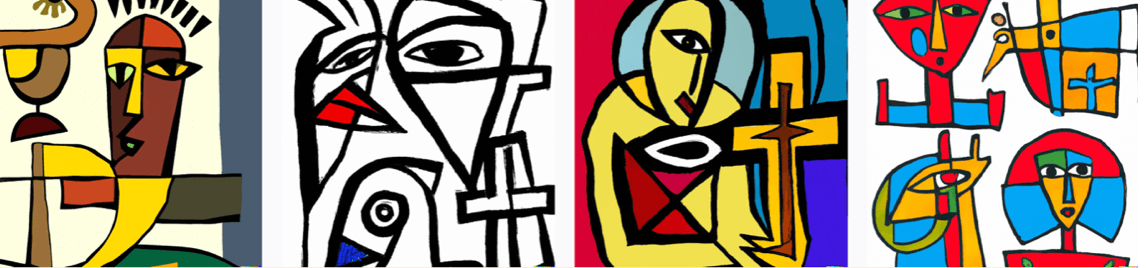
Cubist Christianity. I’m here for it!
Ok, just two more from me. Since I lived in Louisiana for many years, I wonder how many of you know the remarkable work of Clementine Hunter, a self-taught Black folk artist. What if Clementine Hunter had been practitioner of the traditional African religion of Yoruba? Show me, “Yoruba religious images in the style of Clementine Hunter.”
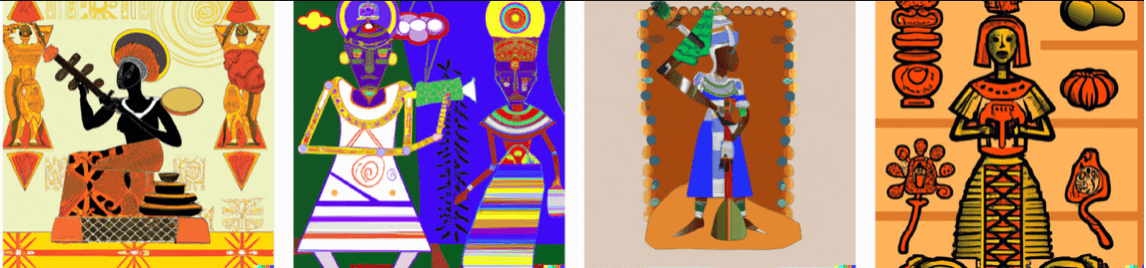
That’s a somewhat obscure request. But DALL-E2 knows all about Clementine Hunter and Yoruba, and within seconds can create an original image combining the two!
Or I was on Zoom the other day with my meditation teachers’ cohort, and we were playing around with the AI art generator Midjourney using the share screen feature. We wondered what it would look like if an opossum experienced Buddhist enlightenment.

A friend who saw this picture made the savvy observation that this bodhisattva opossum could be the cover of a bestselling children’s book!
That was a lot of images, but that’s part of the point. In total, it took me only a matter of minutes to generate all of those images. Even the most talented and efficient human artist would require vastly more time to research and create anything like what we just saw. Such created images can also be a beginning to greater creativity, not an end, not the final product.
The images I’ve been showing you so are also all very quick first drafts. But if you keep working with such an AI systems, you can infinitely refine and enhance your own imagination, skills, and art.
As a final example, last fall The Washington Post ran an article on AI-generated art that won first place at the Colorado State Fair arts competition. It is “so finely detailed the judges couldn’t tell” that a computer created it instead of a human.
The current state of AI innovation is already impressive, and it’s only going to get better and faster from here on. How quickly will it improve? To give you one point of reference, a senior analyst who professionally studies A.I. risk currently estimates that there is a 35 percent chance of “‘transformational A.I.’ — defined as A.I. that is good enough to usher in large-scale economic and societal changes, such as eliminating most white-collar knowledge jobs — emerging by 2036” (The New York Times). That’s a mere 13 years from now. Don’t miss that there is a 66% chance it will take longer to reach transformational A.I. Regardless, evidence is steadily emerging that transformational AI could well happen within the lifespan of humans alive today.
Programs like ChatGPT are already being used to “write screenplays, compose marketing emails and develop video games” (The New York Times):
- What about finance professionals? Since 2017, JPMorgan Chase has been using AI to almost instantaneously review certain types of financial contracts that previously took more than three hundred thousand hours annually for humans to review. That’s a lot of people’s jobs that are now being done by computers.
- What about doctors? In 2018, AI was developed that, “diagnosed brain cancer and other diseases faster and more accurately than a team of fifteen top doctors” and “identified malignant tumors on a CT scan with an error rate twenty times lower than human radiologists.”
- What about lawyers? An AI system trained to spot potential legal issues in contracts has been shown to have a 94 percent accuracy rate as compared with an 85 percent average for human lawyers. The humans needed 92 minutes on average to complete the task, whereas the AI needed twenty-six seconds. When you are being billed by the hour, online AI legal assistance starts looking like an appealing option. (Roose 29-31)
- What about therapists? It might sound terrible, but what if that AI application was programed with perfect recall of all the best therapy training in the world; was willing to patiently listen to you for as long as you needed; and was available twenty-four hours a day year-round?
I could keep going with other professions, including my own; what if they trained an AI on every UU sermon ever preached? But you get the idea.
Futurists are likely correct that, “Artificial intelligence, cloning, genetic engineering, virtual reality, robots, nanotechnology, bio-hacking, space colonization, and autonomous machines are all likely coming, one way or another” (Douglas Rushkoff, Team Human, 211). There’s a lot to say about all that, and we’ll keep exploring these forthcoming changes in future posts. But regardless of what technological innovations the future brings, our challenge in the present is to demand that human rights and environmental sustainability be an integral part of any future.
We also need to be honest that there are fortunate people like me — and a likely number of you as well — who love your jobs, or most parts of your your jobs. But for a lot of other humans on this planet, jobs aren’t great: the hours are too long and the work isn’t life-giving; many are literally backbreaking, hazardous, degrading, unethical, boring. In such cases, maybe it’s good news that the robots are coming for at least those jobs (120-121). What’s so great about jobs?!
Many psychologists have long assured us that what truly makes life worth living is not merely work; it’s meaning and purpose. If AI and robots take over many or most of our jobs, many other options for meaning include refocusing our lives on creating community, cultivating hobbies, enjoying this beautiful world in which we find ourselves, spending time with family and friends, and so much more. That doesn’t sound like a bad future. To be honest, such a future world could also include a lot of people playing video games all day, but that’s all part of the challenges of co-creating a better world — together.
In the words of one philosopher who studies future existential threats to humanity: “There is a long-distance race between humanity’s technological capability, which is like a stallion galloping across the fields, and humanity’s wisdom, which is more like a foal on unsteady legs” (Brian Christian, The Alignment Problem: Machine Learning and Human Values, 313). We need to up our wisdom game — and fast!
In the face of coming advancements in AI, one major tool for maintaining human rights may be a Universal Basic Income (Patheos). How would we pay for that? At least in part by taxing some of the income being made by AI systems. If the robots take our jobs, we are fools if we allow tech billionaires to amass the vast majority of AI wealth for themselves when we could instead mandate that wealth be shared, so that all human beings have a chance to live dignified lives.
We don’t have to reject technology, but we must demand that all sentient beings — all stakeholders on this beautiful planet — be part of the processes of guiding that emerging technology. In the words of Kevin Roose from his book Futureproof: 9 Rules for Humans in the Age of Automation, “There is no looming machine takeover, no army of malevolent robots plotting to rise up and enslave us. It’s just people, deciding what kind of society we want” (Roose xxxvi).
Remember the Declaration of Independence: governments derive “their just powers from the consent of the governed.” Our choice is whether “We the people” will passively let technology — and tech billionaires — shape and use us, or whether we will instead choose to use technology skillfully, wisely, and compassionately.
“Remember…The future is not set. There is no fate, but what we make for ourselves” (Terminator 2). Whatever will be is up to us, both individually and collectively. And I am grateful to be on this journey with all of you.
The Rev. Dr. Carl Gregg is a meditation teacher, spiritual director, and the minister of the Unitarian Universalist Congregation of Frederick, Maryland. Follow him on Facebook (facebook.com/carlgregg) and Twitter (@carlgregg).
Learn more about Unitarian Universalism: http://www.uua.org/beliefs/principles
Previous Post

January 31, 2023
Unexpected Adventures in Philosophy
Next Post

March 10, 2023 Fannie Lou Hamer's Enduring Message to America
Recent Comments
""Next let’s consider the similarly wide range of American religious views about reproductive justice." You ..."
“How Rights Went Wrong”: On the ..."
""
"Me too they are soooo perfectT.E1269.US\f9352CE"
An Afro-Indigenous History of the US ..."
""
“Imagining How a More Just World ..."
Browse Our Archives
Select a Category Advent Anti-Racism Archaeology Atheism Baptism Best of the Year List Book Reviews Buddhism Catholicism Christian Education Church and State Church Planting Climate Change Conscientious Objection to War Creation Spirituality Death Penalty Didache Disability Rights Discernment Easter Ecology Emergent Church Movement Empire-Critical Ethics Evolution Feminist Theology Film Reviews Gandhi Gospel of Mark Gun Control Hinduism Immigration Reform Interfaith Islam JFK Judaism Jungian Spirituality Lectionary Commentary Lent Letters to the Editor LGBT Marriage MLK Multiculturalism Mysticism Nonviolent Activism Occupy Paganism (Earth-centered Religions) Parables Paul Pluralism Politics Process Theology Quantum Physics Requiescat In Pace Seminary and Divinity School Sermon Series Retrospective Sermons Spiritual Direction Spiritual Practices Stewardship (Fundraising) The Book of J The Wheel of the Year (Paganism) Theoblogger Challenge Triathlon Uncategorized Unitarian Universalism Worship Resources Youth Ministry
Select a Month July 2026 May 2026 March 2026 November 2025 October 2025 August 2025 February 2025 December 2024 October 2024 March 2024 January 2024 December 2023 November 2023 March 2023 February 2023 January 2023 December 2022 November 2022 August 2022 March 2022 February 2022 January 2022 December 2021 September 2021 August 2021 July 2021 June 2021 May 2021 February 2021 January 2021 December 2020 August 2020 June 2020 May 2020 April 2020 March 2020 February 2020 January 2020 December 2019 November 2019 October 2019 September 2019 July 2019 June 2019 March 2019 February 2019 January 2019 December 2018 November 2018 October 2018 September 2018 June 2018 May 2018 April 2018 March 2018 February 2018 January 2018 December 2017 November 2017 October 2017 September 2017 August 2017 July 2017 June 2017 May 2017 April 2017 March 2017 February 2017 January 2017 December 2016 November 2016 October 2016 September 2016 August 2016 June 2016 May 2016 April 2016 March 2016 February 2016 January 2016 December 2015 November 2015 October 2015 September 2015 August 2015 July 2015 June 2015 May 2015 April 2015 March 2015 February 2015 January 2015 December 2014 November 2014 October 2014 August 2014 July 2014 June 2014 May 2014 April 2014 March 2014 February 2014 January 2014 December 2013 November 2013 October 2013 September 2013 August 2013 July 2013 June 2013 May 2013 April 2013 March 2013 February 2013 January 2013 December 2012 November 2012 October 2012 September 2012 August 2012 July 2012 June 2012 May 2012 April 2012 March 2012 February 2012 January 2012 December 2011 November 2011 October 2011 September 2011 August 2011 July 2011 June 2011 May 2011 April 2011 March 2011 February 2011 January 2011 December 2010 November 2010 October 2010 August 2009 July 2009 May 2009
Follow Us!
TAKE THE
Religious Wisdom Quiz
What did God make on the fourth day of creation?
Select your answer to see how you score.
Sun, moon, and stars Plants Man Fish and birds
Related posts from Carl Gregg

Reading America at 250: A Nation Wrestles With...


Andrew Holocek on the Power of Darkness

The Stories That Shape Us: Myths, Archetypes, &...
TRENDING AT PATHEOS More Voices

Reading America at 250: A Nation Wrestles With...
As part of my own reflection on the 250th anniversary of the...

Whenever I am reading a book or listening to an argument, I...

President Trump Ban Animal Torture Videos on Facebook
Call for Stricter Regulations of Animal Abuse Content on Facebook Although President...

Draft Amendments to Address Ritual Abuse in New...
The proposed changes would make it illegal for individuals in domestic partnerships...

How Bans on LGBTQ+ Student Clubs Threaten Religious...
On June 20, 2025, the State of Texas passed Senate Bill 12....

The Truth About the Gen Z Revival
This past year, there has been a lot of media buzz surrounding...
view all More Voices blogs
What Are Your Thoughts?leave a comment
Ad-Free & Subscriber Log-In Subscription Support
- About Us
- 2026 Calendar
- Videos
- Podcasts
- Library of World Religions
- Faith In Media Tracker
- Advertise With Us
- Write for Us
- Privacy Policy
- Terms of Service
- Do Not Sell My Data
- Contact Us
- Radiant Digital
- Manage Newsletter Subscriptions
- Unsubscribe From Notifications
- Sitemap
Copyright 2008-2026, Patheos. All rights reserved.
Subscription Support Ad-Free & Subscriber Log-In
Follow Patheos