
BuddhistCatholicContemplativeEvangelicalGeneral ChristianHinduJewishLatter-day SaintMuslimNew VisionsProgressive Christian
Beliefs
- Buddhist
- Catholic
- Contemplative
- Evangelical
- General Christian
- Hindu
- Jewish
- Latter-day Saint
- More Voices
- Muslim
- New Visions
- Pagan
- Progressive Christian
Topics
- Religion News
- Food and Religion
- Sports and Religion
- Religious Art
- Religious Music and Entertainment
- Religious Events
- History and Religion
- Style and Religion
- Politics and Religion
- Women in Religion
- Recreation Outdoors and Religion
- Business Finance and Religion
- Careers Workplace and Religion
- Education and Religion
- Family Parenting and Religion
- Health Fitness and Religion
- Home and Religion
- Relationships and Religion
- Technology and Religion
- Travel and Religion
Columnists
- Buddhist Columnists
- Business Finance and Religion Columnists
- Careers Workplace and Religion Columnists
- Catholic Columnists
- Contemplative Columnists
- Education and Religion Columnists
- Evangelists Columnists
- Family Parenting and Religion Columnists
- General Christian Columnists
- Health Fitness and Religion Columnists
- Hindu Columnists
- History and Religion Columnists
- Home and Religion Columnists
- Jewish Columnists
- More Voices Columnists
- Latter Day Columnists
- Muslim Columnists
- New Visions Columnists
- Nonreligious Columnists
- Pagan Columnists
- Politics and Religion Columnists
- Progressive Columnists
- Recreation Outdoors and Religion Columnists
- Relationships and Religion Columnists
- Religion News Columnists
- Religious Art Columnists
- Religious Events Columnists
- Religious Music and Entertainment Columnists
- Sports and Religion Columnists
- Style and Religion Columnists
- Technology and Religion Columnists
- Travel and Religion Columnists
- Women in Religion Columnists
Resource Library
- 2026 Calendar
- Library of World Religions
- The 100 Most Holy Places on Earth
- Patheos Answers
- Podcasts
- Videos
- Faith Leaders Database
- Anglican Episcopalian
- Bahai
- Baptist
- Buddhism
- Christianity
- Confucianism
- Eastern Orthodoxy
- Hinduism
- Holiness and Pentecostal
- ISKCON
- Islam
- Judaism
- Lutheran
- Methodist
- The Church of Jesus Christ of Latter-day Saints
- New Age
- Paganism
- Presbytarian and Reformed
- Protestantism
- Religion Behind the Scenes
- Roman Catholic
- Scientology
- Shia Islam
- Sikhism
- Sufism
- Sunni Islam
- Taoism
- Zen
- See all religions
Research Tools
 Ad-Free & Subscriber Log-In Subscription Support
Ad-Free & Subscriber Log-In Subscription Support
Follow Patheos 

- Trending:
- Forgiveness
- |
- Marriage
- |
- Consciousness
- |
- Death Penalty
- |
- Election
- |
- Halloween

- Home
- More Voices
- Peak Spiritual Experiences, Psychedelics, & Consciousness Research
Peak Spiritual Experiences, Psychedelics, & Consciousness Research
Last updated on: December 5, 2022 at 11:24 pm by Carl Gregg
Peak Spiritual Experiences, Psychedelics, & Consciousness Research 2022-12-05T23:24:48-05:00 Carl Gregg
Patheos Explore the world's faith through different perspectives on religion and spirituality! Patheos has the views of the prevalent religions and spiritualities of the world.
John Kaag is a philosophy professor who published a book a few years ago with the intriguing title, How William James Can Save Your Life. It’s not my favorite book on James, but Kaag is onto something with that title.
William James was born in 1842 and died in 1910. He has been called the father of American philosophy and the father of American psychology, and he is remembered for coining terms like “stream of consciousness,” “dissociation,” “timeline,” “pluralism” and “multiverse.” If you enjoyed any of those recent Marvel movies about the multiverse, William James might say, “You’re welcome!” (Kaag 1; Yaden 24; Richardson 30).
William James’ brother was the famous novelist Henry James, and although the James family was not Unitarian, they were often Unitarian adjacent. Henry James’ fiction frequently included Unitarian characters. And their sister Alice wrote in her published diaries that of the prevailing religions of the day, Unitarianism came closest to being a fit for their family. Here’s one specific quote from Alice, which I think is mostly intended as a compliment: “When Mother and Father died, we fell back upon the uncompromising and amorphous Unitarian shepherd, for whom no sheep has too varied a fleece” (Susan Ritchie, Dark and Stormy, 283).
The family was also close to many prominent Unitarians, including Nathaniel Hawthorne, Henry Wadsworth Longfellow, Oliver Wendell Holmes, and Henry David Thoreau. And William James’s godfather was none other than Ralph Waldo Emerson, who often spent the night at the family’s home (Yaden 17).
What I particularly want to draw to your attention is William James’ most enduring influence: a book he published in 1902 titled The Varieties of Religious Experience. His most influential innovation was to challenge the field of religious studies to focus less on the history and dogma of ancient religions and more on people’s present-day religious experiences (The Heart of William James, 209). James called for a move from secondhand religion (what other people tell you is true) to firsthand religion (what you know from your own experience). Likewise, the Unitarian Universalist First Source calls this “Direct experience of…transcending mystery and wonder.”
Today’s UUs inherit that source from Transcendentalist forbears like James’s godfather Emerson. And to orient you to the journey I’d like us to take—starting with James’ paradigm-shifting book—I want to briefly reach back to the past of UU history to show how he was influenced by the Transcendentalists; then I want to connect us to today, and invite us to explore one of the places doing the most exciting work to extend James’ work into the future, the Johns Hopkins Center for Psychedelic & Consciousness Research.
Let’s start with James’ godfather Ralph Waldo Emerson, who in 1838 preached a controversial sermon at Harvard Divinity School titled ”Acquaint Thyself First Hand with Deity.” You can tell where James inherited his emphasis on firsthand religion. Connecting back to William James, here’s a quote from The Varieties of Religious Experience in which you can hear him expanding upon his godfather’s call to ”Acquaint Thyself First Hand with Deity.” James wrote:
Churches live at second-hand upon tradition; but the founders of every church owed their power originally to the fact of their direct personal communion with the divine…. I propose to ignore the institutional branch entirely, to say nothing of the ecclesiastical organization, to consider as little as possible the systematic theology and the ideas about the gods themselves, and to confine myself as far as I can to personal religion pure and simple (Richardson, 393).
In our current age, in which an increasing number of people identify as “spiritual, but not religious,” James’s approach may seem commonplace, but in James’ day, it was radical.
And people were hungry for this approach. In the first year alone, James “cleared $10,000 after expenses” on sales of his book, which is the equivalent of more than $300,000 today. He received more letters in response to this book than all his other books combined (420-421), and it has remained continuously in print for more than a century (Yaden 33).
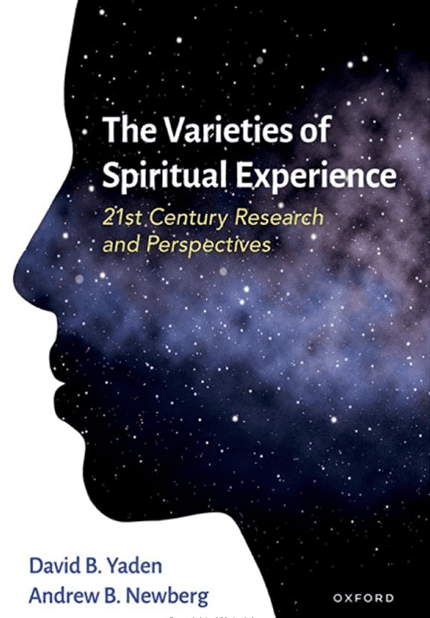 Although there is a lot to say about William James, I don’t want to get lost in the history and fail to connect his legacy to the cutting edge research being done today that he, the Transcendentalists, and others helped inspire. To that end, I want to share with you some highlights from a book published recently by Oxford University Press titled The Varieties of Spiritual Experience: 21st Century Research and Perspectives, which explicitly extends and updates William James for today. This book is co-authored by David Yaden, a professor at Johns Hopkins University School of Medicine—whose research is focused on the potential of psychedelics to create altered states of consciousness and to have long-term positive impacts—and by Andrew Newberg, a professor of Integrative Medicine at Thomas Jefferson University in Philadelphia.
So what do we mean when we talk about what William James called “firsthand religious experience,” what the UU First Source calls “direct experience,” and researchers today call “spiritual experiences?” As researchers at Johns Hopkins have recently collected data building on what James started more than a century ago, they have tracked the frequency with which people today use various terms to describe these sorts of experiences. By far the most common term is spiritual, but paranormal and religious are also frequently used. Less common synonyms include awe, transcendent, mystical, self-transcendent, peak, ecstatic, and numinous (43).
As Hopkins’ researchers have sought to compare and classify these experiences, they created the Mystical Experiences Questionnaire (MEQ) which measures four factors commonly referenced cross-culturally in describing such experiences:
- Unity: “An experience of oneness with all of reality”
- Ecstasy: “Feeling a heightened, positive mood”
- Timelessness: “Loss of one’s usual sense of space and time”
- Ineffability: “The sense that the experience cannot be described adequately in words” (230)
It may also help to briefly share three representative examples of the sorts of experiences that attempt to describe aspects of the ultimately indescribable factors from the MEQ scale (inserted in brackets below).
Let’s start with a report James collected in The Varieties of Religious Experience. The interviewee said: “I felt myself one with the grass, the trees, birds, insects, everything in Nature [UNITY]. I exalted [ECSTASY] in the mere fact of existence, of being part of it all. I knew so well the satisfaction of losing self [LOSS OF SPACE/TIME] in a perception of supreme power and love.”
Be sure not to miss that last part, about “a perception of supreme power and love.” This interviewee was raised in a Christian tradition and interpreted their experience through a theistic theological lens of being absorbed into the presence of God.
Keeping that in mind, let’s consider a second example, this time experienced by Alan Watts, a twentieth-century popularizer of Eastern religious traditions. Watts had a similar experience, but he interpreted it more from a Buddhist perspective: “I lost the boundary of my physical body [LOSS OF SPACE/TIME]. I had my skin, of course, but I felt I was standing in the center of the cosmos [UNITY]. I spoke, but my words had lost their meaning [INEFFABILITY].” [ECSTASY] is not explicit in this short quote, but we know he felt it because he published a whole book about it titled The Joyous Cosmology: Adventures in the Chemistry of Consciousness.
Here’s one more point of comparison from Dr. Jill Bolte-Taylor, a Harvard neuroscientist, who had a similarly mystical experience, but interpreted it from a secular, scientific perspective: “I could no longer discern the physical boundaries of where I began and where I ended. I sensed the composition of my being as that of a fluid rather than that of a solid. I no longer perceived myself as a whole object separate from everything.” (3) [Again: that loss of SPACE/TIME and that sense of UNITY.] Relatedly, if you haven’t watched her TED Talk on “My Stroke of Insight,” I highly recommend it. (She has also published a book of the same name.
William James noted similar interpretative divergences in his own day, and cautioned his audience to hold lightly their metaphysical speculations about what larger reality spiritual experiences may or may not reveal. Instead, James encouraged us not to miss that these experiences can be profound and life-changing regardless of whether or not we can be certain about their ultimate meaning and origin. As a philosophical pragmatist, James used to say that it is often wiser to focus less on the “roots” (the origins) of spiritual experiences and more on the “fruits,” the outcomes of these experiences in terms of profound longterm changes (121).
That being said, it may be the case that spiritual experiences do at least give us a direct, existential experience that our ego—our sense of self—is much more illusory than it often seems, and that the nature of reality is similar to what our UU Seventh Principle calls “the interdependent web of all existence.” No less a thinker than Einstein said that we humans “experience ourselves, [our] thoughts and feelings as something separated from the rest—a kind of optical delusion of consciousness” (225).
Here’s an attempt by researchers at Hopkins to lay out on a spectrum some of what Emerson, James, Einstein, and spiritual teachers throughout the ages describe about the nature of consciousness:
- In “Normal” waking consciousness, most of us have a sense of separateness from the world. “I” (my sense of self or ego) is in here and “you” and the “world” are out there.
- Moving across the continuum, spiritual practices like “Mindfulness” invite us to pay close attention in real time to the minute aspects of our direct experience. If we keep practicing mindfulness, we may begin to notice that the border between our sense of self and the world is actually quite porous, vibratory, and in constant process and flow.
- Many people have also experienced a sense of overlap between self and world when in a “flow” state, while participating in an activity they find particularly absorbing. Some of you may have experienced this happening when you are really caught up in playing a sport. For others of you, perhaps you have experienced it while gardening, creating art, reading, playing a musical instrument, or being immersed in the crowd at a concert. Notice that word absorbing: when one’s sense of self loosens into a flow state, we have a sense of just playing, just creating, just doing, just being.
- You may have also felt this dropping of self happening through a sense of “awe.” Have you ever turned a corner and suddenly seen something breathtakingly beautiful that—even if just for an instant—lifted you out of your usual sense of self?
- As we continue, I feel I would be remiss if I shied away from naming that another significant example of a “Peak” experience for many people—sexual climax. There’s a reason the French call it la petite mort (“the little death”). Here we again find a temporary releasing of the sense of self into a more direct experience, sometimes accompanied by a sense of partially merging with another person.
- And as we approach the other end of the chart toward full-blown mystical experiences, I don’t want us to miss that whether or not you’ve had a fully nondual experience, you likely have experienced various aspects on this continuum of the merging of self and world that can be quite profound in their own right, and can give you a sense of what peak mystical experiences are like. (234)
William James was onto something when he urged scholars to focus on spiritual experiences. People throughout history have counted such experiences as “among the most meaningful moments in life.” And a recent Gallup poll reported that “well over 30% of contemporary Americans” report having had a unitive mystical experience (4).
So for those who are “mysticism-curious,” let me say a little more about how these experiences are cultivated.
Two major paths toward a mystical experience are ecstatic and contemplative (154). There are many examples I could give from the world’s religions, but I’ll use Buddhism and Paganism, which represent classic examples of these two poles of mystical experience.
While the Pagan tradition has many quiet, contemplative elements, the Pagan tradition also has an expertise in cultivating ecstatic, self-transcendent experiences of mystical rapture. Imagine a drum circle at night, and a group inviting you to dance with abandon around a bonfire. Can you imagine your sense of self dropping away—if only for a while—as you let go into that ecstatic group experience?
On the other end of the spectrum, Buddhist sanghas regularly offers time, space and teachings through which you might begin to deeply touch inner tranquility. Or some of you may have experienced a similar taste of self-transcendence at the end of an hourlong yoga practice when you were invited to lie on your back in Shavasana, or “corpse pose.” Have you ever been in corpse pose and felt that sense of yourself melting away, if only for a few moments, allowing you to just be. Again don’t miss the allusion to ego death in that name “corpse pose.”
Over time, one goal of longterm spiritual practice is to make that experience more permanent, such that one’s “normal” flips from one side to the other side. Instead of one’s default experience being a separate ego, one’s new normal becomes a deep sense of interdependence and connectedness. (If you are curious to go deeper, one accessible starting point is Jeffrey Kripal’s book The Flip: Epiphanies of Mind and the Future of Knowledge.)
From Hindu Advaita Vedanta to Buddhist Enlightenment to Jewish Kabbalah, Christian contemplation, Islamic Sufism, and more, spiritual sages across the world’s religions have been teaching for millennia about our human potential to transcend ego and have unitive mystical experiences. As the Buddhist monk said to the hot dog vendor, “Make me one with everything!”
In the spirit of William James, I am fascinated by the work of researchers applying the tools of modern science to help us better understand consciousness and spirituality. I would be remiss if I neglected to invite us to at least briefly explore one major component of what scientists at Johns Hopkins and a growing number of other major research centers are studying: the ways psychedelics can sometimes offer a glimpse of mystical experience (372). Although it usually takes a serious commitment to a spiritual practice to have a long-term, permanent state changes, even a brief glimpse from a psychedelic experience can be a powerful motivation to continue on the spiritual path.
Arguably no one in recent years has done more to raise public awareness about the potential benefits of psychedelics than Michael Pollan in his bestselling book How to Change Your Mind: What the New Science of Psychedelics Teaches Us About Consciousness, Dying, Addiction, Depression, and Transcendence (114). If you don’t have time to read the book, it has recently been turned into a Netflix series by the same name.
To be clear, psychedelics are powerful substances that are not to be trifled with. Ego dissolution, ego death, absorption into flow states, and difficult experiences—even trauma—from the deep recesses of your consciousness can be scary to navigate (239); but, as Pollan’s subtitle points to, these experiences can also teach us a lot about consciousness, dying, addiction, depression, transcendence, and more.
Psychedelics are also currently illegal in the United States, but there is a movement—spurred by the research at Hopkins and other prestigious institutions—toward decriminalization and legalization, especially for therapeutic purposes. For more on the relationship between psychedelics and spiritual practice, see the article “Meditating on Psychedelics : What Camp Are You In?”
Regarding the aspects of reality that psychedelics can give us a glimpse of, as well as what a committed spiritual practice can give us a more permanent experience of, Chögyam Trungpa Rinpoche used to say that, “The bad news is that we are in free fall and we don’t have a parachute. The good news is there is no ground.” We are not separate from one another. Reality is flow, process, and interdependence—all the way down.
What spiritual sages have been teaching for millennia—and what scientists are increasingly discovering empirically—is that at the deepest levels of consciousness, we have never been separate from one another. We are deeply interdependent.
Dr. King put it this way about how this insight can save our lives: “We are caught in an inescapable network of mutuality, tied in a single garment of destiny. Whatever affects one directly affects all indirectly.” It is one thing to think that is a lovely and noble idea. It is quite another when a spiritual experience allows you to live out of a felt, existential experience of that truth.
Similarly, Christian mystics have always contended that the call to love our neighbors as our self is not a burden because at the deepest level, our neighbor is our self. Or, as a profound piece of Indigenous wisdom states: “If you have come here to help me, you are wasting your time, but if you have come because your liberation is bound up with mine, then let us work together.” Truly realizing our interdependence—at a deep existential level—can make all the difference in the world.
The Rev. Dr. Carl Gregg is a certified spiritual director, a D.Min. graduate of San Francisco Theological Seminary, and the minister of the Unitarian Universalist Congregation of Frederick, Maryland. Follow him on Facebook (facebook.com/carlgregg) and Twitter (@carlgregg).
Learn more about Unitarian Universalism: http://www.uua.org/beliefs/principles
Previous Post

November 16, 2022
Imaginable: How To See the Future Coming
Next Post
December 23, 2022 Rest Is Resistance: Downloads from the Nap Bishop
Browse Our Archives
Select a Category Advent Anti-Racism Archaeology Atheism Baptism Best of the Year List Book Reviews Buddhism Catholicism Christian Education Church and State Church Planting Climate Change Conscientious Objection to War Creation Spirituality Death Penalty Didache Disability Rights Discernment Easter Ecology Emergent Church Movement Empire-Critical Ethics Evolution Feminist Theology Film Reviews Gandhi Gospel of Mark Gun Control Hinduism Immigration Reform Interfaith Islam JFK Judaism Jungian Spirituality Lectionary Commentary Lent Letters to the Editor LGBT Marriage MLK Multiculturalism Mysticism Nonviolent Activism Occupy Paganism (Earth-centered Religions) Parables Paul Pluralism Politics Process Theology Quantum Physics Requiescat In Pace Seminary and Divinity School Sermon Series Retrospective Sermons Spiritual Direction Spiritual Practices Stewardship (Fundraising) The Book of J The Wheel of the Year (Paganism) Theoblogger Challenge Triathlon Uncategorized Unitarian Universalism Worship Resources Youth Ministry
Select a Month July 2026 May 2026 March 2026 November 2025 October 2025 August 2025 February 2025 December 2024 October 2024 March 2024 January 2024 December 2023 November 2023 March 2023 February 2023 January 2023 December 2022 November 2022 August 2022 March 2022 February 2022 January 2022 December 2021 September 2021 August 2021 July 2021 June 2021 May 2021 February 2021 January 2021 December 2020 August 2020 June 2020 May 2020 April 2020 March 2020 February 2020 January 2020 December 2019 November 2019 October 2019 September 2019 July 2019 June 2019 March 2019 February 2019 January 2019 December 2018 November 2018 October 2018 September 2018 June 2018 May 2018 April 2018 March 2018 February 2018 January 2018 December 2017 November 2017 October 2017 September 2017 August 2017 July 2017 June 2017 May 2017 April 2017 March 2017 February 2017 January 2017 December 2016 November 2016 October 2016 September 2016 August 2016 June 2016 May 2016 April 2016 March 2016 February 2016 January 2016 December 2015 November 2015 October 2015 September 2015 August 2015 July 2015 June 2015 May 2015 April 2015 March 2015 February 2015 January 2015 December 2014 November 2014 October 2014 August 2014 July 2014 June 2014 May 2014 April 2014 March 2014 February 2014 January 2014 December 2013 November 2013 October 2013 September 2013 August 2013 July 2013 June 2013 May 2013 April 2013 March 2013 February 2013 January 2013 December 2012 November 2012 October 2012 September 2012 August 2012 July 2012 June 2012 May 2012 April 2012 March 2012 February 2012 January 2012 December 2011 November 2011 October 2011 September 2011 August 2011 July 2011 June 2011 May 2011 April 2011 March 2011 February 2011 January 2011 December 2010 November 2010 October 2010 August 2009 July 2009 May 2009
Follow Us!
TAKE THE
Religious Wisdom Quiz
What did Nehemiah rebuild in Jerusalem amid much opposition?
Select your answer to see how you score.
The city wall The palace The tower of Siloam The Temple
Related posts from Carl Gregg

"How the Founding Fathers Became Infallible and Our...

Vampires, Witches, & NPR: The Legacy of Margot...

“Do You Really Want to Know?” From Pope...
“Unsanctifying Human Life”: Wrestling with Peter Singer’s Ethics
TRENDING AT PATHEOS More Voices

Reading America at 250: A Nation Wrestles With...
As part of my own reflection on the 250th anniversary of the...

Whenever I am reading a book or listening to an argument, I...

President Trump Ban Animal Torture Videos on Facebook
Call for Stricter Regulations of Animal Abuse Content on Facebook Although President...

Draft Amendments to Address Ritual Abuse in New...
The proposed changes would make it illegal for individuals in domestic partnerships...

How Bans on LGBTQ+ Student Clubs Threaten Religious...
On June 20, 2025, the State of Texas passed Senate Bill 12....

The Truth About the Gen Z Revival
This past year, there has been a lot of media buzz surrounding...
view all More Voices blogs
Ad-Free & Subscriber Log-In Subscription Support
- About Us
- 2026 Calendar
- Videos
- Podcasts
- Library of World Religions
- Faith In Media Tracker
- Advertise With Us
- Write for Us
- Privacy Policy
- Terms of Service
- Do Not Sell My Data
- Contact Us
- Radiant Digital
- Manage Newsletter Subscriptions
- Unsubscribe From Notifications
- Sitemap
Copyright 2008-2026, Patheos. All rights reserved.
Subscription Support Ad-Free & Subscriber Log-In
Follow Patheos